What is controlled demolition: a professional guide
Controlled demolition is defined as a specialised engineering discipline that uses precise calculations, sequencing, and monitoring to remove structures safely with minimal risk to surrounding areas. Unlike standard demolition, it combines structural mechanics with carefully planned interventions, whether explosive, mechanical, or hybrid, to achieve a predictable outcome. The controlled demolition process covers everything from high-rise building implosions to selective disassembly of internal structures in live environments. For construction professionals and property developers, understanding how it works is the foundation of every safe, compliant, and cost-effective clearance project.
What is controlled demolition and how does it differ from standard practice?
Controlled demolition is the engineered dismantling of a structure using planned methods that prioritise safety, environmental protection, and minimal collateral impact. The industry term most commonly used is “controlled demolition,” though practitioners also refer to it as “selective demolition” when the scope involves preserving adjacent elements. The core distinction from standard demolition is intent: controlled demolition targets specific structural members in a defined sequence, rather than applying brute force across the whole structure.
Modern controlled demolition focuses on structural mechanics and precise weakening of supports rather than on the volume of explosives or machinery deployed. Gravity initiates collapse once supports are weakened, which reflects the engineering foundation of the method. This means the planning phase carries more weight than the physical act of demolition itself. A poorly planned sequence can cause unpredictable load shifts, structural failure in unintended areas, and serious safety risks.
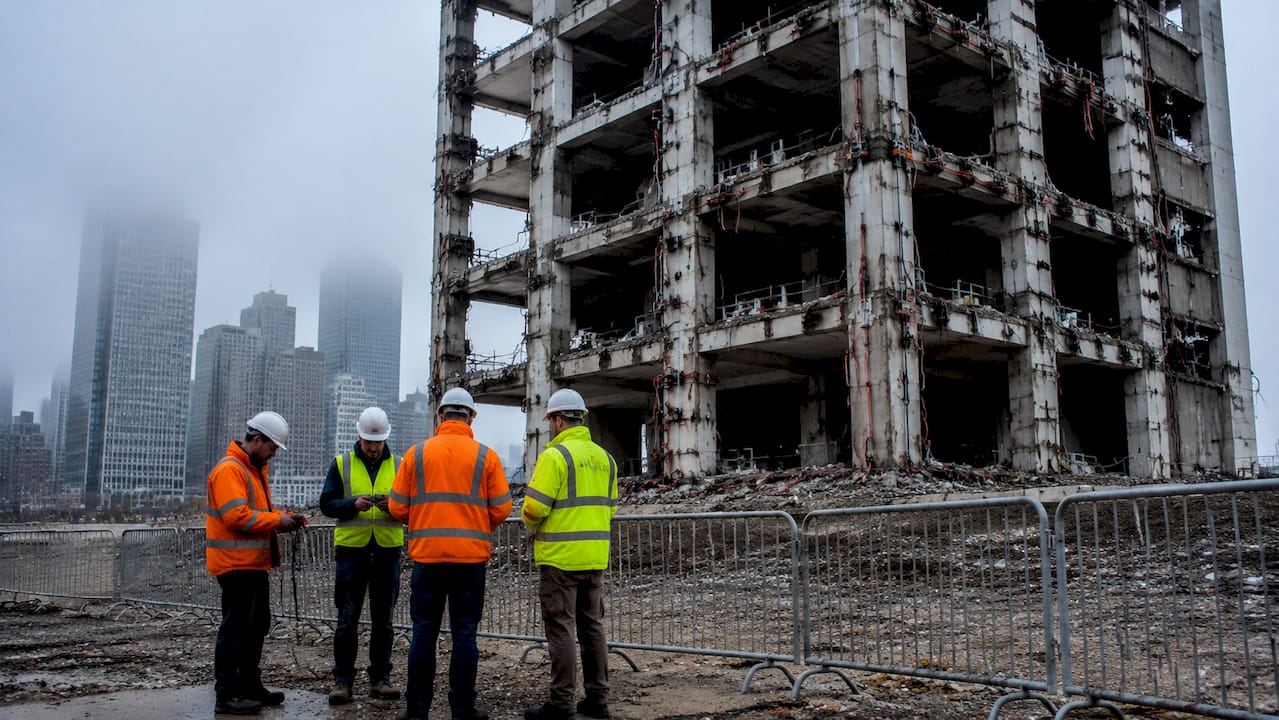
Controlled demolition extends well beyond large building implosions. It is equally relevant for selective disassembly requiring low vibration and high preservation of adjacent components, making it indispensable in complex urban projects. Property developers working in dense city centres or on phased redevelopment schemes will encounter this discipline regularly.
What are the main techniques and tools used?
Controlled demolition techniques fall into three broad categories: explosive, mechanical, and hybrid. Each carries distinct advantages depending on the structure type, site constraints, and environmental requirements.
Explosive demolition is the method most people associate with the discipline. Strategically placed smaller charges weaken key structural supports, allowing the building to collapse under its own weight rather than being blown apart. This approach is commonly chosen for tall buildings where time and cost savings are significant. The charges are sequenced precisely so the structure folds inward rather than outward, protecting adjacent buildings and infrastructure.
Mechanical and robotic methods are the workhorses of day-to-day controlled demolition. Tools used in practice include:
- Hydraulic splitters: exert controlled splitting force along pre-drilled lines, producing low vibration and minimal dust
- Demolition shears: concrete and steel shears mounted on excavator arms that cut through reinforced elements with precision
- Tank cutters and robotic demolition machines: remote-controlled units suited to hazardous or confined environments where human access is restricted
- Sawing and core drilling rigs: used for precise cuts through concrete slabs, walls, and foundations
Hybrid approaches combine preparatory sawing or drilling with hydraulic splitting. This balance of safety and efficiency is particularly effective in dense urban environments where vibration and noise limits are strict.
Pro Tip: When specifying mechanical methods for a project in a live environment, always request vibration monitoring data from previous comparable jobs. Actual site readings are far more reliable than manufacturer specifications alone.
How does the controlled demolition process work step by step?
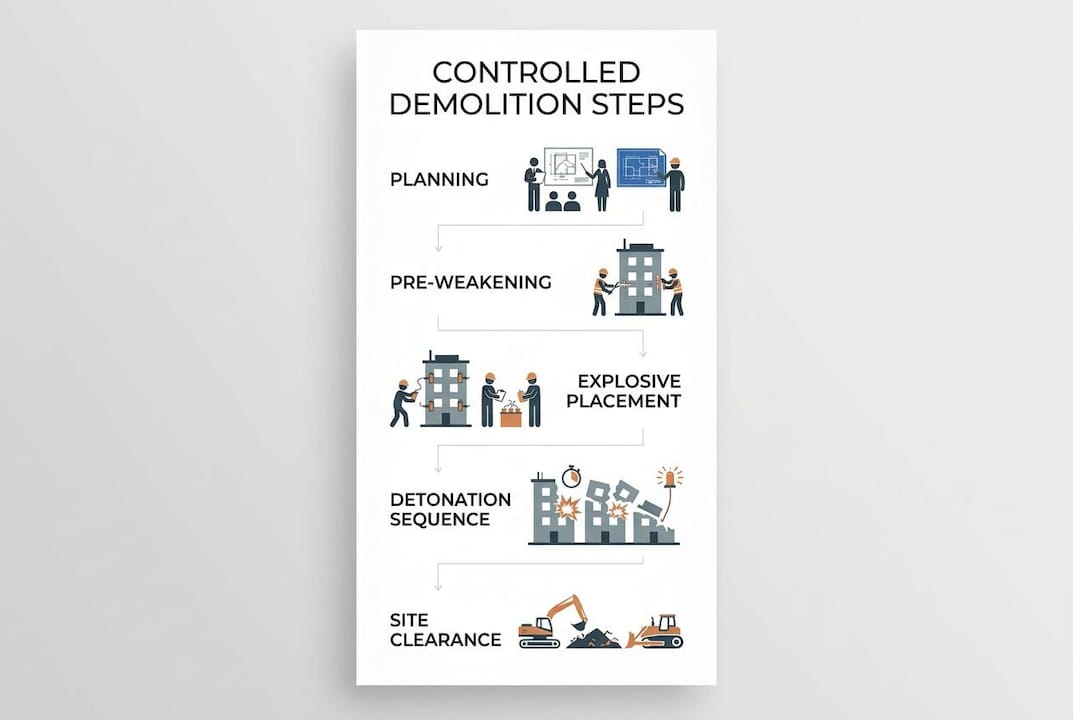
A well-executed controlled demolition process follows a structured sequence. Skipping or compressing any phase increases risk and the likelihood of regulatory intervention.
-
Structural survey and hazard assessment: Engineers carry out a full structural survey to map load paths, identify weaknesses, and locate hazardous materials such as asbestos and lead. Failures in hazard assessment are a leading cause of safety incidents and project shutdowns.
-
Utility isolation: All gas, electricity, water, and telecommunications services are isolated and disconnected before any physical work begins. This step is non-negotiable and must be documented.
-
Pre-weakening and preparation: Structural members are pre-cut or drilled to control the collapse sequence under gravity. Proper modelling of load paths during this phase is critical to predicting structural behaviour and avoiding costly failures.
-
Site preparation and exclusion zones: Exclusion zones are established, neighbouring properties are notified, and evacuation plans are confirmed. Dust suppression systems and vibration monitors are installed.
-
Demolition execution: Whether explosive or mechanical, the demolition is carried out according to the sequenced plan. Real-time monitoring of vibration, dust, and structural movement continues throughout.
-
Debris management and site clearance: Post-demolition, debris is segregated by material type. Material-appropriate separation of debris streams supports compliance with circular economy standards and reduces sorting costs.
Pro Tip: Commission a live site demolition review before finalising your demolition programme. Identifying clashes with live services or neighbouring structures at planning stage costs a fraction of what they cost on site.
What are the safety, environmental, and regulatory considerations?
Controlled demolition safety measures exist to protect workers, the public, and the environment. The discipline carries inherent risks, but a structured approach reduces them to manageable levels.
Key safety and environmental requirements include:
- Exclusion zones: Defined perimeters around the demolition area prevent unauthorised access. The size of the zone depends on the structure height, method used, and proximity to public areas.
- Evacuation and emergency protocols: Neighbouring occupants and businesses must be informed. Emergency response plans are prepared and tested before work begins.
- Dust and noise control: Water suppression, hoarding, and acoustic barriers reduce the impact on surrounding areas. Mechanical methods generally produce lower dust and noise than explosive demolition.
- Hazardous material management: Asbestos, lead paint, and other controlled substances must be removed and disposed of by licensed contractors before demolition proceeds. This is a legal requirement under UK regulations.
- Waste segregation and recycling: Strict material stream separation improves recycling quality, supports regulatory compliance, and reduces overall waste costs. Documentation of cuts and fracture edges is required for environmental reporting.
The table below summarises the primary regulatory considerations for UK controlled demolition projects:
| Consideration | Requirement |
|---|---|
| Hazardous materials survey | Mandatory pre-demolition survey under CDM Regulations 2015 |
| Utility isolation | Written confirmation from each utility provider before works begin |
| Waste classification | Segregation and documentation per Environment Agency guidelines |
| Vibration and noise limits | Compliance with BS 5228 and local authority conditions |
| Neighbour notification | Written notice required for all works with potential impact |
Reviewing demolition safety precautions before mobilisation is the most effective way to identify gaps in your site-specific safety plan.
Controlled demolition vs traditional demolition: which is right for your project?
The choice between controlled and traditional demolition depends on project scale, location, and the level of precision required. The comparison below sets out the key differences.
| Factor | Controlled demolition | Traditional demolition |
|---|---|---|
| Precision | High: targeted structural intervention | Low: broad mechanical force applied |
| Impact on adjacent structures | Minimal with correct planning | Higher risk of collateral damage |
| Vibration and noise | Managed and monitored throughout | Generally higher and less predictable |
| Material separation | Built into the process for recycling | Typically sorted post-demolition |
| Urban suitability | High: preferred in dense environments | Limited in constrained sites |
| Project timeline | Longer planning phase, faster execution | Quicker to mobilise, slower to clear |
| Cost profile | Higher upfront, lower remediation costs | Lower upfront, potential hidden costs |
Controlled demolition is most cost-effective where precision is needed, particularly in dense urban environments. Traditional methods remain appropriate for isolated rural structures with no adjacent buildings or environmental sensitivities. For most urban redevelopment and phased construction projects, controlled demolition delivers better outcomes across safety, environmental compliance, and material recovery.
What emerging trends are shaping controlled demolition in 2026?
The controlled demolition sector is advancing quickly. Several trends are redefining what is possible on site and raising the standard for what professionals should expect from their contractors.
- AI and structural modelling: Deep learning tools now assist engineers in modelling collapse sequences and predicting load path behaviour before a single cut is made. This reduces the margin for error in the pre-weakening phase significantly.
- Robotic demolition: Remote-controlled machines reduce human exposure in hazardous environments. Robotic units can operate in confined spaces, at height, and in areas with residual contamination, tasks previously requiring high-risk manual intervention.
- Precision cutting integration: The combination of diamond wire sawing, hydraulic splitting, and robotic execution is becoming standard on complex urban projects. This hybrid approach produces cleaner material streams and lower environmental impact.
- Selective disassembly for preservation: Controlled demolition is increasingly used in heritage and retrofit projects where adjacent or integrated elements must be preserved. Its expanding role in selective disassembly reflects a broader shift toward building reuse over full replacement.
- Circular economy alignment: Contractors are now expected to demonstrate material recovery rates and provide documentation of waste streams. Recycling demolition waste is no longer optional on most commercial projects. It is a contractual and regulatory requirement.
Staying current with trending demolition methods is a practical necessity for any contractor or developer working on urban regeneration or phased development schemes.
Key takeaways
Controlled demolition is the most effective approach for urban projects where precision, safety, and material recovery must all be managed simultaneously.
| Point | Details |
|---|---|
| Definition and scope | Controlled demolition uses engineered sequencing and monitoring to dismantle structures safely with minimal collateral impact. |
| Technique selection | Choose between explosive, mechanical, or hybrid methods based on structure type, site constraints, and vibration limits. |
| Process phases | Pre-demolition surveys, utility isolation, pre-weakening, real-time monitoring, and debris segregation are all non-negotiable phases. |
| Safety and compliance | UK projects must comply with CDM Regulations 2015, BS 5228, and Environment Agency waste guidelines as a minimum. |
| Emerging technology | AI modelling, robotic tools, and circular economy requirements are now standard expectations on complex urban demolition projects. |
Why the planning phase is where controlled demolition is won or lost
I have worked on enough demolition projects to say with confidence that the physical act of bringing a structure down is rarely where things go wrong. The failures I have seen, and the near-misses I have heard about from colleagues, almost always trace back to the planning phase. A structural survey that missed a load-bearing partition. A pre-weakening sequence that did not account for a dynamic load shift. A utility isolation sign-off that was assumed rather than confirmed.
What strikes me about the direction the industry is taking is that technology is making the planning phase more reliable, not just faster. AI-assisted structural modelling and real-time construction site monitoring are closing the gap between what engineers predict on paper and what actually happens on site. That is a genuine step forward.
My advice to construction professionals and developers is straightforward. Do not treat the pre-demolition phase as an administrative hurdle. Treat it as the most technically demanding part of the project. Invest in a thorough structural survey, commission independent vibration monitoring, and make sure your waste segregation plan is agreed before mobilisation. The projects that run smoothly are the ones where every discipline, structural engineering, environmental compliance, and site management, has been aligned before the first cut is made.
— George
How Gcscontractors approaches professional demolition and site preparation
Gcscontractors delivers strip-out and demolition services for construction professionals and property developers across Cambridge and the surrounding region. The team works within live environments, managing precision strip-out of fixtures, fittings, partitions, and ceilings alongside full structural demolition programmes.

Every project is delivered with a focus on health and safety compliance, environmental care, and minimal disruption to neighbouring occupants and businesses. Whether you are planning a phased redevelopment, a commercial refurbishment, or a full site clearance, Gcscontractors brings the technical knowledge and site experience to deliver it correctly. Contact the team to discuss your project requirements and receive professional guidance on the right approach for your site.
FAQ
What is controlled demolition in simple terms?
Controlled demolition is the planned, engineered removal of a structure using precise methods to ensure it collapses or is dismantled safely, with minimal impact on surrounding areas.
How does explosive demolition work?
Explosive demolition uses strategically placed smaller charges to weaken key structural supports, allowing the building to collapse under its own weight in a controlled direction rather than being blown outward.
What are the main safety requirements for controlled demolition in the UK?
UK projects must comply with CDM Regulations 2015, BS 5228 for vibration and noise, and Environment Agency guidelines for waste classification and hazardous material removal before works begin.
When is controlled demolition preferred over traditional methods?
Controlled demolition is preferred in dense urban environments, on sites adjacent to occupied buildings, and on projects where material recovery and environmental compliance are contractual requirements.
What is the pre-weakening phase in the controlled demolition process?
Pre-weakening involves pre-cutting or drilling structural members to control the collapse sequence under gravity. Correct load path modelling during this phase is critical to avoiding unpredictable structural behaviour.