Explaining demolition hazards: a guide for safety officers
Demolition hazards are defined as the specific physical, chemical, and environmental dangers that arise from dismantling or destroying structures, and they are consistently more severe than those found in standard construction work. Where construction builds load paths, demolition reverses them, creating unpredictable stress redistributions that no generic hazard checklist can fully anticipate. Explaining demolition hazards accurately is the foundation of every effective site safety plan, and it is the first obligation of any competent construction manager or safety officer before a single wall comes down. Regulatory frameworks from OSHA, the UK HSE, SafeWork NSW, and CCOHS all converge on the same principle: identify the hazard before you commit to the method.
What are the primary categories of demolition hazards construction managers must know?
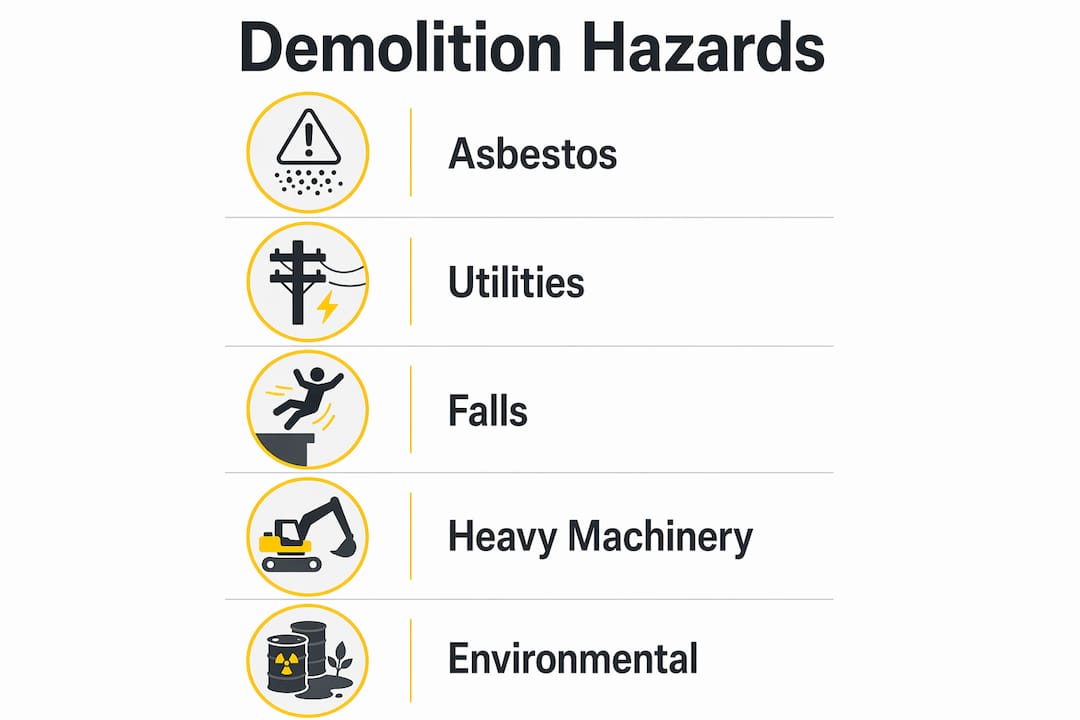
Demolition hazards span six distinct categories, and each demands a separate control strategy. Understanding demolition dangers means treating these categories as concurrent threats rather than a sequential checklist.
Structural collapse is the most consequential risk. Demolition reverses the engineered load paths a structure was designed to maintain. Removing a partition wall, a floor slab, or a steel beam in the wrong sequence can redistribute loads to elements that were never designed to carry them, triggering progressive collapse. The risk is not always visible until it is too late.
Hazardous materials represent a category that frequently surprises even experienced teams. The list includes:
- Asbestos in insulation, floor tiles, ceiling panels, and pipe lagging
- Lead paint on structural steelwork and timber
- Respirable crystalline silica released during concrete and masonry breaking
- Chemical residues in industrial or commercial buildings, including fuel tanks, solvents, and process chemicals
- Biological hazards such as mould and vermin in long-vacant structures
Asbestos removal must precede any structural demolition work. Vibration from mechanical plant can release fibres from materials that appeared undisturbed, which means sequencing is not just a structural concern but a contamination control issue.
Utility-related risks include overhead electrical lines, buried gas mains, water services, and telecommunications cables. Striking a live service during excavation or mechanical demolition is among the most common causes of serious injury on demolition sites.
Falls from height and falling debris remain a persistent hazard in demolition work, particularly during strip-out of upper floors, roof removal, and facade dismantling. Falling objects endanger not only workers directly below but also operatives and members of the public at the site perimeter.
Heavy plant and machinery introduce crush, struck-by, and overturning risks. High-reach excavators, hydraulic breakers, and crane-lifted demolition grabs operate in confined, unstable environments where ground conditions can change rapidly.
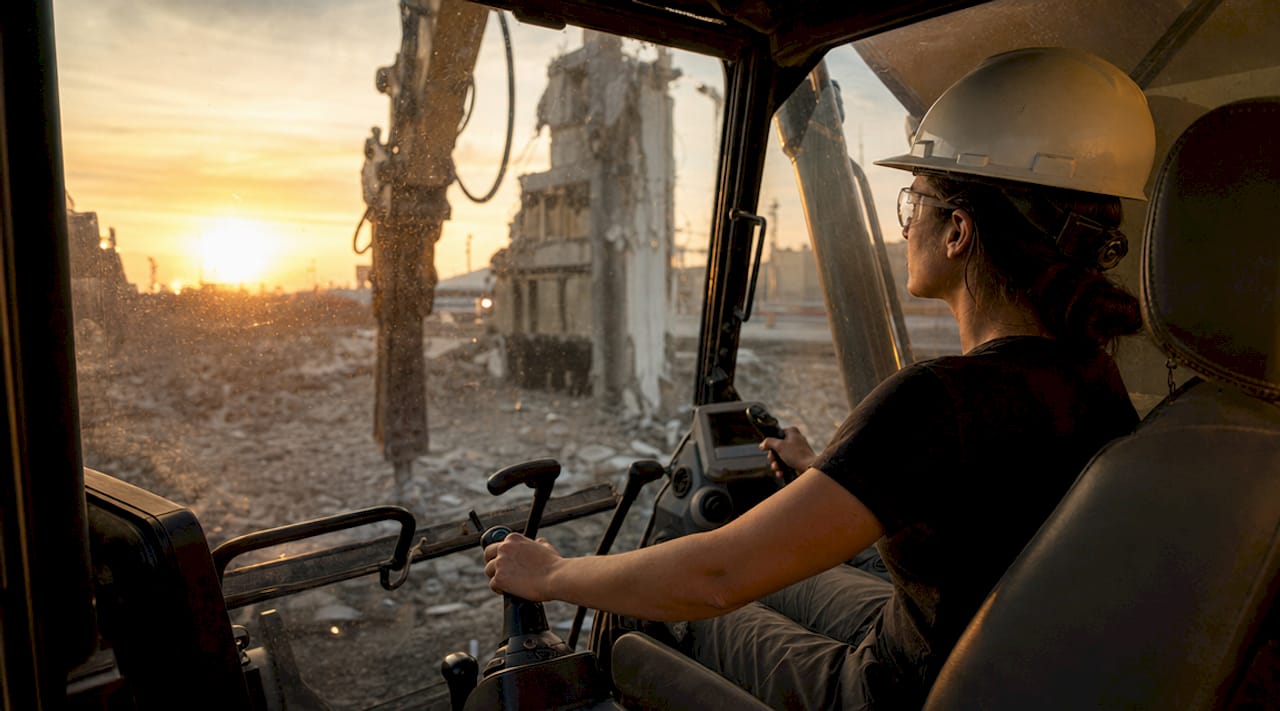
Environmental hazards including dust, noise, vibration, and fire or explosion risk from residual gas or flammable materials complete the picture. Each of these can cause both immediate injury and long-term occupational health damage.
Pro Tip: Never use a generic hazard register from a previous project as the starting point for a new demolition. The specific combination of structure type, age, occupancy history, and site layout makes every demolition hazard profile unique.
How does hazard risk vary by demolition method, site conditions, and project specifics?
Risk severity depends on factors including structural integrity, demolition method, scheduling, site layout, equipment selection, workforce size, and weather. This is not a theoretical observation. It is the reason a risk assessment written for one project cannot be transferred to another without full revision.
-
Demolition method selection. Top-down demolition, where floors are removed progressively from the highest level downward, maintains structural stability better than bottom-up approaches but introduces significant falls-from-height exposure. Mechanical demolition using high-reach excavators reduces worker proximity to the structure but demands precise ground bearing assessments and exclusion zones. Explosive demolition, used rarely in the UK, requires specialist licences and creates simultaneous blast, debris, and dust hazards across a wide radius.
-
Structural assessment and sequencing. Job sequencing errors can destabilise structures by removing load-bearing elements prematurely. A structural engineer must confirm the sequence before work begins, and that sequence must be treated as a constraint, not a suggestion. Any deviation requires a formal reassessment.
-
Site layout and proximity. A demolition site adjacent to a live railway, a school, or a hospital carries a fundamentally different risk profile from an isolated rural structure. Proximity increases the consequences of dust, noise, vibration, and falling debris, and it imposes additional controls on working hours, exclusion zones, and monitoring.
-
Workforce competence and supervision. The quality of hazard identification on site is directly proportional to the competence of the people doing it. An operator who has not been trained to recognise signs of structural instability, or who lacks the authority to stop work, is a systemic risk regardless of how thorough the written plan is.
-
Weather and scheduling. High winds increase the risk of falling debris and destabilise partially demolished facades. Frost weakens mortar joints and can accelerate structural deterioration overnight. Scheduling demolition of exposed structural elements during periods of forecast high winds is a planning failure, not bad luck.
-
Dynamic hazard identification. Demolition hazards vary significantly by project and must be identified specifically rather than relying on generic hazard lists. Conditions discovered mid-demolition, such as concealed asbestos, unexpected voids, or deteriorated steelwork, require the risk assessment to be updated before work continues.
Pro Tip: Build a formal “stop and reassess” trigger into your demolition plan. Define the specific conditions, such as discovery of unregistered asbestos, signs of unplanned movement, or significant weather change, that automatically pause work pending a revised risk assessment.
What are best practices for assessing and managing demolition hazards through risk assessment and planning?
The engineering survey is the cornerstone of demolition hazard management. OSHA requires a competent person to complete a written engineering survey before demolition begins, documenting structural conditions, load paths, hazard identification including utilities, and the basis for demolition sequencing. The UK HSE and CCOHS hold equivalent positions. This survey is not a one-time document. It functions as a living baseline, and discovery of new hazards mid-job requires prompt risk reassessment and control updates.
The practical steps for effective hazard assessment and planning are as follows:
- Commission the engineering survey before any preparatory work begins. The survey must cover structural condition, load-bearing elements, existing damage, and the presence of hazardous materials.
- Verify utility isolation. Before demolition, structures must be assessed for stability and hazardous materials, and all utilities must be identified and either de-energised, capped, or isolated by the relevant service provider. Do not rely on drawings alone. Use cable avoidance tools and confirm with service providers directly.
- Conduct an asbestos survey by a licensed surveyor. If no asbestos register exists, a competent inspection is a gating requirement before any work that could disturb materials begins. Checking asbestos registers before structural work starts is standard practice among compliant demolition contractors.
- Develop a site-specific demolition plan that integrates the engineering survey findings, hazardous materials abatement schedule, utility isolation confirmation, and method statement. This plan must be written for the specific project, not adapted from a template.
- Map hazards to required control competencies. Mapping hazards to specific competencies enables targeted training and controls. Asbestos requires certified abatement operatives. Confined space entry demands formal entry procedures. Electrical isolation needs a qualified electrician. Heavy lifting requires rigging certificates.
- Implement physical control measures including temporary propping and bracing, exclusion zones, debris netting, hoarding, and dust suppression. PPE selection must be hazard and task-specific, covering head protection, respiratory equipment, high-visibility apparel, gloves, safety footwear, and hearing protection.
- Schedule periodic reviews of the risk assessment throughout the project. At minimum, review after each significant phase of work, after any incident or near-miss, and whenever site conditions change materially.
The comparison below illustrates the difference between a static and a dynamic approach to demolition risk assessment:
| Approach | Characteristics |
|---|---|
| Static risk assessment | Written once pre-project, not updated as conditions change, treats hazard list as fixed |
| Dynamic risk assessment | Updated at each project phase, incorporates new findings, triggers formal stop-work reviews |
A dynamic approach is not optional on complex demolition projects. It is the difference between a plan that reflects actual site conditions and one that reflects assumptions made weeks earlier.
What key training, certifications, and compliance requirements support safe demolition hazard control?
Competence in managing hazards in demolition work is not assumed from general construction experience. It requires specific qualifications mapped to the hazards present on each project.
- SafeWork NSW mandates that licensed demolition workers must identify hazards on demolition sites and apply risk management strategies. The training unit CPCCDE3030, introduced in updated regulations from March 2025, is a requirement for both restricted and unrestricted demolition licence holders.
- OSHA requires that the engineering survey be completed by a competent person, a defined role carrying specific knowledge and authority obligations. This is not a title that can be self-assigned without the requisite training and experience.
- Asbestos abatement requires certified operatives in every major jurisdiction. In the UK, this means compliance with the Control of Asbestos Regulations 2012 and, for licensable work, a licence from the HSE.
- Confined space entry demands formal entry procedures, atmospheric monitoring, and trained rescue provision. These requirements apply to any demolition work involving basements, tanks, or enclosed structures.
- Hoisting, rigging, and crane operations require documented operator competence and, in many jurisdictions, formal certification. Unqualified plant operation is one of the most direct routes to a serious incident on a demolition site.
- Ongoing worker training must cover PPE selection and use, hazard recognition specific to the current project phase, emergency response procedures, and the authority and obligation to refuse unsafe work.
- Integration into the health and safety management system is the final requirement. Training records, risk assessments, method statements, and survey documents must be held together, accessible on site, and available for inspection by the relevant enforcing authority.
Key takeaways
Effective demolition hazard management depends on site-specific engineering surveys, dynamic risk assessments, and competency-mapped controls applied before and throughout every phase of work.
| Point | Details |
|---|---|
| Engineering survey is non-negotiable | A written survey by a competent person must precede all demolition work and be updated as conditions change. |
| Asbestos is a gating hazard | Asbestos inspection and abatement must be completed before any structural demolition or vibration-generating work begins. |
| Sequencing drives collapse risk | Removing load-bearing elements in the wrong order is the primary cause of unplanned structural collapse on demolition sites. |
| Competency must match the hazard | Asbestos, confined spaces, electrical isolation, and rigging each require specific certified competence, not general site experience. |
| Risk assessments must be dynamic | Static plans written pre-project become liabilities. Formal review triggers must be built into the demolition programme. |
What I have learned from years of watching demolition plans fail
The most consistent pattern I see in demolition incidents is not ignorance of the hazards. It is the gap between what the written plan says and what actually happens on site. Engineering surveys get completed as a compliance exercise rather than a genuine investigation. The person who wrote the survey is not the person supervising the work. The demolition sequence gets adjusted informally on the day because a machine is in the wrong position, and nobody stops to ask whether that adjustment changes the structural risk.
Failures in demolition safety often originate from flawed planning: incomplete engineering surveys, static demolition plans, or incompetent supervision lead to major incidents. I have seen this play out on projects where the paperwork was exemplary. The hazard register was thorough. The method statement was detailed. But the site supervisor did not have the authority, or the confidence, to stop work when conditions deviated from the plan.
The second pattern is the treatment of hazardous materials as a pre-project box-tick rather than an ongoing concern. Asbestos discovered behind a partition mid-demolition is not an anomaly. It is a predictable outcome on any building constructed before 2000. The question is whether your plan has a formal response protocol for that discovery, or whether the pressure to maintain programme leads to a decision that should never be made.
The third pattern is concurrent hazard management. When you have a high-reach excavator working on one elevation, strip-out operatives on the floor above, and a utility isolation in progress at the boundary, the interaction between those activities creates hazards that none of the individual risk assessments fully captures. The competent person on site must hold the whole picture, not just their own task.
— George
How Gcscontractors supports safe demolition project delivery

Gcscontractors brings direct experience in strip-out and demolition, groundworks, and civil engineering to projects where hazard control and regulatory compliance are non-negotiable. The team works within live environments, which means the discipline required for managing demolition site safety is embedded in every project from survey through to completion. Whether you need support with pre-demolition hazard assessments, method statement development, or fully managed demolition execution, Gcscontractors delivers to the standard that construction managers and safety officers require. Contact Gcscontractors to discuss your project’s specific hazard profile and compliance requirements.
FAQ
What is an engineering survey in demolition?
An engineering survey is a written assessment completed by a competent person before demolition begins, documenting structural conditions, load paths, utility locations, and hazardous materials. OSHA and the UK HSE both require this document as the basis for demolition sequencing and hazard controls.
Why must asbestos be removed before structural demolition starts?
Vibration from mechanical demolition can release asbestos fibres from materials that appear undisturbed, creating airborne exposure risks across the site. SafeWork NSW and UK HSE regulations both require asbestos inspection and abatement to be completed as a gating step before structural work begins.
How do I identify demolition risks specific to my project?
A site-specific engineering survey, a licensed asbestos survey, confirmed utility isolation, and a structural assessment by a qualified engineer are the four baseline steps for identifying demolition risks. Generic hazard lists are a starting point only and must be validated against actual site conditions.
What certifications do demolition workers need?
Certification requirements depend on the hazards present. Asbestos abatement requires licensed operatives, confined space entry requires formal training and rescue provision, and crane or rigging operations require documented competence certificates. SafeWork NSW’s CPCCDE3030 unit is a current requirement for licensed demolition workers in New South Wales.
When should a demolition risk assessment be updated?
A demolition risk assessment must be reviewed after each significant phase of work, after any incident or near-miss, and whenever unexpected conditions are discovered, such as unregistered asbestos, structural deterioration, or changes to the demolition sequence. Treating the initial assessment as a fixed document is one of the most common planning failures in demolition safety management.