Live site demolition process: a guide for project managers
The live site demolition process is defined as the controlled dismantling of structures on or immediately adjacent to occupied or operational environments, where ongoing activity continues throughout the works. Unlike standard construction site demolition, live demolition procedures must account for active services, occupied buildings, and operational infrastructure running in parallel with destructive works. High-risk classification applies from the outset, requiring asbestos removal, hazardous material confirmation, and comprehensive risk planning before any structural work begins. The consequences of inadequate preparation range from structural collapse to regulatory prosecution, making methodical compliance the defining factor between a successful project and a catastrophic one.
What licences and prerequisites are required before live site demolition
Regulatory compliance is the foundation of any live demolition procedure, and the requirements are non-negotiable. In the UK, the Construction (Design and Management) Regulations 2015, commonly known as CDM 2015, govern the planning and execution of demolition works. Method statements are standard practice for high-risk activities, even where no single named document is legally mandated. Contractors must prepare site-specific documentation covering every foreseeable hazard before a single element is touched.
Licensing requirements vary by jurisdiction, but the underlying principle is consistent: only qualified, trained personnel may direct or carry out licensed demolition work. In Australia, for example, SafeWork NSW requires that all workers on licensed demolition sites complete the CPCCDE3030 course, which covers hazard identification and risk management strategies specific to demolition environments. UK project managers should verify equivalent competency frameworks through the Construction Industry Training Board (CITB) and confirm that all operatives hold current relevant qualifications.
Before work commences, the following prerequisites must be confirmed and documented:
- Asbestos register check or competent inspection: Confirm the presence or absence of asbestos-containing materials. Asbestos must be removed before any structural demolition begins, without exception.
- Hazardous chemical survey: Identify all hazardous substances including lead paint, PCBs, and refrigerants. Removal and disposal must follow current environmental regulations.
- Safe Work Method Statement (SWMS): Prepare a site-specific SWMS covering collapse risk, falls, falling objects, essential service proximity, and asbestos. Risk management plans must address every identified hazard with defined controls.
- Notification to local authorities: Inform the relevant planning authority, utility providers, and neighbouring occupants. Liaison with site stakeholders prevents operational conflicts during execution.
- Contractor communication plan: Define roles, responsibilities, and escalation routes for all parties on site before works begin.
Pro Tip: Request utility isolation certificates from each service provider in writing before mobilising. Verbal confirmation of service isolation has caused serious incidents on live sites and will not satisfy a regulatory investigation.
How are demolition methods selected and sequenced for live site projects?
Method selection is governed by four primary factors: the structure type, its proximity to operational assets, the ground conditions, and the environmental sensitivity of the surrounding area. Getting this decision wrong does not just affect programme. It can destabilise adjacent structures, disrupt live services, and expose workers and occupants to unacceptable risk.
The table below compares the most common site deconstruction methods used on live or partially occupied sites:
| Method | Best suited for | Key risk considerations |
|---|---|---|
| Mechanical dismantling (excavators, hydraulic shears) | Reinforced concrete, steel frames, phased removal | Vibration to adjacent structures; requires careful sequencing |
| Controlled explosives (implosion) | Large standalone structures with clear exclusion zones | Dust, vibration, debris throw; extensive exclusion zones required |
| Hydraulic bursters and splitters | Confined spaces, proximity to live services | Low vibration; slower process; suited to sensitive environments |
| Manual strip-out and deconstruction | Interior fit-out, fixtures, partitions, ceilings | Labour-intensive; highest control over material separation |
Sequencing is where most live demolition projects succeed or fail. The Gateshead Flyover demolition is a well-documented example: mechanical ‘munchers’ and steel props were used to remove the structure in balanced phases, with temporary supports repositioned as each section came down. Removing the wrong section first would have created an imbalance capable of causing uncontrolled collapse. The lesson is direct: sequencing must be engineered, not assumed.
Environmental controls are not optional extras. The Liddell Power Station demolition required an 18-month planning phase that included dust and vibration modelling and a 1-kilometre exclusion zone. For live site projects near occupied buildings, dust suppression systems, vibration monitoring, and defined exclusion zones must be specified in the method statement before work begins.
Pro Tip: Commission an independent structural engineer to review your proposed demolition sequence before submission. Peer review of sequencing plans has prevented collapse on multiple complex UK projects and strengthens your compliance position significantly.
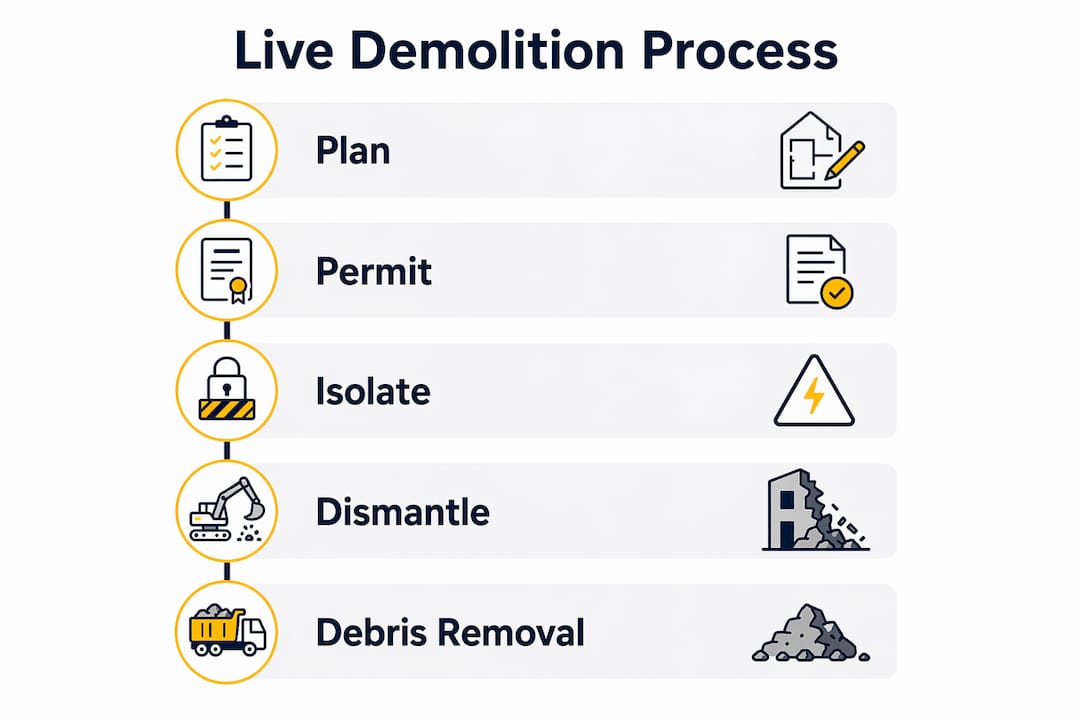
Step-by-step process for executing active site dismantling safely
A structured execution process is the difference between a controlled project and a reactive one. The following sequence applies to the majority of construction site demolition projects on live or partially occupied sites.
-
Survey and existing conditions assessment. Commission a structural survey, services survey, and ground investigation before any other work. Identify all load-bearing elements, live service routes, and potential contamination zones. Document findings with photographs and drawings.
-
Service isolation and verification. Isolate all electrical, gas, water, and telecommunications services. Obtain written isolation certificates. Test to confirm isolation before any mechanical work begins.
-
Hazardous material removal. Remove asbestos, lead paint, and other hazardous substances under licensed conditions. Obtain waste transfer notes and disposal certificates. Do not proceed to structural demolition until clearance certificates are issued.
-
Installation of barriers, hoarding, and signage. Erect physical exclusion zones appropriate to the method being used. Signage must meet CDM 2015 requirements and be legible to all site users, including members of the public where relevant. For sites near occupied buildings, consider fire safety zone planning as part of your exclusion zone design.
-
Supervised demolition execution. Begin structural works in the engineered sequence. A competent supervisor must be present throughout. Temporary props and shoring must be repositioned as each phase progresses to maintain interim structural stability.
-
Continuous monitoring and risk reassessment. Monitor vibration, dust, and structural movement throughout. Hold daily briefings to reassess risk as conditions change. Any deviation from the planned sequence must be reviewed by a structural engineer before proceeding.
-
Waste management and material flow documentation. Segregate materials at source: concrete, steel, timber, and hazardous waste must be separated and documented. A deconstruction protocol records technical method choices, material flows, and environmental controls throughout the project. This document serves as both a compliance record and a coordination tool.
-
Post-demolition verification and site clean-up. Conduct a final structural and environmental inspection. Confirm that all residual hazards have been addressed. Obtain sign-off from the principal contractor and relevant authorities before releasing the site for the next phase of works.
The table below summarises the documentation required at each stage:
| Stage | Required document |
|---|---|
| Pre-demolition | Structural survey, asbestos register, SWMS, service isolation certificates |
| During execution | Daily monitoring logs, waste transfer notes, supervisor sign-off sheets |
| Post-demolition | Clearance certificates, deconstruction protocol, final inspection report |
Common challenges during live site demolition and how to resolve them
Unexpected structural instability is the most serious challenge on any active site dismantling project. Hidden voids, undocumented alterations, and deteriorated materials can all change the structural behaviour of a building mid-demolition. The response is not to stop work and wait. It is to halt the affected sequence, reassess with a structural engineer, and revise the method before continuing.
Hazardous material exposure during demolition is a recurring compliance failure. Asbestos encapsulated within floor screeds, ceiling voids, or pipe lagging is frequently missed during initial surveys. If suspected asbestos is encountered during works, the area must be isolated immediately and a licensed asbestos contractor called to assess and remove the material before demolition resumes.
The following challenges are most commonly reported on live site projects, along with their recommended remedies:
- Environmental control failures: Dust suppression systems failing during mechanical demolition. Remedy: install redundant water suppression and appoint a dedicated environmental monitor on site.
- Coordination failures with adjacent occupants: Vibration or noise exceeding agreed limits affecting neighbouring operations. Remedy: establish a direct communication line with occupant representatives and agree on a stop-work protocol before demolition begins.
- Documentation and notification lapses: Failure to notify utility providers or local authorities within required timeframes. Remedy: use a pre-demolition checklist verified by the principal designer under CDM 2015.
- Sequencing deviations: Operatives removing elements out of sequence due to access constraints. Remedy: mark the engineered sequence on physical drawings displayed on site and require supervisor sign-off before each phase.
“Effective communication and documentation throughout demolition ensure regulatory compliance and facilitate safe coordination among all contractors and site users.” Deconstruction Protocol, Darda GmbH
For projects involving emergency subcontractor sourcing mid-project, ensure that incoming contractors receive a full site induction and review the current SWMS before starting work. Bringing in a new team without a structured handover is one of the most common causes of compliance failure on live sites.
Key takeaways
A live site demolition project succeeds through engineered sequencing, pre-work hazard removal, and documented compliance at every stage, not through reactive management on the day.
| Point | Details |
|---|---|
| Licences and training are mandatory | Confirm all operatives hold relevant qualifications and that a site-specific SWMS is prepared before work starts. |
| Method selection drives risk | Choose between mechanical dismantling, hydraulic bursters, or controlled explosives based on proximity to live assets and environmental sensitivity. |
| Sequencing must be engineered | Use temporary props and phased removal to maintain structural stability throughout, as demonstrated by the Gateshead Flyover project. |
| Documentation is your compliance defence | A deconstruction protocol linking method choices, safety controls, and material flows protects you in any regulatory investigation. |
| Communication prevents incidents | Daily briefings, stop-work protocols, and direct lines to occupants resolve issues before they become emergencies. |
What I have learned from managing complex live site demolition
The biggest misconception I encounter is that demolition is the straightforward end of a project. In reality, the demolition event itself is the final step in a long, risk-managed process. The Liddell Power Station chimneys came down in seconds after 18 months of planning. That ratio tells you everything about where the real work happens.
Pre-planning is where projects are won or lost. I have seen sequencing plans approved by principal contractors that would have created structural imbalances within the first two phases. Independent structural review is not a luxury. It is the check that catches what familiarity blinds you to.
The other area where I see consistent failure is communication between the demolition contractor and the site occupants or adjacent operations. Agreed stop-work thresholds for vibration and noise sound bureaucratic until the moment a neighbouring tenant’s precision equipment is damaged and you are facing a civil claim alongside a regulatory investigation. Formalise those agreements in writing before mobilisation.
Documentation is your defence. A robust deconstruction protocol that links your method specification, execution parameters, and environmental monitoring is not paperwork for its own sake. It is the evidence pack that demonstrates you managed the project correctly, regardless of what happens on site. Build it from day one, not retrospectively.
— George
How Gcscontractors can support your demolition project

Gcscontractors brings direct experience in strip-out, structural demolition, and groundworks on live and partially occupied sites across the UK. The team understands the compliance demands of CDM 2015, the sequencing discipline required on sensitive projects, and the documentation standards that protect clients through every phase of works. Whether you need a tailored demolition method statement, a full risk assessment, or a contractor who can mobilise on complex live environments without disrupting ongoing operations, Gcscontractors has the expertise to deliver. Visit Gcscontractors to discuss your project requirements with a team that prioritises safety, compliance, and quality workmanship from survey through to site clearance.
FAQ
What is the live site demolition process?
The live site demolition process is the controlled dismantling of structures on or adjacent to occupied or operational sites, requiring pre-work hazard removal, engineered sequencing, and continuous safety monitoring throughout. It is classified as high-risk work under most regulatory frameworks, including CDM 2015 in the UK.
What licences are needed for demolition work in the UK?
In the UK, demolition work is governed by CDM 2015, which requires a competent principal contractor, site-specific method statements, and qualified operatives. Contractors must also hold relevant CITB-recognised qualifications and comply with local authority notification requirements before commencing works.
How is a site demolished when adjacent buildings are occupied?
When adjacent buildings are occupied, mechanical dismantling with hydraulic shears or bursters is preferred over explosives, as these methods produce lower vibration and dust. Temporary props maintain structural stability during phased removal, and agreed stop-work thresholds protect neighbouring occupants throughout the process.
Why is asbestos removal required before structural demolition?
Asbestos must be removed before structural demolition because mechanical works disturb materials and release fibres into the air, creating a serious health risk for workers and occupants. Regulatory frameworks including SafeWork NSW and UK Control of Asbestos Regulations 2012 require confirmed clearance before any structural work begins.
What is a deconstruction protocol and why does it matter?
A deconstruction protocol is a document that records method choices, safety controls, material flows, and environmental monitoring throughout a demolition project. It serves as both a compliance record and a coordination tool, providing evidence that the project was managed correctly if a regulatory or legal challenge arises.