Demolition safety precautions: a site manager’s guide
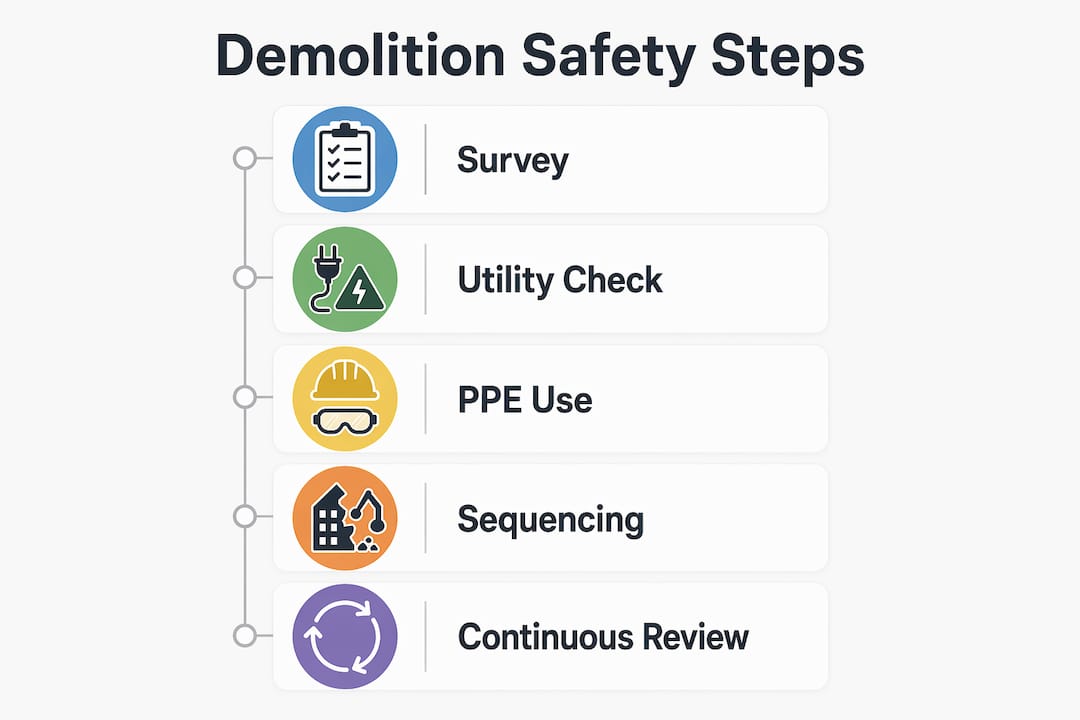
Demolition safety precautions are the controls and procedures required to protect workers, the public, and surrounding structures from the hazards created by building demolition. In the UK, these precautions are governed by the Construction (Design and Management) Regulations 2015, alongside guidance from the Health and Safety Executive (HSE). Getting them right demands more than a signed risk assessment. It requires engineering surveys, utility isolation, hazardous material abatement, PPE selection, and active on-site supervision working together from the first day of planning to the final clearance. This guide covers each stage in the order you need to act on it.
What risk assessments must precede demolition work?
Risk assessment in demolition is not optional paperwork. It is the legal and operational foundation on which every safe demolition project is built. The industry term for the primary pre-demolition document is an engineering survey, and it must be completed by a competent person before any structural work begins.
Over 50% of OSHA Subpart T citations relate to failure to conduct a written engineering survey before demolition. That figure tells you where most projects go wrong before a single wall comes down.
The engineering survey must identify:
- Structural integrity of the building, including load-bearing walls, floor conditions, and basement voids
- Hazardous substances present on site, including asbestos, lead paint, and respirable crystalline silica
- Adjacent structures and their proximity, particularly in urban or live environments
- Underground services including drainage, gas mains, and electrical ducting
- Contaminated ground conditions that may affect worker safety during excavation
A pre-demolition survey is not a one-time document. Engineering surveys must be updated whenever site conditions change, whether that is an unexpected void discovered mid-project or a structural change caused by adjacent works. Treating the survey as a living document prevents the most common category of safety violations on demolition sites.
Pro Tip: Assign a named competent person to review and sign off any survey update. Verbal acknowledgements of changed conditions do not satisfy regulatory requirements and will not hold up in an HSE inspection.
How to prepare a demolition site for safety compliance
Site preparation is where the majority of demolition safety failures originate. The steps below must be completed before any structural disturbance begins.
- De-energise and isolate all utilities. Electricity, gas, water, and telecommunications must be disconnected at source. Contact each utility provider and obtain written confirmation of isolation.
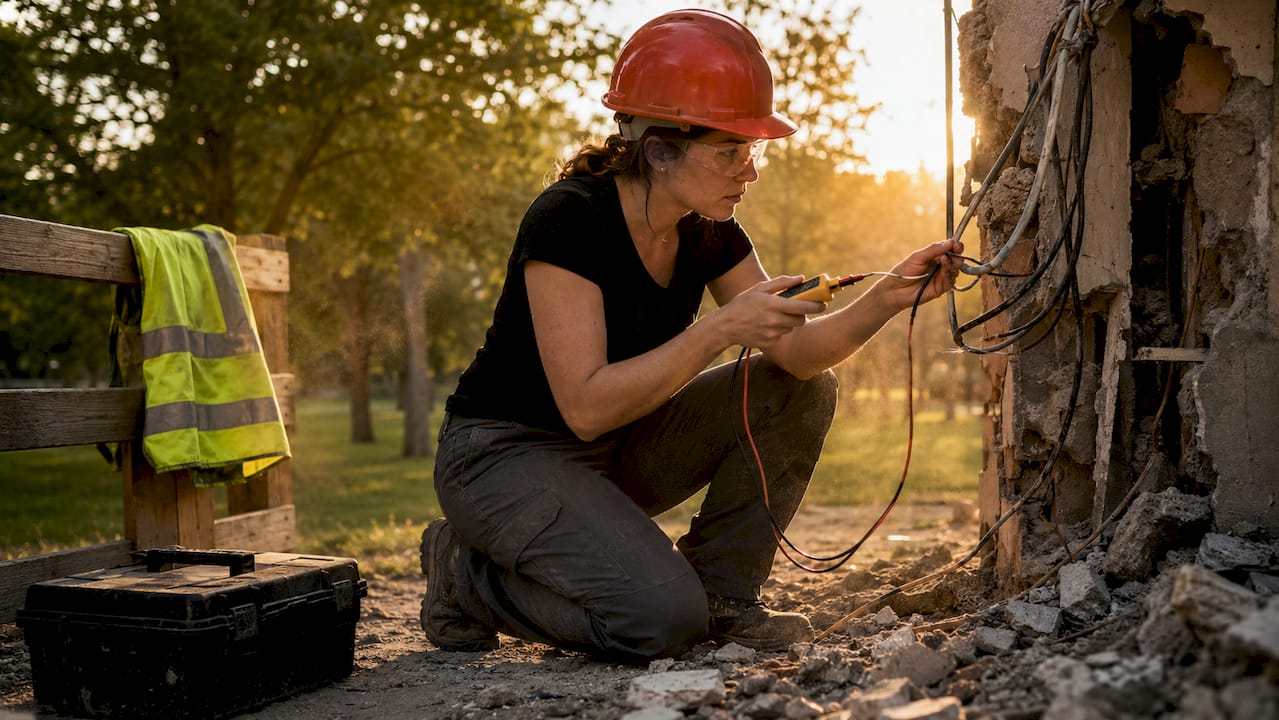
- Verify isolation on site directly. Utility isolation must be verified on site through direct testing, not assumed from provider assurances. Assumptions based on provider statements have caused fatal accidents.
- Obtain all required permits. Notify the relevant authority at least 5 days before commencing high-risk demolition involving structures 6 metres or higher or use of explosives.
- Submit a written fire safety plan. Fire codes mandate a written fire safety plan for demolition projects exceeding $5,000 in value, submitted before work begins. Fire safety in demolition is a regulatory requirement, not a best practice.
- Establish exclusion zones. Physical barriers must prevent public access to the demolition footprint. Hoarding, fencing, and signage must meet local authority standards.
- Brief all workers on hazard controls. Every operative on site must understand the specific hazards identified in the engineering survey before they begin work.
Public safety during demolition depends heavily on how well exclusion zones are maintained. A construction site hoarding guide sets out the compliance standards for physical barriers in UK construction environments.
Pro Tip: Do not rely solely on utility provider confirmation letters. Use a calibrated voltage tester and gas detector on site before any cutting, breaking, or excavation work begins. This single step prevents the most catastrophic demolition accidents.
What PPE and hazard controls are essential during demolition?
PPE must be selected based on a job hazard assessment, not a generic site-wide policy. The hazards present on a demolition site vary by task, location, and phase of work. PPE selection must reflect that variation.
The core PPE requirements for demolition operatives are:
- Head protection: Hard hats rated to EN 397, replaced after any significant impact
- Eye and face protection: Safety goggles or visors when cutting, breaking, or working near overhead debris
- Respiratory protection: FFP3 masks or powered air-purifying respirators (PAPRs) for asbestos and silica work
- Hand protection: Cut-resistant gloves for handling sharp debris; chemical-resistant gloves for hazardous material removal
- Hearing protection: Ear defenders rated to the noise level of the specific equipment in use
- Fall arrest systems: Full harness and anchor point for any work at height above 2 metres
Beyond PPE, active hazard controls must run throughout the project. Health risks from airborne contaminants like silica and asbestos are the primary cause of long-term occupational illness in demolition, not structural collapse. Dust suppression using water damping, on-tool extraction, and enclosure systems must be in place before any material disturbance begins.
“Hazard assessments that remain static paperwork are ineffective. Active, continuous site supervision ensures safety plans work in practice.” — SafetyCulture, Demolition Hazards
Lockout/tagout (LOTO) procedures must be applied to all mechanical plant and electrical equipment during maintenance or when operatives work in proximity to moving parts. Daily toolbox talks and written Job Safety Analysis (JSA) reviews keep the entire crew aligned on current hazards. A JSA reviewed daily with all workers improves hazard awareness more effectively than a document filed at project start and never revisited.
How should demolition sequencing be managed to reduce risk?
Demolition sequencing is the planned order in which materials, fixtures, and structural elements are removed. Getting the sequence wrong is the fastest route to an uncontrolled collapse or a hazardous material release.
The correct operational order is:
- Abatement first. Remove all asbestos-containing materials, lead paint, and other hazardous substances before any structural demolition begins. Premature structural demolition releases hazardous dust before abatement, increasing both health risk and regulatory liability.
- Strip-out second. Remove fixtures, fittings, partitions, ceilings, and non-structural elements. This reduces load and exposes the structural frame for assessment.
- Structural demolition third. Work from the top down, removing floors and walls in a controlled sequence that maintains structural stability at each stage.
- Ground-level clearance last. Once the structure is down, clear and grade the site before any groundworks or foundation work begins.
The table below compares two common approaches to demolition sequencing and their safety outcomes:
| Approach | Method | Safety Outcome |
|---|---|---|
| Planned sequential demolition | Abatement, strip-out, then structural removal in stages | Controlled collapse risk, full regulatory compliance |
| Unplanned concurrent demolition | Structural and strip-out work running simultaneously | High risk of uncontrolled collapse and contaminant release |
Throughout operations, continuous hazard reassessment is non-negotiable. Supervisors must use radio communication or agreed hand signals when machinery is operating near operatives. Emergency response protocols, including evacuation routes and first aid locations, must be briefed to all workers at the start of each shift. For projects in occupied or live environments, the live site demolition process requires additional controls to manage public safety during demolition alongside operational efficiency.
What are the most common demolition safety mistakes?
The most frequent failures in health and safety in demolition are procedural, not technical. They occur when written plans are not followed in the field.
The top errors site managers must guard against are:
- Failing to update the engineering survey. A survey completed at project start becomes inaccurate the moment site conditions change. Assign responsibility for survey updates to a named individual.
- Assuming utility isolation without verification. Provider confirmation is not the same as verified isolation. Always test on site before work begins.
- Inadequate dust and contaminant controls. Skipping water damping or on-tool extraction to save time creates long-term health liabilities and regulatory exposure.
- Losing active supervision during operations. Written plans do not supervise workers. A named supervisor must be present and engaged throughout each shift.
- Improper sequencing. Starting structural demolition before abatement is complete is one of the most common causes of regulatory enforcement action on demolition sites.
Pro Tip: Walk the site at the start of every shift with the engineering survey in hand. Compare current conditions against the documented baseline. Any discrepancy requires a survey update before work continues. This habit alone prevents the majority of compliance failures.
For a detailed breakdown of hazards in demolition sites and the regulatory obligations attached to each, the demolition hazards guide for safety officers covers the full scope of common demolition hazards and their legal controls.
Key takeaways
Safe demolition requires a written engineering survey, verified utility isolation, correct abatement sequencing, and active daily supervision to meet regulatory standards and protect workers.
| Point | Details |
|---|---|
| Engineering survey is mandatory | A written survey by a competent person must precede all demolition and be updated as conditions change. |
| Verify utility isolation on site | Never rely on provider assurances alone; test directly with calibrated equipment before any work begins. |
| Abatement before structural work | Remove asbestos and hazardous materials before structural demolition to prevent contaminant release. |
| PPE must match the specific hazard | Select respiratory, eye, hand, and hearing protection based on a task-level job hazard assessment. |
| Active supervision is non-negotiable | A named supervisor must be present throughout each shift; written plans alone do not ensure compliance. |
Why written plans are only half the job
I have worked on demolition projects where the paperwork was immaculate and the site was a liability. The engineering survey was thorough, the risk assessment was signed, and the fire safety plan was submitted on time. Then the crew started work, conditions changed, and nobody updated a single document.
The hardest lesson in demolition safety is that the plan is not the protection. The people are. A JSA reviewed with the crew every morning, a supervisor who walks the site before the first machine starts, and a culture where operatives feel confident flagging a change in conditions: these are the controls that actually prevent accidents.
I have also seen the opposite failure. Sites where supervision was present but passive. A supervisor standing on site is not the same as a supervisor actively managing hazards. The difference between those two states is the difference between a near-miss and a fatality.
The other point I would press on is airborne contaminants. Most site managers think about structural collapse as the primary risk. The data says otherwise. Asbestos and silica exposure cause far more long-term harm than structural incidents, and they are invisible. You cannot see a silica hazard the way you can see an unstable wall. That invisibility makes it easier to deprioritise, and that is exactly why it must be the first item on your daily hazard review.
If you are managing a project in a live environment, the complexity multiplies. Public safety during demolition in occupied areas requires a level of planning and communication that goes well beyond standard site controls. Do not underestimate it.
— George
How Gcscontractors supports safe demolition projects
Gcscontractors delivers strip-out and demolition services across Cambridge and the wider East of England, with a consistent focus on health, safety, and regulatory compliance at every project stage. From pre-demolition surveys and utility coordination through to structural removal and site clearance, the team operates to CDM 2015 standards and local authority requirements.

Whether you are planning a commercial strip-out, a structural demolition, or a phased project within a live environment, Gcscontractors brings the experience and compliance framework your project requires. Contact the team directly to discuss your project requirements and receive professional guidance on safe, compliant demolition delivery. Visit the demolition services page to find out more.
FAQ
What is an engineering survey in demolition?
An engineering survey is a written assessment by a competent person that identifies structural hazards, hazardous substances, and site conditions before demolition begins. It must be updated whenever site conditions change during the project.
How much notice is required before high-risk demolition?
Authorities require written notification at least 5 days before commencing high-risk demolition involving structures 6 metres or higher or the use of explosives.
What PPE is required on a demolition site?
PPE must be selected based on a job hazard assessment and typically includes hard hats, eye protection, FFP3 respiratory masks, cut-resistant gloves, hearing protection, and fall arrest systems for work at height.
Why must abatement happen before structural demolition?
Structural demolition before abatement releases asbestos fibres and silica dust into the air, creating serious health risks for workers and increasing regulatory liability. Abatement must always be completed first.
How often should a job safety analysis be reviewed on site?
A JSA is most effective when reviewed with the entire crew daily, not filed at project start. Daily review maintains hazard awareness and keeps communication current as site conditions evolve.