Reporting incidents in demolition: a 2026 guide
Reporting incidents in demolition is the process of documenting and notifying relevant parties of any accidents, near misses, or hazardous events occurring on demolition sites to maintain safety and comply with legal obligations. The Health and Safety Executive (HSE) in the UK, alongside frameworks such as RIDDOR (Reporting of Injuries, Diseases and Dangerous Occurrences Regulations), sets clear legal duties for site managers and contractors. Demolition work carries a distinct risk profile. Fatal four hazards in demolition include falls, struck-by incidents, caught-in or between events, and electrocution, with structural collapse being the leading cause of fatalities. Getting incident reporting right is not optional. It is the foundation of demolition site safety and legal compliance.
What are the key steps for reporting incidents in demolition?
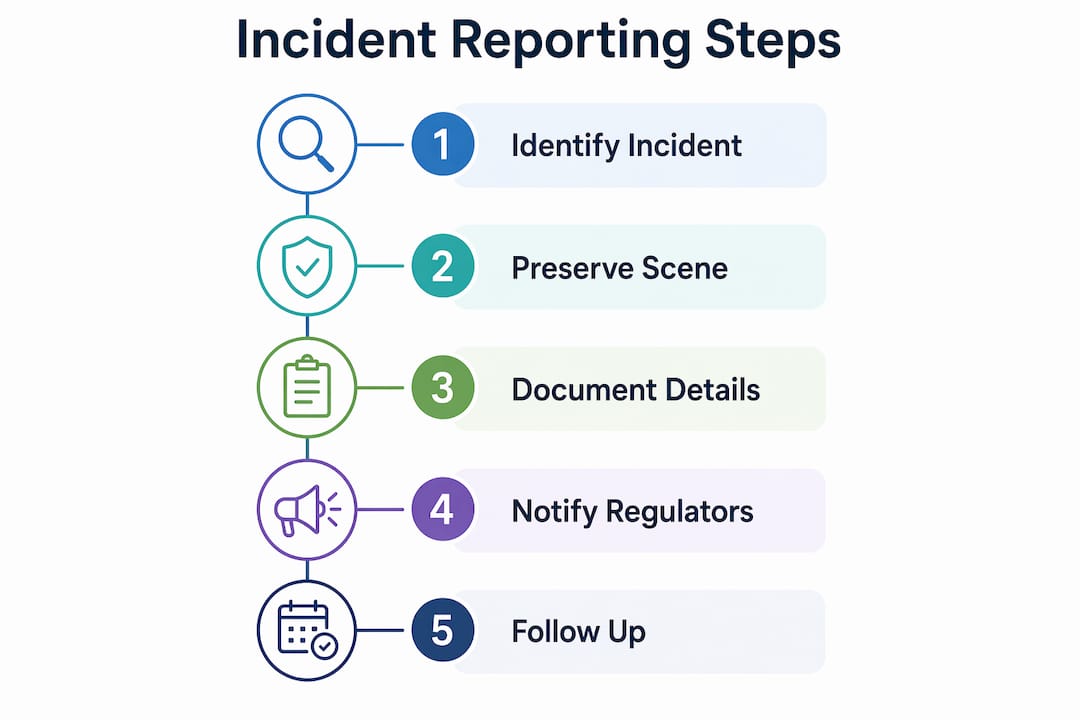
Effective incident reporting procedures follow a clear sequence. Skipping any step risks losing evidence, breaching regulations, and missing the chance to prevent the next incident.
-
Report within the same shift. Same-shift reporting for all incidents, including near misses, is the industry standard. Details fade quickly after a shift ends, and delayed reports produce incomplete investigations.
-
Secure the scene immediately. Site preservation is legally mandated until an inspector releases it. Failure to secure the area destroys forensic evidence and can expose the project manager to criminal liability.
-
Document thoroughly. Record the time, location, personnel involved, equipment in use, and environmental conditions. Photograph the scene from multiple angles. Collect eyewitness accounts on the same shift while memories are fresh.
-
Notify the relevant regulator without delay. For fatalities, immediate notification within 8 hours is a common legal requirement. Failure to meet this deadline triggers penalties and heightened legal liability.
-
Complete the formal incident report. Use your organisation’s standard form or digital system. Include root cause observations, corrective actions proposed, and the names of all witnesses.
-
Submit to the principal contractor and client. Both parties carry legal duties under CDM Regulations 2015 and must be informed of notifiable incidents promptly.
Pro Tip: Use a mobile digital reporting tool such as those offered via platforms like MapTrack to capture photos, GPS location, and timestamps at the point of incident. This removes the risk of detail loss and creates an automatic audit trail.
What regulatory requirements govern incident reporting in demolition?

Demolition work sits under some of the most demanding safety legislation in UK construction. Project managers must understand which incidents are reportable, to whom, and within what timeframe.
Under RIDDOR, employers must report deaths, specified injuries, over-seven-day incapacitation injuries, occupational diseases, and dangerous occurrences to the HSE. Dangerous occurrences include structural collapses and scaffold failures, both of which are common in demolition. The CDM Regulations 2015 place additional duties on principal contractors to maintain a site safety file and report notifiable incidents to the HSE.
For high-risk demolition work, written notice to regulators at least 5 days before work starts is mandatory where structures exceed 6 metres, load-shifting machinery operates on suspended floors, or explosives are used. This pre-notification requirement exists alongside post-incident reporting obligations.
| Incident type | Reporting deadline | Reporting body (UK) | Documentation required |
|---|---|---|---|
| Fatality | Within 8 hours | HSE (RIDDOR) | Full incident report, witness statements |
| Specified injury | Without delay | HSE (RIDDOR) | Incident report, medical assessment |
| Over-7-day injury | Within 15 days | HSE (RIDDOR) | Incident report |
| Dangerous occurrence | Without delay | HSE (RIDDOR) | Scene photographs, structural assessment |
| Near miss | Same shift (internal) | Principal contractor | Near miss log, corrective action record |
Non-compliance carries serious consequences. Failure to report a fatality within the required window can result in prosecution, unlimited fines, and custodial sentences for directors. Civil liability claims also become significantly harder to defend when reporting records are absent or incomplete.
How does incident reporting support risk management in demolition?
The primary purpose of incident reports is continuous improvement, not just regulatory compliance. Neglecting root cause analysis after each incident misses the most direct opportunity to prevent the next one.
A three-tier investigation approach is the recommended standard. Supervisors handle minor incidents, safety teams manage moderate ones, and formal multidisciplinary teams investigate serious incidents. This structure ensures appropriate depth and impartiality at every level.
Near misses deserve the same rigour as injury events. A near miss on a demolition site is a signal that a hazard exists and has not been controlled. Capturing and analysing near misses consistently is one of the most effective ways to prevent major accidents before they occur.
Incident data also informs direct changes to the demolition plan. Treating the demolition plan as a living document that adapts to new information and incident findings is the mark of a well-managed project. Static plans that ignore incident feedback are a documented cause of catastrophic failures and unexpected collapses.
Key ways incident reporting feeds into demolition project risk management:
- Root cause analysis identifies whether a failure was procedural, equipment-related, or behavioural, directing corrective action precisely.
- Trend identification across multiple incidents reveals systemic hazards that single-event reviews miss.
- Demolition sequence review after a structural near miss can prevent a premature collapse caused by out-of-sequence work.
- Pre-demolition survey updates triggered by incident findings improve the accuracy of hazard assessments. A thorough pre-demolition survey is the foundation of safe planning and one of the most commonly neglected requirements.
- Toolbox talk updates based on real site incidents are far more effective than generic safety briefings.
Pro Tip: Integrate your incident reporting system directly with your safety management system. When an incident triggers an automatic review of the relevant section of the demolition plan, corrective actions get implemented rather than filed and forgotten.
What are the challenges of incident reporting on demolition sites?
Demolition sites present specific obstacles that make accurate and timely reporting harder than on standard construction projects. Understanding these obstacles is the first step to overcoming them.
- Witness dispersal. Demolition crews often move quickly between tasks and locations. By the end of a shift, key witnesses may have left the site. Same-shift reporting protocols directly address this, but they require active enforcement by supervisors.
- Scene contamination. Debris, dust, and ongoing work can alter an incident scene within minutes. Many project managers fail to secure sites immediately after an incident, resulting in compromised investigations and lost evidence.
- Incomplete information. Workers under pressure sometimes submit reports with missing details. Mandatory fields in digital reporting forms prevent this by refusing submission until all required information is entered.
- Delayed reporting culture. A blame-focused site culture discourages workers from reporting near misses and minor incidents. This creates a false picture of site safety and allows hazards to persist unchallenged.
- Communication gaps between crews and supervisors. On large demolition projects with multiple subcontractors, incident information can fail to reach the principal contractor. Clear written protocols specifying who reports to whom, and by what method, close this gap.
- Coordination with inspectors. When the HSE or a local authority inspector attends the scene, the project manager must be prepared to provide documentation immediately. Disorganised records cause delays and create a poor impression with regulators.
Practical solutions include mobile reporting apps with mandatory fields, designated incident marshals on each shift, and regular training that frames reporting as a professional duty rather than a disciplinary trigger. A guide to demolition hazards for safety officers provides a useful framework for structuring hazard recognition and reporting training.
Paper-based vs digital incident reporting: which is better for demolition?
The method used to capture incident data directly affects its quality, completeness, and legal defensibility. Paper-based and digital systems each have a place, but their differences matter significantly in a demolition context.
| Feature | Paper-based reporting | Digital reporting |
|---|---|---|
| Speed of submission | Slow; relies on physical handover | Immediate; submitted from the scene |
| Data richness | Text only; photos attached separately | Photos, GPS, timestamps captured automatically |
| Audit trail | Manual; risk of loss or alteration | Automatic; tamper-evident logs |
| Regulatory compliance | Adequate if completed correctly | Stronger; automatic escalation and deadline alerts |
| User training required | Minimal | Moderate; initial setup and training needed |
| Cost | Low upfront | Higher upfront; lower long-term admin cost |
| Accessibility in field | Always available | Requires charged device and signal or offline mode |
Digital incident reporting systems with automatic timestamps, GPS, photo attachments, and automatic escalation deliver measurably better accuracy and compliance outcomes than paper methods. The automatic audit trail is particularly valuable when defending against legal claims or responding to HSE investigations.
Paper systems remain viable for very small sites or as a backup. The risk is human error in transcription and the physical loss of records. For any demolition project of significant scale, digital reporting is the clear choice.
Key takeaways
Effective incident reporting in demolition requires same-shift documentation, immediate scene preservation, regulatory notification within defined deadlines, and systematic root cause analysis to prevent recurrence.
| Point | Details |
|---|---|
| Report on the same shift | Delay causes information loss; same-shift reporting is the industry standard for all incident types. |
| Preserve the scene immediately | Legal mandates require scene security until inspector release; failure compromises investigations. |
| Know your notification deadlines | Fatalities require notification within 8 hours under RIDDOR; missing this deadline risks prosecution. |
| Treat the demolition plan as live | Update the plan after every significant incident to prevent the same failure recurring. |
| Use digital tools for accuracy | Digital systems with GPS and photo capture produce stronger audit trails than paper records. |
Why incident reporting is the most underused safety tool in demolition
Most project managers treat incident reporting as a compliance task. Fill in the form, submit it, move on. That approach wastes the most valuable safety data a demolition site generates.
In my experience working on strip-out and demolition projects in live environments, the near miss report is almost always more useful than the injury report. By the time someone is hurt, the hazard has already done its damage. Near misses are the warning shots. Sites that capture them consistently and act on them quickly are the ones that finish projects without fatalities.
The hardest cultural shift is getting workers to report without fear. Blame-free reporting is not a soft HR concept. It is a practical tool. When workers know a report leads to a fix rather than a disciplinary, they report more. More data means better decisions. The live site demolition process adds further complexity because incidents affect not just the demolition crew but adjacent occupants and operations.
The other mistake I see repeatedly is treating the demolition plan as finished once work starts. Inadequate pre-demolition planning is the leading cause of fatalities in this sector. Every incident report is a data point that should feed back into that plan. If it does not, the plan is just paperwork.
— George
How Gcscontractors supports safe demolition and incident compliance
Gcscontractors delivers professional strip-out and demolition services with health, safety, and regulatory compliance built into every project. Our teams operate in live environments where incident reporting procedures must function under real pressure, not just in theory.

We apply structured incident reporting protocols across all our demolition and groundworks projects, from pre-notification to post-incident root cause review. Our approach to safe demolition site preparation integrates incident documentation directly with project planning, so findings drive real changes rather than sitting in a folder. If you are managing a demolition project and want a contractor that takes safety reporting as seriously as the physical work, get in touch with Gcscontractors today.
FAQ
What is RIDDOR and does it apply to demolition?
RIDDOR (Reporting of Injuries, Diseases and Dangerous Occurrences Regulations) applies to all UK construction work, including demolition. Employers must report deaths, specified injuries, dangerous occurrences such as structural collapses, and over-seven-day incapacitation injuries to the HSE.
How quickly must a fatality be reported on a demolition site?
Fatalities must be reported to the relevant regulator within 8 hours. Missing this deadline risks prosecution, unlimited fines, and significantly weakens any legal defence.
What counts as a near miss in demolition?
A near miss is any unplanned event that did not result in injury or damage but had the potential to do so. Examples include unsecured debris falling near workers, unplanned partial structural collapse, and equipment striking an unoccupied area.
Should near misses be reported the same way as injuries?
Near misses require the same same-shift reporting discipline as injury events. They are captured internally rather than submitted to the HSE, but they must be documented, investigated, and fed back into the demolition plan.
What are the consequences of failing to report a demolition incident?
Non-compliance with RIDDOR reporting obligations can result in prosecution, unlimited fines, and custodial sentences for company directors. It also undermines civil liability defences and damages relationships with regulators and clients.