Community relations in demolition: a 2026 guide
Community relations in demolition is the integrated process of engaging local residents, governments, and organisations to provide transparent information and address health and safety concerns throughout a project’s lifecycle. The US EPA frames demolition engagement as a necessary element of planned activities, not an optional extra, ensuring citizens can take safety precautions and participate in decisions about site reuse. Regulatory frameworks from Ohio EPA, the UK government’s Grenfell Tower updates, and St. Louis dust control ordinances all confirm that structured stakeholder communication directly reduces conflict, protects public health, and builds the trust that keeps projects on schedule.
What are the essential components of community relations in demolition?
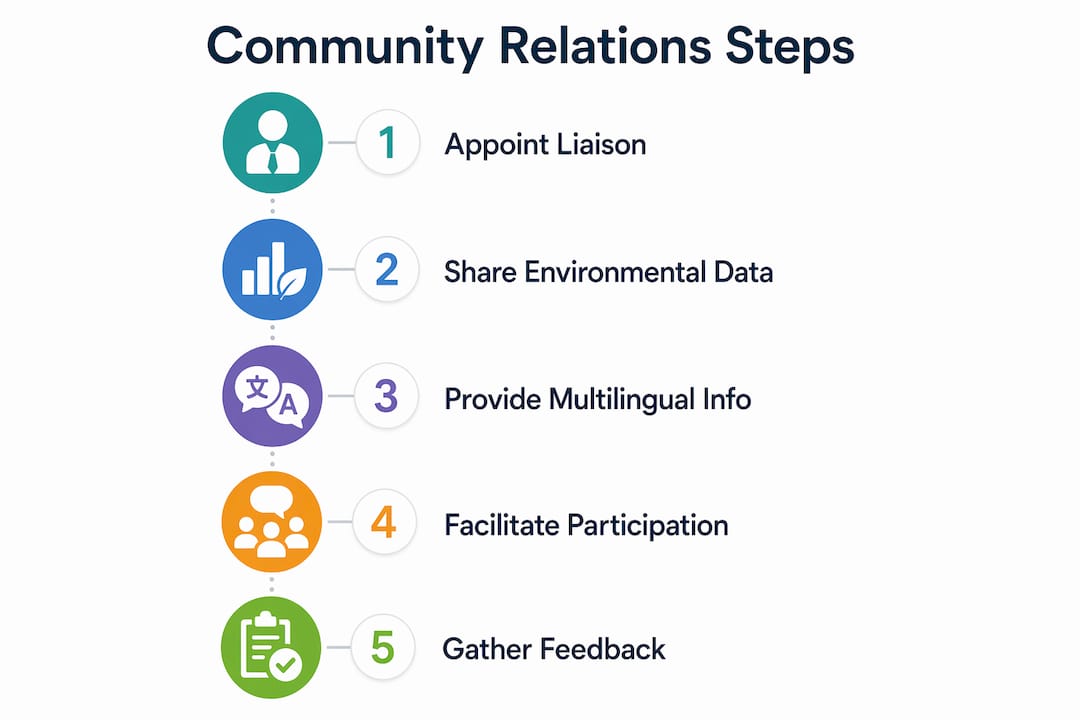
Effective community relations in demolition rest on five interconnected components. Each one addresses a different failure point that, left unmanaged, can escalate into formal complaints, enforcement action, or project delays.
- A named community liaison officer. This person owns all two-way communication between the project team and local residents. They attend community meetings, field complaints, and feed resident concerns back into project decision-making. Without a named individual, accountability dissolves and residents have no clear point of contact.
- Regular environmental monitoring reports. Dust, noise, and vibration data must be published on a defined schedule, not only when problems arise. Scheduled monitoring communications reduce ambiguity and prevent conflict escalation by giving residents a reliable data cadence they can plan around.
- Community access for environmental sampling. Residents and independent representatives should be able to conduct or observe air quality and soil sampling. This is not just good practice. Ohio EPA’s enforcement order at the Bunting Bearings site mandated community sampling coordination as a legal condition before further demolition could proceed.
- Multi-channel communication. Online platforms, printed notices, community meetings, and social media channels must work together. Relying on a single channel excludes residents who lack digital access or who speak languages other than English.
- Hazardous material mitigation plans with public disclosure. Lead, asbestos, and silica dust require documented control measures. These plans must be shared with the community in plain language, not filed away in a technical appendix.
Pro Tip: Create a simple one-page summary of your hazardous material mitigation plan and distribute it door-to-door within 200 metres of the site boundary before work begins. Residents who receive information proactively are far less likely to raise formal objections once demolition starts.
How do regulatory examples shape community relations approaches?
Three regulatory cases from 2026 define the current standard for demolition stakeholder communication and set clear expectations for project teams.
| Regulatory example | Key community relations requirement | Outcome |
|---|---|---|
| US EPA large-scale residential demolition framework | Governments, businesses, and non-profits must coordinate to keep citizens informed and able to take safety precautions | Sets baseline expectation for multi-stakeholder engagement |
| Ohio EPA order at Bunting Bearings site | Named liaison, communication plan, lead dust controls, and documented waste management mandated before further demolition | Enforcement-backed accountability for hazardous material sites |
| UK government Grenfell Tower updates | Multilingual dust, noise, and vibration reports published on a regular schedule for bereaved families, survivors, and residents | Demonstrates that consistent multilingual reporting builds long-term public trust |
| St. Louis dust control ordinance | Misting fans, fencing, and resident safety advisories required during tornado-related demolitions | Protects health and reduces liability when demolition is unplanned or urgent |
The Ohio EPA case is particularly instructive. The Bunting Bearings enforcement order did not simply require technical lead mitigation. It required a named individual, a written communication plan, and coordinated access for community environmental testing. This means regulators now treat community relations as a technical deliverable, not a soft skill.
“Community involvement is a necessary element of planned demolition activities tied to health precautions and reuse decisions.” — US EPA
The Grenfell Tower updates reinforce a different lesson. Publishing environmental data in multiple languages, on a predictable schedule, for an audience that includes bereaved families and trauma-affected survivors, demonstrates that community trust requires both technical accuracy and human sensitivity. Projects that treat monitoring reports as bureaucratic box-ticking miss this entirely.
What methods foster meaningful community participation?
Meaningful participation goes beyond distributing leaflets. It requires feedback loops where resident input visibly shapes project decisions.
- Establish a regular meeting cadence before demolition begins. Monthly meetings held at accessible local venues, with minutes published online within five working days, signal that the project team takes resident input seriously. Face-to-face exchanges remain the most effective channel for building trust, particularly with older residents or those with limited digital access.
- Use integrated online and offline channels simultaneously. Research on collaborative governance in demolition and reconstruction projects confirms that multi-channel information disclosure increases resident participation and trust. Social network analysis of these projects shows that combining online platforms with in-person meetings produces stronger governance outcomes than either channel alone.
- Create a formal feedback register. Every resident concern, complaint, or suggestion must be logged, assigned to a responsible team member, and responded to within a defined timeframe. Publishing a summary of the register monthly demonstrates accountability and discourages the perception that feedback disappears into a void.
- Balance government or contractor leadership with resident autonomy. Residents should have a genuine role in decisions about site reuse, not just the opportunity to comment on decisions already made. Resident-led renewal models show the benefit of empowering residents via participation channels, though governance influence remains a challenge when decision-making authority is not explicitly shared.
- Provide accessible summaries of technical data. Environmental monitoring reports should include a plain-language summary alongside the technical data. Residents cannot meaningfully participate in decisions if the information they receive requires specialist knowledge to interpret.
Pro Tip: If your project involves a community with significant non-English-speaking residents, translate your key communications into the two or three most common local languages. The Grenfell Tower updates set a clear precedent for this approach, and it directly reduces the risk of misinformation spreading through informal networks.
How do demolition projects manage community health and safety concerns?
Health and safety management is the area where community relations and technical project delivery overlap most directly. Residents living near demolition sites face real risks from dust, noise, vibration, and hazardous materials. Managing these risks transparently is both a legal obligation and a trust-building opportunity.
- Dust containment. St. Louis officials confirmed that misting fans, perimeter fencing, and direct resident safety advisories are the standard response to fugitive dust from demolition sites. These measures must be documented, monitored, and reported to the community, not simply deployed and forgotten.
- Lead and hazardous material controls. Sites with known or suspected lead contamination require documented mitigation plans that include community access for independent environmental sampling. The Ohio EPA order at Bunting Bearings established that technical mitigation and community access must be synchronised, not treated as separate workstreams.
- Noise and vibration monitoring. Readings should be taken at the site boundary and at the nearest occupied properties. Results must be published within the agreed reporting window, with clear thresholds that trigger automatic community notification if exceeded.
- Incident reporting protocols. Any unplanned release of dust, hazardous material, or excessive vibration must trigger an immediate community alert, not a retrospective mention in the next monthly report. Residents who discover incidents through social media before receiving official notification lose trust rapidly and rarely recover it.
- Integration of technical and communication workstreams. Safety officers responsible for explaining demolition hazards to residents must work directly with the community liaison officer. When technical and communication teams operate in silos, monitoring data is collected but never reaches the people who need it.
Key takeaways
Effective community relations in demolition require a named liaison, scheduled environmental reporting, and genuine feedback loops embedded in project governance from the outset.

| Point | Details |
|---|---|
| Appoint a named liaison | A dedicated liaison officer creates accountability and gives residents a direct, reliable point of contact. |
| Publish monitoring data on schedule | Regular dust, noise, and vibration reports reduce conflict by giving communities a predictable data cadence. |
| Mandate community sampling access | Regulatory precedents, including the Ohio EPA Bunting Bearings order, require independent community access to environmental testing. |
| Use multi-channel communication | Combining online platforms with in-person meetings produces stronger resident participation than either channel alone. |
| Treat health disclosures as trust tools | Transparent hazardous material plans and incident alerts protect public health and build long-term community confidence. |
Why community relations is the discipline demolition gets wrong most often
I have seen projects where the technical demolition work was genuinely excellent. Dust suppression was in place, lead controls were documented, vibration was within limits. And yet the project still generated formal complaints, local press coverage, and a fractious relationship with the council. The reason, almost every time, was the same: the community found out about problems from neighbours and social media rather than from the project team.
The US EPA’s position is that community involvement is integral to risk management, not a communications add-on. I agree completely, but the practical implication is harder than it sounds. It means your community liaison officer needs to be in the room when technical decisions are made, not briefed afterwards. It means your monitoring reports need to go out even when the data is unremarkable, because the cadence itself is what builds trust.
The Grenfell Tower updates are the clearest example of this principle at scale. Publishing multilingual environmental reports on a regular schedule, for an audience that includes people who have experienced profound loss, is not a legal formality. It is an act of institutional respect that shapes how the entire project is perceived. Most demolition projects are not Grenfell, but the principle transfers directly. Residents who receive consistent, honest information before they ask for it are partners. Residents who have to chase information become adversaries.
The trend towards data-driven transparency is accelerating. Regulatory bodies are increasingly requiring named individuals, written plans, and documented community access as conditions of demolition consent. Projects that build these structures voluntarily, before they are mandated, will find the process far less disruptive than those that treat community relations as a compliance exercise.
— George
How Gcscontractors supports community relations on demolition projects
Gcscontractors brings direct experience of working within live environments where community relations and regulatory compliance must run in parallel. The team supports project managers and local authorities in appointing liaison officers, structuring communication plans, and meeting the environmental monitoring obligations that regulators now expect as standard.

Whether you are managing a strip-out in an occupied building or a full structural demolition in a residential area, Gcscontractors can help you build the stakeholder engagement framework your project needs. The live site demolition guide covers the full process from pre-demolition community notification through to post-demolition reporting. For projects requiring detailed site preparation and compliance planning, the compliant UK site preparation guide sets out the regulatory steps in full. Contact Gcscontractors directly to discuss your project’s specific community engagement requirements.
FAQ
What is community relations in demolition?
Community relations in demolition is the structured process of engaging local residents, governments, and organisations to provide transparent information about health risks, environmental monitoring, and site reuse decisions throughout a demolition project. The US EPA defines it as a necessary element of planned demolition activities, not an optional communication exercise.
Why do demolition projects need a community liaison officer?
A community liaison officer provides a named, accountable point of contact for residents and ensures that feedback reaches project decision-makers. Ohio EPA’s enforcement order at the Bunting Bearings site made appointing a liaison a legal condition, reflecting the regulatory direction of travel across the industry.
How often should environmental monitoring data be published?
Monitoring data for dust, noise, and vibration should be published on a defined, regular schedule throughout the demolition period. The Grenfell Tower community updates demonstrate that a consistent reporting cadence reduces conflict and maintains trust more effectively than one-off or reactive disclosures.
What are the main health risks demolition projects must communicate to residents?
The primary risks are fugitive dust, lead and asbestos contamination, and noise and vibration. St. Louis officials confirmed that dust from demolition sites requires active containment measures alongside direct resident safety advisories, particularly where hazardous materials may be present.
How can residents participate meaningfully in demolition project decisions?
Residents can participate through formal feedback registers, regular community meetings with published minutes, and access to independent environmental sampling. Research on collaborative governance in demolition confirms that combining online and offline communication channels produces higher resident engagement and stronger governance outcomes than single-channel approaches.