Civil engineering’s vital role in site preparation: 2026 guide
Many construction project managers and property developers assume civil engineering only becomes relevant once groundworks are underway. That assumption is costly. Civil engineering shapes every phase of site preparation, from the very first ground investigation through to regulatory sign-off. Understanding its full scope is not just useful; it is essential for protecting your programme, your budget, and your legal standing. This guide cuts through the confusion, explaining what civil engineering genuinely covers, how it tackles the most challenging UK site conditions, and why early involvement is the single most effective step you can take before a spade enters the ground.
Table of Contents
- What civil engineering really entails in site preparation
- Common site challenges and how civil engineering addresses them
- The hidden world of regulatory compliance
- Strategic civil engineering: Enabling better project outcomes
- Beyond compliance: What most guides miss about civil engineering
- Partner with proven civil engineering expertise
- Frequently asked questions
Key Takeaways
| Point | Details |
|---|---|
| Early site investigation | Civil engineers uncover hidden risks in ground and site conditions before work starts. |
| Beyond regulation | Meeting regulations does not guarantee safety; expert civil engineering minimises overlooked risks. |
| Compliance navigation | Civil engineers guide your project through evolving building and safety laws for lasting results. |
| Proactive value | Strategic engineering input protects budgets and enables faster, safer project delivery. |
What civil engineering really entails in site preparation
Civil engineering in the pre-construction phase goes far beyond shifting earth or laying drainage. Before any design is finalised, a competent civil engineer will carry out a structured ground investigation that standard topographic surveys simply cannot replace. A topographic survey tells you what the land looks like. A ground investigation tells you what the land is, and that distinction can make or break a project.
The ground investigation process involves:
- Borehole drilling and trial pitting to assess soil composition and bearing capacity
- Contamination testing where previous industrial use is suspected
- Groundwater monitoring to identify high water table conditions
- Subsidence risk mapping using datasets such as the BGS PSA (British Geological Survey Property Subsidence Assessment)
- Tree effect evaluations on clay soils, where root systems alter moisture content and require deeper foundations
- Coastal proximity assessments where structures must maintain a critical distance from cliff crests
Poor ground conditions such as contamination, high water tables, and subsidence risks require expert assessment using BGS PSA datasets, and these are not edge cases you can address reactively. They need to be identified before designs are drawn.
Civil engineers also engage with building regulations at the earliest stages. This includes liaising with local authorities, reviewing planning conditions that affect ground treatment, and ensuring that foundation design aligns with both the ground conditions found and the regulatory framework in force. This early regulatory navigation prevents costly redesigns later in the programme.
Our groundworks expertise at GCS Contractors is built on exactly this kind of front-loaded investigation, ensuring that what is found below ground is never a surprise during construction.
Pro Tip: Bring your civil engineer in before you commission your structural or architectural designs. The ground conditions they identify will directly influence foundation type, drainage strategy, and enabling works requirements. Doing it the other way around is one of the most common and avoidable causes of programme delay.
Common site challenges and how civil engineering addresses them
With the range of tasks now clear, it is essential to show how civil engineering directly overcomes typical UK site challenges. The UK’s varied geology, dense urban fabric, and ageing land use history create a specific set of risks that require targeted expertise.
| Site challenge | Diagnostic tool | Civil engineering response |
|---|---|---|
| Ground contamination | Soil and water sampling | Remediation design, capping or removal strategy |
| High water table | Groundwater monitoring | Dewatering systems, tanked foundations |
| Subsidence risk | BGS PSA dataset | Deeper foundations, ground improvement works |
| Trees on clay soils | Root mapping, soil shrinkage data | Foundation depth calculated as 0.75 x (tree height minus distance) |
| Coastal cliff proximity | Topographic and geotechnical survey | Minimum 12-metre setback from cliff crest enforced |
| Complex urban sites | Site-specific enabling works assessment | Temporary works designed to BS5975 |
Each of these challenges follows a clear pattern: investigate, diagnose, and design a proportionate response. Complex urban sites require special enabling works and compliance with the temporary works code BS5975, which governs the design and management of scaffolding, shoring, and other temporary structures on constrained sites.
For contaminated ground, the response is rarely simple. Civil engineers must assess whether contamination is localised or widespread, whether it poses a risk to future occupants or neighbouring land, and whether remediation or containment is the more appropriate solution. Each decision has cost, programme, and legal implications.
Thorough ground investigation is not an optional extra. It is the foundation of every sound risk management strategy on site. Skipping it does not save money; it defers costs to a point in the programme where they are far more disruptive to address.
For solutions for challenging ground conditions, experienced civil engineers bring both the technical tools and the regulatory knowledge to design responses that are proportionate, compliant, and buildable.

The hidden world of regulatory compliance
Site challenges lead naturally into the need for rigorous compliance, which evolves alongside legal and safety standards. Regulatory compliance in civil engineering is not a single checklist; it is a dynamic process that changes as legislation develops and as site-specific risks are uncovered.
The Building Safety Act 2022 significantly raised the bar for what constitutes acceptable risk in construction. Under this legislation, fire safety and structural collapse risk are assessed with greater scrutiny than before. Importantly, even minor risks can be flagged as defects under the Building Safety Act 2022, with remediation determined via PAS9980 assessments.
Here is a comparison of civil engineering inputs that are legally required versus those that represent best practice:
| Compliance area | Legally required | Best practice (not mandated) |
|---|---|---|
| Foundation design | Yes, Building Regulations Part A | Independent peer review of ground investigation |
| Contamination assessment | Yes, where risk is identified | Full Phase 2 investigation on all brownfield sites |
| Temporary works design | Yes, under CDM 2015 | Third-party sign-off to BS5975 |
| Fire risk assessment (existing buildings) | Yes, under BSA 2022 for higher-risk buildings | PAS9980 assessment for all multi-storey residential |
| Drainage design | Yes, Building Regulations Part H | Sustainable drainage systems (SuDS) modelling |
The compliance steps civil engineers help navigate before construction begins include:
- Reviewing planning conditions and pre-commencement requirements with the local planning authority
- Commissioning ground investigation and contamination reports to satisfy Building Regulations
- Designing foundations and drainage to comply with Approved Documents A, C, and H
- Preparing temporary works briefs and appointing a temporary works coordinator under CDM 2015
- Identifying whether the project falls within the scope of the Building Safety Act 2022 and, if so, engaging with the Building Safety Regulator
Understanding where the legal minimum ends and where genuine risk management begins is one of the most valuable things a civil engineer brings to your project.
Strategic civil engineering: Enabling better project outcomes
A strong grasp of compliance sets the stage for civil engineering’s strategic value throughout a project’s lifetime. When civil engineers are involved early and consistently, the benefits extend well beyond avoiding problems. They actively improve project outcomes.
Here is how experienced civil engineering input contributes to successful delivery:
- Cost control: Ground risks identified early are far cheaper to address than those discovered during construction
- Programme certainty: Early enabling works prevent the kind of unforeseen delays that compress later programme stages
- Risk anticipation: Proactive assessment of ground conditions, drainage, and access constraints removes uncertainty from the critical path
- Stakeholder confidence: Thorough pre-construction reporting gives clients, funders, and planners the evidence they need to proceed with confidence
- Regulatory readiness: Pre-construction compliance work means approvals are sought with complete information, reducing the risk of conditions or refusals
Complex sites with urban constraints or specific ground risks benefit from advance enabling works informed by civil engineers. A practical example: on a constrained urban site with adjacent live structures, a civil engineer can design a temporary retaining system, specify monitoring requirements, and coordinate the sequence of works so that enabling activities do not compromise neighbouring buildings or utilities. Without that input, the same site becomes a programme risk from day one.
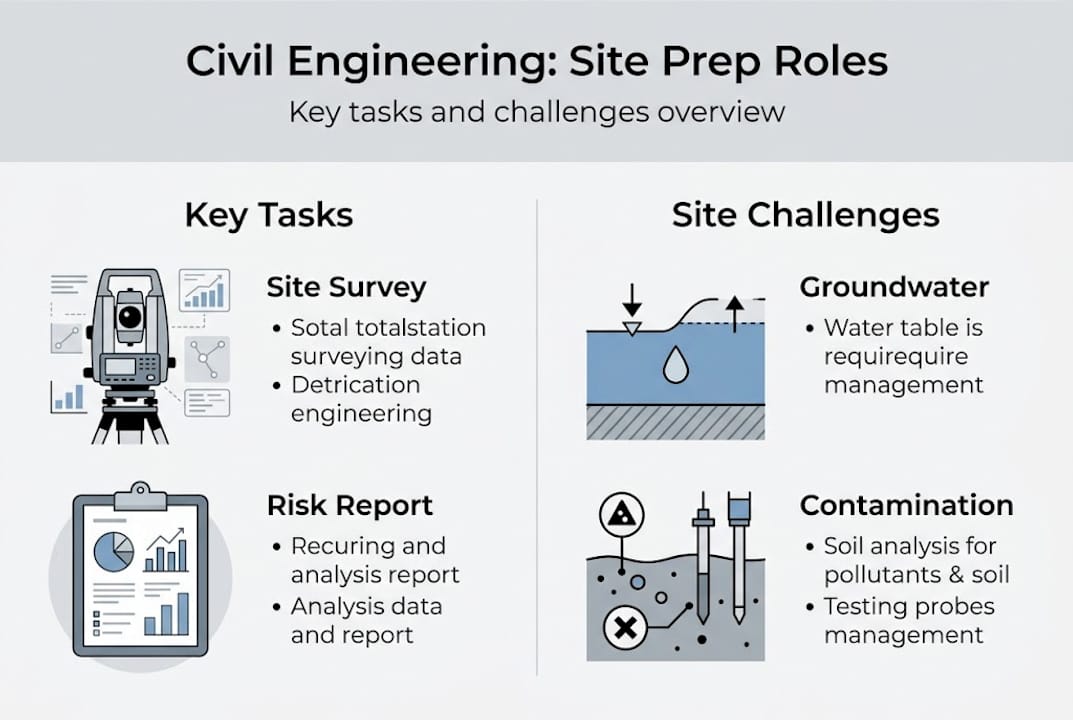
Our approach to civil engineering for project efficiency is built around exactly this kind of strategic involvement, not just technical delivery.
Pro Tip: Set up regular review meetings with your civil engineer throughout the pre-construction and construction phases. Compliance requirements and ground conditions can both produce surprises. Staying aligned means you can respond quickly rather than reactively.
Beyond compliance: What most guides miss about civil engineering
Most articles on civil engineering frame it as a compliance discipline. Follow the regulations, pass the inspections, move on. That framing is too narrow, and it leads project managers to underuse one of the most strategically valuable resources available to them.
We have seen projects where early civil engineering input did not just prevent problems; it created genuine value. A thorough ground investigation on a brownfield site revealed ground conditions suitable for a different foundation system, cutting foundation costs significantly and accelerating the programme by several weeks. That outcome was not compliance. It was competitive advantage.
Challenges and solutions in civil engineering are rarely just technical. They are commercial and strategic. The civil engineer who tells you what you cannot do on a site is valuable. The one who tells you what you can do, and how to do it better than your original plan, is indispensable.
Treat civil engineers as strategic allies from the earliest stages of project conception, not as technical support brought in to solve problems that have already materialised.
Partner with proven civil engineering expertise
The insights in this article point to one consistent conclusion: civil engineering input, applied early and expertly, is one of the most effective investments a project manager or developer can make.

At GCS Contractors, we provide specialist groundworks and civil engineering services across the UK, covering everything from initial ground investigation and enabling works through to drainage design and foundation construction. Our teams are experienced in working within live environments and complex urban sites, with a consistent focus on health, safety, and regulatory compliance. To find out how our GCS Contractors civil engineering services can support your next project, get in touch with our team today for an initial consultation.
Frequently asked questions
What are the most common site risks civil engineering can uncover?
Civil engineering surveys reveal issues like ground contamination, high water tables, subsidence and tree risks on clay soils, all of which are potential causes of costly programme changes if identified late.
Does compliance with regulations guarantee my project’s safety?
No. Building regulations can miss certain risks, and under the Building Safety Act 2022, even low-level risks related to fire or structural collapse can be labelled as defects requiring remediation via PAS9980 assessment.
How early should I engage a civil engineer for my project?
Engage a civil engineer before detailed design begins. Early involvement allows site-specific challenges to be identified and built into the design from the outset, avoiding expensive redesigns and programme delays.
What is the value of PAS9980 assessments in large projects?
PAS9980 fire risk assessments provide a structured methodology for judging and addressing fire safety beyond the minimum compliance threshold, ensuring that site-specific fire risks are properly evaluated and managed under the Building Safety Act 2022.