Live environment working list: the UK contractor’s guide
Brief your team before anyone enters the building: restrict access to agreed windows, erect hoarding or temporary segregation, issue a permit to work, and appoint a single point of contact for escalation. That one sentence covers the four controls that prevent most incidents on occupied sites. Your live environment working list, in its shortest form, looks like this:
- Segregation and hoarding: physical barriers between the works area and occupied zones, checked before each shift
- Access windows: agreed start/finish times confirmed with facilities management (FM) in writing
- Permit to work: issued, signed, and closed for every high-risk task (hot works, confined spaces, live services, working at height)
- Temporary services: continuity of power, data, water, and fire detection confirmed before isolation
- Monitoring and escalation contacts: named individual on site and named client contact available throughout the working window
Copyable RAMS opener: “These works are carried out within an occupied live environment. All operatives have been briefed on site restrictions, access windows, emergency arrangements, and the permit-to-work system in force. Segregation is maintained at all times and will be inspected at the start and end of each shift.”
Pro Tip: Run a 10-minute preflight check immediately before each working window opens. A short pre-start walkthrough catches most last-minute issues before occupants are at risk, a principle that applies equally to live broadcast operations and construction.
Key takeaways
A defensible live environment working list combines physical segregation, documented permits, proactive stakeholder communication, and a contingency allowance sized to the site’s occupancy complexity.
| Point | Details |
|---|---|
| Start with segregation | Erect hoarding and confirm access windows in writing before any operative enters the building. |
| RAMS must name live-environment controls | Include phasing, segregation, competence, emergency actions, and monitoring in every RAMS document. |
| Communicate early and often | Issue a pre-works notice at least five working days before start; send FM a daily update by 07:30. |
| Budget for programme uplift | Restricted access windows typically add a significant amount to programme duration on heavily restricted sites. |
| Gcscontractors for occupied-site works | Gcscontractors delivers SMSTS-supervised, CHAS-accredited strip-out, demolition, and groundworks in live environments across Cambridge and East Anglia. |
Table of Contents
- What goes on your live environment working list?
- How do you write RAMS and permits for a live site?
- How should you communicate with occupants and stakeholders?
- What extra controls apply in healthcare, food, and laboratory environments?
- How do you manage deliveries, crane lifts, and site protection on an occupied site?
- How do you control noise, vibration, and nuisance on a live site?
- What emergency and business continuity arrangements does a live site need?
- What do live environment works cost and how long do they take?
- How Gcscontractors delivers live environment projects
- The part of live-environment planning most project managers get wrong
- Gcscontractors: live-environment strip-out, demolition, and groundworks in Cambridge and East Anglia
- Sources
What goes on your live environment working list?
A practical live environment checklist groups tasks by category so nothing falls between disciplines. Use the numbered sequence below to build your site-specific document, then adapt the template at the end of this section for RAMS or permit packs.
Access and phasing
- Confirm permitted working hours in writing with FM or estates before mobilisation.
- Agree a phasing plan: which areas are live, which are handed over, and when transitions occur.
- Mark access routes on a site plan and share with all operatives and the client’s FM team.
- Appoint a site supervisor responsible for enforcing access restrictions every shift.
Segregation and hoarding
- Erect temporary hoarding or solid partitions to the agreed specification before any works begin.
- Inspect hoarding integrity at the start and end of every shift; record findings.
- Fit self-closing doors or airlock arrangements where dust or noise migration is a risk.
- Display clear signage on both sides of the hoarding: works in progress, no unauthorised entry.
Temporary services and welfare
- Survey all live services (electrical, gas, water, data, fire detection) before isolation; mark on drawings.
- Confirm temporary supplies are in place and tested before the permanent service is interrupted.
- Provide welfare facilities (WC, hand-washing, rest area) within or adjacent to the works zone without routing through occupied areas.
Environmental controls
- Dust suppression: damp-down, HEPA-filtered extraction units, and sticky mats at zone exits.
- Waste segregation bins positioned within the works zone; no waste transit through occupied areas.
- Noise and vibration monitoring log started on day one; readings shared with FM weekly.
Plant and lifting
- Confirm plant routes and turning circles on the site plan; check overhead obstructions.
- Lift plans signed off before any crane or MEWP operation; exclusion zones marked and marshalled.
- Plant pre-use checks completed and recorded each morning before operatives start.
Deliveries and storage
- Delivery windows agreed with FM; no unscheduled arrivals during peak occupancy periods.
- Designated unloading area segregated from pedestrian routes; banksman on duty during all vehicle movements.
- Materials stored within the works zone only; no overspill into occupied corridors or car parks.
Communications and occupants
- Pre-works notice issued to all affected occupants at least five working days before start.
- Day-of update sent to FM by 07:30 on each working day, confirming activities and any changes.
- Emergency messaging protocol agreed: who calls whom, and by what means, if an incident occurs.
Permits and emergency arrangements
- Permit-to-work log maintained on site and available for inspection at all times.
- Fire alarm interaction agreed with FM: temporary isolations, alternative detection, and reinstatement times recorded.
- Evacuation routes from the works zone confirmed, posted, and included in the toolbox talk.
Pro Tip: Treat this list as a living document. After each working day, note any items that needed adjustment and update the checklist before the next shift. Operations checklists that include post-work debriefs consistently outperform those that treat the list as static.
How do you write RAMS and permits for a live site?
Risk Assessment and Method Statements (RAMS) for occupied sites need more detail than those written for vacant buildings. The following headings should appear in every RAMS document for live environment works.
- Scope and phasing: which areas are affected, in what sequence, and what triggers a phase change
- Segregation method: type of hoarding, inspection frequency, and responsible person
- Personnel competence: SMSTS, CSCS cards, and any site-specific inductions required before entry
- Emergency actions: fire evacuation procedure, first-aid arrangements, and escalation contacts
- Environmental controls: dust, noise, vibration, and waste management measures
- Monitoring: what is measured, how often, and what threshold triggers a stop-work instruction
Permit-to-work triggers
Issue a permit before any of the following tasks on a live site:
- Hot works (cutting, grinding, welding) within or adjacent to occupied zones
- Isolation of fire detection, suppression, or alarm systems
- Work on or near live electrical services
- Confined space entry (drainage chambers, ceiling voids, service ducts)
- Working at height above occupied areas or public routes
Each permit must name the issuing authority, the operative, the task, the duration, and the reinstatement check. Retain completed permits for the project file; the streaming reliability framework of assigning named roles to every critical function applies directly here.
Pro Tip: Designate one person as the single permit authority on site. Multiple signatories create gaps; a single named supervisor who issues, monitors, and closes every permit removes ambiguity.
How should you communicate with occupants and stakeholders?
Poor communication causes more complaints on live sites than poor workmanship. Identify every stakeholder group before works begin and assign each one an information need and a delivery method.
Key stakeholders and what they need:
- Occupants and tenants: advance notice of noisy works, access restrictions, and emergency procedures
- Facilities management: daily activity updates, permit status, and any changes to temporary services
- Estates and security: access lists, delivery schedules, and out-of-hours contact numbers
- Cleaning teams: revised cleaning routes, contamination zones to avoid, and waste collection points
Sample notification schedule
- Five working days before start: written pre-works notice to FM and all affected occupants, covering scope, programme, working hours, and emergency contacts.
- Day before start: confirmation email to FM with the day-one activity plan and any access restrictions.
- Each working day by 07:30: brief update to FM confirming planned activities, any permit isolations, and expected completion time.
- Immediately on any incident: verbal notification to FM, followed by a written record within one hour.
- On practical completion: written debrief note covering works completed, any outstanding items, and reinstatement confirmation.
Document every consent and restriction in writing. Where occupants are temporarily excluded from an area, record the exclusion, the reason, and the reinstatement time in the site diary.
What extra controls apply in healthcare, food, and laboratory environments?
Sensitive occupied environments require controls beyond standard construction practice. Zoning is the foundation: establish clean routes for occupants and dirty routes for construction traffic, and never allow them to cross.
- Temporary anterooms: fit a temporary lobby or airlock at the works zone boundary to prevent contamination migration.
- Negative pressure: where works generate dust or biological risk adjacent to clinical or laboratory areas, consult the client’s infection control team about negative-pressure arrangements before works begin.
- PPE uplift: standard PPE may be insufficient; document any enhanced requirements (FFP3 masks, disposable coveralls, boot covers) in the RAMS and brief operatives before entry.
- Cleaning coordination: agree a daily cleaning schedule with the client’s FM team; construction waste must not accumulate overnight in sensitive zones.
- Reinstatement checks: before handing back any area in a healthcare or food environment, carry out a joint inspection with the client’s infection control or quality team and record the outcome.
Pro Tip: Ask the client’s infection control lead for their own zone map before you draw yours. Their classification of clean, dirty, and transitional areas will be more detailed than anything you can derive from drawings alone.
How do you manage deliveries, crane lifts, and site protection on an occupied site?
Logistics on a live site require more planning than on a vacant one because every vehicle movement and every lift takes place in proximity to people who have no construction awareness.
- Delivery windows: restrict deliveries to agreed times, typically outside peak occupancy periods (avoid 08:00–09:30 and 12:00–13:30 in most office environments).
- Pedestrian segregation: use physical barriers, not just signage, to separate vehicle routes from pedestrian routes during all deliveries and plant movements.
- Banksman: a trained banksman must be present for every vehicle reversing or manoeuvring within the site boundary.
- Traffic management plan: submit to FM and, where required, the local authority before mobilisation; update it whenever delivery patterns change.
Crane and lift controls
- Prepare a written lift plan for every crane or MEWP operation, signed by a competent person.
- Mark exclusion zones on the site plan and erect physical barriers before the lift begins.
- Appoint a slinger/signaller and confirm radio or hand-signal protocol with the crane operator.
- Notify FM of the lift window; agree a contingency time in case of weather or access delays.
- Inspect all lifting equipment and accessories against the AVL equipment checklist principle of verifying spares and redundancy before a critical operation begins.
For site protection, the site setup checklist covers hoarding specification, temporary electrics, floor protection, and dust suppression items in detail.
How do you control noise, vibration, and nuisance on a live site?
Noisy and vibrating works are the most common source of occupant complaints and, if unmanaged, can trigger enforcement action under the Control of Pollution Act 1974.
- Permitted hours: agree working hours with FM and, where required, the local authority before any noisy works begin. Typical permitted hours for noisy works in occupied commercial buildings are 08:00–17:00 Monday to Friday, but always confirm with the client.
- Advance notice: give FM at least 48 hours’ written notice before any particularly noisy task (breaking out, percussive drilling, saw-cutting).
- Acoustic screens: position acoustic barriers around noisy plant where practicable; they reduce transmitted noise at source rather than at the receiver.
- Schedule management: plan the noisiest tasks for the lowest-occupancy windows, typically early morning or Friday afternoons in office environments.
- Vibration monitoring: where works are adjacent to sensitive equipment (MRI scanners, precision laboratory instruments, server rooms), fit vibration monitors and agree trigger levels with the client before works start.
Pro Tip: A brief written noise and vibration log, updated daily, is your strongest defence if a complaint escalates to the local authority. It demonstrates proactive management rather than reactive damage limitation.
What emergency and business continuity arrangements does a live site need?
Construction works must integrate with the building’s existing fire strategy, not override it. Before any works begin, obtain a copy of the current fire risk assessment and emergency plan from FM.
- Alarm interaction: agree with FM how temporary isolations of the fire alarm will be managed; every isolation must be time-limited, recorded, and reinstated before the building is reoccupied.
- Evacuation routes: confirm that works do not obstruct any designated escape route; if they do, agree an alternative route with FM and the responsible person before works start.
- Fire marshals: appoint a construction fire marshal for the works zone; brief them on the building’s assembly point and the FM team’s emergency contacts.
- Temporary overrides: document every temporary override of a life-safety system (sprinklers, smoke detectors, emergency lighting) in the permit-to-work log.
Emergency contact template
- Site supervisor (construction): name, mobile number
- Client FM contact: name, mobile number, out-of-hours number
- Building emergency services: fire, police, ambulance (999), and building-specific security
- Utility emergency lines: gas (0800 111 999), electricity (network operator), water (supplier)
- Principal contractor / project manager: name, mobile number
Distribute this list at every toolbox talk and post it inside the works zone entrance.
What do live environment works cost and how long do they take?
Working inside an occupied building costs more and takes longer than equivalent work on a vacant site. Budget for the following uplifts when preparing your programme and cost plan.
Common cost drivers and typical uplift factors:
- Restricted access windows: fewer productive hours per day; allow for 20–40% longer programme durations on heavily restricted sites.
- Specialist protection: hoarding, dust suppression, floor protection, and temporary services add direct cost that does not appear on a vacant-site bill of quantities.
- Additional supervision: a dedicated site supervisor for live-environment compliance is rarely optional; factor in the full-time cost.
- Temporary services: maintaining continuity of power, data, and fire detection during works requires temporary installations that add both cost and programme time.
- Cleaning: daily or shift-end cleaning of works zones and adjacent areas is a recurring cost that is frequently underestimated.
Contingency allowances on live-environment projects typically run higher than on vacant sites. Justify the contingency to your client by referencing the access restrictions, the permit-to-work overhead, and the cost of any unplanned stoppages. Enabling works guidance sets out how advance surveys and pre-works activities reduce the risk of unplanned stoppages during the live phase.
How Gcscontractors delivers live environment projects
Gcscontractors brings a structured, documented approach to every occupied-site project. Before mobilisation, the team prepares a site-specific RAMS, a phasing plan, and a communications schedule, all reviewed with the client’s FM or estates team before a single operative enters the building. Supervision is maintained throughout by SMSTS-qualified site managers, and all operatives carry valid CSCS cards. Where pre-qualification is required, Gcscontractors holds CHAS accreditation or equivalent, giving clients and principal contractors the assurance they need for procurement and insurance purposes.

The company’s experience spans strip-out and demolition in occupied commercial buildings, groundworks and drainage in live operational yards, and enabling works on phased development sites across Cambridge and East Anglia. The live-environment contractor’s guide and the live site demolition process guide set out the sequencing and safety controls Gcscontractors applies to occupied-building demolition and strip-out.
Pro Tip: Ask any contractor tendering for live-environment works to provide a sample RAMS and a sample communications plan from a comparable previous project. The quality of those documents tells you more about their live-environment competence than any accreditation list.
The part of live-environment planning most project managers get wrong
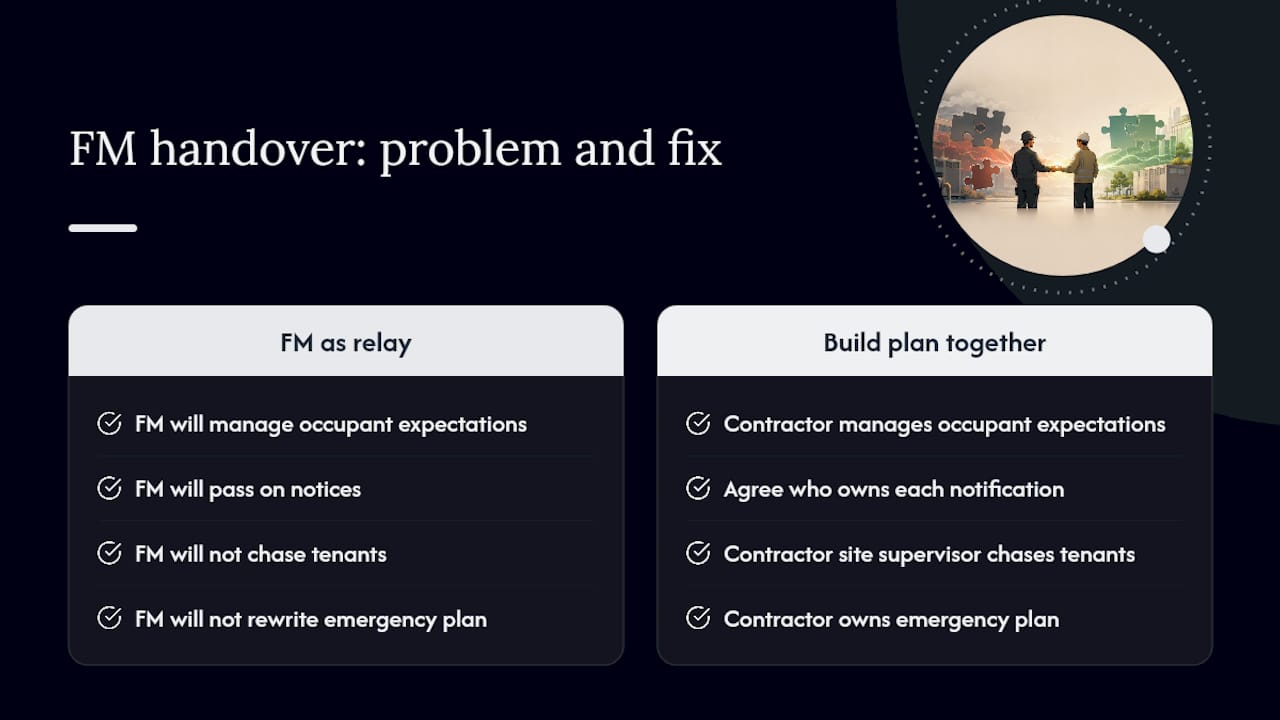
The conventional advice on live-environment projects focuses almost entirely on the physical controls: hoarding, permits, noise limits. Those controls matter, but they are not where most projects go wrong. The real failure point is the handshake between the construction team and the building’s FM or estates function, specifically the assumption that FM will manage occupant expectations on the contractor’s behalf.
FM teams are responsible for the building, not the project. They will pass on notices, but they will not chase down a tenant who ignores an access restriction, and they will not rewrite your emergency plan to fit the building’s fire strategy. That work belongs to the contractor’s site supervisor. When a project manager treats FM as a communication relay rather than a co-author of the live-environment plan, the gaps show up in the first week: occupants in areas they should not be, deliveries arriving at the wrong time, fire alarm isolations that run over their permitted window.
The fix is straightforward. Before mobilisation, sit down with the FM lead and build the communications plan together, not just share it with them. Agree who owns each notification, who has authority to stop works if an occupant complaint escalates, and what the reinstatement sign-off process looks like. That 30-minute meeting at the start of a project saves days of reactive management during it.
Gcscontractors: live-environment strip-out, demolition, and groundworks in Cambridge and East Anglia
Gcscontractors specialises in construction works inside occupied buildings and operational sites, where the difference between a well-run project and a disruptive one comes down to planning, supervision, and communication. For project managers and principal contractors who need a subcontractor with documented live-environment experience, SMSTS-qualified supervision, and CHAS accreditation, Gcscontractors offers strip-out, demolition, groundworks, drainage, and enabling works across Cambridge and East Anglia.

Every project starts with a site-specific RAMS, a phasing plan, and a stakeholder communications schedule prepared before mobilisation. Works are supervised by qualified site managers who hold current CSCS cards and are experienced in permit-to-work systems, temporary service management, and reinstatement to client specification. For demolition-specific compliance guidance, the demolition safety precautions guide sets out the controls Gcscontractors applies on every strip-out and demolition project.
Contact Gcscontractors to discuss your live-environment project and request a site-specific method statement.
Sources
- Streaming Reliability Checklist Before a Live Event
- Live Event Tech & Operations Checklist for 2026
- Tech Checklists for Flawless Live Setup
Recommended
- Working in live environments: the contractor’s practical guide
- Site setup explained: the UK construction guide
- The Essential Site Preparation Checklist for Self-Build Projects in the UK (2026) – GCS Contractors Ltd
- Groundworks Subcontractor UK: A Professional Selection & Technical Reference Guide – GCS Contractors Ltd