Enabling Works for Construction Sites: The Definitive Guide to Site Preparation in 2026
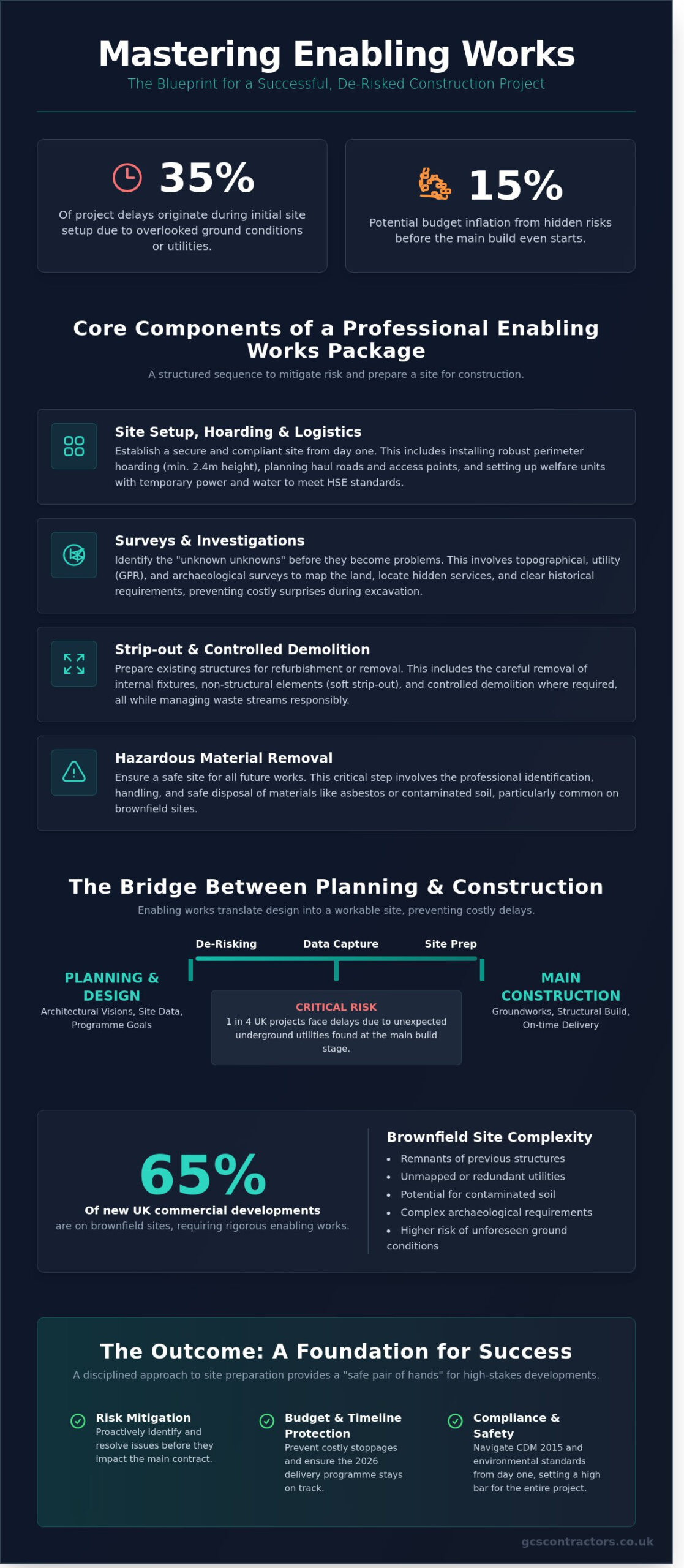
Industry data suggests that over 35% of project delays in the UK originate during the initial site setup phase, often due to overlooked ground conditions or unmapped utilities. You’ve likely felt the pressure of managing multiple early-stage contractors while worrying about hidden risks that could inflate your budget by 15% before the main build even starts. We understand that the first phase of any project is the most volatile, and you need a disciplined partner to maintain order. This guide helps you master the complexities of enabling works for construction sites to mitigate risk and protect your 2026 delivery programme. By reading on, you’ll gain a clear strategy for site clearance and the confidence to manage a seamless transition to groundworks. We’ll examine the technical scope of site preparation, specific risk mitigation strategies, and the essential compliance measures required to keep your project on track and within budget from day one.
Key Takeaways
- Learn how to distinguish between basic site clearance and the specialised activities required to prepare complex commercial sites for the main contract.
- Discover the strategic importance of integrating enabling works for construction sites with groundworks to prevent delays and ensure a seamless transition of data.
- Gain insights into navigating CDM 2015 regulations and environmental standards to mitigate risk and protect local biodiversity from the outset.
- Understand the core components of a professional setup, including the establishment of secure perimeters and the execution of safe demolition or internal strip-outs.
- Identify how a disciplined, technical approach to site preparation provides a “safe pair of hands” for high-stakes commercial developments.
What are Enabling Works for Construction Sites?
Enabling works for construction sites are the essential preparatory work activities that transform a raw site into a safe, accessible environment ready for the main building phase. Our team views these tasks as the vital foundation of any successful project. While some might mistake this for simple site clearance, specialised enabling works involve complex engineering and logistical planning. This phase is particularly critical for commercial builds where underground services or structural remnants from previous eras complicate the landscape.
We often deliver these services under a separate, early-stage contract. This strategy allows developers to de-risk the project by identifying ground conditions or hazardous materials before the main contractor arrives. It provides a clear window to resolve unforeseen issues, ensuring the main construction programme stays on track. As the first professional team on the ground, the enabling works contractor establishes the site’s operational standards and security protocols from day one. This early presence is a hallmark of a well-managed project, providing the client with a safe pair of hands before the heavy lifting begins.
The Scope of Enabling Works
The scope of these works is highly variable and depends on the specific site history. On a greenfield site, we might focus on access roads and initial drainage. However, on brownfield sites, which account for roughly 65% of new UK commercial developments, the requirements are more rigorous. Activities typically include:
- Topographical and utility surveys: Mapping the land and existing services.
- Site security: Installing secure perimeter hoarding and signage.
- Structural strip-outs: Removing internal fixtures and soft demolition.
- Archaeological investigations: Working with specialists to clear historical requirements.
- Hazardous material removal: Safe disposal of asbestos or contaminated soil.
This stage facilitates the “Golden Thread” of site information. By documenting every utility diversion and ground investigation, we provide a digital record that supports safety and compliance throughout the building’s lifecycle. Our team delivers this information with precision, ensuring that subsequent contractors have a clear, documented starting point.
The Bridge Between Planning and Construction
We act as the bridge that translates architectural designs into a physical, workable site environment. Designers create visions; we ensure those visions are builds that can actually happen. We identify “unknown unknowns” through intrusive investigations and Ground Penetrating Radar (GPR) surveys. These surveys are essential, as 1 in 4 UK construction projects face delays due to unexpected underground utilities. By uncovering these issues early, we prevent costly stoppages during the main build.
Early intervention allows us to set the tone for site discipline. We implement strict health and safety standards and professional conduct right from the start. This disciplined approach ensures that when the main build begins, the site is already a high-performance environment. Our team delivers the certainty required to move from the planning office to the heavy machinery phase without the fear of hidden surprises. It’s about creating a seamless transition that protects the client’s investment and timeline.
Core Components of a Professional Enabling Works Package
A successful build relies on a clear, prepared site. Our team delivers a structured approach to transition any site from its current state to a construction-ready environment. The Core Components of Enabling Works involve a precise sequence of activities designed to mitigate risk before the main contractor arrives. By identifying potential obstacles early, we prevent the costly delays that frequently plague the early stages of a project. Professional enabling works for construction sites provide the foundation for safety, compliance, and logistical efficiency.
Site Setup, Hoarding, and Logistics
Securing the perimeter is the first priority. We install robust timber or steel hoarding, typically at a minimum height of 2.4 metres, to protect the public and prevent unauthorised access. Logistics planning involves organising haul roads and site access points to minimise disruption to the local community. We’ve seen projects where poor logistics planning caused 15% delays in daily material deliveries. Our team also establishes essential welfare units and temporary 110v power and water supplies, ensuring the site meets HSE standards from the very first day of the programme.
Beyond the perimeter, securing high-value plant machinery and commercial vehicles against theft is another critical risk to manage. Specialist providers like Lock and Track offer advanced vehicle security solutions, such as immobilisers and trackers, to protect these valuable assets.
Maintaining these welfare facilities to a high standard is crucial for site morale and HSE compliance. For professional support with this and the final post-construction clean, you can check out That’s Cleaning.
Strip-out and Controlled Demolition
Refurbishment projects often require a comprehensive soft strip. This process involves the safe removal of non-structural elements like floor coverings, suspended ceilings, and internal partitions. We manage structural integrity during the removal of internal walls by coordinating closely with structural engineers to install temporary propping. In a 2023 project, our team removed 400 tonnes of internal fittings while maintaining the building’s core stability. We ensure all waste is segregated and recycled according to current environmental regulations, providing a clean slate for the fit-out phase.
This preparation is crucial for the subsequent fit-out specialists, from electricians to dedicated suppliers like Universal Blinds UK or even artisan fireplace experts such as HrejiciKrby kamnářství kominictví, who all rely on a solid and safe structural base.
Managing Underground Utilities and Services
Excavation is a high-risk activity without accurate mapping. We utilise Ground Penetrating Radar (GPR) to map buried assets before any ground is broken. This technology identifies gas, water, and electrical lines that might not appear on historical site plans. Obtaining “dead” certificates for disconnected services is a non-negotiable safety step for our site teams. If essential services traverse the site, we manage the diversion process to prevent the £10,000-per-day costs often associated with accidental utility strikes. Managing enabling works for construction sites means ensuring every service is accounted for before heavy machinery arrives.
Our earthworks and remediation services address the physical ground conditions. This includes levelling the site and treating soil contamination or invasive species like Japanese Knotweed. We handle the removal of obstructions that could interfere with the piling or foundation stages. If you’re preparing for a complex build, our dedicated enabling works team can manage these critical initial phases to ensure your programme remains on schedule and within budget.
Navigating Risk, Compliance, and Environmental Standards
Effective enabling works for construction sites require more than just clearing ground; they demand strict adherence to the Construction (Design and Management) Regulations 2015 (CDM 2015). We ensure every project begins with a robust safety framework. This includes managing the transition between pre-construction planning and physical site activity. Our team often adopts the role of Principal Contractor during this phase, taking full responsibility for site security, welfare facilities, and the coordination of all specialist subcontractors to ensure 100% compliance with Health and Safety Executive (HSE) standards.
The archaeological and ecological watching brief is a critical component of our risk management strategy. If a discovery is made, such as protected species or historical remains, we trigger a pre-defined protocol immediately. According to data from the Chartered Institute for Archaeologists, early intervention and professional watching briefs prevent an average of 4 weeks in unplanned project delays. We coordinate with local authorities to document finds without compromising the overall project timeline, keeping the programme moving while respecting statutory obligations.
Health and Safety Excellence
Our team delivers a structured approach to hazardous material management. Before any structural alterations begin, we reference Refurbishment and Demolition (R&D) surveys to identify hidden risks. Under the Control of Asbestos Regulations 2012, we manage the safe removal and disposal of any identified ACMs (Asbestos Containing Materials). We also implement a Site Waste Management Plan (SWMP). Although the legal mandate for SWMPs in England ended in 2013, we maintain them as a best-practice tool to provide 100% transparency on material movement. This allows us to track every tonne of soil or concrete that leaves the site.
During the strip-out phase, we prioritise the circular economy by shifting from simple disposal to material recovery. We target a 95% diversion rate from landfill for non-hazardous waste. By segregating timber, metals, and aggregates at the source, we reduce the carbon footprint of the project and lower disposal costs for our clients. This meticulous approach ensures that the enabling works for construction sites don’t just prepare the land, they protect the client’s reputation and budget.
Environmental and Community Impact
Maintaining positive relations with neighbours is a priority that we address through technical precision. We implement dust suppression systems and real-time noise monitoring to stay within the limits set by Section 61 of the Control of Pollution Act 1974. These measures are essential in urban environments where vibration levels must be tightly controlled to protect adjacent structures and residents. We provide regular reports to stakeholders to demonstrate that we’re operating within agreed parameters.
Sustainable drainage is another vital focus during the initial site preparation. We install silt traps and temporary interceptors to prevent runoff into local watercourses, ensuring that the site remains compliant with Environment Agency guidelines. These proactive steps contribute significantly to achieving BREEAM credits, particularly within the ‘Waste’ and ‘Land Use and Ecology’ categories. By integrating these environmental standards from day one, we provide a seamless transition to the main construction phase, ensuring the project stands on a foundation of quality and responsibility.
Strategic Planning: Integrating Enabling Works with Groundworks
Construction projects often suffer when enabling works and groundworks are treated as separate, isolated phases. This siloed approach creates a dangerous disconnect. We’ve seen instances where a lack of communication between disconnected contractors led to a £14,500 budget overrun. This happened because the enabling team failed to record a specific utility depth for the groundwork crew. A seamless transition isn’t just a preference; it’s a financial necessity for any developer.
Effective enabling works for construction sites provide the data that dictates the entire build’s success. Soil quality analysis and utility mapping aren’t just administrative tasks. They’re the intelligence that informs foundation design. If site investigations from early 2024 reveal a high water table or unexpected contaminants, the groundwork strategy must change before the first excavator arrives. This proactive planning prevents the 18% delay typically caused by unexpected ground conditions during the first phase of construction.
Managing the overlap between site clearance and the first foundation pour requires a disciplined schedule. We utilise a rolling handover where the groundwork team begins as soon as the first zone is cleared and certified. This approach eliminates the cost of idle heavy machinery. On a standard commercial site in the UK, idle plant hire can easily exceed £2,100 per week. By integrating these phases, you maintain momentum and keep the site active.
Hiring a single turnkey contractor typically reduces project management overheads by 12%. Managing multiple specialist firms increases the risk of finger-pointing when delays occur. A single partner accepts total responsibility for the site’s evolution. This ensures that the team clearing the site is fully aware of the requirements for the team pouring the concrete. It’s a method that prioritises the project’s long-term health over short-term procurement wins.
The Turnkey Advantage for Developers
Reducing contractual interfaces simplifies the supply chain. We provide a single point of accountability from the first fence post to the finished slab. This “one neck to wring” philosophy ensures that nothing falls through the cracks. A single partner also manages the complex transition from S278 works on public highways to internal site roads with far greater precision. This eliminates the jurisdictional disputes that often delay road adoptions by up to 6 months.
Tendering for Enabling Works
Accurate fixed-price quotes depend on the quality of your tender package. You must include detailed topographical surveys and asbestos reports to avoid future claims. We suggest evaluating contractors on their RIDDOR safety records and past performance on similar 2023 projects. The lowest bid in enabling works for construction sites frequently results in a 25% increase in variations later. Reliability saves more money than a cheap initial quote.
Ensure your project starts on firm ground with a partner who understands the full lifecycle of the build.
Why GCS Contractors is Your Partner for Enabling Works
GCS Contractors Ltd brings over 10 years of specialised experience in delivering professional groundworks and civil engineering across the United Kingdom. We’ve built our reputation on being a safe pair of hands for developers and main contractors alike. While we’re headquartered in Cambridge, our operational capacity allows us to manage large-scale infrastructure projects nationally. We provide a complete end-to-end service. This begins with the very first fence post of a site setup and concludes with the final layer of road surfacing. By managing the entire lifecycle, we eliminate the friction often found when transitioning between different sub-contractors. Our clients value this continuity because it reduces administrative burden and ensures accountability remains with a single, reliable partner.
The GCS Methodology: Precision from Day One
Our proactive approach focuses on identifying site risks before they evolve into project-stopping delays. We don’t just react to site conditions; we anticipate them through technical rigour and meticulous planning. Our team utilises a modern fleet of plant and GPS-guided technology to ensure every millimetre of preparation is cost-effective and accurate. This digital precision allows us to move earth and install temporary works with a level of efficiency that traditional methods can’t match. GCS Contractors Ltd maintains a steadfast commitment to British safety standards, holding key quality accreditations including CHAS and SMAS to ensure every site meets rigorous HSE requirements. We believe that a tidy, well-organised site is a safe site, and this discipline starts the moment we arrive.
Seamless Integration with Civil Engineering
The real strength of GCS lies in how our enabling works team prepares the ground specifically for our groundwork engineers. This internal synergy means the transition from site clearance to foundation pouring is seamless. We understand the specific requirements of the build phases that follow, so we don’t just clear a site; we prepare it for the next stage of the engineering process. This foresight prevents the need for rework and ensures that following trades can begin their tasks without delay. It is this integrated mindset that makes our enabling works for construction sites a critical asset for complex developments. We treat the enabling phase as the foundation of the project’s entire timeline, not just a preliminary task to be rushed through.
Our track record includes numerous examples of how early intervention protects a project’s bottom line. In a 2022 commercial project in East Anglia, our early intervention during the enabling phase identified a potential drainage conflict that hadn’t been picked up in the initial surveys. By resolving this conflict during the initial site preparation, we saved the client 4 weeks of potential downtime during the main construction phase. This proactive problem-solving is a hallmark of our service. We don’t just report problems; we provide the engineering solutions to fix them. Whether you’re dealing with a constrained urban site or a sprawling national infrastructure project, our team has the technical depth to keep your schedule on track.
Discuss your upcoming site preparation with our dedicated team to ensure your project starts on the strongest possible footing. We’re ready to bring our decade of expertise to your next development, providing the reliability and precision your investment deserves.
Lay the Groundwork for a Seamless Construction Project
Expert enabling works for construction sites provide the essential foundation that ensures a project remains on programme and within budget. By prioritising early-stage site clearance, utility management, and regulatory compliance, developers can avoid the costly delays that often derail large-scale builds. It’s about transforming a complex site into a ready-to-build environment through meticulous planning and technical precision. Success in 2026 relies on this proactive approach to mitigate risks before they escalate.
This principle of establishing a solid foundation extends beyond the physical site. For construction firms and developers looking to expand into burgeoning international markets like the UAE, navigating the corporate landscape is just as critical as navigating the ground conditions. Services from firms like Sarsan Corporate Services specialise in providing that essential business setup support, ensuring a smooth start for new ventures abroad.
GCS Contractors delivers this certainty through our accredited civil engineering team. With over 10 years of industry experience, we provide comprehensive S278 and BWIC expertise to handle every technical hurdle your site presents. We operate as a dedicated partner, offering a safe pair of hands to navigate the high-stakes requirements of modern site preparation. Our safety-focused approach ensures your project starts on firm ground, meeting every legal and environmental standard from day one.
Partner with GCS Contractors for professional enabling works and groundworks to secure your next development. We’re ready to help you build with confidence.
Frequently Asked Questions
What is the difference between enabling works and site clearance?
Site clearance is a specific subset of enabling works that involves removing vegetation, topsoil, and surface debris. Enabling works for construction sites cover a much broader scope, including structural demolition, service diversions, and the installation of haul roads. While clearance might take 2 to 5 days for a standard plot, full enabling works often span 8 to 12 weeks to prepare the site for the main contractor.
Do I need a separate contract for enabling works?
You can choose to use a separate contract for enabling works, such as a JCT Minor Works or a standalone enabling works agreement. Many developers opt for this route to de-risk the project before the main build contract starts. According to the RICS, separating these phases can reduce the main contract’s contingency budget by 5% to 10% because ground risks are identified and mitigated before the primary team arrives.
How long do enabling works typically take for a commercial site?
Enabling works for a typical 2,000 square metre commercial site usually take between 8 and 14 weeks to complete. This timeline includes 2 weeks for site mobilisation and roughly 6 weeks for core activities like service disconnections or piling mats. Factors like archaeological finds or the discovery of unmapped utilities can extend this period by 20 working days depending on the local authority’s requirements.
What are the most common risks discovered during the enabling phase?
The most common risks discovered are unmapped utility services and unforeseen ground contamination. Data from the Health and Safety Executive (HSE) suggests that roughly 25% of brownfield sites contain unexpected hazardous materials that require specialist handling. Other frequent issues include Japanese Knotweed infestations or historical foundations that weren’t captured in the initial 2D site surveys, which can delay projects by 15 working days.
Is asbestos removal considered part of enabling works?
Asbestos removal is a critical component of enabling works when refurbishing or demolishing existing structures. Our team ensures all Type 3 pre-demolition surveys are completed before any physical work begins on site. Under the Control of Asbestos Regulations 2012, this process must be handled by licensed contractors. It often takes 10 to 20 working days for a standard industrial unit to be certified safe for general construction.
How do enabling works affect the overall construction budget?
Enabling works typically account for 5% to 15% of the total project budget, depending on the site’s previous usage. Investing in thorough enabling works for construction sites helps prevent expensive delays during the main build phase. By identifying ground issues early, you can avoid the 20% cost overruns often associated with latent defects found after the main contractor has mobilised their equipment.
What role does a setting out engineer play in enabling works?
A setting out engineer establishes the precise coordinates and levels required for the project’s infrastructure. They use robotic total stations and GPS equipment to mark out the exact positions of haul roads, site boundaries, and drainage runs. This ensures that every element of the enabling phase aligns with the 1:500 scale site plan, preventing boundary disputes or structural misalignments that could cost £10,000 or more in remedial works.
Are enabling works required for greenfield sites?
Enabling works are essential for greenfield sites to provide the necessary infrastructure for the main construction team. While you won’t face demolition tasks, you’ll need to install 200mm thick hardcore haul roads and establish temporary power and water connections. These works also include ecological mitigation, such as installing newt fencing, which must be in place for at least 30 days before heavy machinery arrives on site.