Why project management matters in demolition: a UK guide
Competent project management is the single factor that separates a safe, compliant, and cost-effective demolition from one that runs over budget, injures workers, and attracts enforcement action. In the UK, that means working within CDM 2015, the Control of Asbestos Regulations 2012, and BS 6187 from the first day of planning. Gcscontractors delivers this structured approach across Cambridge and East Anglia, coordinating every phase from survey to handover.
Strong demolition project management must deliver:
- Safety and legal compliance — CDM 2015 duty-holder appointments, RAMS, permit-to-work systems and asbestos abatement plans in place before any physical work begins
- Regulatory certainty — Demolition Method Statement (DMS) approved, waste duty-of-care documentation auditable, and local authority notifications submitted on time
- Schedule control — Critical path built around hazardous-material abatement so heavy plant never mobilises before prerequisites are complete
- Cost control — disposal routes, temporary works and access constraints priced into the tender, with clear change-order logic
- Resource recovery — source segregation and recycling chains embedded from the outset to reduce net disposal costs and meet ESG targets
Three actions you can take right now: commission a pre-demolition survey (asbestos, structural, services), integrate hazardous-materials abatement as a critical path task rather than a parallel activity, and appoint a named project manager with clear CDM responsibilities before any contractor is engaged.
Table of Contents
- Why does project management matter so much in demolition?
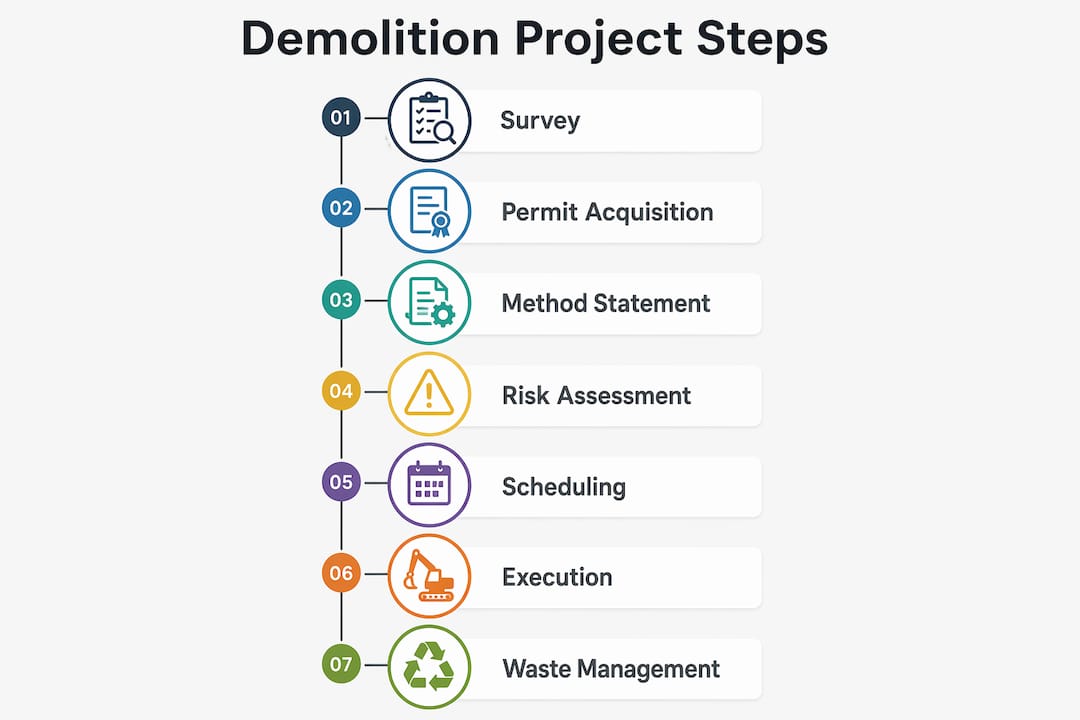
- What are the key steps in a demolition project?
- What does UK law require from demolition project managers?
- How do you choose the right demolition method?
- How does waste management reduce costs and support sustainability?
- What risks most commonly derail demolition projects?
- How does CPM scheduling improve demolition outcomes?
- What drives cost and timeline on demolition packages?
- What should a demolition survey cover?
- Demolition sequence in practice: the Gcscontractors approach
- Key takeaways
- What the industry gets wrong about demolition project management
- Gcscontractors: strip-out, demolition, and site preparation across Cambridge and East Anglia
- Useful UK sources and standards for demolition project managers
Why does project management matter so much in demolition?
Demolition project management is the structured planning, coordination, and control of all works from initial survey through to site handover. It is not simply supervising a wrecking crew. The project manager acts as a governance centre, accountable for technical delivery, regulatory compliance, and broader stakeholder commitments including ESG obligations.
On a UK demolition project, the stakeholders a project manager must actively coordinate include:
- Client or developer — sets objectives, budget, and programme constraints
- Principal designer — holds CDM 2015 pre-construction phase duties
- Principal contractor — responsible for the construction phase plan and site safety
- Demolition contractor — produces the DMS and RAMS, executes physical works
- Environmental consultants — advise on contamination, waste classification, and discharge consents
- Utility providers — must disconnect or protect live services before structural removal begins
- Local authority — issues prior approval for demolition, building control notifications, and any traffic management orders
- Neighbours and community representatives — require early notification, vibration and dust monitoring commitments, and a clear escalation contact
Core responsibilities tied to UK practice include securing all permits, producing and maintaining the DMS, preparing and reviewing RAMS for each phase, discharging waste duty-of-care obligations with auditable waste transfer notes, and keeping a complete project record for post-handover liability purposes. Regulatory compliance in construction is a continuous obligation throughout the project, not a box ticked at the start.
What are the key steps in a demolition project?
A well-managed demolition follows a defined sequence. Skipping or compressing steps is where cost and safety problems originate.
- Feasibility and pre-demolition survey — structural appraisal, asbestos and contaminant survey, services scan, and material quantification. Deliverables: survey reports, services drawings, hazardous-material register.
- Design and method selection — Demolition Method Statement drafted, temporary works designed, demolition method confirmed against site constraints. Deliverables: DMS, temporary works design, structural engineer sign-off.
- Permitting and notifications — prior approval from local authority, building control notification, utility disconnection or protection agreements, traffic management orders. Deliverables: approved permits, utility confirmation letters, TM orders.
- Soft strip — removal of fixtures, fittings, partitions, ceilings, and non-structural elements before any structural demolition. Deliverables: waste transfer notes for each material stream, photographic record.
- Hazardous-materials abatement — asbestos removal, lead paint treatment, and any other notifiable work carried out by licensed contractors. Site certified clean before structural works proceed. Deliverables: air clearance certificate, waste consignment notes, licensed contractor records.
- Temporary works and phased structural demolition — propping, shoring, and sequential removal of structural elements in the order specified by the DMS. Deliverables: temporary works inspection records, daily site diary, photographic progress log.
- Clearance and grading — removal of arisings, crushing of concrete on-site where viable, grading to formation level. Deliverables: waste transfer notes, recycling receipts, topographic survey.
- Handover — site handed over clean, with full documentation pack. Deliverables: closeout report, permit closures, final waste summary, as-built record.
PMI guidance consistently identifies early contractor engagement and frequent coordination meetings as critical to keeping this sequence on track and managing scope changes before they cascade.
Typical programme durations:
- Small urban project (single residential or small commercial): 2–6 weeks, with soft strip and abatement overlapping where the hazardous-material register is low-risk
- Medium project (multi-storey commercial or industrial unit): 8–16 weeks, with abatement on the critical path before structural removal
- Large urban project (multi-building or complex industrial site): 20–52 weeks, with phased handover of cleared areas to follow-on contractors
What does UK law require from demolition project managers?
Safety and legal compliance are not optional extras. They are the foundation on which every other project management decision rests. The key UK instruments are:
- CDM 2015 — requires appointment of a principal designer and principal contractor on notifiable projects, a construction phase plan, and a health and safety file at handover
- Control of Asbestos Regulations 2012 — mandates a Type 3 (destructive) asbestos survey before demolition, licensed removal for notifiable asbestos-containing materials, and air clearance certification
- BS 6187:2011 — the British Standard for demolition, setting out method selection, sequence planning, temporary works, and site safety requirements
- Waste duty of care — all waste producers must ensure waste is handled, transported, and disposed of legally, with a complete audit trail of waste transfer notes
- Environmental permitting — certain activities (crushing, burning, treating contaminated material) require an environmental permit or exemption registration
The required document set for a compliant UK demolition includes: Demolition Method Statement, RAMS for each phase, asbestos survey and abatement plan, waste management plan, permit-to-work system, temporary works design and inspection register, and CDM construction phase plan.
Practical demolition safety precautions must be embedded in the RAMS and reviewed at every phase change, not filed once and forgotten.

Pro Tip: Schedule asbestos and contaminant surveys as the very first item on the critical path. Permit lead times for licensed asbestos removal can run to several weeks. If abatement is treated as a side activity, heavy plant will sit idle waiting for site clearance certificates — a direct and avoidable cost.
How do you choose the right demolition method?
Match the method to the site objective first: speed, precision, minimal vibration, or maximum material recovery. No single method suits every project.
Mechanical demolition (high-reach excavator, hydraulic breaker, crusher)
- Best for: open sites, speed, large concrete and masonry structures
- Advantages: fast, cost-effective for bulk removal, on-site crushing reduces outbound haulage
- Constraints: vibration and dust require monitoring near sensitive receptors; access for large plant must be confirmed early; structural integrity must be assessed before high-reach plant is deployed
Selective deconstruction (manual strip, careful dismantling)
- Best for: material recovery, heritage structures, constrained urban sites
- Advantages: maximises reclaimed material value, lower vibration, better suited to phased handover
- Constraints: slower, more labour-intensive, requires detailed material quantification upfront
Robotic and remote demolition
- Best for: confined spaces, high-contamination environments, structures unsafe for operatives
- Advantages: reduces operative exposure to hazards, precise
- Constraints: higher plant cost, slower output per shift
Explosive or blast demolition
- Best for: large isolated structures (cooling towers, tall chimneys) where access is clear
- Advantages: very fast structural removal
- Constraints: extensive regulatory approvals, exclusion zones, specialist contractors only; rarely applicable in dense UK urban environments
Site-fit checklist before confirming method:
- Confirmed access routes and load-bearing capacity for plant
- Proximity to sensitive receptors (schools, hospitals, occupied buildings)
- Vibration and noise limits set by local authority or planning condition
- Segregation and recycling capacity on-site
- Temporary works requirements for adjacent structures
- Utility protection or disconnection status
How does waste management reduce costs and support sustainability?
Structured waste management directly reduces net disposal costs and supports client ESG commitments. Academic research positions demolition as a regenerative opportunity when managed for material recovery, treating the process as part of urban renewal rather than simple clearance.
Practical measures to capture that value:
- Conduct a pre-demolition material survey to quantify concrete, steel, timber, brickwork, and fit-out materials separately
- Appoint contractors with established recycling chains for concrete crushing, metal recovery, and timber processing
- Segregate waste streams at source during soft strip to avoid cross-contamination, which downgrades recyclable material to mixed waste
- Prepare waste transfer notes for each stream and maintain an auditable waste management log throughout the project
- Specify recycling and diversion targets in the contract and require contractors to report against them
The Institution of Civil Engineers identifies digital scheduling and waste management strategies as tools that maintain milestone control while improving material recovery rates.
Statistic: The UK construction and demolition sector generates more waste by weight than any other industry in the country. Structured source segregation and on-site crushing can materially reduce outbound haulage costs and landfill tax liability, while providing recycled aggregate for follow-on groundworks.
Pro Tip: Stage your segregation areas so each material stream has a dedicated skip or bay from day one of soft strip. Mixing streams at this stage is the single most common reason demolition waste ends up classified as mixed C&D waste, attracting higher disposal costs and failing ESG reporting requirements.
What risks most commonly derail demolition projects?
Prioritise the hazards that physically stop structural works: undiscovered asbestos or contamination, hidden live services, and temporary works failure. These three account for the majority of programme overruns on UK demolition projects.
| Hazard | Likely impact | Practical mitigation |
|---|---|---|
| Undiscovered asbestos or contamination | Work stoppage, licensed removal, programme delay of weeks | Type 3 destructive survey before works; contingency budget for additional abatement |
| Hidden live services (gas, electric, water) | Serious injury risk, utility outage, programme stop | Services scan and utility provider confirmation before any ground break or structural removal |
| Temporary works failure | Structural collapse, injury, programme loss | Temporary works design by a qualified engineer; daily inspection register; independent check |
| Adverse weather | Plant access, ground conditions, crane operations suspended | Seasonal programme allowances; weather monitoring; contingency float on weather-sensitive tasks |
| Equipment breakdown | Idle time, subcontractor delay | Plant maintenance schedules; named backup plant or hire agreements |
| Neighbour or community objection | Injunction risk, reputational damage, programme delay | Early notification, vibration and dust monitoring, named liaison contact, regular updates |
PMI guidance recommends establishing physical boundaries early and coordinating with utility providers for planned outages or protections as a baseline mitigation for neighbour and services risk.
Contingency planning checklist:
- Named escalation contacts for each risk category (utilities, environmental, structural)
- Contingency budget line agreed with client at tender stage (typically expressed as a percentage of contract value)
- Incident reporting procedure in place from day one, with clear thresholds for work suspension
- Neighbour liaison log maintained and shared with the client weekly
- Insurance cover confirmed for third-party property damage and environmental liability
For live-site demolitions, managing a live-site demolition process requires additional controls including phased exclusion zones and daily briefings with adjacent occupiers.
How does CPM scheduling improve demolition outcomes?

The Critical Path Method, treated as a living document rather than a fixed baseline, is the most effective scheduling tool for demolition. CPM guidance from Archdesk confirms that integrating hazardous-material surveys into the first step of the critical path reduces volatility in structural removal works and prevents costly idle time when plant arrives before prerequisites are complete.
In demolition, unlike new construction, every task removes structural stability. The sequence is not additive; it is subtractive. If a high-reach excavator is mobilised before soft strip and abatement are complete, the project pays for idle machinery and risks a compliance breach. The CPM baseline must therefore reflect the actual dependency chain: survey, then abatement, then soft strip, then structural removal, then clearance.
BIM and 4D scheduling link the programme to the physical model, giving the project manager and client a visual forecast of how the structure will reduce over time. Digital models and schedule-cost linkages raise forecast quality and transparency, making change propagation visible before it becomes a cost event. Drones used for weekly site assessment provide photographic evidence of progress against the programme and can identify access or safety issues before they cause delays. Telematics on plant equipment records utilisation rates, helping the project manager identify idle time and reallocate resources.
Pro Tip: Build permit lead times and hazardous-material survey durations into the CPM baseline from the outset. A licensed asbestos removal contractor may need two to four weeks’ notice. If that lead time sits outside the programme, the critical path is already broken before work starts.
What drives cost and timeline on demolition packages?
The largest cost drivers on a UK demolition project are hazardous-material handling, constrained access, disposal routes, and temporary works. Understanding these at tender stage is the difference between a realistic budget and a series of costly variations.
Key cost and timeline drivers:
- Hazardous materials — volume and type of asbestos-containing materials, lead paint, or contaminated ground directly sets abatement cost and programme duration; this is the single most variable line item
- Access constraints — restricted road access, low headroom, or proximity to live structures increases plant cost and reduces output per shift
- Disposal routes — distance to licensed disposal facilities and landfill tax rates affect haulage and tipping costs; on-site crushing reduces both where space permits
- Temporary works — propping and shoring adjacent structures adds cost and extends programme, but is non-negotiable where party walls or shared foundations are present
- Seasonal factors — ground conditions, crane wind limits, and traffic management windows all vary by season; winter programmes on constrained urban sites carry higher risk
- Licences and permits — traffic regulation orders, skip licences, scaffold licences, and environmental permits each carry lead times that must be built into the programme
Procurement notes for developers and construction managers:
- Structure the contract to incentivise recycling: specify minimum diversion targets and require contractors to provide audited waste transfer records at each stage
- Set clear change-order logic in the contract documents, with agreed rates for additional abatement, disposal, or temporary works so variations are priced fairly and quickly
- Require the contractor to submit a waste management plan and a CPM programme at tender stage; these documents reveal whether the contractor has genuinely priced the work or is relying on post-contract variations
- Ask critical questions of any demolition contractor before appointment, covering CDM duty-holder experience, asbestos licensing, waste management capability, and insurance cover
What should a demolition survey cover?
A demolition survey is the project’s foundation. Without it, every subsequent decision — method selection, programme, budget, temporary works design — rests on assumption rather than evidence.
Standard deliverables from a pre-demolition survey:
- Asbestos and contaminant report — Type 3 (destructive) survey identifying all asbestos-containing materials, their condition, and recommended abatement method; also covers lead paint, PCBs, and other notifiable substances
- Structural appraisal — identifies load-bearing elements, primary support columns, later structural modifications, and any evidence of structural distress or undocumented alterations
- Services scan — locates and maps all live services (gas, electricity, water, telecoms, drainage) within and immediately adjacent to the structure
- Material quantification — estimates volumes and weights of concrete, steel, masonry, timber, and fit-out materials to inform waste logistics and recycling planning
Survey outputs feed directly into the CPM (abatement duration and permit lead times), temporary works design (load paths and propping requirements), and waste logistics (skip sizing, recycling chain selection, and disposal cost estimates).
Red flags that should trigger deeper investigation:
- Evidence of undocumented services (unexplained pipework, conduit, or ductwork not shown on existing drawings)
- Structural anomalies such as cracked or displaced load-bearing elements, evidence of previous fire damage, or undocumented reinforcement
- High contamination potential in former industrial, laboratory, or healthcare buildings where hazardous substances may have been stored or used
- Restricted access that prevents a complete survey, leaving areas uninspected and therefore unpriced
Building regulations in England interact with demolition activities at several points, and the survey should confirm which notifications and approvals are required before works commence.
Demolition sequence in practice: the Gcscontractors approach
The single project-management decision that keeps a demolition sequence on track is staging abatement before plant mobilisation. Every other efficiency gain depends on that one sequencing call.
Gcscontractors follows a structured on-site sequence on every project:
- Pre-start checks — CDM appointments confirmed, construction phase plan issued, all permits in hand, site set up with exclusion zones and welfare facilities
- Services isolation — utility disconnections confirmed in writing before any physical work begins
- Soft strip — fixtures, fittings, partitions, and ceilings removed and segregated by material stream; waste transfer notes raised for each load
- Hazardous-materials abatement — licensed asbestos removal completed, air clearance certificate obtained, site certified clean before structural plant is mobilised
- Temporary works installation — propping and shoring installed and inspected by the temporary works supervisor before adjacent structural elements are removed
- Phased structural demolition — sequential removal in the order specified by the DMS, with daily site diary entries and photographic records
- Clearance and recycling — arisings removed, concrete crushed on-site where viable, site graded to formation level
- Handover — full documentation pack issued including all waste transfer notes, recycling receipts, permit closures, and CDM health and safety file
PMI’s coordination guidance recommends sharing daily status reports with site managers to keep stakeholders aligned and react to scope changes before they affect the programme.
On-site project manager checklist (daily):
- Morning briefing with all trades: confirm day’s sequence, permit status, and any changes to the DMS
- Permit-to-work verification: check all active permits are current and signed off
- Waste segregation spot check: confirm each material stream is going to the correct skip or bay
- Temporary works inspection: visual check of all props and shoring; log in the inspection register
- Neighbour liaison log: record any complaints, queries, or observations from adjacent occupiers
- End-of-day review: confirm progress against CPM, note any deviations, and update the programme
Example KPIs for a medium-sized commercial demolition:
- Equipment utilisation rate (target: above 80% of available shift hours)
- Cubic metres cleared per shift (benchmarked against the programme)
- Inspection frequency (temporary works: daily; waste segregation: every load)
- Abatement phase completion against CPM milestone
The demolition sequence breakdown guide from Gcscontractors provides a detailed reference for project managers running live-site works.
Key takeaways
Effective demolition project management in the UK requires hazardous-material abatement on the critical path, a named project manager with CDM responsibilities, and auditable waste documentation from survey to handover.
| Point | Details |
|---|---|
| Abatement on the critical path | Schedule asbestos surveys and licensed removal before structural plant mobilises to prevent costly idle time. |
| CDM 2015 compliance from day one | Appoint principal designer and principal contractor before any pre-construction work begins. |
| CPM as a living document | Treat the programme as a real-time tool, updating it as site conditions change to protect hard milestones. |
| Waste management reduces cost | Source segregation and on-site crushing lower landfill tax liability and support ESG reporting. |
| Gcscontractors for delivery | Gcscontractors provides strip-out, demolition, and site-preparation project management across Cambridge and East Anglia. |
What the industry gets wrong about demolition project management
The conventional wisdom treats demolition as the straightforward end of a building’s life: knock it down, clear the site, move on. That framing is where most project failures begin.
The projects that run over budget and over programme are almost never the ones where something catastrophic happened. They are the ones where the project manager treated abatement as a parallel activity rather than a prerequisite, or where the CPM was built once at tender and never updated, or where the waste management plan was a document produced for the client rather than a tool the site team actually used.
There is a deeper issue too. Demolition project management is increasingly a governance function, not just a site supervision role. The project manager must hold the CDM duty-holder chain together, maintain the ESG audit trail, and manage community relations simultaneously. Developers who appoint a project manager late, or who treat the role as interchangeable with a general site manager, consistently pay for that decision in variations and delays.
The other underestimated factor is the survey. A Type 3 destructive asbestos survey costs a fraction of what a programme delay costs. Yet it is still the item most commonly value-engineered at tender stage. The forensic quality of the pre-demolition survey sets the ceiling on everything that follows: the accuracy of the programme, the reliability of the budget, and the safety of the site team.
Gcscontractors’ experience on live sites in Cambridge and East Anglia confirms that the projects which complete on time and within budget share one characteristic: the project manager was appointed before the survey was commissioned, not after.
Gcscontractors: strip-out, demolition, and site preparation across Cambridge and East Anglia
Gcscontractors delivers strip-out and demolition project management for developers, building contractors, and property owners across Cambridge and East Anglia. Where other contractors separate demolition from what comes next, Gcscontractors provides a continuous service from strip-out and site preparation through to groundworks, foundations, and drainage, with a named project manager accountable for the full sequence.

Services directly relevant to this article include: soft strip and fixture removal, hazardous-materials abatement coordination, temporary works management, waste segregation and recycling logistics, site clearance and grading, and follow-on groundworks and civil engineering. Every project is delivered with full CDM documentation, auditable waste transfer records, and compliance with CDM 2015, the Control of Asbestos Regulations, and BS 6187.
Gcscontractors holds Constructionline and SafeContractor accreditations, providing developers and principal contractors with the verified compliance evidence they need before appointment. To discuss your demolition or site setup and enabling works requirements, contact Gcscontractors directly for a project-specific conversation.
Useful UK sources and standards for demolition project managers
Every project manager working on UK demolition should have these documents to hand:
- CDM 2015 (Construction (Design and Management) Regulations 2015) — the primary duty-holder framework for all notifiable construction and demolition projects; use it to confirm appointments, construction phase plan requirements, and health and safety file obligations
- Control of Asbestos Regulations 2012 — sets out survey requirements, licensing conditions for notifiable asbestos work, and air clearance certification; consult before commissioning any survey or abatement works
- BS 6187:2011 (Code of Practice for Full and Partial Demolition) — the British Standard covering method selection, sequence planning, temporary works, and site safety; use as the technical baseline for the Demolition Method Statement
- Institution of Civil Engineers (ICE) — publishes guidance on demolition practice, stakeholder coordination, and digital tools for project management; useful for CPM and waste management benchmarks
- PMI — precision planning for demolition projects — practical guidance on stakeholder coordination, daily status reporting, and change control; use to structure coordination meetings and scope-change protocols
- MDPI — demolition practices, procedures and management — academic research on circular-economy approaches to demolition; use to justify material recovery targets and selective deconstruction methods in client-facing documentation
- Compliance tips for demolition — Gcscontractors’ practical guide to the UK regulatory landscape for demolition contractors; useful as a working checklist alongside the statutory instruments above