Temporary support in demolition: a project manager’s guide
Temporary support in demolition is defined as an engineered system of structures installed to stabilise a building and manage structural loads while elements are progressively removed. The industry term for this discipline is “temporary works,” and it covers shoring, propping, falsework, and support scaffolds that transfer imposed loads safely throughout the demolition sequence. Under HSE guidance, these systems must be designed, installed, and maintained to withstand foreseeable loads. Getting this wrong does not just delay a project. It can cause progressive collapse, regulatory enforcement, and serious harm to workers and the public.
What are the common types of temporary support systems used in demolition?
Temporary works cover a broad scope of structural stability solutions, and selecting the right system depends entirely on the loads, geometry, and sequence of your specific project. The four systems you will encounter most often on UK demolition sites are shoring, propping, falsework, and support scaffolding.
Shoring is used to stabilise excavations and adjacent structures when ground is exposed or undermined during demolition. Raking shores and flying shores are common in terrace or semi-detached demolition where a neighbouring structure must remain stable.
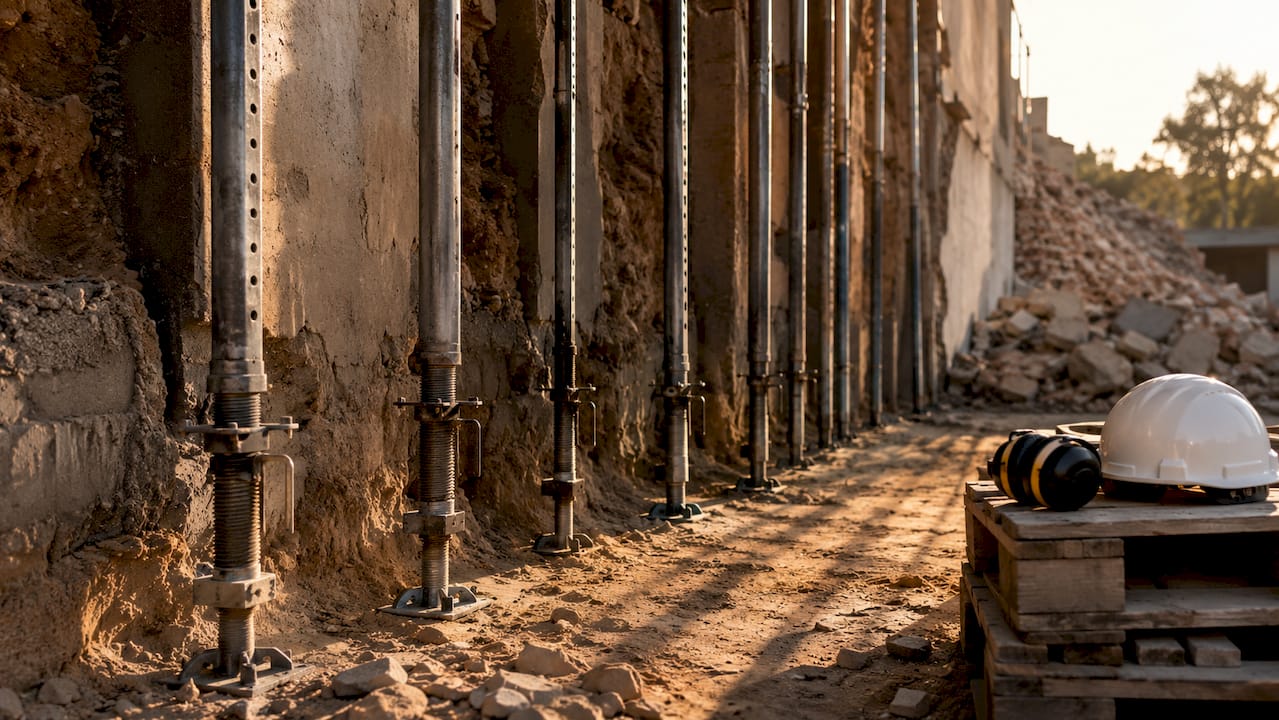
Propping supports walls and floors that lose their structural connection as elements are stripped out. Hydraulic props and acrow props are the standard tools here, and they must be sized and positioned according to a calculated design, not guesswork.
Falsework supports beams, lintels, or concrete slabs that would otherwise be unsupported during partial demolition. It is particularly relevant when retaining a façade or a structural frame while the interior is cleared.
Support scaffolds provide temporary load-bearing structures that transfer imposed loads safely during demolition. Specialist systems can incorporate low-vibration demolition methods, including concrete pulverisers, which reduce impact on the remaining structure and on adjacent supports.
| System | Primary Use | Typical Scenario | Key Limitation |
|---|---|---|---|
| Shoring | Stabilise excavations and adjacent walls | Terrace demolition, basement works | Requires ground investigation data |
| Propping | Support walls and floors mid-demolition | Strip-out of load-bearing partitions | Load capacity is prop-specific |
| Falsework | Carry beams, lintels, slabs temporarily | Façade retention, partial demolition | Must be designed for exact load |
| Support scaffold | Transfer imposed loads across a structure | Large-span or multi-storey demolition | Complex design and installation |
- Choose shoring when ground movement or adjacent structure stability is the primary risk.
- Choose propping when individual walls or floor plates lose their lateral or vertical support.
- Choose falsework when a beam or slab must remain in place while its supports are removed.
- Choose support scaffolding for large-scale load transfer across multiple levels.
Pro Tip: Never assume an off-the-shelf prop or shore is adequate without professional design input. Temporary works equipment must be selected following manufacturers’ instructions and designed for site-specific load and interface conditions. Components are not universally interchangeable.
How are temporary support systems designed and regulated?
The HSE is unambiguous on this point. Temporary support systems must be designed, installed, and maintained to withstand foreseeable loads, and for anything beyond simple applications, independent design checks are required. This is not optional. It is a legal obligation under the Construction (Design and Management) Regulations 2015.
The British Standard BS 5975 is the primary code of practice governing temporary works procedures in the UK. It sets out the management framework, design requirements, and inspection protocols that your project must follow. Compliance with BS 5975 is the clearest way to demonstrate that your temporary works are managed to a recognised standard.
The design process for demolition shoring systems follows a clear sequence:
- Structural assessment. A structural engineer reviews the existing building, identifies load paths, and determines what support is needed at each stage of demolition.
- Design calculations. Calculations are produced for each temporary works element, specifying load capacity, geometry, and connection details.
- Independent check. For complex or high-risk schemes, a second competent engineer checks the calculations independently before installation begins.
- Method statement. A written method statement documents the installation sequence, load limits, and inspection requirements for each system.
- Approval to load. A formal permit-to-load or permit-to-proceed is issued before any temporary works are loaded or relied upon.
The Temporary Works Coordinator (TWC) sits at the centre of this process. The TWC must be formally appointed with the authority to stop work if temporary works are not satisfactory. The TWC also advises on build sequence to prevent compromising structural stability. On larger projects, this role is distinct from the site manager and must be filled by a competent, experienced professional.
Pro Tip: The most common design pitfall is failing to account for load redistribution as demolition progresses. Your structural engineer must model each phase of the sequence, not just the final state. A design that is safe at the start of demolition can become unsafe three days later if the sequence deviates.
What are the key risks and pitfalls in demolition temporary works?
Progressive collapse is the primary risk in demolition temporary works. A 2026 Building Engineer case study illustrates this precisely: demolition progressed from a weakened state to premature collapse because temporary bracing proposed in the design was not clearly installed or verified on site. The diaphragm action of the floor was lost, and the structure became critically unstable. That sequence of events is not unusual. It is a pattern that repeats when verification is treated as an administrative task rather than a structural control.
The risks you need to manage actively on any demolition project include:
- Unverified installation. Temporary bracing or propping that appears on a drawing but is never confirmed as installed to the correct specification.
- Sequence deviation. Works proceeding out of order, removing a structural element before its temporary replacement is in place.
- Load path changes. As demolition progresses, evolving load paths require exact sequence management. A wall removed on day four may transfer load to a prop that was only designed for day-two conditions.
- Interference by other trades. Other site activities can damage or displace temporary works without the demolition team being aware.
- Inadequate inspection. A single inspection at installation is not sufficient. Inspection workflows must cover installation, operational use, and evolving site conditions throughout the demolition programme.
“Build sequence and verification are often the highest risk points. If temporary stability is proposed but not installed or verified, collapse risk escalates dramatically.” — Building Engineer, 2026
The practical response to these risks is a phased support strategy. Each phase of demolition must have its own temporary works state defined, checked, and signed off before the next phase begins. The TWC holds the authority to halt works if any phase deviates from the approved design. For project managers, the key discipline is refusing to allow programme pressure to override the verification process. A one-day delay to confirm a prop is correctly installed is always preferable to the alternative.
For further context on demolition site safety and the regulatory framework that governs it, the Gcscontractors hazard guide for safety officers provides a practical reference.
How to coordinate temporary support in live demolition projects
Coordination is where temporary works planning either holds together or falls apart. On a live site, you are managing the interaction between the demolition sequence, the temporary works installation, inspections, and the activities of other trades simultaneously. The project manager’s role is to create a system where each of these activities is sequenced, documented, and verified without gaps.
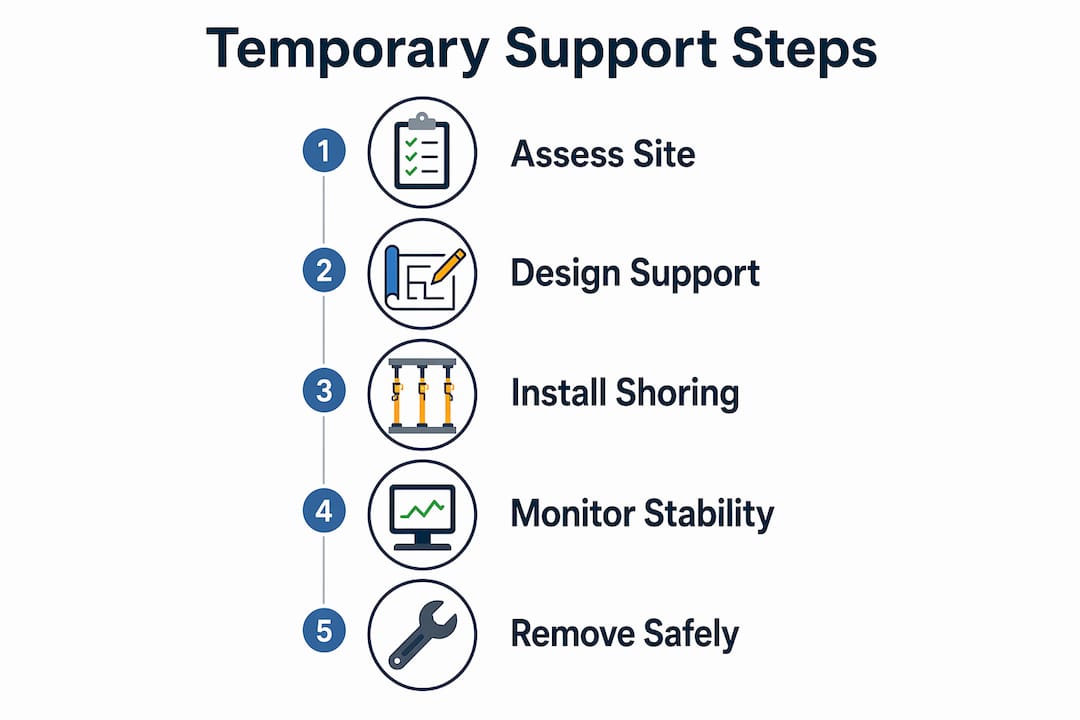
The implementation sequence for temporary structural support on a live demolition project runs as follows:
- Design acceptance. Confirm that the temporary works design has been reviewed, independently checked where required, and formally accepted by the TWC.
- Pre-installation briefing. Brief the installation team on the design drawings, load limits, and the specific sequence of installation. Do not assume the drawings are self-explanatory.
- Supervised installation. A competent person supervises the installation of each temporary works element and confirms it matches the design specification.
- Inspection and sign-off. The TWC or a delegated competent inspector formally checks the installed works and issues a permit-to-proceed before demolition loads are applied.
- Ongoing monitoring. Inspections continue at defined intervals and after any event that could affect stability, including adjacent demolition activity, heavy rainfall, or vibration from plant.
- Controlled removal. Temporary works are removed only when the permanent structure or the demolition sequence no longer requires them, and only with TWC approval.
Documentation is not optional at any of these stages. Every inspection, permit, and deviation from design must be recorded. This protects your project legally and provides the evidence trail that HSE expects to see if an incident occurs.
Pro Tip: The most effective communication tool between the structural engineer, TWC, and site team is a simple temporary works register. List every element, its design reference, installation date, inspection dates, and removal date. Update it daily. It takes ten minutes and removes the ambiguity that causes incidents.
For a detailed walkthrough of managing these responsibilities on an active site, the Gcscontractors live site demolition guide covers the full process from planning through to completion.
Key takeaways
Effective temporary support in demolition requires engineered design, formal management, and verified installation at every phase of the sequence.
| Point | Details |
|---|---|
| Define the system correctly | Temporary works include shoring, propping, falsework, and support scaffolds, each designed for specific load conditions. |
| Follow BS 5975 and HSE requirements | Design, independent checks, and formal inspection are legal obligations, not optional best practice. |
| Appoint a TWC with real authority | The Temporary Works Coordinator must have the power to stop work and must be formally appointed before demolition begins. |
| Verify installation at every phase | Unverified temporary bracing is a direct cause of premature collapse; confirmation must be documented before each phase proceeds. |
| Manage load paths continuously | As demolition progresses, load paths change and temporary works must be reviewed and updated to match each new structural state. |
Why temporary works discipline is the difference between a safe project and a serious incident
I have seen temporary works treated as a box-ticking exercise on too many demolition projects. A prop gets placed roughly where the drawing shows it, nobody checks the base plate condition, and the site moves on. That approach works until it does not.
The technical reality of demolition is that you are deliberately creating a series of intermediate structural states, each of which is weaker than the last. Every element you remove changes the load path for everything that remains. The temporary works are not a backup plan. They are the structural system for that phase of the project. Treating them with any less rigour than you would apply to a permanent structure is a mistake.
The 2026 Building Engineer case study on premature collapse is worth reading in full if you have not already. What strikes me about it is not that the design was wrong. The design included the necessary bracing. The failure was in the gap between what was designed and what was verified on site. That gap is a management failure, and it is entirely preventable.
My advice to project managers is to engage your structural engineer and TWC before the demolition method statement is written, not after. The sequence of temporary works installation and the sequence of demolition are inseparable. If your TWC is reviewing drawings after the programme is fixed, you have already created risk. Get them in the room at the planning stage, and give them the authority the HSE requires them to have.
The pre-demolition survey is the right starting point. It tells you what you are dealing with structurally before any design work begins.
— George
Work with specialists who understand temporary works in demolition
Gcscontractors brings direct experience in strip-out and demolition across live environments, with a compliance-first approach to health, safety, and local building regulations.

Whether you are planning a phased demolition in a live commercial building or managing a complex structural strip-out, Gcscontractors can support you from pre-demolition survey through to completion. The team understands the load path management, sequencing, and documentation that HSE expects. Start with the live site demolition process guide to understand how a compliant demolition programme is structured, or review the site preparation steps to confirm your project is set up correctly from day one. Contact Gcscontractors to discuss your project requirements.
FAQ
What is temporary support in demolition?
Temporary support in demolition refers to engineered systems such as shoring, propping, and falsework that stabilise a structure and manage loads during the demolition sequence. These systems are removed once the relevant phase is complete or the permanent structure no longer requires them.
What does a temporary works coordinator do on a demolition site?
The Temporary Works Coordinator is formally appointed to manage all temporary works on site, with the authority to stop work if systems are not installed or maintained correctly. The TWC also advises on demolition sequence to prevent compromising structural stability at any phase.
Which regulations govern demolition shoring systems in the UK?
HSE requirements under the Construction (Design and Management) Regulations 2015 apply, and BS 5975 is the primary code of practice for temporary works procedures. Both set out design, inspection, and management obligations that project managers must meet.
How often should temporary works be inspected during demolition?
Inspection is an ongoing requirement, not a single event at installation. Competent person inspections must cover installation, operational use, and any changes in site conditions, including activity by other trades that could affect support stability.
What causes premature collapse during demolition?
Premature collapse most commonly results from temporary bracing that is designed but not verified as correctly installed on site, or from demolition proceeding out of sequence before the required temporary support is in place. Both failures are management issues, not design failures.