Structural integrity in demolition: the 2026 guide
Structural integrity in demolition is defined as the capacity of a structure to remain stable and safe at every stage of the dismantling process, preventing unplanned collapse and protecting workers, adjacent buildings, and the public. The industry term for this discipline is structural stability management, and it sits at the heart of every compliant demolition project. Standards including OSHA 29 CFR 1926.850(a), BS 6187:2011, and the ASSP ANSI/ASSP A10 series set the legal and technical baseline. Engineering surveys and method statements are not optional extras. They are the primary tools that keep a structure predictable when it is being taken apart.
What engineering surveys are required before demolition to assess structural integrity?
A competent person must conduct a formal engineering survey before any demolition work begins, covering framing, floor load capacity, and wall stability, with written evidence required for every project. This requirement under OSHA 29 CFR 1926.850(a) exists because structures rarely behave exactly as their original drawings suggest. Decades of alteration, loading, and environmental exposure change how a building carries weight.
The survey must address several critical areas:
- Structural framing: Identify load paths, primary and secondary members, and any modifications made since original construction.
- Floor load capacity: Confirm whether floors can support plant, debris, and personnel during the demolition sequence.
- Wall stability: Assess which walls are load bearing and which can be removed without triggering progressive movement.
- Hazardous materials: Record the location of asbestos, lead, and other substances that affect how and in what order work proceeds.
- Adjacent structures: Evaluate the impact on structural stability of neighbouring buildings, shared walls, and underground services.
A common failure in practice is treating the survey as a one-time document completed before mobilisation. Engineering surveys should be dynamic documents, updated continuously as demolition exposes hidden structural elements. A wall that appears non-load bearing on a drawing may conceal a steel transfer beam installed during a previous refurbishment. Without reassessment at each stage, that discovery becomes a crisis rather than a managed finding.
Pro Tip: Commission a pre-demolition survey that includes explicit decision points for reassessment. Your pre-demolition survey guide should specify who has authority to halt work when conditions differ from the baseline assessment.

The check-box compliance culture is the single biggest threat to survey quality. A survey that lists structural elements without providing engineering judgement on their interaction is not a compliant document. Project managers must insist on written conclusions, not just inventories.
Which demolition methods best preserve structural stability and ensure safety?
Top-down demolition is the standard approach for maintaining structural stability during dismantling. Working from the highest floor downward keeps the remaining structure in its most stable configuration at every stage. Removing lower supports before upper loads are resolved is the primary cause of progressive collapse on demolition sites.
Progressive collapse is the primary structural risk during demolition, requiring explicit sequencing, propping, and exclusion zones in method statements to prevent chain-reaction failures. A single premature removal of a column or beam can transfer load to members not designed to carry it, triggering a sequence of failures that spreads far beyond the initial removal point. This is not a theoretical risk. It is the mechanism behind the majority of serious demolition incidents.
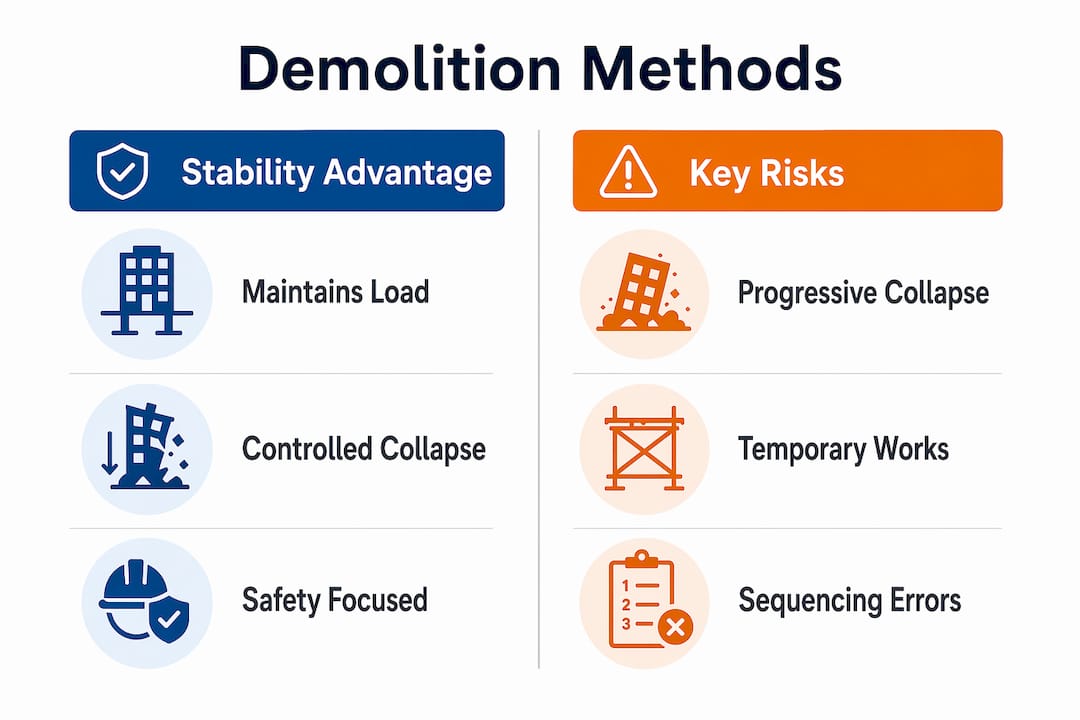
| Method | Stability advantage | Key risk to manage |
|---|---|---|
| Top-down sequential | Maintains load path integrity at each stage | Requires strict floor-by-floor sequencing |
| Selective strip-out | Preserves structure while removing non-structural elements | Misidentification of load-bearing components |
| Mechanical demolition | Controlled removal using plant | Overreach and unplanned impact loading |
| Controlled implosion | Simultaneous removal minimises progressive risk | Requires extensive pre-weakening and exclusion zones |
Temporary works are not supplementary. Propping, shoring, and bracing are engineering interventions that substitute for the structural capacity being removed. The demolition sequence breakdown must specify where temporary supports are installed, the load they are designed to carry, and the point at which they can be safely removed.
Pro Tip: Method statements must include engineering rationale proving stability at every intermediate stage of removal, not just a list of techniques. A statement that describes what will happen without explaining why it is safe does not meet BS 6187:2011 requirements.
Choosing demolition methods driven by commercial pressures before survey completion causes many structural failures. The survey findings must dictate method choice. When a contractor selects a method because it suits available plant or programme timescales, and then attempts to fit the survey around that decision, the result is an unsafe method statement that cannot demonstrate stability at each stage.
How are demolition safety standards and regulations evolving to protect structural integrity?
ASSP updated ANSI/ASSP A10 standards including A10.26 in 2026, enhancing emergency preparedness and pre-planning for structural collapses and hazardous spills on demolition sites. This update reflects a shift in regulatory thinking: compliance is no longer satisfied by having a plan in place. The plan must now demonstrate that it addresses specific collapse scenarios and defines the response protocol for each.
The key regulatory developments affecting demolition practice in 2026 include:
- ANSI/ASSP A10.26 (2026): Requires explicit emergency action plans covering structural collapse, with defined evacuation routes and communication protocols.
- OSHA 29 CFR 1926.850(a): Continues to mandate written engineering surveys before demolition, with enforcement focus on the competence of the person conducting the assessment.
- CDM 2015 Regulation 20(2): Requires the principal contractor to manage and monitor site conditions throughout the project, including structural stability checks at each phase.
- BS 6187:2011: Specifies that method statements must contain engineering rationale, not procedural descriptions alone.
CDM 2015 Regulation 20(2) places a specific duty on the principal contractor to maintain ongoing supervision by a competent person throughout demolition. This is not satisfied by an initial survey and a site manager with general construction experience. The competent person must have specific demolition engineering knowledge and the authority to halt work when conditions change. For project managers, demolition compliance guidance is an area where the gap between paper compliance and genuine safety is most visible.
The 2026 updates also increase scrutiny of inspection protocols during demolition. Inspections must be recorded, dated, and linked to the current phase of work. A generic weekly inspection record does not satisfy the requirement for phase-specific structural assessment.
What are best practices for project managers to maintain structural integrity throughout demolition?
Effective management of structural stability during demolition requires dynamic reassessment, not a static plan executed without revision. Conditions change as work progresses. Hidden voids, undocumented alterations, and unexpected material conditions are routine findings on any significant demolition project. The management system must accommodate these discoveries without halting the programme unnecessarily.
The following numbered sequence reflects the order in which project managers should apply these practices:
- Establish a baseline structural assessment. Commission a full engineering survey before mobilisation. Confirm that the competent person has specific demolition engineering credentials, not just general structural experience.
- Define reassessment trigger points. Specify in the method statement the conditions that require a formal reassessment. These include exposure of undocumented structural elements, deviation from the planned sequence, and any unplanned movement or cracking.
- Grant halt authority to the competent person. The engineer or structural specialist must have documented authority to stop work without requiring management approval. Commercial pressure must not override structural judgement.
- Manage floor openings actively. Safe demolition mandates that floor openings for material disposal must not exceed 25% of floor area. Exceeding this threshold changes the load distribution across the remaining floor structure in ways that the original survey may not have assessed.
- Coordinate hazardous material removal with structural sequencing. Asbestos removal, for example, often requires access to areas that are structurally sensitive. The sequence for hazardous material works must be integrated with the structural demolition sequence, not planned in isolation.
- Use structural performance analysis for complex projects. A structured decision-making process integrates engineering performance assessments, economic evaluations, and project-specific planning, leading to safer controlled demolitions. High-fidelity modelling is now accessible and should be used on any project where the structural behaviour is not straightforward.
Pro Tip: Treat the method statement as a live document. Update it formally when conditions change, and ensure that every revision is communicated to all operatives on site. A method statement that exists only in the site office provides no protection to the worker making decisions at the face.
Demolition safety failures often result from treating safety as isolated checkboxes rather than a systemic process of genuine engineering investigation and responsive planning. Project managers who build reassessment into the programme rhythm, rather than treating it as an interruption, consistently deliver safer and more efficient projects.
Key takeaways
Maintaining structural integrity in demolition requires engineering surveys, method statements with written rationale, and continuous reassessment at every phase of the project.
| Point | Details |
|---|---|
| Engineering surveys are mandatory | A competent person must produce written evidence covering framing, floor load capacity, and wall stability before work begins. |
| Surveys must be dynamic | Update the survey continuously as demolition exposes hidden structural elements to prevent hazardous surprises. |
| Method statements need engineering rationale | Listing techniques is not enough; every phase must demonstrate structural stability with written engineering justification. |
| Top-down sequencing controls collapse risk | Working from the highest floor downward keeps load paths intact and reduces the risk of progressive failure. |
| Regulatory standards tightened in 2026 | ANSI/ASSP A10.26 and CDM 2015 Regulation 20(2) now require phase-specific inspections and documented emergency collapse protocols. |
What the industry keeps getting wrong about demolition surveys
The most persistent problem I see on demolition projects is not a lack of surveys. It is a lack of honest surveys. Teams commission the document, file it, and then proceed with a method that was decided before the surveyor arrived on site. The survey becomes a retrospective justification rather than a genuine investigation.
The second failure is sequencing driven by plant availability. If the only machine on site is a long-reach excavator, there is a temptation to use it everywhere, regardless of whether the structural sequence supports that approach. Method statements should prioritise engineering-driven sequencing over commercial and equipment pressures to avoid instability and safety hazards. I have seen projects where this shortcut cost far more in remedial temporary works than the original plant hire saving.
Viewing demolition as an aspect of urban renewal supported by advanced modelling increases safety and aligns demolition with sustainable development goals. That framing matters practically. When a project team sees demolition as a precision engineering exercise rather than a clearance operation, they invest in the survey quality, the method statement rigour, and the temporary works design that make the difference between a controlled project and an incident. The site safety precautions that protect workers are not separate from programme efficiency. They are the same thing.
— George
How Gcscontractors supports structural integrity on demolition projects
Gcscontractors brings direct experience in strip-out and demolition to projects where structural stability management is non-negotiable. From method statement preparation aligned with BS 6187:2011 and the 2026 ANSI/ASSP A10 updates, to competent person supervision throughout the demolition sequence, the team works within live environments where precision and compliance are equally critical.

For project managers planning a demolition or strip-out programme, the strip-out and demolition guide covers the full scope of safe site preparation, from initial survey through to final clearance. Gcscontractors operates across Cambridge and the wider East of England, delivering demolition and strip-out services that meet current health, safety, and local building regulation requirements. Contact the team to discuss your project requirements.
FAQ
What is structural integrity in demolition?
Structural integrity in demolition is the capacity of a structure to remain stable and safe at every stage of dismantling. It is maintained through engineering surveys, correct sequencing, and temporary support systems.
What must an engineering survey include before demolition?
Under OSHA 29 CFR 1926.850(a), the survey must cover structural framing, floor load capacity, and wall stability, with written evidence produced by a competent person before work begins.
What is progressive collapse and how is it prevented?
Progressive collapse is a chain-reaction structural failure triggered by the premature removal of a load-bearing member. It is prevented through explicit top-down sequencing, propping, and defined exclusion zones in the method statement.
How do 2026 demolition safety standards affect project planning?
The 2026 ANSI/ASSP A10.26 update requires emergency action plans covering structural collapse scenarios, with defined evacuation routes and communication protocols integrated into pre-demolition planning.
How often should structural assessments be updated during demolition?
Structural assessments should be updated continuously as demolition exposes hidden elements, and formally revised whenever conditions deviate from the baseline survey findings or the planned sequence changes.