Site mobilisation process: a guide for project managers
The site mobilisation process is the contractor’s structured sequence of actions taken after contract award to make a site safe, compliant, and operational before physical works begin. Under Building Regulations 2010 and CDM Regulations 2015, that sequence carries statutory weight, not just programme logic. The single most important first action is confirming lawful site possession and obtaining a signed site possession certificate before any operatives or plant arrive on site.
The core mobilisation components are:
- Statutory permits and building control approvals
- Temporary works design and installation (fencing, hoardings, access roads)
- Welfare facilities and site offices
- Temporary utilities (power, water, drainage, communications)
- Site security and access control
- Stakeholder and subcontractor communications
TL;DR: Confirm site possession in writing, extract every mobilisation obligation from the contract preliminaries, and have welfare, fencing, and temporary power operational before the first operative steps on site.
Table of Contents
- What does the site mobilisation process actually cover?
- Your itemised mobilisation plan: a UK checklist
- Who is responsible for what during mobilisation?
- How long does mobilisation take, and what does it cost?
- UK safety, welfare and compliance at mobilisation
- What documents close out the mobilisation phase?
- First 30 days: a mobilisation template you can use now
- Key takeaways
- What experienced site managers know that checklists do not say
- Gcscontractors: mobilisation and site setup in Cambridge and East Anglia
- Authoritative UK sources and further reading
What does the site mobilisation process actually cover?
Mobilisation sits between contract award and the first productive construction activity. It covers every action needed to make the site legally possessed, physically secure, and operationally ready. What it does not cover is equally worth stating: permanent works design changes, long-lead procurement of structural materials, and construction-phase production activities all fall outside mobilisation scope.
In contractual terms, mobilisation obligations are usually embedded in the preliminaries, employer’s requirements, and particular specifications. Those documents define the contractor’s setup obligations, the timeline for delivering welfare and access, and the acceptance criteria the employer or engineer will inspect before issuing a works-commencement notice. Missing a buried obligation in the preliminaries is one of the most common and costly mobilisation errors.
“A good mobilisation plan begins with a contract review, compliance sweep and structured reconnaissance visit before a single line of the site plan is drawn.” — Quollnet construction mobilisation guidance
Planning should begin at the tender stage. Pricing logistics, perimeter security, and compliance costs before contract award produces more accurate bids and faster delivery once the contract is signed. Contractors who treat mobilisation as a post-award afterthought typically spend the first two weeks firefighting rather than progressing.
Pro Tip: Read the preliminaries and particular specifications line by line before drafting your mobilisation programme. Obligations buried in those sections, such as specific fencing standards, welfare ratios, or traffic management requirements, will not appear in the main works schedule but will be inspected and enforced.
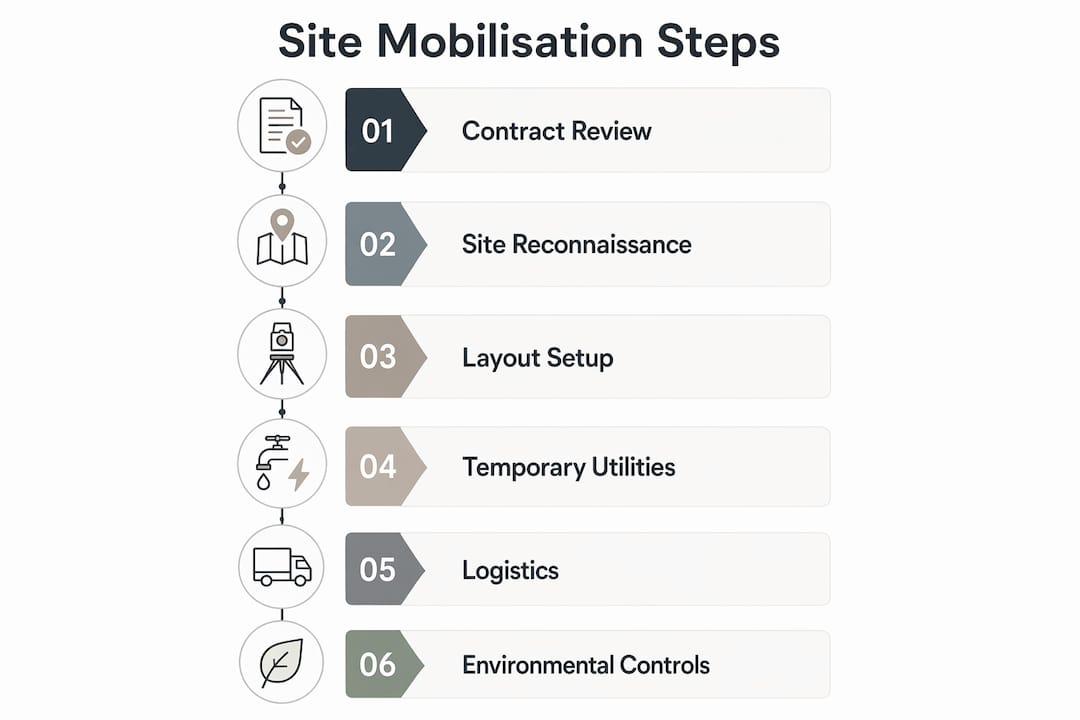
Your itemised mobilisation plan: a UK checklist
A construction mobilisation plan must translate contract obligations, site constraints, and authority requirements into a working startup plan. The structure below gives you the core categories to populate.
Step 1: Contract and compliance review
Start by extracting every mobilisation obligation from the contract documents. Check the preliminaries, employer’s requirements, CDM pre-construction information pack, and any planning conditions attached to the consent. Confirm which approvals must be in place before works commence under Building Regulations 2010.
Step 2: Site reconnaissance
Visit the site before drafting the plan. Record overhead and underground services, access road widths and load ratings, neighbour interfaces, existing drainage outfalls, and any ecology or contamination constraints. A GNSS or total station boundary survey at this stage prevents disputes later.

Step 3: Site layout and temporary facilities
Establish the site compound layout, including:
- Hoardings and security fencing (minimum 2.4 m high panels, post centres no greater than 3.0 m, under-fence gaps below 50 mm)
- Pedestrian and vehicle gates with separate routes
- Welfare block (toilets, washing facilities, rest area, drying room)
- Site office and document control station
- Secure storage for plant, materials, and hazardous substances
- Crane and plant hard-standing locations
- Laydown and materials storage areas
Hoarding and fencing standards are not discretionary. The specification in the contract preliminaries will typically reference a minimum height and panel type; confirm this before ordering.
Step 4: Temporary utilities
Commission temporary power, water supply, drainage, and communications before the first operative arrives. Welfare facilities must be operational from day one. Stable internet connectivity should be treated as a mobilisation priority where contract administration is managed digitally.
Step 5: Logistics and deliveries
Agree a delivery booking system, designate a loading bay with at least one pedestrian-only exit, and produce a laydown plan that sequences materials arrivals to avoid congestion. Separate pedestrian and vehicle routes from the outset; traffic segregation is a day-one requirement, not a later refinement.

Step 6: Environmental controls
Install wheel-wash facilities, silt fencing or bunding where required, and designate waste storage areas with segregation for hazardous and non-hazardous streams. Confirm the site drainage plan so surface water does not discharge untreated.
Mobilisation acceptance criteria: reference thresholds
| Item | Minimum standard | Acceptance check |
|---|---|---|
| Perimeter fencing height | 2.4 m | Physical measurement on installation |
| Fence post centres | ≤ 3.0 m | Measured during inspection |
| Under-fence gap | < 50 mm | Gap gauge check at all panels |
| Welfare: toilets | adequate toilets provided proportional to the number of operatives on site | Count against induction register |
| Loading bay | 1 pedestrian-only exit | Confirmed on site layout drawing |
| Temporary power | Earth resistance test passed | Test certificate on file |
| Site internet | Stable connection for document control | Speed test logged at commissioning |
Early, structured planning at this level prevents cost escalation by resolving infrastructure and resource issues before full execution begins, as industry research confirms.
Who is responsible for what during mobilisation?
Clear accountability is what separates a controlled mobilisation from a chaotic one. The table below maps the core roles to their mobilisation obligations.
Core role responsibilities
Principal contractor holds overall responsibility for the mobilisation period under CDM 2015. This includes preparing and maintaining the construction phase plan, appointing a competent site manager, and ensuring welfare facilities are in place before works commence. The principal contractor also manages the interface with the principal designer and the client on pre-construction information.
Site manager owns day-to-day delivery of the mobilisation programme. They confirm site possession, manage subcontractor access, run inductions, and maintain the daily site diary and inspection register. The site manager is the first point of contact for building control inspections during mobilisation.
Startup lead / mobilisation manager (where appointed) coordinates the parallel workstreams: temporary works, utilities, logistics, and permit applications. On larger projects this role prevents the site manager from being pulled into programme management at the expense of site safety.
Employer / engineer reviews and accepts mobilisation deliverables at defined quality gates. They issue the commencement notice only when acceptance criteria are met.
Subcontractors must attend induction before accessing the site, submit their own method statements and risk assessments, and comply with the site rules issued by the principal contractor.
“Project mobilisation plans commonly include resource allocation, stakeholder alignment, risk management and a mobilisation schedule with clear milestones and KPIs to transition from contract award to operational status.” — RedSky best practice guide
Governance and quality gates
Define mobilisation milestones in the programme and assign a named signoff authority to each. Typical quality gates include:
- Site possession certificate signed and filed
- Boundary survey completed and agreed
- Hoardings and fencing inspected and accepted
- Welfare operational and inspected
- Temporary power commissioned and earth resistance test passed
- All operatives inducted
- Construction phase plan issued to client
Pro Tip: Use a construction scheduling tool to assign each quality gate a predecessor activity and a named owner. When a gate slips, the programme flags it immediately rather than surfacing the delay at the next progress meeting.
Evidence of acceptance should be photographic and documentary. A signed possession certificate, dated inspection photographs, and a completed induction register are the minimum records to hold. Under CDM 2015, the construction phase plan must be in place before the construction phase begins, which means before mobilisation activities that constitute construction work.
How long does mobilisation take, and what does it cost?
Mobilisation duration varies with project scale, but the sequencing logic is consistent. Permits and statutory notifications must lead; temporary power and welfare follow; fencing and compound setup run in parallel; plant and materials deliveries come last.
Typical mobilisation activity lead times
| Activity | Typical lead time | Typical duration on site |
|---|---|---|
| Building control application | 5 working days (Full Plans) | N/A |
| CDM F10 notification to HSE | Before construction phase starts | N/A |
| Temporary power connection | 2–6 weeks (DNO dependent) | 1–2 days installation |
| Temporary water connection | 1–3 weeks | 1 day installation |
| Hoardings and fencing | 1–2 weeks (supply) | 2–5 days installation |
| Welfare block delivery | 1–2 weeks | 1 day positioning |
| Traffic management scheme | 2–4 weeks (LA approval) | 1–3 days setup |
| Site inductions | Ongoing from day one | Continuous |
The DNO connection lead time is the most common critical-path risk. Order temporary power as early as possible, ideally before contract award if the procurement route allows.
Major cost drivers in a mobilisation budget:
- Temporary works design and installation (fencing, hoardings, access roads, crane pads)
- Plant hire for compound setup and early enabling works
- Welfare block hire and servicing
- Traffic management scheme design and implementation
- Permit and statutory notification fees
- Temporary utility connections and metering
Early mobilisation planning reduces cost escalation risk by resolving site infrastructure and resource issues before full execution begins. Mobilisation work packages typically represent a small share of total project cost, but delays in this phase have a disproportionate effect on the overall programme. Build a contingency allowance into the mobilisation budget specifically for utility connection delays and permit lead times, as these are the two items most likely to extend the mobilisation period beyond the planned duration.
UK safety, welfare and compliance at mobilisation
Statutory compliance at mobilisation is not optional and not deferrable. Building Regulations 2010 approvals and any planning conditions must be confirmed before construction commences. Failing to secure these permits prior to mobilisation can cause significant delays and non-compliance.
Day-one safety checklist
- Signed site possession certificate on file
- Construction phase plan issued and accessible on site
- CDM F10 notification submitted to HSE (where required)
- Welfare facilities operational: toilets, washing, rest area, drying room
- Pedestrian and vehicle routes physically segregated
- Site induction completed for every person on site
- Emergency procedures posted and briefed
- First aid kit and named first aider confirmed
- Fire extinguishers positioned at welfare and office
- Inspection register opened and first entry made
Welfare must be available from the moment the site is established. Pedestrian and vehicle routes must be separated, and loading bays must have at least one pedestrian-only exit. These are not aspirational standards; they are the baseline the HSE expects to find on any inspection.
Site security requires a fencing specification that meets the contract standard, a daily lock log recording who opened and closed each gate, and a photographic record of the perimeter. That record supports liability defence if unauthorised access is later alleged.
The HSE’s welfare guidance for construction sites sets out minimum provision requirements by operative count. Check those ratios against your induction register weekly, not just at mobilisation, as headcount rises during the early works phase.
Inspection and reporting routines should be established from day one: a daily site inspection, a written record of any unsafe conditions found and the action taken, and a clear escalation path to the site manager and principal contractor. Evidence of these routines is what demonstrates compliance if an incident occurs.
What documents close out the mobilisation phase?
Mobilisation is not complete until the evidence pack is assembled and accepted. The following records are the minimum required to close mobilisation and move to the works-commencement stage.
“Templates and checklists reduce the chance of missing critical startup tasks such as permits, temporary utilities, inductions and inspection test plans during mobilisation, and many field checklists include photographic evidence and logs as acceptance records.” — WorldOfPM project mobilisation guidance
Essential mobilisation documents
- Signed site possession certificate with agreed possession date
- Boundary survey extract (GNSS or total station, signed by surveyor)
- Temporary works approvals (design check certificates for hoardings, access roads, crane pads)
- Building control approval or confirmation of application submission
- CDM F10 notification receipt from HSE
- Construction phase plan (issued, version controlled, accessible on site)
- Induction register (signed by every person who has accessed the site)
- Permit-to-work register (opened and active for any high-risk activities)
- Welfare inspection record (signed off against acceptance criteria)
- Temporary power test certificate (earth resistance test result)
- Photographic perimeter record (dated, geotagged where possible)
Document control during mobilisation should follow the same revision log discipline as the main works. Issue every document with a revision number, a date, and a distribution list. When the employer or engineer requests evidence at a progress meeting, a clean, version-controlled pack is far more defensible than a folder of undated photographs.
Pro Tip: Package the mobilisation evidence pack as a single PDF or shared folder at the point of works commencement. Label it clearly with the project reference, possession date, and version number. If a dispute arises six months later about site conditions at handover, that pack is your primary defence.
Quality gates to move from mobilisation to works start should be signed by the site manager and the employer’s representative. Both signatures confirm that the site has been inspected, acceptance criteria have been met, and the construction phase can lawfully begin.
First 30 days: a mobilisation template you can use now
A well-managed mobilisation reduces start-up productivity loss. The first 30 days template below maps critical actions to ownership and acceptance criteria. Adapt it to your project by adding contract-specific obligations from the preliminaries.
“Setting short ‘first 30 days’ milestones, daily risk routines and document control measures protects early progress and prevents the disorganised transition from contract award to site activity that costs programmes their first weeks.” — Quollnet first 30 days checklist
First 30 days: critical actions and ownership
| Days | Action | Owner | Acceptance criterion |
|---|---|---|---|
| 1 | Obtain signed site possession certificate | Site manager | Signed document on file |
| 1–2 | GNSS/total station boundary survey | Surveyor | Survey extract agreed with employer |
| 1–3 | Install perimeter fencing and gates | Site manager | Inspection passed, photos logged |
| 1–3 | Deliver and commission welfare block | Site manager | Welfare operational, ratios met |
| 2–5 | Connect temporary power | Electrical contractor | Earth resistance test certificate |
| 3–7 | Connect temporary water and drainage | Plumber / civil | Flow confirmed, drainage tested |
| 1–7 | Submit/confirm building control application | PM / agent | Acknowledgement on file |
| 1–7 | Issue construction phase plan to client | Principal contractor | Signed receipt from client |
| 1–7 | Complete inductions for all site personnel | Site manager | Induction register complete |
| 7 | Establish document control system | PM | Revision log active, distribution confirmed |
| 7 | Commission site internet and communications | IT / telecoms | Connection stable for document control |
| 30 | First progress meeting and mobilisation review | PM + employer | Minutes issued, open items logged |
Adapting the template to your project type
Greenfield sites typically require more temporary infrastructure: access roads, wheel-wash, and surface water drainage from scratch. Allow additional time and budget for these items.
Brownfield sites add contamination management, asbestos surveys, and existing services decommissioning to the mobilisation checklist. The site preparation process for brownfield projects should include a Phase 2 ground investigation review before any excavation commences.
Live sites require a detailed interface management plan: segregation of the public or occupants from construction activity, phased access arrangements, and noise and vibration monitoring from day one. Gcscontractors has direct experience delivering live site demolition and enabling works in occupied environments across Cambridge and East Anglia.
The programme relationship between permits, utilities, and plant delivery is linear: permits must be confirmed before utilities are connected, and utilities must be operational before plant is delivered and operatives mobilise in volume. Any delay to the permit stage cascades directly into plant and labour costs.
Key takeaways
A controlled site mobilisation process requires confirmed site possession, statutory approvals, and operational welfare before a single operative begins productive work.
| Point | Details |
|---|---|
| Confirm possession first | Obtain a signed site possession certificate on day one before any plant or operatives arrive. |
| Extract contract obligations | Read the preliminaries line by line to identify every mobilisation requirement before drafting the programme. |
| Prioritise permits and utilities | DNO connections can take several weeks; order temporary power early, ideally before contract award where the procurement route allows. |
| Set clear quality gates | Assign a named signoff authority to each mobilisation milestone and document acceptance with photographs and signed records. |
| Gcscontractors for mobilisation support | Gcscontractors delivers groundworks, site setup, strip-out, and drainage as mobilisation work packages across Cambridge and East Anglia. |
What experienced site managers know that checklists do not say
Most mobilisation failures are not caused by missing a checklist item. They are caused by underestimating lead times and overestimating cooperation from third parties.
The DNO is the most common culprit. Temporary power connections in the UK can take anywhere from two to six weeks depending on the network operator and the complexity of the connection. Contractors who order temporary power on the day of site possession routinely lose two to four weeks of productive mobilisation time. The fix is simple: initiate the DNO application at tender stage, before the contract is even awarded. If the bid is unsuccessful, cancel the application. If it is awarded, the connection is already in the queue.
Fencing specification is another area where experience matters. The contract preliminaries will state a minimum height and panel type, but they rarely specify the under-fence gap or the post-centre spacing in enough detail. Inspectors will measure both. Installing fencing to the wrong specification and having to relay it wastes a week and damages the client relationship before the first brick is laid.
Gate congestion on day one is predictable and preventable. When every subcontractor, supplier, and welfare contractor arrives simultaneously, a single gate becomes a bottleneck that delays the entire mobilisation. A simple delivery booking system, even a shared spreadsheet, resolves this. The site setup checklist Gcscontractors uses on its own projects includes a delivery slot matrix as a standard item.
Photo records and daily lock logs are not bureaucracy. They are the evidence base that protects the contractor if an access dispute, a theft claim, or an HSE inspection arises. Start them on day one and maintain them without gaps. A photographic chainage of the perimeter fence, taken weekly, takes ten minutes and has resolved disputes that would otherwise have taken months.
Early Wi-Fi provisioning is undervalued. Where contract administration is managed digitally, a stable connection from day one means RFIs, inspection requests, and document transmittals are processed in real time rather than batched at the end of the week. That alone can recover a week of programme time over a typical mobilisation period.
Gcscontractors: mobilisation and site setup in Cambridge and East Anglia
When mobilisation includes strip-out, demolition, groundworks, or drainage, the quality of the specialist contractor you appoint determines whether the programme holds. Gcscontractors delivers these work packages as part of a coordinated mobilisation engagement across Cambridge and East Anglia, working directly with principal contractors, developers, and property owners.

A typical engagement starts with a site survey and a review of the contract preliminaries, followed by a mobilisation plan that covers site setup, enabling works, and the evidence pack required for works commencement. Gcscontractors’ teams are experienced in live environments, which means mobilisation on occupied sites is managed with the same rigour as greenfield projects. Services include groundworks and foundations, drainage installation, site clearance, and strip-out and demolition as enabling works.
To request a mobilisation quotation, prepare your contract preliminaries, site plan, and programme dates. Contact Gcscontractors with those documents and a site visit can be arranged promptly. The earlier in the programme you make contact, the more options there are to sequence the work efficiently and avoid the lead-time delays that compress mobilisation budgets.
Authoritative UK sources and further reading
The sources below are the primary references for UK mobilisation compliance. Use them when preparing statutory submissions, responding to regulatory queries, or verifying the standards cited in this guide.
“Obtaining necessary planning permissions and building control approvals before construction commences is mandatory under UK Building Regulations 2010; failing to secure these permits prior to mobilisation can cause significant delays and non-compliance.” — GOV.UK Building Regulations approval
Key UK authorities and guidance:
- Building Regulations 2010 — GOV.UK: the statutory basis for building control approvals required before construction commences. Confirm which route applies (Full Plans or Building Notice) at the earliest opportunity.
- CDM Regulations 2015 — HSE: sets out dutyholder responsibilities for the principal contractor, principal designer, and client. The construction phase plan must be in place before the construction phase begins.
- HSE welfare guidance for construction — hse.gov.uk: minimum welfare provision standards by operative count, including toilets, washing facilities, and rest areas.
- Local planning authority — confirm planning conditions and any pre-commencement conditions attached to the consent before mobilising.
- Local building control or approved inspector — confirm the inspection schedule and notification periods required during mobilisation and early works.
- CIOB — ciob.org: the Chartered Institute of Building publishes guidance on construction management, contract administration, and site management practice relevant to mobilisation planning.
When preparing a statutory submission or responding to a building control query, always use the primary GOV.UK or HSE source rather than a secondary guide. Regulations are updated periodically, and the primary source reflects the current version. For project-specific regulatory queries, consult a qualified building control officer or CDM coordinator rather than relying solely on published guidance.