Personal protective equipment in demolition: the site manager’s guide
Personal protective equipment in demolition is a specialised set of safety gear selected according to the specific hazards present on each site and task. Demolition exposes workers to falling debris, silica dust, impact injuries, and high noise levels. Generic construction PPE does not address these risks adequately. Site managers must match every item of protective gear for construction work to a documented hazard, following the Personal Protective Equipment Regulations 1992 and current HSE guidance. Getting this right from day one protects workers, satisfies legal obligations, and keeps projects on programme.
Which types of personal protective equipment are essential for demolition tasks?
Demolition PPE must cover head, respiratory, eye and face, hand, foot, hearing, and high-visibility protection. Each category addresses a distinct hazard class found on demolition sites. Selecting the right item within each category requires understanding the specific task being performed.
- Head protection. Hard hats rated for both impact and penetration are mandatory. Standard construction helmets meet EN 397, but sites involving overhead work or falling masonry benefit from helmets with a higher impact rating.
- Eye and face protection. Safety glasses alone are insufficient for concrete cutting or jackhammering. Goggles seal against airborne particles, while full face shields protect against larger flying debris. Use both together when the task demands it.
- Respiratory protection. Silica dust is the primary respiratory hazard in demolition. A half-face respirator with P3 filters is the minimum for concrete cutting. Full-face respirators are required where asbestos or other hazardous substances are present.
- Hand protection. Impact-resistant gloves rated for cut, puncture, and abrasion resistance are the standard for demolition. ANSI/ISEA 138 impact-rated gloves or CE-marked equivalents provide the necessary multi-hazard coverage.
- Foot protection. Safety boots must carry both steel toecap and midsole puncture resistance. Demolition floors are unpredictable, and crush injuries from falling masonry are a documented risk.
- High-visibility apparel. Any area where plant or vehicles operate requires EN ISO 20471 Class 2 or Class 3 high-visibility tabards or jackets. This is not optional where mobile plant is active.
- Hearing protection. Jackhammers and breakers routinely exceed 100 dB. Earmuffs rated to SNR 30 or above, or correctly inserted earplugs with equivalent attenuation, are required during sustained noisy operations.
Pro Tip: Carry a task-by-task PPE matrix in your site induction pack. List each demolition activity in one column and the required PPE in the next. Workers can then self-check before starting any new task.
How should site managers select PPE based on demolition hazards?
PPE selection starts with a pre-demolition hazard identification exercise, not a catalogue. Hazard identification must cover physical risks such as falling objects and structural collapse, chemical risks such as lead paint and asbestos, and airborne risks such as silica and general construction dust. Each hazard class points to a specific PPE requirement.
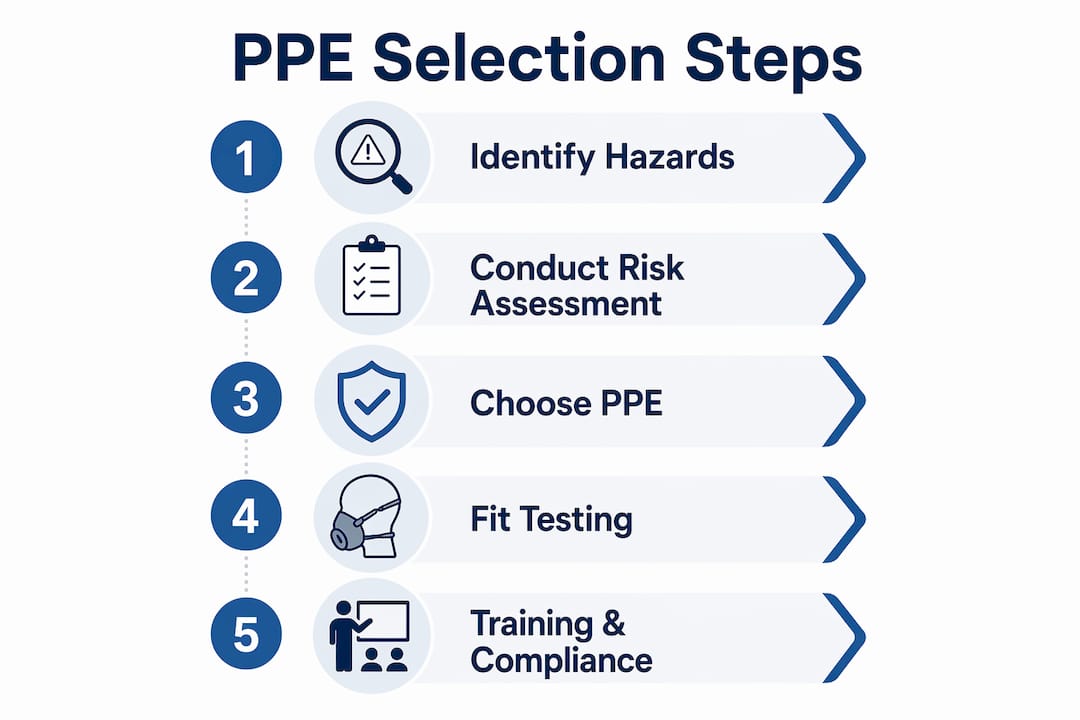
The selection process works in five steps:
- Survey the structure before work begins. A pre-demolition survey identifies hazardous materials, structural weaknesses, and utility locations. This directly informs which PPE categories are needed from day one. Gcscontractors routinely integrates this survey into the method statement before any operative sets foot on site.
- Map tasks to hazards. Concrete cutting generates silica dust and flying fragments. Jackhammering creates noise and vibration. Debris removal involves manual handling and sharp edges. Each task carries a different hazard profile and therefore a different PPE requirement.
- Reassess as demolition progresses. Hazards change as the structure comes down. Dust levels increase, structural stability shifts, and previously concealed materials are exposed. PPE must adapt to these evolving conditions throughout the project.
- Apply the hierarchy of controls first. PPE is the last layer of protection, not the first. Engineering controls such as dust extraction, wet cutting methods, and structural bracing reduce hazards at source. Administrative controls such as task rotation and restricted access zones come next. PPE then covers residual risk.
- Check PPE compatibility across the full system. A respirator that cannot seal properly because of a helmet suspension system is a compliance failure, not a minor inconvenience. Verify that every item works together before issuing it to operatives.
Pro Tip: Use a recognised checklist such as those published by CCOHS or OSHA as a starting template, then adapt it to your specific site conditions. A generic checklist is a floor, not a ceiling.
Consulting a structured risk assessment framework alongside site-specific surveys gives site managers a repeatable process that holds up to HSE scrutiny.
What are the compliance and training requirements for PPE on demolition sites in the UK?
UK law sets clear obligations for PPE provision and use on demolition sites. The Personal Protective Equipment Regulations 1992 require employers to provide suitable PPE free of charge wherever a risk cannot be adequately controlled by other means. Head protection and safety footwear are mandatory on construction sites, and high-visibility clothing is required wherever vehicles or plant are operating.
Compliance covers more than issuing equipment. Site managers must address the following:
- Respiratory protection programme. OSHA requires a written programme covering medical evaluation, fit testing, and maintenance. UK practice mirrors this under COSHH regulations. Fit testing must be completed before first use, repeated when the respirator model changes, and reviewed annually.
- Medical clearance before fit testing. Operatives must be medically cleared before a tight-fitting respirator is issued. This step has a lead time. Build it into the project programme before mobilisation.
- PPE inspection before and during use. Pre-use inspection is a legal requirement, not a recommendation. Damaged or degraded PPE must be withdrawn from use immediately and replaced.
- Site induction training. Every operative must receive site-specific PPE training at induction. This covers what to wear, when to wear it, how to fit it correctly, and what to do if it is damaged.
- Role-specific and hazard-specific training. Training requirements vary by demolition type and hazard. Asbestos removal requires licensed contractor certification. Confined space entry requires specific competency training. WHMIS training applies where hazardous substances are present.
- Supervision and enforcement. Issuing PPE without enforcing its use is a compliance failure. Site managers must monitor PPE use throughout the working day and address non-compliance immediately.
How do site managers manage PPE compatibility and practical challenges?
PPE compatibility is one of the most underestimated challenges in demolition safety. Helmets, goggles, and respirators must be tested together as a system. A respirator that fits correctly in isolation may fail to seal when worn alongside a helmet with a low brim or goggles with a wide frame. The result is a gap in protection that the operative may not notice.
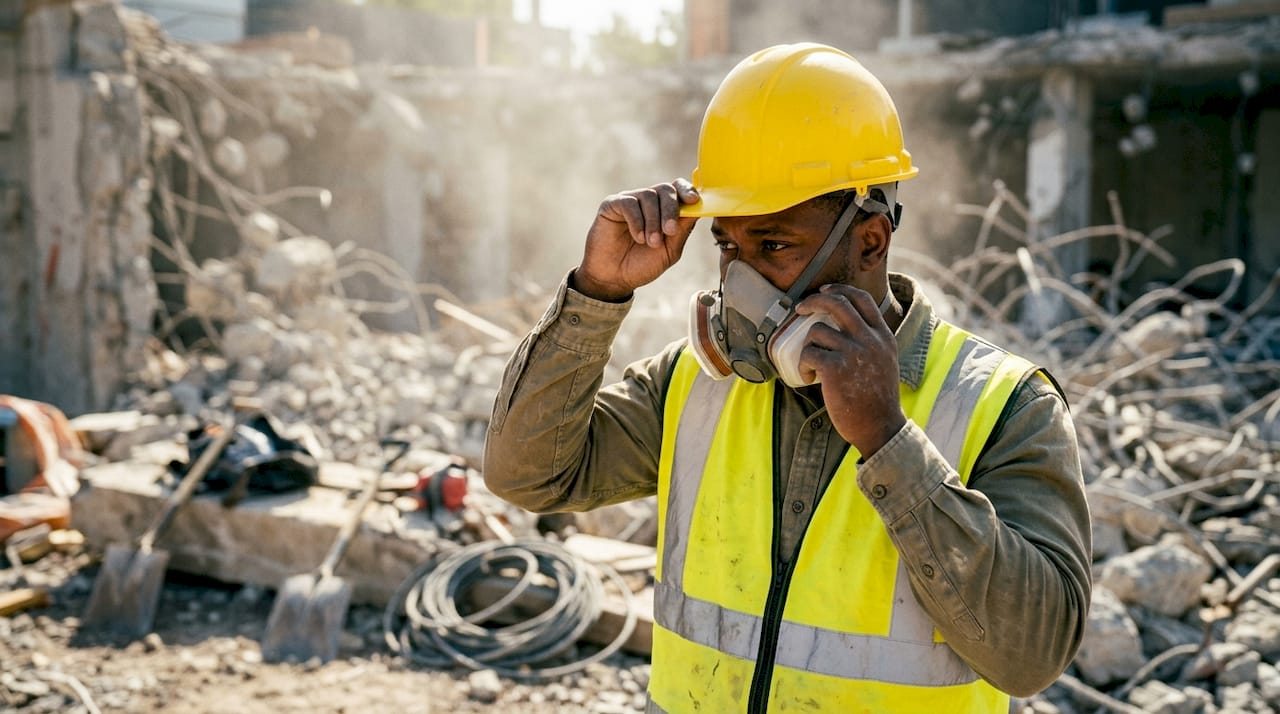
Poor compatibility causes workers to adjust or remove PPE during tasks. This is the single most common cause of PPE non-compliance on active demolition sites. Discomfort from pressure points, heat build-up, or restricted vision drives operatives to make informal adjustments that compromise protection.
The table below summarises the most common compatibility issues and their practical solutions:
| PPE combination | Common issue | Practical solution |
|---|---|---|
| Respirator and safety helmet | Helmet brim breaks face seal | Use a helmet with adjustable suspension or a chin-strap model |
| Goggles and half-face respirator | Frame pressure causes seal failure | Select low-profile goggles designed for respirator compatibility |
| Earmuffs and safety helmet | Cup seal distorted by helmet shell | Use helmet-mounted earmuffs rated for the noise level on site |
| Safety glasses and face shield | Double lens causes fogging | Use anti-fog coated lenses and ensure adequate ventilation |
Managing filter and cartridge stock is a practical challenge that is frequently overlooked. P3 filters for silica dust have a finite service life. Running out mid-project forces operatives to work without adequate respiratory protection or to stop work entirely. Order replacement stock before mobilisation and track usage against task schedules.
Scheduling fit testing and medical evaluations also carries a lead time. Early administrative planning avoids delays at the start of a project. Build these requirements into the pre-construction programme alongside utility surveys and structural assessments. For guidance on integrating these steps into a broader site safety plan, the demolition safety precautions guide published by Gcscontractors covers the full pre-start process in detail.
Key takeaways
Effective PPE management in demolition requires hazard-led selection, system compatibility checks, and consistent training and supervision throughout the project lifecycle.
| Point | Details |
|---|---|
| Hazard-led PPE selection | Match every item of PPE to a documented hazard identified in the pre-demolition survey. |
| PPE as the last control layer | Apply engineering and administrative controls first; PPE covers residual risk only. |
| Compatibility testing | Test helmets, respirators, and eye protection together as a system before issuing to operatives. |
| Respiratory programme compliance | Complete medical clearance and fit testing before first use, and repeat fit testing annually. |
| Training and supervision | Deliver site-specific PPE training at induction and enforce correct use throughout the project. |
What I have learned about PPE compliance on demolition sites
The gap between PPE provision and consistent use is where most demolition safety failures occur. I have seen sites where every operative was issued the correct equipment at induction, and by week two, half of them were wearing respirators around their necks rather than over their faces. The equipment was right. The follow-through was not.
The most common mistake I see is the one-size-fits-all PPE kit. A site manager orders a standard demolition PPE package, issues it uniformly, and considers the job done. But a concrete cutter and a debris clearance operative face entirely different hazard profiles. Issuing identical kits to both is a compliance shortcut that creates real risk.
PPE planning belongs in the method statement, not the site cabin. By the time operatives arrive on site, the PPE requirements for each task should already be documented, procured, and ready. Retrofitting PPE decisions after work has started is how projects accumulate near-misses. I have found that building a simple task-to-PPE matrix into the method statement, and reviewing it at each stage of demolition, keeps compliance visible and manageable. Workers who understand why they are wearing specific equipment are far more likely to wear it correctly. That conversation happens at induction, and it needs to be repeated as the site evolves.
— George
Gcscontractors: professional demolition with safety built in
Safe demolition depends on getting PPE planning right before the first operative steps on site. Gcscontractors brings that discipline to every strip-out and demolition project, from single-floor fit-outs to full structural clearance.

Gcscontractors operates across live environments where safety compliance is non-negotiable. Every project begins with a thorough hazard assessment, documented PPE requirements, and site-specific induction. For site managers who need a reliable demolition partner with a proven safety record, the professional demolition and strip-out guide sets out exactly how Gcscontractors approaches safe site preparation. For projects in Cambridge and the surrounding region, strip-out and demolition services are available with full compliance support from survey to completion.
FAQ
What PPE is legally required on demolition sites in the UK?
UK law requires head protection and safety footwear on all construction sites under the Personal Protective Equipment Regulations 1992. High-visibility clothing is mandatory wherever vehicles or plant are operating.
Why is fit testing required for respirators in demolition?
Fit testing confirms that a tight-fitting respirator seals correctly against an individual’s face. A respirator that does not seal provides no reliable protection against silica dust or other airborne hazards.
How often should PPE be inspected on a demolition site?
PPE must be inspected before each use. Damaged or degraded items must be withdrawn immediately and replaced before the operative returns to work.
What is the biggest PPE compatibility risk in demolition?
Respirator seal failure caused by helmets or goggles is the most common compatibility issue. Helmets, respirators, and eye protection must be tested together as a system, not individually.
When should PPE planning begin for a demolition project?
PPE planning should be included in the method statement before mobilisation. Medical clearances and fit testing carry lead times that must be built into the pre-construction programme.