Material salvage explained: a UK guide for builders
Material salvage, in the UK construction context, means the planned, selective recovery of reusable materials from a building or site before or during demolition. It is distinct from maritime salvage, which is the recovery of ships, cargo, or wreck material from water and is governed by the Merchant Shipping Act 1995 and administered by the Receiver of Wreck. For construction projects, the duty of care under the Environmental Protection Act 1990 means every recovered material that leaves site must be documented correctly. Three bodies of guidance shape how this works in practice: CL:AIRE, the WRAP quality protocol for production of aggregate from inert waste, and the Receiver of Wreck for anything found in or near water.
Table of Contents
- What does material salvage actually cover?
- Why salvage matters commercially and environmentally
- Which UK laws and regulations govern salvage and reuse?
- How do you check whether a salvaged item is safe to reuse?
- What paperwork and compliance checks must you keep?
- Where do salvaged materials go in the UK?
- Common misconceptions about salvage you should know
- How do contractors decide what is worth salvaging?
- Gcscontractors’ practical checklist for managing salvage on projects
- Key takeaways
- Why treating materials as assets changes everything
- Gcscontractors’ salvage-capable strip-out and demolition services
- Useful sources and further reading
What does material salvage actually cover?
The term covers two legally separate activities that share a name but almost nothing else.
Construction and site-won material salvage is the deliberate recovery of reusable items from a building or site before demolition begins or during a controlled deconstruction. The goal is to extract value, reduce waste, and divert material from landfill. A pre-demolition audit identifies what is worth recovering before any work starts.
Maritime wreck salvage applies when material is recovered from the sea, a river, or a tidal area. Under the Merchant Shipping Act 1995, anyone who finds wreck material in UK waters must report it to the Receiver of Wreck within 28 days. Failure to do so is a criminal offence. The Receiver then determines ownership and whether a salvage award applies.
Commonly salvaged construction materials include:
- Structural hardwood and softwood timber, including beams, joists, and floorboards
- Handmade or reclaimed clay bricks and terracotta tiles
- Natural slate and clay roof tiles
- Cast iron and steel structural sections, radiators, and pipework
- Non-ferrous metals: copper pipework, lead flashing, brass fittings
- Architectural metalwork: balustrades, gates, and grilles
- Period fixtures: fireplaces, doors, sash windows, and stone flags
- Reclaimed aggregates and hardcore where quality protocols are met
The distinction matters because the legal obligations, the paperwork, and the people you notify are entirely different depending on which type of salvage you are dealing with.
Why salvage matters commercially and environmentally
Salvage is not simply a sustainability gesture. On a medium-sized commercial strip-out, separating non-ferrous metals and using targeted scrap collection rather than mixed skip hire can convert a disposal cost into income, as analysis by Globalardour demonstrates. Skip hire charges accumulate per load; scrap merchants pay per tonne for copper, lead, and aluminium. The difference on a single project can be substantial.
Statistic callout: Reusing materials on site rather than disposing and replacing them reduces embodied carbon by avoiding additional manufacturing energy. The Resource Futures guidance on maximising re-use ranks materials by ease of implementation and potential savings, and recommends using a Site Waste Management Plan (SWMP) as a live document to record every re-use decision.
Beyond the direct commercial gain, regulatory and procurement pressure is increasing. Many public sector and large private developer clients now require a pre-demolition audit and a Material Management Plan (MMP) as a condition of contract. Treating salvage as an afterthought, rather than a planned activity, means missing both the revenue and the compliance tick.
Which UK laws and regulations govern salvage and reuse?
Getting the legal framework right is non-negotiable. Here is a concise map of what applies and when.
- Merchant Shipping Act 1995: Governs maritime salvage. Anyone recovering wreck material from UK waters must report to the Receiver of Wreck. The Act defines salvage terms, sets out the Receiver’s role, and provides for salvage awards.
- Environmental Protection Act 1990 (duty of care): Applies to all recovered construction materials. Waste remains waste until it meets end-of-waste criteria. Every movement of waste material off site requires a waste transfer note, and the holder of the waste is legally responsible for its correct disposal or reuse.
- Construction (Design and Management) Regulations 2015 (CDM): Regulation 20 requires that demolition and dismantling, including salvage activity, be planned and recorded in writing before work begins. This covers the method, sequence, and any structural risks.
- BS 6187:2011 (demolition code of practice): Published by the BSI, this code covers project development, site assessments, safe deconstruction techniques, and materials handling for reuse and recycling. It is the industry benchmark for demolition competence.
- WRAP quality protocol and CL:AIRE guidance: The WRAP quality protocol sets verification requirements for when processed demolition aggregate ceases to be waste. CL:AIRE provides equivalent guidance for site-won soils and materials. Both can remove the need for waste management permits when their requirements are met.
- Permits and exemptions (U1, T6, T7): Certain storage, treatment, or processing of demolition waste triggers a requirement for an Environment Agency (EA) permit or a registered exemption. The DRG105 guidance from the NFDC summarises which activities need which authorisation and when a verification plan can substitute for a permit.
- Geographic variations: CDM 2015 and the Environmental Protection Act 1990 apply across England, Wales, and Scotland, though Scottish waste regulations have some procedural differences. Northern Ireland operates under separate but broadly equivalent legislation. Always confirm the applicable regime for the project’s location.
How do you check whether a salvaged item is safe to reuse?
Not every recovered item is fit for reuse, and using a structurally compromised component creates serious liability. A systematic inspection process reduces that risk.
Visual inspection checklist before any reuse decision:
- Check for structural damage: cracks, splits, deformation, or missing sections in timber, masonry, or metalwork
- Look for rot, fungal growth, or insect damage in timber (probe with a bradawl to test density)
- Inspect for corrosion, pitting, or section loss in ferrous and non-ferrous metals
- Check for thermal damage: charring, warping, or discolouration from fire or heat
- Look for contamination signs: soot, chemical staining, oil residue, or unusual odours
- Examine mortar condition on reclaimed bricks (friable mortar may indicate frost damage or sulphate attack)
When professional assessment is required:
- Any timber intended for a structural or loadbearing application must be graded by a TRADA-trained or C16/C24-certified timber grader, or assessed by a structural engineer
- Moisture content testing (target below 20% for most internal uses) should be carried out with a calibrated moisture meter before installation
- Steel sections from pre-1980 structures may require mill certificate verification or independent testing before reuse in a structural role
Hazardous material checks are mandatory before any salvage work begins. Asbestos-containing materials (ACMs) must be identified by a licensed asbestos surveyor; no salvage work may proceed in affected areas until ACMs are removed or made safe. Lead paint on pre-1960s joinery, mercury in old fluorescent fittings, and polychlorinated biphenyls (PCBs) in some electrical equipment all require specialist handling and disposal. The demolition safety precautions guide sets out the PPE and safe systems of work required.
Pro Tip: Commission an asbestos refurbishment and demolition survey (R&D survey) before the pre-demolition audit, not after. Finding ACMs mid-audit halts the programme and increases costs significantly.
What paperwork and compliance checks must you keep?
Documentation is where many salvage projects fall short. The Environmental Protection Act 1990 places the duty of care on the waste holder, and that duty does not disappear because the material has commercial value.
Required records for every salvage project:
- Site Waste Management Plan (SWMP) or Material Management Plan (MMP): — Records what materials were recovered, how much, where they went, and whether they were reused, recycled, or disposed of. The Resource Futures guidance recommends using the SWMP as a live document updated throughout the project, not a one-off form completed at the end.
For compliance tips specific to demolition projects, the contractor’s compliance guide covers permit requirements and duty-of-care obligations in detail.
Where do salvaged materials go in the UK?
The UK has a well-established network of outlets for reclaimed construction materials, and knowing where to direct material improves both recovery rates and commercial returns.
Reclamation yards are the primary destination for architectural salvage: period bricks, stone flags, roof tiles, fireplaces, and joinery. Yards assess condition and pay accordingly, or take material on a sale-or-return basis. Prices vary significantly by region and material type.
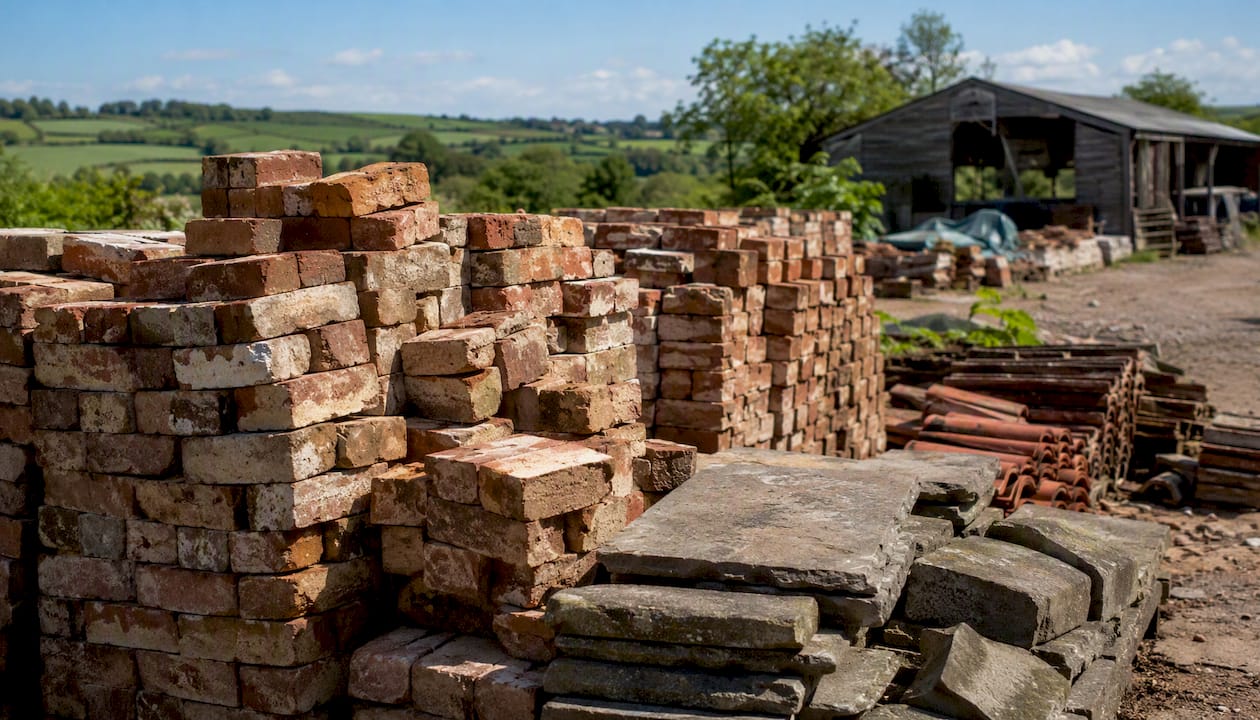
Salvoweb, operated by Salvo Ltd, is the UK’s principal online marketplace for reclaimed building materials. Sellers list individual items or batches; buyers search by material type, location, and condition. It is particularly effective for unusual or high-value items such as Victorian cast iron columns or reclaimed hardwood flooring.
Community Wood Recycling operates a network of social enterprises across the UK that collect, process, and resell reclaimed timber. They accept donations from contractors and provide collection services in some areas. This is a practical route for timber that is too low-grade for specialist reclaimers but too good for skip.
Ashwells Timber Ltd is a specialist reclaimer of structural and architectural timber, including old-growth oak, pitch pine, and elm. They assess timber for structural reuse and can provide grading certificates where appropriate, making them a useful contact for contractors with significant timber volumes.
Preparation tips for sellers:
- De-nail and clean timber before presenting it; dirty or nail-studded timber attracts lower prices or refusal
- Grade bricks by type, size, and condition; mixed, ungraded batches sell at a discount
- Photograph materials clearly and note dimensions, estimated quantities, and any known history
- Obtain a condition certificate or grading report for structural timber where possible
Common misconceptions about salvage you should know
Several persistent misunderstandings lead contractors and property owners into legal or commercial mistakes.
- Scrap and salvage are not the same thing. Scrap is bulk collection of mixed, low-value demolition debris. Salvage is the selective, planned recovery of reusable assets. Treating salvageable timber as scrap destroys its value; treating contaminated scrap as salvage creates a liability.
- “Old means unsafe” is false. Pre-industrial hardwoods such as pitch pine and old-growth oak are often denser and more durable than modern equivalents. The Constructors Company playbook on timber salvage recommends structural inspection and grading rather than automatic rejection of aged timber.
- Recovered material is not automatically “not waste.” Under UK law, a material remains waste until it meets documented end-of-waste criteria. Claiming a material is “reused” without the verification plan and waste transfer notes does not remove the legal obligation.
- Salvage does not require a permit in all cases, but it does require documentation in all cases. The exemption regime (U1, T6, T7) removes the need for a full EA permit in many scenarios, but the exemption must be registered and the conditions met. Assuming no paperwork is needed because the material has value is a common and costly error.
- Maritime salvage law applies even to small finds. Recovering a ship’s anchor, old mooring chains, or cargo from a riverbed in the UK requires notification to the Receiver of Wreck regardless of the item’s apparent value.
How do contractors decide what is worth salvaging?
The decision is commercial as much as environmental. Contractors weigh four factors: material value, effort to reclaim, storage and logistics, and programme impact.
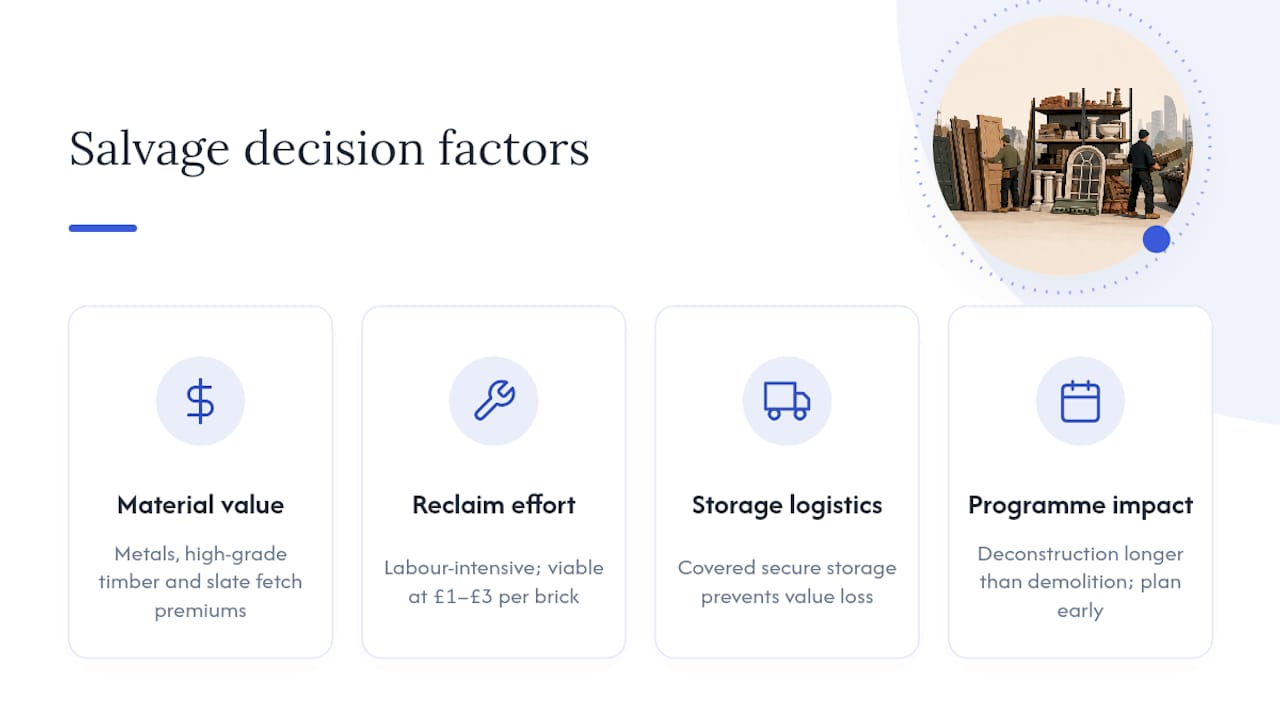
Material value is the starting point. Non-ferrous metals (copper, lead, aluminium) command reliable scrap prices and are worth segregating on almost every project. High-grade structural timber, period brickwork, and natural slate carry premium reclamation values. Standard concrete block or modern softwood rarely justifies the handling cost.
Effort to reclaim determines whether selective deconstruction is viable. Hand-stripping a Victorian terrace to recover handmade bricks is labour-intensive but commercially justified when the bricks sell at £1–£3 each. Recovering modern machine-made bricks from a 1980s office block rarely covers the labour cost.
Storage and logistics matter on constrained sites. If there is no space to stack, grade, and protect recovered materials, their condition deteriorates and their value falls. Early programme planning should allocate a secure, covered storage area for salvage.
Programme impact is the factor most often underestimated. Soft strip and deconstruction take longer than mechanical demolition. The commercial case for salvage must account for the additional time on site, not just the resale value of the materials. When the programme is tight, selective salvage of the highest-value items only is often the right call.
Switching from mixed skip hire to segregated scrap collection for metals alone can convert a disposal cost into income on most commercial projects, as the skip hire vs scrap collection analysis illustrates. The principle extends to timber and masonry: the earlier the decision is made in the programme, the greater the return.
Gcscontractors’ practical checklist for managing salvage on projects
This checklist covers the full project cycle from planning to handover. It is designed for project teams managing demolition, strip-out, or deconstruction where salvage is a planned activity.
Project checklist:
- Commission an asbestos R&D survey before any other survey or audit work begins
- Appoint a qualified surveyor to carry out a pre-demolition audit and produce a salvage inventory
- Prepare a Material Management Plan (MMP) or SWMP before work starts, as required under CDM 2015
- Confirm which EA exemptions (U1, T6, T7) apply and register them before material is moved
- Designate a secure, covered storage area on site for salvaged materials
- Brief the demolition or strip-out contractor on the salvage sequence and segregation requirements
- Carry out soft strip before any mechanical plant is deployed
- Inspect, tag, and record each batch of recovered material as it is segregated
- Arrange waste transfer notes for all material movements off site
- Update the SWMP or MMP as a live document throughout the project
- Confirm end-of-waste status for any material claimed to have exited waste classification
- At handover, compile the full salvage record: quantities recovered, destinations, transfer notes, and verification plans
Onsite roles to assign:
- Client representative: approves the salvage plan and monitors commercial outcomes
- Salvage lead (contractor): responsible for sequencing, segregation, and condition records
- Health and safety officer: oversees hazardous material checks and safe systems of work
- Verification responsible person: maintains the MMP/SWMP and signs off end-of-waste documentation
Questions to ask a contractor before appointing them:
- Do you carry out pre-demolition audits, and can you provide a sample report?
- How do you segregate and record salvaged materials on site?
- Which EA exemptions do you typically register, and who manages the paperwork?
- Do you have established relationships with reclamation yards or specialist buyers?
- Can you provide waste transfer notes and a completed SWMP at project handover?
For a detailed look at how deconstruction sequencing affects salvage outcomes, the demolition sequence breakdown guide covers the programme planning in full.
Key takeaways
Material salvage in the UK requires planned deconstruction, documented compliance, and early procurement decisions to deliver both commercial and environmental value.
| Point | Details |
|---|---|
| Define the type of salvage first | Maritime salvage (Receiver of Wreck) and construction salvage (duty of care, CDM) carry entirely different legal obligations. |
| Plan before you demolish | CDM 2015 requires demolition and dismantling to be planned in writing; a pre-demolition audit is the starting point for any salvage programme. |
| Documentation is mandatory | Waste transfer notes, an MMP or SWMP, and verification plans are required for all recovered materials, regardless of their commercial value. |
| Scrap and salvage are different | Salvage is selective recovery of reusable assets; scrap is bulk mixed debris. Treating salvageable material as scrap destroys value and compliance records. |
| Gcscontractors delivers salvage-capable strip-out | Gcscontractors manages pre-demolition audits, soft strip, segregation, and compliance documentation for projects in Cambridge and East Anglia. |
Why treating materials as assets changes everything
The conventional view of demolition is that it generates waste to be managed. The more accurate view, and the more profitable one, is that it generates assets to be recovered. Contractors who plan salvage from the first site visit consistently outperform those who treat it as an afterthought, both on margin and on sustainability metrics.
The shift is not complicated in principle. A pre-demolition audit costs a fraction of what a skip programme costs on a medium project. An MMP takes a day to prepare. Segregating non-ferrous metals adds minimal time to a strip-out. Yet the combined effect, converting disposal costs into income, reducing landfill fees, and satisfying client procurement requirements, is material on almost every project above a certain scale.
What is often underestimated is the compounding effect of good records. A contractor who can demonstrate, through a completed SWMP and verified end-of-waste documentation, that 80% of a building’s materials were reused or recycled is a more attractive subcontractor to a developer with sustainability targets. That track record has commercial value beyond the individual project.
The timber salvage research from the Constructors Company playbook makes a point worth repeating: deconstruction requires a different skillset from demolition. You cannot simply slow down a demolition crew and expect salvage-quality results. The planning, the sequencing, and the people need to be right from the start.
Gcscontractors’ salvage-capable strip-out and demolition services
Contractors and developers in Cambridge and East Anglia who need salvage built into their demolition programme, not bolted on afterwards, can rely on Gcscontractors for the full scope. The team carries out pre-demolition audits, manages soft strip and controlled deconstruction, handles segregation and on-site storage, and produces the compliance documentation (MMP, waste transfer notes, verification plans) required at handover.

Where hazardous materials are present, Gcscontractors coordinates with licensed asbestos contractors and ensures safe systems of work are in place before any salvage activity begins. The result is a project where materials are recovered at maximum value, paperwork is complete, and the client receives a clear record of what was salvaged, where it went, and what it was worth. For projects where salvage is a client requirement or a commercial priority, the strip-out and demolition service page sets out the full capability. Contact Gcscontractors to request a site audit or project quote.
Useful sources and further reading
The table below lists the primary UK statutes, standards, and guidance documents relevant to material salvage. Bookmark or download the documents most relevant to your project type.
| Document | Scope | Applies to |
|---|---|---|
| Merchant Shipping Act 1995 | Maritime salvage, Receiver of Wreck process, salvage awards | UK-wide (maritime) |
| CDM Regulations 2015 | Written planning of demolition and dismantling, including salvage | England, Wales, Scotland |
| Environmental Protection Act 1990 | Duty of care, waste transfer notes, end-of-waste criteria | England, Wales, Scotland |
| BS 6187:2011 (BSI) | Code of practice for demolition: deconstruction, materials handling, reuse | UK-wide (industry standard) |
| DRG105 Waste and Permitting (NFDC) | EA exemptions (U1, T6, T7), verification plans, WRAP quality protocol | England and Wales |
| Resource Futures: Maximising re-use on site | SWMP use, re-use matrices, case studies for on-site material recovery | England and Wales |
| Constructors Company timber salvage playbook | Pre-demolition audits, timber inspection, deconstruction skills | UK-wide guidance |
For England and Wales-specific waste permitting questions, the Environment Agency’s own guidance pages should be the first point of reference. For Scotland, the Scottish Environment Protection Agency (SEPA) administers equivalent controls. Northern Ireland uses the Northern Ireland Environment Agency (NIEA). Always confirm the applicable regulator for your project’s location before registering exemptions or applying for permits.