Disconnecting utilities safely: the UK property guide
Arrange a permanent, boundary-level disconnection through the relevant network operator — not just a meter switch-off — and obtain written termination certificates before any demolition or major structural works begin. That single step separates a legally compliant project from a dangerous one. Industry guidance confirms that meter removal or internal isolation alone is insufficient for demolition safety; the physical severance and capping must happen at or outside the site boundary, carried out by the network operator or their approved agent.
Before you pick up the phone, have these three items ready:
- Site address and scaled site plans showing the building footprint and the location of meters and service entries.
- Meter identifiers: your MPAN (Meter Point Administration Number) for electricity and your MPRN (Meter Point Reference Number) for gas. Both appear on your energy bills.
- Proof of authority: either a copy of the title register confirming ownership, or written authorisation from the property owner if you are acting as a manager or contractor.
With those in hand, run a UK One Call check to identify all buried services on site, then contact each network operator directly to begin the formal disconnection application.
Key takeaways
Permanent, boundary-level disconnection by the network operator — with written termination certificates for every utility — is the only legally compliant and safe basis for proceeding with demolition or major structural works in the UK.
| Point | Details |
|---|---|
| Start early | Gas and electricity disconnections typically take several weeks; HV or complex cases can take several months. |
| Gather identifiers first | You need your MPAN (electricity) and MPRN (gas) before any network operator will process your application. |
| Use UK One Call | Run a Lines Search Before You Dig enquiry to identify all buried services before submitting applications. |
| Insist on written certificates | Verbal confirmation from an operative carries no legal weight; hold signed termination certificates before demolition begins. |
| Gcscontractors coordinates the process | Gcscontractors manages operator applications, site surveys, and certificate collection for demolition projects in Cambridge and East Anglia. |
Table of Contents
- How to disconnect utilities: which services are affected and what ‘disconnection’ actually means
- Who carries out the work and what paperwork do you need to provide?
- Step-by-step process to arrange a permanent disconnection
- What do utility disconnections cost and how long do they take?
- What are the legal and safety requirements before demolition?
- Common mistakes that cause delays, costs, and danger
- How professionals coordinate utility disconnections: what to expect
- The detail most clients miss before demolition starts
- Gcscontractors manages utility disconnections for demolition projects
- Sources
How to disconnect utilities: which services are affected and what ‘disconnection’ actually means
The phrase “disconnect utilities” covers five distinct service types in the UK, and each one has a different physical process, a different responsible body, and a different definition of what “disconnected” actually means for demolition purposes.
- Gas: The Gas Distribution Network (GDN) — such as Cadent, SGN, Northern Gas Networks, or Wales & West Utilities — caps the service at the distribution main in the street. Your meter is removed first by the supplier, but the live pressurised pipe in the highway remains until the GDN physically severs it.
- Electricity (LV and HV): The Distribution Network Operator (DNO) — such as UK Power Networks, Western Power Distribution, or Electricity North West — isolates and removes the service cable at the site boundary. For high-voltage (HV) supplies, the process is more complex and may require a substation decommission.
- Water supply: The water company severs the communication pipe at the boundary stop tap or at the water main, then caps it. Switching off the internal stop tap does nothing to the live pressurised main in the street.
- Foul sewer and surface water drainage: Sewer abandonment is a formal statutory process. United Utilities’ guidance on sewer closure requires detailed drawings, CCTV connectivity surveys, manhole records, and an on-site inspection — often witnessed by a water company representative — before abandonment is accepted as complete.
- Telecoms and fibre: Openreach or the relevant network provider removes the overhead or underground drop and disconnects at the street cabinet or exchange. This is usually the quickest disconnection to arrange but still requires a formal request.
The table below sets out the responsible body and the physical meaning of disconnection for each utility.
| Utility | Responsible body | What disconnection involves |
|---|---|---|
| Gas | GDN (e.g. Cadent, SGN) | Meter removed by supplier; GDN caps at distribution main |
| Electricity (LV) | DNO (e.g. UK Power Networks) | Service cable cut and removed at site boundary |
| Electricity (HV) | DNO (specialist team) | Substation decommission; longer lead time |
| Water supply | Water company (e.g. Anglian Water) | Communication pipe severed and capped at boundary |
| Foul sewer | Water company (developer services) | CCTV survey, manhole records, witnessed abandonment |
| Telecoms/fibre | Openreach or network provider | Drop removed; disconnected at cabinet or exchange |
Turning off a meter or closing an internal valve does not de-energise or de-pressurise the service at the street. For demolition, that live service remains a serious hazard until the network operator has physically severed it.
Who carries out the work and what paperwork do you need to provide?
There are two separate organisations involved in every utility disconnection: the meter owner or supplier (who bills you and owns the meter) and the network operator (who owns the pipes, cables, and mains in the street). Both must be contacted, and in the right order.
Your supplier arranges meter removal. The network operator then carries out the physical severance at the boundary or main. You cannot skip the supplier stage and go straight to the network operator, because the meter must be removed before the network operator will attend.
Industry guidance from Crown Energy confirms that contractors must supply the statutory provider with the site address, MPAN or MPRN, site plans marking the building, and payment details to initiate a demolition disconnection. For water, United Utilities requires a formal application with contact information, the address, supply details, and a site location plan before arranging survey and works.
Finding your MPAN and MPRN: Your MPAN is a 21-digit number on your electricity bill, usually shown in a grid format. Your MPRN is a 6–10 digit number on your gas bill. If the property is vacant and you have no bills, contact the relevant network operator directly with the site address; they can locate the identifiers from their records.
Document checklist — have these ready before applying:
- Full site address and postcode
- MPAN (electricity) and MPRN (gas)
- Meter serial numbers (from the meter face)
- Scaled site plan showing building footprint, meter locations, and service entry points
- Proof of ownership (Land Registry title register) or written authorisation from the owner
- Contractor name and contact details
- Payment method for operator fees
- UK One Call reference number confirming buried service locations
For leasehold or multi-occupancy properties, you will also need written consent from the freeholder or management company before any network operator will accept your application.
Step-by-step process to arrange a permanent disconnection
Follow these steps in order. Starting late is the single most common cause of programme delay on demolition projects.
- Confirm authority to instruct. Obtain title register confirmation or written owner authorisation. Without this, no network operator will accept your application.
- Collect all identifiers and site plans. Gather MPAN, MPRN, meter serial numbers, and a scaled site plan. Commission a topographic survey if no current plan exists.
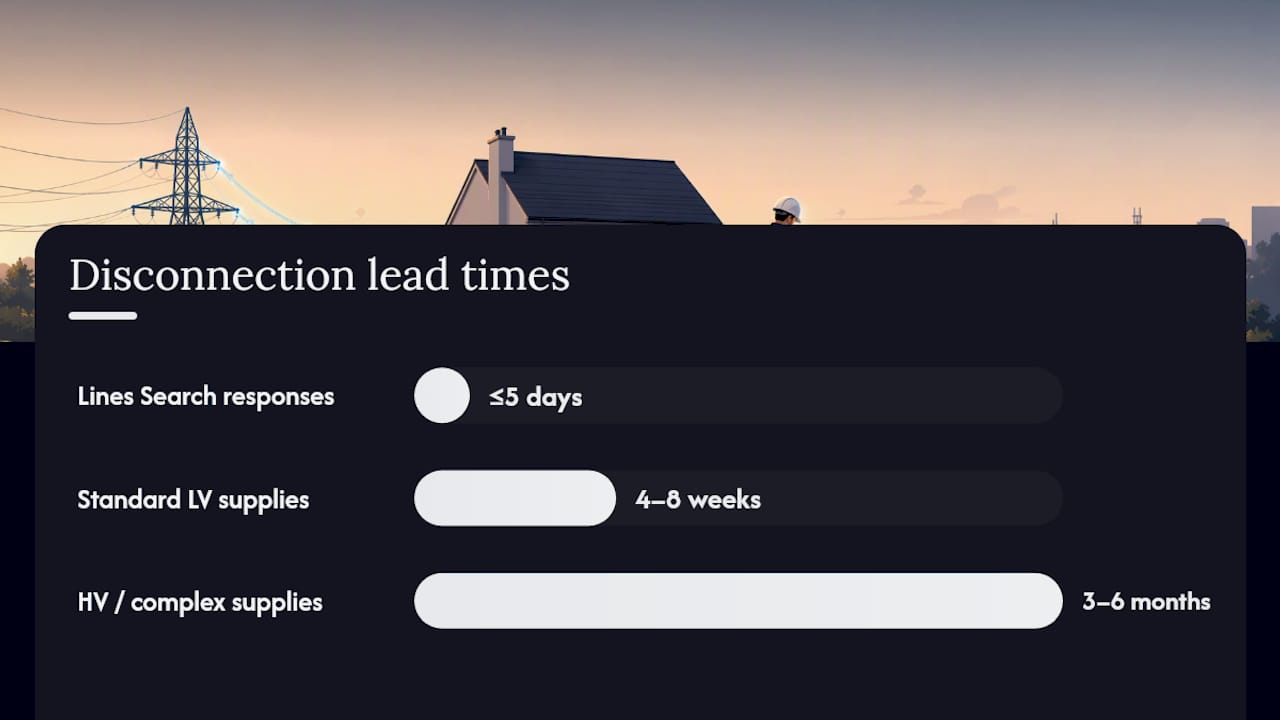
- Run a UK One Call check. Submit a Lines Search Before You Dig enquiry to identify all buried apparatus on and adjacent to the site. Allow up to five working days for responses.
- Contact each supplier to arrange meter removal. Notify your gas and electricity suppliers in writing that you require meters removed for demolition. Confirm the target date and request written confirmation of the removal appointment.
- Submit disconnection applications to each network operator. Contact the relevant DNO, GDN, water company developer services team, and telecoms provider. Submit the full document pack listed above with each application.
- Accept costs and arrange payment. Each operator will issue a quotation. Review, accept, and pay promptly — the clock on their lead time typically starts from receipt of payment, not from your application date.
- Book on-site work and attend on the day. Confirm access arrangements with each operator. Be present on site during physical disconnection works. Verify that the operative is from the network operator or their approved agent, not a subcontractor acting without authorisation.
- Obtain termination and disconnection certificates. Insist on written, authorised certificates for every utility before demolition begins. These are your legal proof that the service has been physically severed.
Shared or communal supplies: Where a meter serves more than one property, or where a service runs through your site to serve a neighbouring property, you cannot simply disconnect without the network operator’s involvement and, in most cases, a diversion scheme. Identify shared supplies at the UK One Call stage and raise them explicitly in your application.
Recommended timeline: Start the disconnection process at contract award, not at the point demolition is imminent. Industry guidance recommends budgeting 4–8 weeks for standard gas and electricity LV supplies, and up to 3–6 months for HV supplies, shared services, or where wayleaves and diversions are required.
Pro Tip: Be on site for every physical disconnection. Ask the operative to show you their authorisation from the network operator before work starts, and do not allow demolition to proceed on any service until you hold the signed termination certificate in your hand.
What do utility disconnections cost and how long do they take?
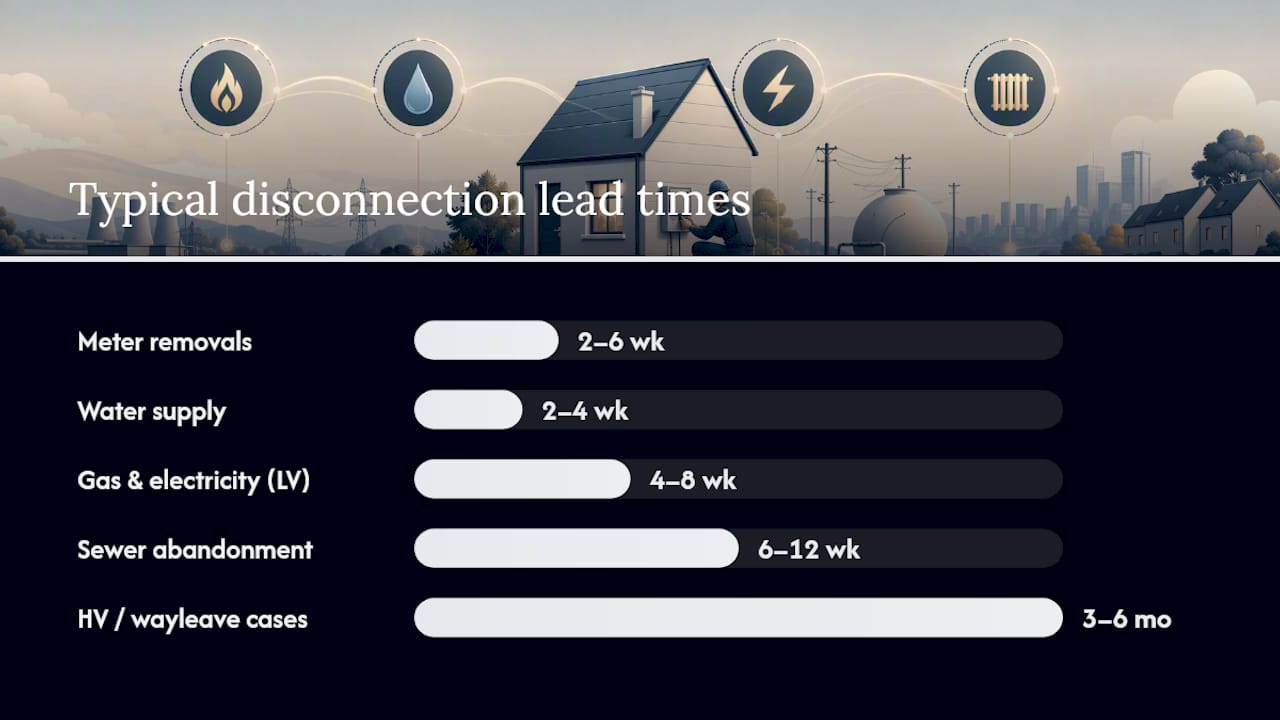
Lead times and costs vary considerably by utility type, site complexity, and network operator workload. Professional disconnection services report typical turnaround times of around 2–6 weeks for straightforward meter removals and disconnections, though this figure covers the meter-removal stage rather than the full boundary-level severance.
For the complete disconnection process, plan around these ranges:
- Gas and electricity (LV): 4–8 weeks from application acceptance to physical works.
- Water supply disconnection: 2–4 weeks for a standard communication pipe severance.
- Sewer abandonment: 6–12 weeks or longer, given the CCTV survey, drawing preparation, and witnessed inspection requirements.
- HV electricity, shared supplies, or wayleave cases: 3–6 months. Early engagement with the DNO is the only reliable way to compress this.
- Telecoms: Usually 2–4 weeks, often the quickest to resolve.
Types of fees to expect:
- Network operator attendance and severance fees (charged per utility)
- Survey and quotation fees (some operators charge before issuing a quote)
- Highway permit fees where works are in the public highway (under the New Roads and Street Works Act 1991)
- CCTV survey and sewer abandonment inspection fees
- Legal and wayleave negotiation costs for complex cases
Factors that extend timescales and increase costs:
- Shared supplies requiring diversion schemes
- HV electricity supplies needing substation decommissioning
- Wayleaves on live cables crossing third-party land
- Works in the highway requiring NRSWA permits and traffic management
- Sewer abandonment requiring CCTV surveys coded to the WRC Manual of Sewer Classification
To reduce delays: submit your UK One Call enquiry and all applications simultaneously where possible, provide complete and accurate site plans at first submission, agree access dates with each operator in writing, and appoint a single coordinator to manage all operator communications. Incomplete applications are returned and restart the clock.
What are the legal and safety requirements before demolition?
Physical disconnection works must be carried out by the network operator or an approved appointed agent. This is not a preference — it is a statutory and safety requirement. No contractor, however competent, may sever a live gas main or electricity cable without the relevant authorisation.
The key regulatory framework covering utility disconnection before demolition includes:
- Gas Safety (Installation and Use) Regulations 1998: Require that gas services are identified and, where possible, disconnected before demolition works begin.
- Electricity at Work Regulations 1989: Impose a duty to ensure electrical systems are safe; live cables adjacent to demolition works must be de-energised by the DNO.
- Water Industry Act 1991: Governs sewer adoption and abandonment; formal consent from the sewerage undertaker is required before a public sewer can be abandoned.
- HSG47 (Avoiding Danger from Underground Services): Provides practical guidance on identifying, locating, and safely managing buried services before and during excavation and demolition.
- DSEAR (Dangerous Substances and Explosive Atmospheres Regulations 2002): Relevant where sewer abandonment creates risk of flammable gas accumulation in confined spaces.
Statutory provisions also set formal processes and notice periods — including written notices of up to 28 days in some cases — for the relocation or removal of utility apparatus where alternative apparatus must be constructed.
For demolition safety precautions beyond utility disconnection, a structured site manager’s checklist covers the broader on-site obligations that apply once disconnection is confirmed.
Common mistakes that cause delays, costs, and danger
Most problems on demolition projects involving utilities trace back to a small number of avoidable errors. Knowing them in advance is the most practical form of risk management.
Relying on internal isolation only. Closing the internal stop tap, switching off the consumer unit, or turning the gas meter valve does not remove the live service in the street. Industry guidance is explicit that internal isolation is insufficient for demolition safety. The pressurised pipe or live cable remains until the network operator severs it at the boundary or main.
Failing to remove meters before applying for network disconnection. Network operators will not attend to sever the service until the meter has been removed by the supplier. Skipping this step adds weeks to the programme.
Not obtaining written termination certificates. Verbal confirmation from an operative on site carries no legal weight. Without a signed, authorised certificate, you have no proof the service is safe, and your demolition contractor may — correctly — refuse to proceed.
Not checking for shared or communal supplies. A meter that serves your property may also serve a neighbouring building. Disconnecting it without a diversion scheme could cut supply to a third party and expose you to liability.
Red flags to watch for during the process:
- Unclear meter ownership: If the meter is not registered to the property address in the network operator’s records, resolve this before submitting your application. Unregistered meters cause significant delays.
- Wayleave on a live cable: If a cable crosses third-party land under a wayleave agreement, the DNO may advise diversion rather than disconnection. Engage a solicitor and the DNO’s wayleave team early.
- DNO advising diversion rather than disconnection: This usually means the cable serves other properties beyond yours. Request a full network diagram from the DNO and clarify the scope of works before accepting any quotation.
- Water company requiring CCTV survey for sewer abandonment: This is standard practice, not a complication. Budget for it from the outset and commission a drainage contractor to prepare the required drawings and survey report in advance of the application.
How professionals coordinate utility disconnections: what to expect
Appointing an experienced contractor to coordinate utility disconnections removes the most time-consuming and technically demanding parts of the process from your workload. A competent coordinator does not simply make phone calls; they manage a parallel programme of operator applications, site surveys, access bookings, and certificate collection across every utility simultaneously.
Concrete tasks a contractor handles on your behalf:
- Identifying meter ownership and confirming registered supply addresses with each network operator.
- Contacting suppliers to arrange meter removal and confirming removal dates in writing.
- Submitting formal disconnection applications to the DNO, GDN, water company developer services, and telecoms provider, with the complete document pack.
- Arranging and attending site surveys for each operator.
- Booking and attending physical disconnection works, verifying operative authorisation on the day.
- Collecting and filing all termination and disconnection certificates.
- Flagging shared supplies, wayleaves, or HV issues early and managing the resolution process.
The coordination benefit is most visible on projects where multiple utilities need disconnecting within a tight programme. By submitting all applications simultaneously and pre-booking surveys, an experienced contractor can avoid the sequential delays that occur when each utility is treated as a separate task. Professional utility disconnection services confirm that end-to-end management of the process typically produces faster and more predictable outcomes than owner-managed applications.
For site clearance and preparation, the coordination of utility disconnections sits within a broader programme of enabling works that must be sequenced correctly before any structural demolition begins.
Pro Tip: When appointing a contractor to coordinate disconnections, ask specifically whether they will attend on site during physical works and whether they will collect original signed certificates. A coordinator who manages the process remotely and accepts verbal confirmation from operatives is not providing the same level of assurance as one who is present and holds the paperwork.
For utility disconnection timing within a broader demolition programme, project-management guidance on utility coordination highlights the value of parallel scheduling — running operator applications concurrently rather than sequentially — to compress overall lead times.
The detail most clients miss before demolition starts
The single item that most consistently catches clients off guard is the presence of a wayleave or a shared supply that was not identified until after the disconnection application was submitted. By that point, the programme has already been built around an assumed lead time, and the discovery of a diversion requirement or a third-party consent process adds weeks — sometimes months — to the schedule.
The fix is straightforward: run your UK One Call enquiry and review the responses with a contractor who understands network diagrams before you finalise your demolition programme. If any response indicates apparatus in or adjacent to your site that is not clearly yours alone, raise it with the relevant network operator immediately and ask for a written confirmation of ownership and service extent. That one conversation, held early, is worth more than any amount of contingency time added to the back end of a programme.
The step-by-step checklist above is the practical tool to use alongside that early engagement.
Gcscontractors manages utility disconnections for demolition projects
Gcscontractors provides a single point of contact for the full utility disconnection process on demolition and strip-out projects across Cambridge and East Anglia. The team handles supplier notification, network operator applications, site survey attendance, and termination certificate collection — so you are not managing five separate operator relationships while trying to run a construction programme.

From the first UK One Call enquiry through to written confirmation of boundary-level severance, Gcscontractors coordinates each stage in line with Gas Safety Regulations, the Electricity at Work Regulations, and the Water Industry Act. Every disconnection is documented, and no demolition work proceeds until the full certificate pack is in place. For projects where the disconnection sequence is critical to the demolition programme, the team’s experience with live site demolition processes and demolition sequencing means the utility programme is built into the project schedule from day one, not bolted on as an afterthought. Contact Gcscontractors to discuss your project and get a clear picture of lead times and costs before your programme is fixed.
Sources
- Demolition utility disconnections – Multi-Utility Decommissioning | Crown Energy
- DRG108_Disconnection_of_Services_2019.pdf
- Guide to sewer closure – United Utilities
Recommended
- Professional Site Clearance Services: A Guide to Construction Readiness – GCS Contractors Ltd
- Utility Trenching in Cambridge: A Professional Guide to Service Installation – GCS Contractors Ltd
- Garden drainage tips: your practical UK guide for 2026
- Professional Strip Out in Cambridge: A How-To Guide for Site Preparation – GCS Contractors Ltd