Building deconstruction process: the 2026 professional guide
The building deconstruction process is the deliberate, sequential disassembly of a structure to recover reusable materials while maintaining safety and regulatory compliance. Unlike mechanical demolition, which reduces a building to rubble in days, deconstruction treats every component as a recoverable asset. Construction and demolition waste accounts for 20–50% of municipal solid waste in developed countries. That figure alone explains why project managers are under growing pressure to plan deconstruction projects with the same rigour they apply to new builds. Regulatory bodies including OSHA, the EPA, and standards such as 40 CFR Part 61 Subpart M set the compliance baseline every team must meet before a single fixture is removed.
What are the key stages in the building deconstruction process?
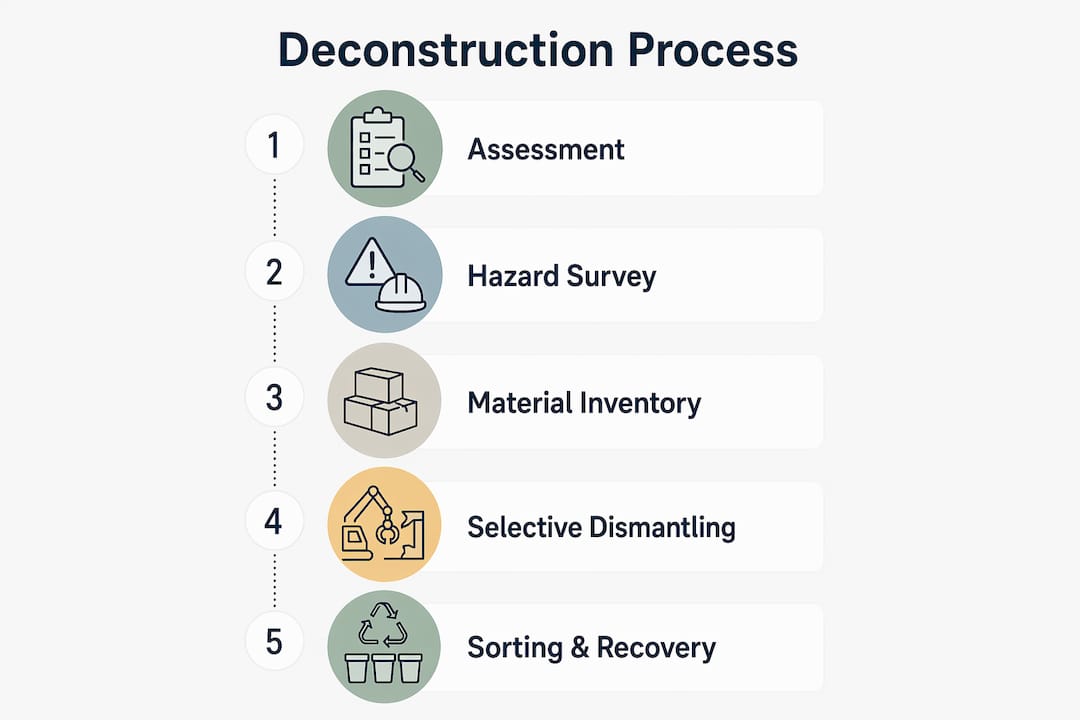
The deconstruction process follows a strict five-stage sequence. Each stage builds on the last, and skipping any one of them creates safety risks, compliance failures, or material losses that cannot be recovered later.
-
Preliminary assessment. A full structural survey, hazardous material audit, and material inventory come first. Project managers identify which components have reuse value and which require specialist disposal. This stage also determines whether the project is financially viable.
-
Hazardous material abatement. Asbestos, lead paint, polychlorinated biphenyls (PCBs), and mercury-containing equipment must be removed and disposed of by licensed contractors before any salvage work begins. Compliance with OSHA 29 CFR 1926.1101 and EPA 40 CFR Part 61 Subpart M is mandatory at this stage, not optional.
-
Sequential disassembly. Work proceeds in reverse construction order: interior finishes first, then mechanical and electrical systems, then structural elements. Reversing the construction sequence protects worker safety and reduces damage to joists, beams, and brickwork that would otherwise be lost.
-
Material sorting and staging. Each material stream is separated on-site as work progresses. Timber, steel, masonry, and glass go into dedicated areas. Mixed loads lose reuse value immediately, so segregation is non-negotiable.
-
Final site clearance. Residual waste is removed, the site is made safe, and all documentation is completed. Chain of custody records support tax appraisals and regulatory sign-off.
Pro Tip: Complete your material inventory before mobilising any labour. Identify resale or donation markets for timber, steel, and brickwork in advance. Deconstruction is labour-intensive and unpredictable; having buyers lined up before work starts protects your project economics.
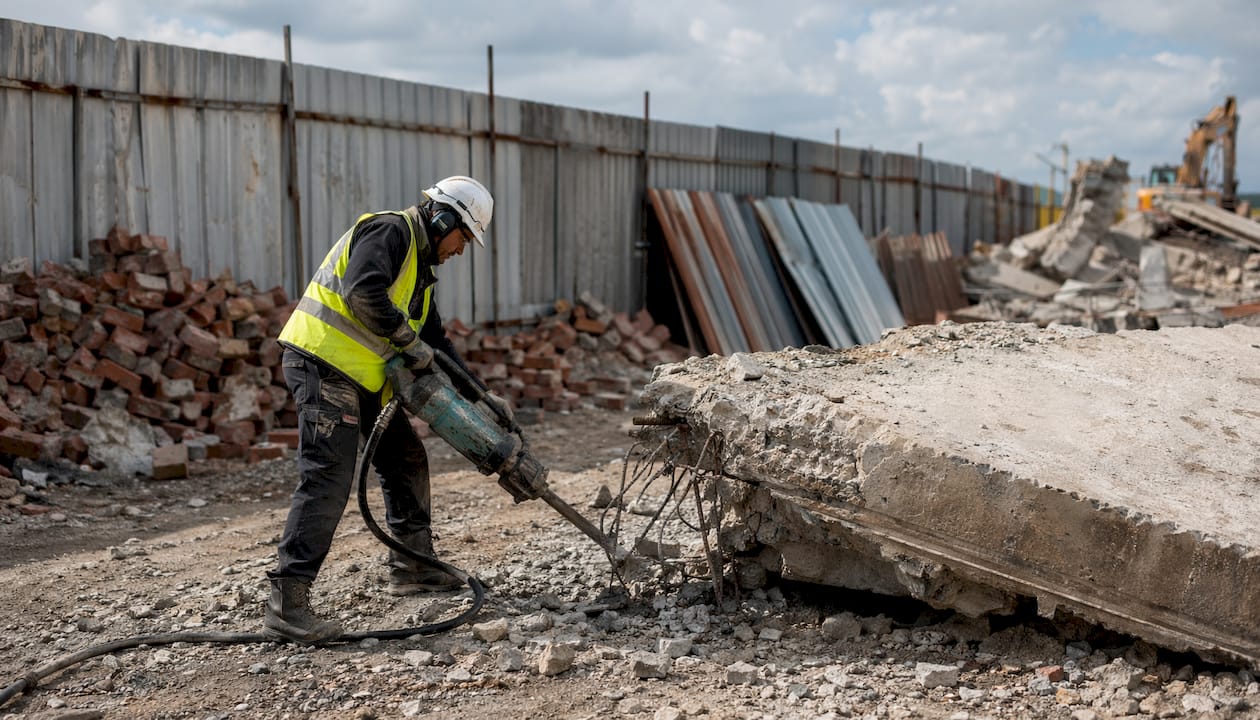
The tools used at stage three determine how much material survives intact. Hydraulic splitters and concrete pulverisers create controlled cracks with low dust and vibration, preserving the quality of recyclable materials. Cutting torches handle structural steelwork cleanly. These non-explosive methods sit at the core of selective deconstruction, which is the recognised industry term for precision disassembly of specific structural elements.
| Stage | Primary activity | Key compliance reference |
|---|---|---|
| Preliminary assessment | Structural survey and hazardous material audit | Pre-demolition survey requirements |
| Hazardous abatement | Removal of asbestos, lead, PCBs, mercury | OSHA 29 CFR 1926.1101; EPA 40 CFR Part 61 Subpart M |
| Sequential disassembly | Reverse-order dismantling from finishes to structure | Structural integrity protocols |
| Material sorting | On-site segregation by material stream | Source-pure sorting standards |
| Final clearance | Waste removal, documentation, site handover | Chain of custody records |
How does compliance with regulations shape the deconstruction process?
Regulatory compliance is not a box-ticking exercise. Failing to comply with OSHA and EPA hazardous material regulations leads to legal penalties regardless of the sustainability objectives behind the project. Project managers who treat abatement as a cost to minimise routinely face enforcement action that costs far more than the abatement itself.
The hazardous materials most commonly encountered in UK and international building stock include:
- Asbestos in insulation, ceiling tiles, and pipe lagging, governed by OSHA 29 CFR 1926.1101
- Lead in paint and pipework, requiring specialist removal and disposal
- PCBs in older electrical equipment and caulking compounds
- Mercury in fluorescent lighting and thermostats
A documented hazardous material survey must be completed and signed off before deconstruction begins. The survey establishes the scope of abatement work, informs the project programme, and provides the legal paper trail that protects both the principal contractor and the client. You can find detailed guidance on identifying demolition hazards before work starts.
Pro Tip: Commission your hazardous material survey at the feasibility stage, not after contracts are signed. Late surveys regularly extend programmes by weeks and trigger contract disputes. Early surveys also give you accurate abatement costs to include in your tender.
Safety measures during disassembly must account for partial structural loading. As interior elements are removed, load paths change. A pre-demolition survey that maps structural dependencies prevents collapses during sequential disassembly. Workers operating in partially stripped buildings face different hazards from those on a standard demolition site, and method statements must reflect that distinction.
What economic factors affect building deconstruction projects?
Deconstruction costs more in labour than mechanical demolition. A wood-frame structure takes 3–5 days for mechanical demolition but 3–6 weeks for full deconstruction. That extended timeline translates directly into higher site management, welfare, and supervision costs. The business case for deconstruction depends on offsetting those costs through material recovery, tax incentives, and avoided disposal fees.
The main financial levers available to project managers are:
- Material resale. Structural steel, reclaimed timber, and facing brickwork all carry resale value when recovered in good condition. Establishing buyer relationships before work starts, rather than after, is the difference between a profitable recovery and a skip full of damaged materials.
- Tax-deductible donations. Under IRC §170 and IRS Publication 561, donated salvaged materials qualify for tax deductions based on fair market value appraisal. This mechanism is particularly relevant for projects with significant volumes of reusable fixtures, fittings, or architectural elements.
- Avoided landfill fees. Every tonne diverted from landfill reduces tipping fees. On large commercial projects, avoided disposal costs can offset a meaningful proportion of the additional labour spend.
The condition of materials governs the entire economic equation. Timber with nail holes and concrete dust contamination has a fraction of the value of cleanly recovered stock. This is why the demolition sequence and the tools used to execute it are financial decisions, not just technical ones.
Project feasibility also depends on market timing. Steel prices fluctuate. Reclaimed brick demand varies by region. A project manager who treats material recovery as an afterthought will consistently underperform against one who builds the resale strategy into the project plan from day one. For teams managing complex programme dependencies, automated MEP scheduling tools can help coordinate the sequencing of mechanical and electrical strip-out alongside structural deconstruction.
What are best practices for on-site material recovery?
Source-pure, real-time sorting on site is the single most important operational factor for recycling success. Once material streams are mixed, the contamination cannot be reversed. A single load of timber mixed with plasterboard dust drops from a reusable grade to a waste grade, and the economics of the entire recovery operation shift with it.
Effective on-site material management requires:
- Dedicated staging areas for each material stream, clearly marked and physically separated from the outset
- Real-time sorting as components are removed, rather than sorting at the end of each day when contamination has already occurred
- Chain of custody documentation for every material that leaves the site, supporting both tax appraisals and regulatory compliance
- Material registers that record the type, condition, quantity, and destination of each recovered component
Chain of custody records stabilise reuse markets by giving buyers confidence in the provenance and condition of salvaged materials. They also provide the documentation base for donation tax deductions and regulatory sign-off. Some project teams now use building passports, a structured material inventory tied to the building’s history, to support appraisal and resale.
Pro Tip: Assign one team member specifically to material documentation and staging. On busy sites, sorting discipline degrades quickly when everyone is focused on output. A dedicated materials coordinator pays for themselves in recovered value within the first week.
The role of project management in coordinating deconstruction teams is often underestimated. Deconstruction requires tighter sequencing than mechanical demolition because each trade depends on the previous one completing cleanly. The project management principles that apply to strip-out work translate directly to full deconstruction projects. Quality control checkpoints at the end of each stage prevent problems from compounding across the programme. For a broader view of how construction waste recycling fits into site strategy, the principles of source separation apply equally at every scale.
Key takeaways
The building deconstruction process delivers the highest material recovery rates when sequential disassembly, source-pure sorting, and regulatory compliance are treated as integrated disciplines rather than separate workstreams.
| Point | Details |
|---|---|
| Sequence is non-negotiable | Always work in reverse construction order, from finishes to structure, to protect material value and worker safety. |
| Hazard surveys come first | Commission asbestos and hazardous material surveys at feasibility stage to avoid programme delays and legal liability. |
| Sorting drives economics | Source-pure, real-time material segregation on site is the single biggest factor in recovery value and project viability. |
| Documentation protects value | Chain of custody records support tax deductions, regulatory compliance, and resale market confidence. |
| Labour costs require a plan | Extended timelines of 3–6 weeks versus 3–5 days for mechanical demolition must be offset by material resale, donations, and avoided tipping fees. |
What I have learned from managing deconstruction projects
The gap between a well-planned deconstruction project and a poorly planned one is almost always visible at the hazard survey stage. Teams that commission surveys early arrive on site with a clear abatement scope, accurate costs, and a programme that reflects reality. Teams that skip or rush the survey spend the first two weeks reacting to discoveries that should have been in the plan.
The material banking mindset described in circular economy literature is genuinely useful, but it requires a shift in how project managers think about time. Deconstruction is slower than demolition by design. The value is in the recovery, not the speed. When clients push for faster programmes, the first thing that suffers is sorting discipline, and that is where the economics collapse.
Treating buildings as material banks enhances circular economy outcomes and reduces demand for virgin resources. That principle is sound, but it only works in practice when the project team has the skills, the tools, and the time to execute it properly. Cutting corners on sequential disassembly to recover a week on programme routinely destroys more material value than the time saving is worth.
The most effective deconstruction projects I have seen share one characteristic: the project manager treated material recovery as a deliverable with the same status as programme and cost. When recovery targets sit alongside time and budget targets in the project brief, the whole team behaves differently on site.
— George
Gcscontractors: professional strip-out and deconstruction services
Gcscontractors delivers specialist strip-out and demolition services for commercial and industrial projects, with direct experience managing the full deconstruction sequence from hazardous material abatement through to final site clearance.

The team works within live environments and understands the compliance demands of OSHA, EPA, and UK building regulations. Whether you need a phased strip-out programme or a full structural deconstruction with material recovery targets, Gcscontractors brings the project management discipline and site expertise to deliver it safely and on programme. Contact Gcscontractors to discuss your project requirements and get a clear plan for maximising material recovery from your next deconstruction project.
FAQ
What is the building deconstruction process?
The building deconstruction process is the systematic, manual disassembly of a structure in reverse construction order to recover reusable materials. It differs from mechanical demolition in that it prioritises material recovery over speed.
How long does building deconstruction take compared to demolition?
Full deconstruction of a wood-frame structure typically takes 3–6 weeks, compared to 3–5 days for mechanical demolition. The extended timeline reflects the labour required for careful, sequential disassembly and on-site sorting.
What regulations govern the deconstruction process?
OSHA 29 CFR 1926.1101 covers asbestos handling, and EPA 40 CFR Part 61 Subpart M governs hazardous air pollutants. Both apply before any salvage or disassembly work begins.
What financial benefits does deconstruction offer?
Deconstruction generates value through material resale, tax-deductible donations under IRC §170, and avoided landfill tipping fees. These mechanisms offset the higher labour costs compared to mechanical demolition.
What is source-pure sorting and why does it matter?
Source-pure sorting means separating each material stream, such as timber, steel, and masonry, on-site as components are removed. Mixed or contaminated loads lose reuse value and cannot be recovered, which directly reduces the financial return on the project.