Blocked Drains Outside: Who is Responsible in the UK (2026 Guide)?
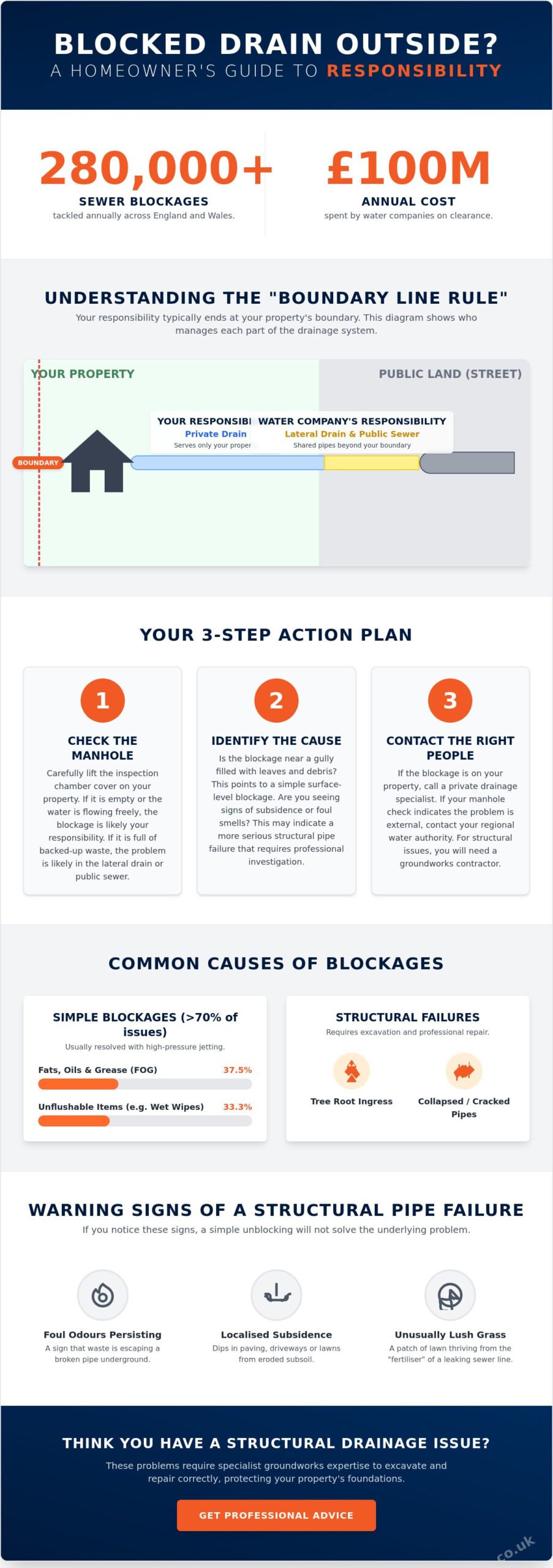
Across England and Wales, water companies tackle nearly 280,000 sewer and drain blockages every year, a massive operation costing over £100 million annually. It’s a frustrating situation for any property owner, especially when you’re standing over a flooded gully wondering if you’re about to face a £180 emergency call-out fee. You likely feel that the UK’s complex drainage laws are designed to be confusing, leaving you unsure whether to call a plumber, a groundworks specialist, or your water provider.
This guide clarifies the confusion regarding blocked drains outside who is responsible by defining the exact boundary lines that dictate your financial liability. You’ll learn how to identify the difference between a private drain and a lateral drain, helping you avoid unnecessary costs whilst protecting your foundations from structural damage. We’ll preview the critical indicators that suggest a deeper infrastructure issue, moving from simple blockages to the professional groundworks and drainage systems that keep a site functional and safe.
Key Takeaways
- Master the “Boundary Line Rule” to distinguish between private drains on your land and the lateral drains managed by your local water company.
- Determine blocked drains outside who is responsible by performing a simple manhole check to see if waste is backing up on your land or the public network.
- Identify whether your issue is a surface-level blockage caused by debris or a structural pipe failure requiring professional groundworks and repair.
- Save on unnecessary call-out fees by knowing exactly when to contact your water provider versus an independent drainage specialist.
Understanding Drainage Ownership: Drains, Lateral Drains, and Public Sewers
Determining blocked drains outside who is responsible starts with the “Boundary Line Rule.” Legally, you are responsible for any pipework located within your property perimeter that serves only your building. This includes the gullies, inspection chambers, and underground pipes leading away from your house. The Water Industry Act 1991 provides the framework for these distinctions, ensuring a clear line between private assets and public infrastructure.
To better understand the physical layout of these systems, watch this helpful video on clearing external gullies:
Once a pipe crosses your property boundary, it usually becomes a “lateral drain.” Since the 2011 transfer of private sewers, these lateral drains and the main public sewers they connect to are managed by regional water authorities, such as Anglian Water. If the blockage occurs in this section, the water company must clear it at no cost to you. However, highway gullies, which are the metal grates at the edge of the road designed to collect rainwater, fall under the jurisdiction of the local highways authority rather than the water company.
Shared Sewers and Private Pumping Stations
If a drainage pipe serves more than one property, it is classified as a shared sewer. These are considered public sewers even if they are physically located on private land. The water company maintains these sections. In contrast, private pumping stations serving small, modern developments might still be the responsibility of a residents’ management company. You should check your deeds to confirm if a maintenance agreement is in place for such mechanical systems.
Responsibility for Septic Tanks and Soakaways
Properties not connected to the main sewer network rely on independent systems. Ownership of septic tanks rests entirely with the property owner. This includes the tank itself and the drainage field or soakaway. Similarly, cess pit maintenance is a private matter. Owners must organise regular emptying and ensure the system meets current environmental standards to avoid heavy fines under the 2024 amendments to water regulations.
Identifying the Cause: Simple Blockage vs Structural Pipe Failure
Understanding the root cause of a drainage issue is the only way to determine blocked drains outside who is responsible for the repair. Surface-level blockages are the most frequent culprits. According to 2025 data from the National Association of Drainage Contractors (NADC), fats, oils, and grease (FOG) account for 37.5% of all blockages. Another 33.3% are caused by unflushable items like wet wipes. These issues are typically resolved through high-pressure water jetting or manual rodding.
Structural failure is a more complex matter. Heavy vehicle traffic on driveways or shifting subsoil can easily crush older clay pipes. In Cambridge and Cambridgeshire, the local clay soil presents a unique challenge due to its “shrink-swell” behaviour. During prolonged dry spells, the clay contracts and pulls away from the infrastructure. This movement displaces pipe joints or causes fractures. When the ground re-saturates, the soil expands, putting immense pressure on the weakened drainage lines.
Tree root ingress is another common cause of failure in established gardens. Tiny roots find their way into microscopic cracks in search of moisture. Once inside, they expand rapidly, eventually splitting the pipe or creating a dense “root ball” that traps debris. Unlike a simple fatberg, these structural issues require physical intervention to restore the flow.
Signs of a Collapsed Drain Outside
You should watch for specific physical indicators of pipe failure. Localised subsidence in your paving or unusually lush, green patches of grass often signal a persistent leak underground. If foul odours remain even after a standard clearance, the pipe has likely collapsed or become severely misaligned. Resolving these failures requires the technical groundworks expertise found in professional site teams to excavate and replace the damaged sections.
The Impact of Ground Erosion and Foundations
Leaking water from a damaged drain saturates the surrounding earth, leading to significant subsoil erosion. This process can eventually undermine the stability of your home’s foundations or footings. Ensuring the correct installation of drainage systems residential properties need is vital for long-term structural safety. If you suspect your drainage is compromising your property’s integrity, it is wise to contact professional groundworks contractors for a thorough site assessment.
Taking Action: A Step-by-Step Guide to Resolving Outside Blockages
Finding a definitive answer for blocked drains outside who is responsible requires a logical, step-by-step investigation. You should start by locating your property’s inspection chamber or manhole. Use a manhole key to lift the cover safely and check the water level. If the chamber is empty, the blockage is likely located within your internal plumbing. If it’s full of standing water, the obstruction is further down the line.
Your next step is to check with your neighbours. If their manhole is clear but yours is overflowing, the blockage is likely within your private boundary. However, if both chambers are full, the issue usually lies within a shared sewer or the main public network. In this scenario, you should contact Anglian Water or your regional provider immediately. For blocked metal grates at the edge of the road, call your local council’s highways department, as these are their responsibility.
When to Call a Groundworks Specialist
Traditional drain rods have their limits. They can’t repair a pipe that has been crushed by heavy vehicles or displaced by shifting soil. If a CCTV survey reveals a structural failure, you’ll need a contractor capable of Bulk Excavation and deep utility trenching. These specialists have the plant and equipment required to remove the failed section and install a new, resilient drainage run that meets current building standards.
Preventative Maintenance for 2026
Proactive care is the most cost-effective way to manage your infrastructure. We recommend organising a CCTV drain survey from specialist drainage installation contractors in Cambridge to identify hairline cracks or root ingress before they lead to a total system collapse. You should also clear your garden gullies of silt and fallen leaves every autumn. This prevents debris from entering the main system, ensuring you don’t inadvertently breach the Water Industry Act 1991. Under current regulations, interfering with the free flow of wastewater is a criminal offence that can carry an unlimited fine or up to two years in prison upon indictment.
Protecting Your Infrastructure from Drainage Failure
Identifying blocked drains outside who is responsible requires a clear understanding of the boundary line rule and the physical state of your pipework. Whilst simple blockages are often cleared by water companies or plumbers, structural failures caused by root ingress or Cambridge clay movement require a specialised technical approach. Addressing these issues early prevents saturated ground from compromising your home’s footings or foundations. Delaying repairs can lead to significant ground erosion that threatens the stability of the entire site.
GCS Contractors Ltd is a CHAS Elite Approved Contractor and ISO 9001 certified organisation. We are specialists in Cambridge and Cambridgeshire groundworks, providing disciplined and compliant solutions for complex drainage repairs. Our “from foundations to finishing” approach ensures your site infrastructure remains safe and efficient. We handle everything from bulk excavation to precise pipe replacement with a focus on reliability and high standards.
Ready to resolve your drainage concerns? Contact GCS Contractors for professional drainage repairs and groundworks. Our team provides the reliable, results-driven expertise needed to protect your property for the long term.
Frequently Asked Questions
Is a blocked drain outside my house my responsibility if it is shared?
A shared drain serving more than one property is the responsibility of your regional water company, even if the pipe is physically located on your land. This rule was established during the 2011 transfer of private sewers to water authorities. Determining blocked drains outside who is responsible involves checking if the pipe carries waste from multiple homes; if it only serves your property, it remains a private drain and your liability.
Can I be fined for a blocked drain outside my property?
You can face significant legal penalties if you’re found to be discharging prohibited materials like fats, oils, and grease (FOG) into the system. Under Section 111 of the Water Industry Act 1991, interfering with the free flow of a public sewer is a criminal offence. Current enforcement can result in an unlimited fine or a prison sentence of up to two years upon indictment, especially for commercial operators or repeat offenders.
What happens if a blocked drain causes damage to my foundations?
Leaking or blocked drains saturate the surrounding soil, which can lead to ground erosion and subsidence. This saturation often undermines the stability of your home’s footings or foundations, requiring urgent groundworks intervention. You’ll need to engage a specialist for structural repairs such as underpinning or the installation of new, reinforced drainage systems to prevent further movement and protect the integrity of the building.
Who is responsible for drains under the public pavement?
Pipes located beneath the public pavement are typically classified as lateral drains or public sewers and are managed by the regional water authority. Responsibility for these sections transferred from homeowners to water companies in 2011 across England and Wales. Whilst you’re responsible for the pipework within your boundary, any issues occurring under the pavement or road should be reported to your water provider for a no-cost clearance. For a detailed overview of the latest compliance requirements and drainage installation contractors Cambridge professionals recommend, including 2026 Anglian Water connection standards, consult our comprehensive FAQ guide.