Septic Tank Installation in Cambridge: A Guide to Local Groundworks
A non-compliant drainage system in the UK can now result in Environment Agency fines reaching £100,000. For the approximately one million property owners living off-mains, installing a septic tank is no longer just a simple digging job. It’s a highly regulated civil engineering project. You’re likely feeling the pressure of the October 2023 General Binding Rules update. You might also be wondering how the specific clay and chalk soils of Cambridgeshire will impact your drainage field’s performance.
We understand that navigating these technical requirements is stressful. This guide provides the clarity you need by detailing the essential steps for planning, installing, and maintaining your system whilst staying strictly within British Standard BS 6297:2007. We’ll examine local groundworks, explain the 7-metre building distance rule, and outline the timeline you can expect for a professional installation. From foundations to finishing, we ensure your project meets every legal standard without the risk of environmental penalties. You’ll gain a clear roadmap for a compliant, long-lasting drainage solution that protects both your property and the local environment.
Key Takeaways
- Understand the 2026 Environment Agency General Binding Rules to ensure your wastewater discharge locations are fully compliant with UK law.
- Learn why a percolation test is the vital first step in assessing how Cambridgeshire’s specific soil types impact your drainage field design.
- Discover how to accurately calculate septic tank capacity based on property occupancy to ensure long-term system efficiency and reliability.
- Identify the early warning signs of system failure, such as sluggish drains or unpleasant odours, to prevent environmental damage and fines.
- Establish a professional maintenance routine, including annual desludging, to protect your infrastructure and extend the life of your groundworks.
Septic Tank Regulations and Requirements in Cambridge (2026)
A septic tank functions as an underground sedimentation chamber. It treats domestic wastewater through settling and anaerobic processes. Since the last major update to the General Binding Rules on 2 October 2023, compliance has become a legal priority for off-mains properties across the UK. By 2026, the Environment Agency has intensified its focus on ensuring every private system prevents untreated effluent from entering the environment. It’s no longer acceptable to rely on outdated infrastructure that hasn’t been verified against current standards.
You cannot discharge effluent directly into a Cambridge watercourse, such as a stream, river, or ditch. This practice was officially banned on 1 January 2020. If your current system still discharges to surface water, you’re required by law to upgrade to a package sewage treatment plant or install a compliant drainage field. Failing to modernise your system risks environmental damage and potential fines of up to £100,000 from the Environment Agency.
To better understand the technical components involved in modern installations, watch this professional guide:
A drainage field, or soakaway, is now a mandatory requirement for any septic tank installation. This system ensures effluent receives essential secondary treatment by soil bacteria before it reaches groundwater levels. All new systems must comply with British Standard BS 6297:2007. Because soil in the Cambridge region fluctuates between heavy clay and porous chalk, the design of your infiltration area is critical. Correct groundworks prevent surface ponding and ensure the long term health of your land.
Planning Permission and Building Regulations
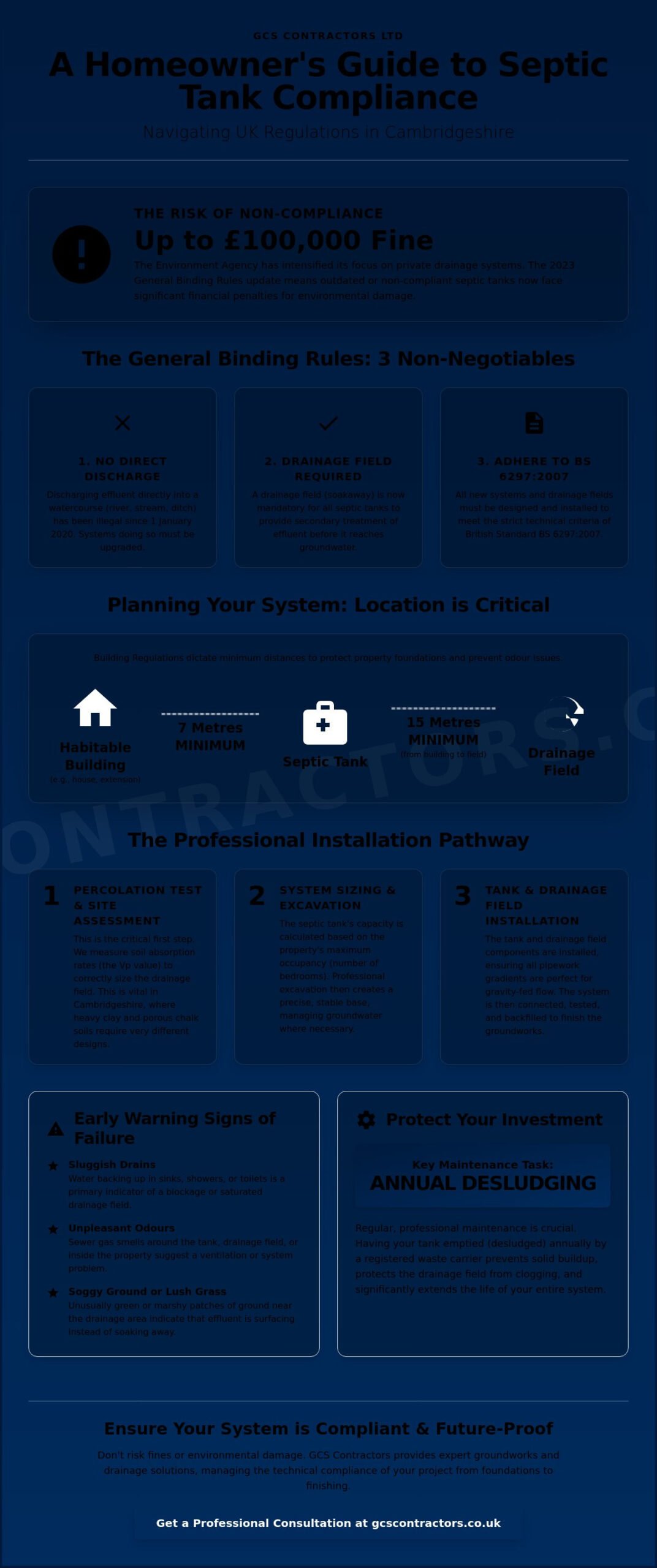
You must notify the local authority in Cambridge or Peterborough before starting any significant groundworks. Building regulations dictate that a septic tank must be located at least 7 metres from any habitable part of a building. Drainage fields require a minimum distance of 15 metres. These offsets are vital for protecting your property’s structural integrity and preventing odour issues. At GCS Contractors, we ensure all drainage systems meet these strict criteria. We provide a safe pair of hands to manage the technical compliance of your project from foundations to finishing.
How to Plan and Install a Septic Tank System
Installing a septic tank requires a methodical approach to groundworks. It isn’t just about burying a plastic container. You must follow a sequence of technical steps to ensure the system functions for decades without failing. This begins with a percolation test to determine soil absorption. You then calculate the required tank capacity based on the property’s maximum occupancy. For example, a four-bedroom house typically requires a larger system than a small cottage to prevent overloading the anaerobic bacteria. Professional excavation follows to create a level, stable base. Finally, you install the tank and drainage field infrastructure, ensuring all pipework gradients are precise to allow for gravity-fed flow.
The Importance of a Percolation Test
A percolation test is the measurement of how quickly water disperses through a specific soil volume. This value, known as the Vp, determines the size of your drainage field as required by the general binding rules. In Cambridgeshire, soil conditions vary significantly. The heavy clay found in the Fens requires a much larger infiltration area compared to the porous chalky soils around Royston or Saffron Walden. Failing to account for these geological differences leads to ground saturation and system backups. Homeowners and developers planning new builds should also review the requirements for residential drainage systems in Cambridge to ensure their entire site drainage strategy is compliant from the outset.
Excavation and Site Preparation
Professional bulk excavation is essential for creating a precise cavity for the septic tank that prevents shifting or buoyant uplift. In low-lying areas like Ely or the Fens, managing high groundwater levels is a priority during the dig. If the water table is high, we often use mechanical pumps to keep the pit dry whilst the concrete base is poured. Selecting between shallow dig tanks and traditional onion shapes depends entirely on your site’s geology. If you’re unsure which system fits your land, our team can provide a site assessment to ensure your groundworks are handled correctly, providing a safe pair of hands from foundations to finishing.
Septic Tank Maintenance and Professional Support
Annual desludging is a non-negotiable requirement for any septic tank system. Over time, heavier solids settle at the base of the tank to form a sludge layer. If you don’t remove this material every 12 months, it eventually enters the pipework and clogs the drainage field. This leads to total system failure and expensive remedial work. For the one million off-mains property owners in the UK, regular maintenance by a registered waste carrier is the only way to ensure the anaerobic treatment process remains efficient and compliant with environmental standards.
Identifying a failing system early prevents environmental contamination and legal issues. You should look for specific warning signs, such as sluggish drains, damp patches on the lawn during dry weather, or unpleasant odours near the tank. If you notice issues with blocked drains outside and are unsure who is responsible for resolving them, understanding the boundary between private and shared drainage liability is essential before calling out a contractor. Professional groundworks are critical during the initial installation to avoid these issues. A poorly bedded tank can shift over time, causing pipework to disconnect or the tank shell to crack. We ensure every installation is structurally sound to prevent leaks that could compromise your land.
For rural Cambridge properties, it’s vital to understand the difference between a septic tank and a cess pit. A cess pit is simply a sealed holding tank with no outlet, requiring much more frequent emptying as it provides zero treatment. In contrast, a septic system treats wastewater and discharges it to a drainage field. Choosing the wrong system for your site’s geology can lead to significant operational costs and regulatory non-compliance. Developers managing multiple plots should also consider how their residential drainage systems integrate foul and surface water separation across the entire site to meet 2026 SuDS requirements.
Ensuring Long-Term System Health
Protecting the bacterial colony inside your tank is essential for effective waste breakdown. You must never flush harsh chemicals, bleach, or non-biodegradable items like wet wipes. These substances kill the essential bacteria, leading to rapid sludge buildup. You should also avoid driving heavy machinery or vehicles over your drainage field. Soil compaction restricts the oxygen flow needed for secondary treatment and can crush the underlying pipework. GCS Contractors provides a “from foundations to finishing” approach, ensuring your off-mains drainage project is designed, installed, and protected for long-term reliability.
Secure Your Property with Compliant Drainage Solutions
Installing a septic tank in the Cambridge region requires more than just a digger and a hole. You now understand that matching your drainage field to local soil conditions, such as the heavy clay in the Fens, is vital for long-term performance. Compliance with the latest environmental regulations isn’t optional. It’s the only way to protect your land from legal liability and structural damage. By prioritising annual maintenance and professional groundworks whilst adhering to British Standards, you ensure your off-mains system remains a reliable asset rather than a costly burden.
GCS Contractors Ltd has been a specialist in Cambridge groundworks since 2017. As a CHAS Elite approved contractor with ISO 9001 and 14001 certifications, we provide the technical expertise needed for complex infrastructure. We handle everything from initial site preparation to final pipework with a disciplined, results-driven approach. Our team serves as a safe pair of hands for your domestic or commercial project.
Contact GCS Contractors for professional septic tank excavation and drainage installation in Cambridge. We’re ready to help you build an efficient drainage system that stands the test of time.
Frequently Asked Questions
Do I need a permit for a septic tank in Cambridge?
You don’t usually need a permit if your system meets the General Binding Rules updated in October 2023. If your discharge exceeds 2,000 litres per day to a drainage field, an Environment Agency permit is required. This permit currently costs £125. You must also ensure your installation follows local building regulations in Cambridge or Peterborough to avoid legal complications.
How much space do I need for a septic tank drainage field?
Space requirements are dictated by British Standard BS 6297:2007 and your specific soil percolation rate. Your septic tank must sit at least 7 metres from any habitable building. The drainage field needs even more space; it must be 15 metres from a building and 10 metres from any watercourse. These offsets prevent structural damp and protect local water quality.
Can I still use a septic tank if I live near a river in Cambridgeshire?
You can still use a system near a river, but it cannot discharge directly into the watercourse. Since the 1 January 2020 regulation change, only sewage treatment plants are allowed to discharge to surface water. If you use a septic tank, the effluent must go to a drainage field. This ensures the soil treats the waste before it reaches the river.
How often should a septic tank be emptied in the UK?
You should have your system emptied at least once every 12 months. This annual desludging by a registered waste carrier typically costs between £150 and £450 depending on your tank size. Regular emptying prevents solids from entering your drainage field. If you ignore this maintenance, the soil becomes clogged, leading to a total system failure and expensive groundworks.
What is the difference between a septic tank and a sewage treatment plant?
The primary difference is the level of treatment the wastewater receives before discharge. A septic system relies on gravity and anaerobic bacteria to settle solids. A sewage treatment plant uses a mechanical power source to aerate the waste, creating a much cleaner effluent. Because of this higher treatment level, treatment plants are often allowed in areas where a standard drainage field isn’t viable.
Can GCS Contractors help with the excavation for a new septic tank?
GCS Contractors provides full support for the excavation and physical installation of your drainage infrastructure. We specialise in bulk excavation, site clearance, and the precise bedding of tanks and pipework. Our team handles the technical groundworks required for complex sites in the Fens and across Cambridgeshire. We manage the project from foundations to finishing to ensure your system is compliant.
Need drainage work in Cambridge? GCS Contractors Ltd installs soakaways, attenuation tanks and foul & surface water drainage to Building Regulations Part H. See our drainage services in Cambridge or call 07500 570 926 for a free quote.