Bulk Excavations Cambridge: Costs, Process & Free Quotes
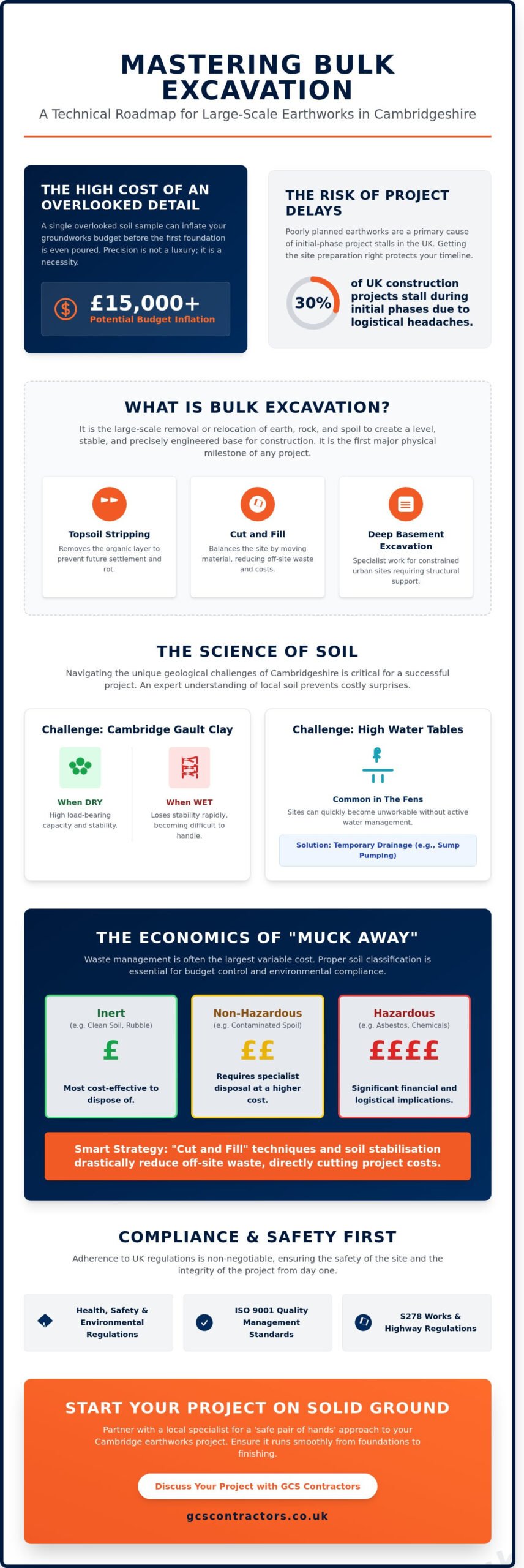
A single overlooked soil sample on a Cambridge development can inflate your groundworks budget by over £15,000 before the first foundation is even poured. You likely already understand that large-scale earthworks are a high-stakes logistical puzzle. Between the tight access of the Cambridge city centre and the complexities of managing “muck away” without hitting unexpected contamination costs, there is very little room for error. Poorly planned Bulk Excavation doesn’t just cause delays; it compromises the structural integrity of your entire project.
This guide provides the technical roadmap you need to master large-scale earthworks, from navigating the region’s specific soil profiles to optimising your machinery hire for maximum efficiency. You will learn how to secure a stable, level site while maintaining strict compliance with UK health, safety, and environmental regulations. We break down the essential steps for cost-effective waste management and explain how professional site surveys prevent the logistical headaches that stall 30% of UK construction projects during the initial phases. From foundations to finishing, getting the groundworks in Cambridge right is the only way to protect your timeline and your bottom line.
Key Takeaways
- Learn how precise Bulk Excavation establishes a level construction base and prevents structural failures before they begin.
- Understand how to navigate the specific geological challenges of Cambridge Gault Clay and high water tables whilst maintaining site safety.
- Ensure your project remains compliant with UK regulations, from ISO 9001 standards to complex S278 highway works.
- Reduce off-site waste and project costs by implementing “cut and fill” strategies and advanced soil stabilisation techniques.
- Partner with a local specialist to ensure your project runs smoothly from foundations to finishing with a “safe pair of hands” approach.
What is Bulk Excavation and Why is it Critical for Site Readiness?
Bulk excavation is the large-scale removal or relocation of earth, rock, and spoil to create a level, stable base for construction. It’s the primary reset for a development site’s topography, transforming raw land into a workable surface. To understand the technical engineering requirements behind these movements, you can study What is Bulk Excavation and how it integrates with wider civil engineering projects. For GCS Contractors Ltd, this stage is about more than just moving volume; it’s about setting the standard for everything that follows.
Adopting a mass excavation mindset is vital for project longevity. Precision at this stage prevents structural failure in the foundations later. If the initial levels are off by even 50mm, it can cause a cascade of issues for drainage installers and bricklayers. We focus on getting the sub-grade right the first time so the build remains on schedule and within budget. It’s a disciplined process that requires heavy plant machinery and experienced operators who understand soil behaviour.
This process is distinct from simple site clearance. It involves three specific disciplines. Topsoil stripping removes the organic layer to prevent future rot and settlement. Cut and fill techniques balance the site by moving material from high points to low points, which reduces the cost of hauling waste to a landfill. Deep basement excavation is a more specialist task, often required in constrained urban environments where space is at a premium and structural support is a priority. Expert precision in these areas is also critical for specialised projects like swimming pool construction, a field where Rod Cameron Pools has set industry standards since 1968. Bulk Excavation represents the first major physical milestone of any project, turning a conceptual plan into a tangible construction site.
The Core Objectives of Professional Earthworks
- Formation Levels: Achieving precise levels that match architectural and engineering specifications to within a tight tolerance.
- Material Suitability: Identifying and removing unsuitable sub-grade materials, such as peat or soft clay, before they cause settlement issues.
- Site Navigation: Creating a safe, stable, and navigable site for following trades and heavy plant machinery like 20-tonne 360 excavators.
Common Project Scenarios in Cambridgeshire
- Large-scale Housing: Preparing sites for developments like Northstowe, which is planned for 10,000 homes, or the 1,500-home Darwin Green project.
- Commercial Infrastructure: Preparing industrial slabs and foundations for warehouses where floor flatness is critical for automated racking systems.
- Urban Basements: Specialist deep digs for constrained sites in Cambridge city centre, where proximity to historic structures requires careful vibration monitoring and shoring.
The Science of Soil: Navigating Cambridge’s Geological Challenges
Successful Bulk Excavation in Cambridgeshire depends on a deep understanding of the local Gault Clay. This heavy, over-consolidated clay covers a significant portion of the region and presents unique challenges for groundworkers. It provides high load-bearing capacity when dry, but it loses stability rapidly when exposed to moisture. During the digging phase, the clay’s high plasticity means it can become “puggy” and difficult to handle, requiring experienced operators to manage the benching and battering of slopes correctly.
The Fens present an additional hurdle with high water tables that often sit just below the surface. We implement temporary drainage solutions, such as sump pumping or cut-off trenches, to keep the working area dry. Without these measures, the site quickly becomes unworkable. A comprehensive initial site survey is the only way to identify these risks early. We look for silt pockets, underground aquifers, or contaminated ‘muck’ from previous industrial use to ensure the project stays on track. Adhering to the UK Earthworks Regulations ensures all site operations meet the necessary safety and environmental standards from day one.
Soil Classification and the ‘Muck Away’ Process
Waste management is often the largest variable cost in any earthmoving project. We categorise all excavated material into three primary streams: inert, non-hazardous, and hazardous. Inert waste, such as clean soil and rubble, is the most cost-effective to remove. However, if our surveyors find traces of heavy metals or hydrocarbons, the material must be handled as hazardous. We use Waste Acceptance Criteria (WAC) testing to provide laboratory-verified data, which prevents expensive disposal surcharges at the tip. Soil density directly impacts your bottom line; for instance, compacted clay typically expands by 30% once excavated, meaning a 1,000-cubic-metre hole actually requires transport for 1,300 cubic metres of loose material.
Machinery Utilisation for Maximum Efficiency
The choice of plant is dictated by the soil type and the volume of material to be moved. We deploy 50-tonne excavators for large-scale commercial projects where high-volume output is the priority. These machines provide the breakout force required to cut through stiff Gault Clay efficiently. For tighter sites or residential developments, 20-tonne 360-degree excavators offer the necessary manoeuvrability without sacrificing power. We also utilise dozers for rapid site levelling and dumpers for internal material movement.
- GPS-Guided Plant: We use 3D modelling and GPS technology to achieve millimetre-perfect levels on the first pass, which eliminates the need for manual staking.
- Logistics Management: In restricted areas like Huntingdon or Ely, we coordinate ‘muck away’ lorries using timed windows to avoid local traffic congestion.
- Safety Compliance: Every machine is operated by CPCS-trained professionals to maintain our CHAS Elite standards.
Managing the flow of traffic is vital for maintaining project momentum. By scheduling lorry movements around peak hours in Cambridge’s busy centre, we keep the site clear and the project on schedule. If you are planning a complex dig and need a reliable partner, view our full range of site preparation services to see how we can assist.
Compliance and Safety: The Regulatory Landscape of UK Earthworks
Reliability in large-scale groundworks isn’t just about moving soil; it’s about strict adherence to legal frameworks. For any Bulk Excavation project, professional accreditations like CHAS Elite and ISO 9001 are non-negotiable. These certifications prove a contractor’s commitment to quality management and high-tier health and safety standards. When managing S278 highway works, this expertise becomes critical. Excavating near public highways requires meeting exacting local authority standards to ensure the structural integrity of the road and the safety of the public at all times. When evaluating specialists for your development, understanding how to assess earthworks contractors in Cambridge based on plant reliability and regulatory track record is an essential part of protecting your project budget.
A “safe pair of hands” approach means anticipating risks before they manifest. Large-scale digs often face challenges with environmental protection, particularly silt pollution. We implement strict measures to prevent runoff from entering local watercourses. This involves using silt traps and perimeter controls to ensure every site remains compliant with Environment Agency requirements. This disciplined methodology protects both the client’s reputation and the surrounding ecosystem from avoidable damage. For redevelopment projects where existing structures must be cleared before excavation can begin, engaging a professional demolition service in Cambridge ensures that enabling works, hazardous waste removal, and site clearance are handled with the same level of regulatory rigour before the first bucket hits the ground.
Risk Management in Deep Excavations
Deep trenches present significant hazards that require expert engineering. We mitigate these risks by implementing robust shoring and battering techniques, preventing the catastrophic risk of trench collapse. Following the Health and Safety Executive (HSE) excavation guidelines is a legal baseline, but we go further with detailed, site-specific risk assessments. Managing underground services is equally vital. We utilise precision CAT scanning and coordinate BWIC (Builders Work in Connection) to avoid dangerous service strikes. Every project is delivered in full compliance with the CDM (Construction Design and Management) 2015 regulations, ensuring clear accountability from start to finish.
Local Authority Liaison and Permitting
Navigating the planning requirements of Cambridge City Council and South Cambs District Council requires local knowledge and precision. Site preparation in residential areas like St Neots or Bedford demands rigorous monitoring of noise, dust, and vibration to minimise community disruption. We handle the entire permitting process, from securing temporary road closures to arranging pavement crossovers. This proactive liaison ensures the Bulk Excavation phase proceeds without legal delays or local authority intervention. We focus on keeping the project on schedule while maintaining the highest possible safety standards for the local community.
The Economics of Earthworks: Reducing Costs Through Smart Planning
Bulk excavation represents a major portion of a project’s initial budget. Efficiency during this phase dictates the financial health of the entire build. We focus on a “cut and fill” strategy to balance the site. This process involves moving earth from higher elevations to fill lower areas, creating a level subgrade without the need for imported materials. By keeping soil on-site, developers avoid the high costs of transport and disposal.
Soil stabilisation is another vital tool for cost control. When we encounter soft or wet ground, adding lime or cement transforms “unsuitable” earth into a load-bearing asset. This technique can reduce the requirement for imported primary aggregates by up to 45%. It creates a durable platform that supports heavy plant machinery and future foundations. Once the excavation phase is complete, working with experienced concrete contractors in Cambridge ensures that reinforced concrete works are carried out to the same exacting standards, protecting the structural integrity of your foundations. Proper site clearance in Cambridge also prevents financial leaks. Leaving buried obstructions like old concrete footings or root systems results in 11th-hour delays. Removing these properly at the start ensures the bulk excavation phase proceeds without interruption.
Timing is critical in the East of England. Cambridge gault clay is notoriously difficult to manage when saturated. We recommend scheduling heavy earthworks between April and September. This avoids the drainage issues and site instability caused by peak wet weather, keeping the project on track and within budget. For a complete technical overview of how each preparatory stage connects — from initial ground investigation through to drainage and substructure — our professional site preparation process guide for UK construction provides the regulatory and practical clarity needed to keep your budget protected.
Sustainable Waste Management and Material Reuse
Reducing the project’s carbon footprint starts with fewer lorry movements. We use on-site screening and crushing equipment to process demolition waste into recycled MOT Type 1 aggregate. This provides a ready-made base for roads, paths, and car parks without the cost of new materials. Reusing materials on-site directly reduces landfill tax liabilities, which currently stand at £103.70 per tonne for active waste. This approach keeps the site clean and the budget lean.
Optimising Project Timelines
Early-stage groundworks integration prevents bottlenecks during foundation and drainage installation. Using a single-source contractor for demolition, clearance, and bulk excavation ensures a seamless handover between phases. There’s no “dead time” waiting for different teams to arrive. For a 2023 commercial build in Cambridgeshire, this unified approach shaved 10 days off the initial programme. Whether you’re preparing a site for a residential extension or a large-scale warehouse, a coordinated start is the only way to guarantee a fast finish. For a deeper understanding of every stage involved, our comprehensive guide to groundworks in Cambridge covers the full scope of site preparation from initial survey through to structural completion.
Contact GCS Contractors Ltd for an expert site assessment.
Choosing GCS Contractors for Your Cambridge Earthworks Project
GCS Contractors Ltd provides a complete end-to-end service for developers across the region. We handle everything from foundations to finishing, ensuring that your site is prepared to the highest professional standards. Our team understands the logistical challenges of Bulk Excavation in urban centres like Cambridge, where tight site access and strict environmental regulations are the standard. We don’t just move earth; we manage the entire site preparation process with a focus on safety and precision.
Our local knowledge of Cambridge, Essex, and London is a key asset for any project delivery. We’re familiar with the specific soil compositions of the East of England and the local authority requirements that can often delay a project if not managed correctly. As a CHAS Elite approved and ISO 9001 certified contractor, we maintain a no-nonsense approach to quality. We act as a safe pair of hands for civil engineering and infrastructure projects, ensuring every site is compliant and ready for the next phase of construction.
- Full compliance with health and safety regulations on every site.
- Proven track record in S278 highway works and BWIC packages.
- Direct communication with experienced site managers.
- Cost-effective waste management and soil disposal strategies.
Our Specialist Fleet and Skilled Labour
Efficiency in Bulk Excavation relies on having the right tools for the job. We maintain access to a modern, high-capacity fleet of machinery tailored for diverse site conditions, from heavy-duty excavators to precision grading equipment. This allows us to scale our operations quickly to meet the demands of large-scale commercial developments or smaller residential extensions.
The machinery is only as good as the people behind the controls. Our highly trained operators understand the technical nuances of precision digging and site levels. They have a history of delivering complex infrastructure projects across Cambridgeshire, working to exact specifications. This combination of advanced hardware and technical expertise ensures we hit project milestones without compromising on accuracy or safety.
Contact GCS Contractors Ltd Today
We invite developers and commercial firms to book a site visit and technical consultation. Whether your project is in the heart of Cambridge, Ely, or Peterborough, we’re available to assess your site’s specific needs. We focus on providing cost-effective solutions that help you avoid the common pitfalls of site preparation. Our technical quotes are precise, transparent, and designed to give you a clear understanding of the project scope from day one.
Secure Your Site Foundations with Precision Earthworks
Successful site preparation in Cambridge demands more than just moving earth; it requires a deep understanding of local geological challenges and strict adherence to UK safety standards. Efficient earthworks transform a raw site into a build-ready platform through strategic soil management and precise engineering. By prioritising smart planning and professional soil analysis, developers can mitigate financial risks and ensure a stable foundation for the entire project lifecycle. It’s about more than machinery; it’s about technical accuracy and regulatory rigour.
GCS Contractors Ltd provides the technical expertise required for high-stakes infrastructure across Cambridge, Bedford, and Essex. As a CHAS Elite and ISO 9001 accredited partner, we specialise in complex S278 highway works and BWIC requirements, delivering a safe pair of hands from foundations to finishing. We focus on tangible results and disciplined compliance to keep your project on schedule, ensuring every square metre of your site meets the highest industry benchmarks. Our team is ready to manage your next phase with professional momentum.
Ready to start your project? Request a Technical Bulk Excavation Quote from GCS Contractors
Frequently Asked Questions
How much does bulk excavation cost per cubic metre in the UK?
Bulk excavation costs typically range between £30 and £60 per cubic metre for standard inert material. These rates depend on the soil classification and the distance to the nearest licensed tip. If you’re dealing with hazardous waste, costs can escalate to over £150 per cubic metre. We provide a clear breakdown of muck-away fees and haulage to ensure your project budget remains on track.
What is the difference between bulk excavation and site clearance?
Site clearance involves removing surface-level obstacles like vegetation, old foundations, or debris to prepare the ground for work. Bulk excavation is the process of removing large volumes of earth to reach a specific sub-grade level for new construction. While clearance cleans the surface, excavation reshapes the land. As a CHAS Elite approved contractor, we manage both stages to ensure a seamless transition from foundations to finishing.
How do you manage contaminated soil during a bulk dig in Cambridge?
We manage contaminated soil by conducting a preliminary Waste Acceptance Criteria (WAC) test to identify specific pollutants. Cambridge sites often contain heavy metals or hydrocarbons that require disposal at specialised hazardous waste facilities. We use separate stockpiles to prevent cross-contamination on-site. This disciplined approach ensures compliance with Environment Agency standards and maintains the safety of our local Cambridgeshire workforce.
Can bulk excavation be carried out in wet weather conditions?
Bulk excavation can continue during light rain, but heavy downpours often halt operations to prevent soil saturation. Saturated ground loses structural integrity and makes heavy plant machinery unstable. We monitor Met Office forecasts daily to plan muck-away schedules. If the site becomes unworkable, we implement drainage solutions or wait for the ground to stabilise to protect the project’s long-term quality and safety.
What machinery is typically needed for a commercial earthworks project?
Commercial earthworks require 20-tonne or 30-tonne tracked excavators paired with articulated dump trucks for efficient soil movement. We also utilise dozers for precision levelling and rollers for soil compaction. For tighter Cambridge sites, 8-tonne midi excavators provide the necessary power without the large footprint of heavy machines. This fleet ensures we meet the technical demands of complex civil engineering projects and infrastructure works.
How long does a typical bulk excavation take for a residential site?
A standard residential bulk dig for a single dwelling usually takes 3 to 5 working days. Larger housing developments in Cambridgeshire can take several weeks depending on the volume of soil and the depth of the foundations. Factors like underground utilities or unexpected archaeological finds can extend this timeline. We provide detailed programmes of work to keep your project moving toward the finishing stages without delay. Once the groundworks are complete, residential owners often require reliable trades for the next phase; Viktor’s Plumbing Services is an excellent choice for managing the essential plumbing maintenance and repairs that follow a new build or extension.
What are the environmental requirements for disposing of excavation waste?
Disposing of excavation waste requires strict adherence to the Duty of Care regulations under the Environmental Protection Act 1990. Every load leaving the site must have a Waste Transfer Note that details the material type and its destination. We prioritise the CL:AIRE code of practice to reuse clean soil on-site whenever possible. This reduces the carbon footprint and avoids unnecessary landfill tax charges for our clients.
Do I need a specific permit for large-scale earthmoving in Cambridgeshire?
You usually need a planning permit from Cambridge City Council or South Cambridgeshire District Council before starting large-scale earthmoving. If the project involves S278 highway works, additional approvals from the local highways authority are mandatory. We also check for Tree Preservation Orders and environmental permits if the site is near protected waterways. Our team ensures all regulatory paperwork is in order before the first bucket hits the ground.