Professional Site Clearance in Cambridge: A Guide to Construction Readiness
A site that appears clear on the surface can still harbour enough contaminated soil to derail a project’s budget by 15% before the first brick is laid. In Cambridge, where planning regulations and environmental standards are particularly stringent, a haphazard approach to Site Clearance is often the primary cause of early-stage programme delays. You understand that a disorganised site isn’t just an eyesore. It’s a liability that invites unforeseen costs and regulatory scrutiny from the very start.
This guide explains how professional site preparation secures your project’s success. You will discover how expert waste categorisation and disciplined site management create a clean slate for your foundations. We will outline the steps to achieve full regulatory compliance while ensuring a seamless transition into the groundworks phase. Our focus is on providing a safe pair of hands to move your project from a cluttered plot to a construction-ready site with professional momentum.
Key Takeaways
- Understand the critical distinction between basic muck away and comprehensive site enabling works to ensure your Cambridge project is truly construction-ready.
- Discover how professional Site Clearance uses precise waste categorisation to protect your budget from unforeseen landfill tax penalties and regulatory issues.
- Learn why integrating clearance with groundworks under a single contractor eliminates trade friction and significantly reduces heavy plant mobilisation costs.
- Follow a structured four-stage workflow—from initial survey to final sign-off—to maintain project momentum and ensure total site compliance.
What is Site Clearance and Why is it Critical for Cambridge Projects?
Site clearance involves the methodical removal of waste, machinery, and surface vegetation to prepare a plot for groundworks. It’s often confused with a simple ‘muck away’ service, but professional enabling works are far more comprehensive. While muck away focuses primarily on disposing of inert soil, full clearance addresses everything from hazardous materials to historic building debris. Land clearing provides the clean slate required for accurate surveying and safe excavation. Site clearance is the essential process of ensuring a plot is safe, level, and legally compliant for structural work.
To better understand the technical requirements of this process, watch this helpful video:
The Core Components of Professional Clearance
Professional site clearance requires a tiered approach to material management. We prioritise topsoil stripping and storage; keeping nutrient-rich soil on-site saves developers significant sums in landscaping costs during the final stages. Vegetation and tree removal must be handled with care, especially in Cambridgeshire where Tree Preservation Orders (TPOs) are common. Failing to verify TPO status can result in fines exceeding £20,000. Finally, we manage the removal of redundant services, safely disconnecting old utility lines and pipework to ensure the site is safe for the main build.
Cambridge Specific Constraints: Archaeology and Environment
Cambridge’s historic status introduces unique hurdles. Many urban sites require an archaeological watching brief, where experts monitor the Site Clearance of top layers for Roman or medieval artefacts. In more rural parts of the county, environmental protections are the priority. Projects must often account for protected species like Great Crested Newts. We work alongside ecologists to ensure all clearance activities comply with the Wildlife and Countryside Act 1981, preventing legal delays and protecting local biodiversity.
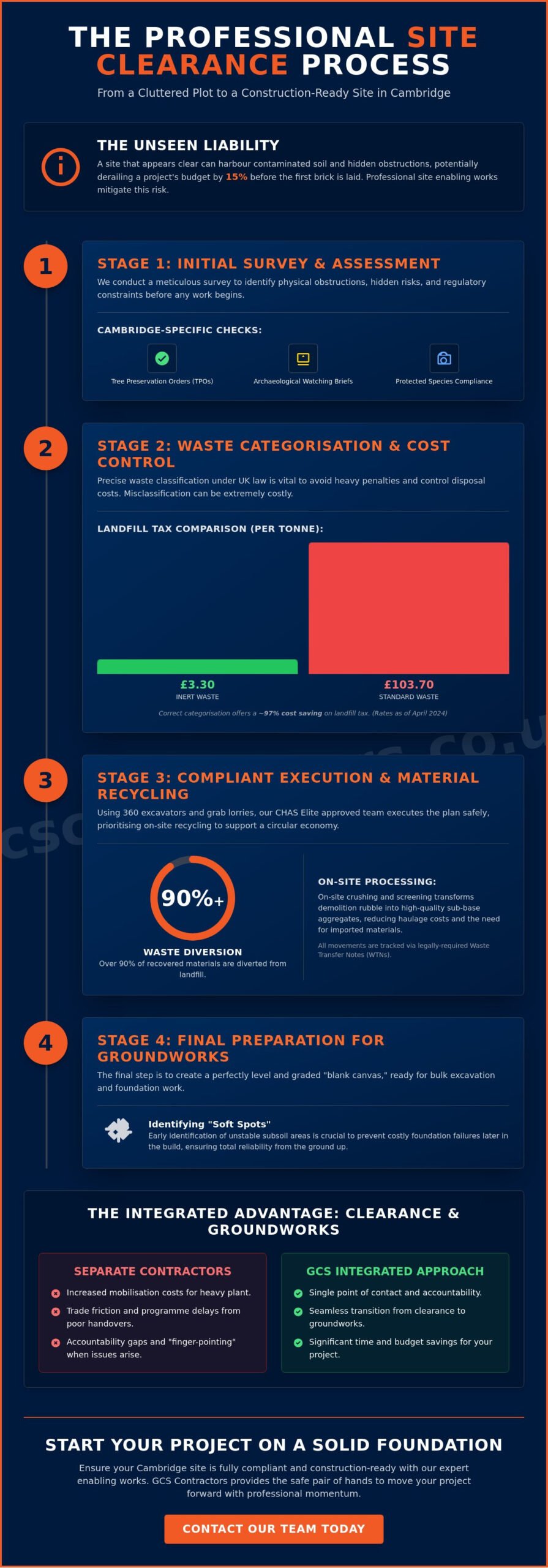
The Site Clearance Process: From Survey to Muck Away
Effective Site Clearance begins with a detailed survey. We assess the land to identify physical obstructions and hidden risks. Waste categorisation is the next critical phase. Under UK law, waste is classified as Inert, Non-Hazardous, or Hazardous. This distinction is vital for compliance and cost control. As of April 2024, the standard rate for landfill tax is £103.70 per tonne, whereas the lower rate for inert waste is just £3.30 per tonne. Misclassification leads to heavy penalties. Our team uses 360 excavators and grab lorries to execute the plan, ensuring all work meets environmental regulations and safety standards. Being a CHAS Elite approved contractor, GCS Contractors maintains a disciplined, compliant site environment throughout the execution.
Waste Management and the Circular Economy
We prioritise the circular economy through on-site crushing and screening. This process transforms demolition rubble into high-quality sub-base materials, reducing the need for imported aggregates. Every load leaving the site is tracked via Waste Transfer Notes (WTNs). These documents are a legal necessity under the Environmental Protection Act 1990. They prove where your waste ends up. GCS Contractors minimises landfill reliance across East England by diverting over 90% of recovered materials back into construction cycles.
Preparing the Ground for Bulk Excavation
Clearance sets the stage for Bulk Excavation. We focus on precise levelling and grading to create a workable “blank canvas.” During this stage, our engineers identify “soft spots” in the subsoil. Identifying these unstable areas early prevents foundation failures later in the build. It’s how we deliver “from foundations to finishing” with total reliability. If you’re planning a project in Cambridgeshire, contact our team
Why Integrated Clearance and Groundworks Save Time and Budget
Managing multiple trades often leads to unnecessary delays. When Site Clearance and groundworks are split between different firms, finger-pointing becomes common if site levels aren’t perfect or debris is left behind. Using a single contractor eliminates this friction. It also slashes plant mobilisation costs. Moving heavy machinery like 20-tonne 360 excavators to a Cambridge site involves significant transport fees. Doing this once for both clearance and initial groundworks provides a direct budget saving.
Adhering to Safety requirements for site clearing ensures the project starts without legal or physical incidents. This integrated approach serves as the essential foundation for any successful demolition service or new build. While a DIY approach might seem cheaper initially, it carries massive long-term structural risks. Professionals ensure all organic matter is removed. If roots or vegetation are left in the soil, they rot over time, creating voids that lead to slab subsidence and expensive remedial repairs.
Seamless Transitions to Substructure Works
Early Site Clearance allows our team to map out drainage and utility trenching with precision. In Cambridge and Cambridgeshire, we frequently work with heavy Gault clay. This soil requires expert handling during the clearance phase to prevent drainage issues or “heave” later. By clearing the site with the final substructure in mind, we optimise the construction programme and ensure the ground is ready for immediate excavation. For projects requiring significant below-ground works, following a rigorous deep excavation safety and planning checklist is essential to maintain compliance and protect your workforce.
Choosing Your Cambridge Clearance Partner
When vetting earthworks contractors, look for CHAS Elite approved status and ISO 9001 accreditation. These markers prove a contractor is a safe pair of hands for complex civil engineering tasks. The GCS approach is simple: “From foundations to finishing.” We ensure your site is cleared, levelled, and ready for the first pour without the typical delays of multi-contractor handovers. We’re a disciplined, results-driven partner for any developer or homeowner in the region.
Prepare Your Cambridge Site for Construction Success
Preparing your land isn’t just about moving soil; it’s the essential first step in mitigating project risk. By integrating these initial works with groundworks, developers can significantly reduce lead times and avoid the logistical friction of managing multiple sub-contractors. Our team operates a full fleet of modern excavation machinery, ensuring every muck-away task meets stringent environmental and safety standards.
We’re specialists in Cambridge soil conditions and local planning requirements, providing the technical oversight needed for complex civil engineering. As a CHAS Elite and ISO 9001 certified contractor, GCS Contractors Ltd maintains the highest levels of compliance and safety on every job. We handle the entire process from initial surveys to the final removal of materials, keeping your budget and timeline on track. Professional site preparation process ensures your land is stable, compliant, and ready for foundations. Our disciplined approach gives you a safe pair of hands for any scale of earthworks.
We’re ready to help you move your project forward with efficiency and precision.
Frequently Asked Questions
Do I need planning permission for site clearance in Cambridge?
You don’t usually need specific planning permission for site clearance if the work’s part of a project that already has planning approval. However, you must check for Tree Preservation Orders (TPOs) or if the land sits within one of Cambridge’s 12 conservation areas. Under the Wildlife and Countryside Act 1981, it’s a legal requirement to protect nesting birds and bats. We ensure all clearance works comply with local authority regulations to keep your project on track.
How much does site clearance cost for a residential project?
Site clearance costs for residential projects in Cambridgeshire depend on waste volume and site access. Industry benchmarks from 2024 indicate a typical range of £500 to £3,000 for standard residential plots. This price excludes the removal of specialist hazardous materials like asbestos or contaminated soil. As a CHAS Elite approved contractor, we provide transparent quotes based on the specific volume of vegetation, soil, and debris that requires removal from your site.
What is the difference between muck away and site clearance?
Site clearance is the comprehensive process of preparing land for construction, whilst muck away refers specifically to the removal of inert waste like soil and rubble. A full clearance includes the removal of surface vegetation, old structures, and general debris. Muck away is often the final stage of earthworks, focusing on the bulk transport of excavated materials. From foundations to finishing, we manage both processes using grab lorries to ensure all waste reaches licensed facilities.
How long does it take to clear a typical one-acre site?
Clearing a typical one-acre site in Cambridge generally requires 3 to 5 working days. This timeline assumes the use of professional machinery like 20-tonne excavators and efficient waste removal logistics. If the land contains heavy woodland or reinforced concrete foundations from previous buildings, the duration can increase by 40 percent. Our team prioritises rapid, safe execution to ensure your site is construction-ready without causing unnecessary delays to your build schedule.