Earthworks Contractors in Cambridge: A Professional Buying Guide (2026)
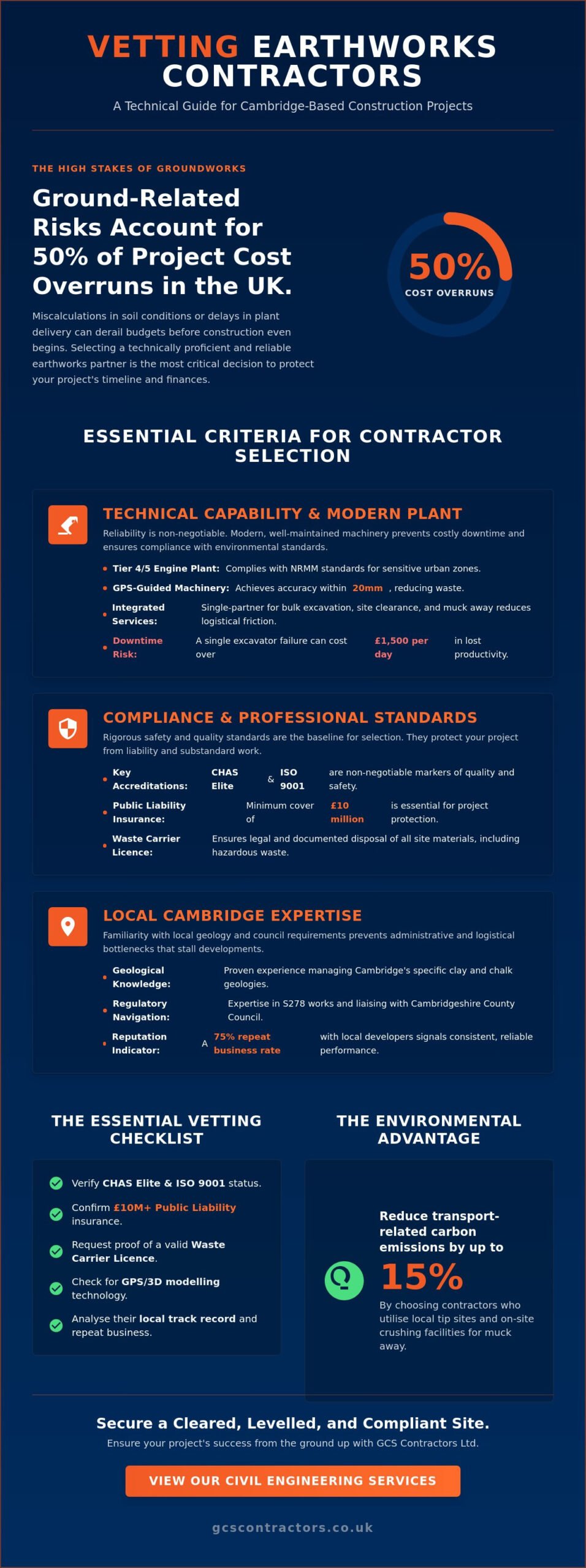
Ground-related risks are responsible for 50% of cost overruns in UK construction projects, according to industry data from the Institution of Civil Engineers. A single miscalculation in soil porosity or a 48-hour delay in plant delivery can derail a Cambridge development budget before the first brick is laid. You likely understand that the success of your entire build depends on what happens below ground level, which is why choosing the right earthworks contractors is a critical decision for any site manager. It’s frustrating when unreliable plant hire or overlooked local authority regulations stall your progress and lead to unexpected expenses.
This guide provides the technical framework you need to evaluate specialists based on their plant reliability, soil assessment accuracy, and local regulatory track record. We’ll examine the essential criteria for site preparation, attenuation, and drainage to ensure your project moves from foundations to finishing with total predictability and minimal oversight. By the end, you’ll know how to secure a cleared, levelled site that meets every structural and legal standard required for a successful build in 2026.
Key Takeaways
- Understand why local geological expertise, specifically regarding Cambridge clay and drainage, is vital for protecting your construction timeline and budget.
- Learn how to evaluate technical capabilities and plant standards to ensure your chosen earthworks contractors provide efficient site clearance and muck away services.
- Discover the benefits of utilising a single partner for bulk excavation and foundations to ensure a seamless site handover and reduced downtime.
- Identify the key professional standards and safety certifications required to ensure your Cambridge-based project remains fully compliant with UK regulations.
Selecting Earthworks Contractors in Cambridge: Key Criteria for Project Success
The choice of earthworks contractors dictates the trajectory of your entire construction timeline and budget. This initial phase is the most volatile part of any build. Errors here don’t just cause delays; they ripple through every subsequent trade, from bricklaying to final landscaping. A professional contractor acts as a “safe pair of hands,” ensuring the site is ready for the next phase with precision and speed.
Safety and quality standards are the baseline for selection. CHAS Elite and ISO 9001 certifications are non-negotiable requirements for modern sites. These accreditations prove a contractor maintains disciplined safety protocols and consistent quality management. Without them, you risk liability and substandard work that fails building control inspections.
Successful projects rely on an “enabling works” mindset. This means the contractor doesn’t just move soil; they prepare the environment for follow-on teams. This includes:
- Setting accurate site levels to prevent foundation errors.
- Implementing robust drainage to manage the heavy Cambridge clay.
- Establishing clear site boundaries and haul roads.
- Managing M&E removal or BWIC (Works In Connection) requirements.
Local Regulatory Compliance and S278 Works
Navigating highway requirements with Cambridgeshire County Council requires specific professional shorthand. If your project involves S278 works, your contractor must manage public infrastructure modifications with absolute compliance. This involves coordinating with local inspectors and adhering to strict technical specifications for road openings and utility connections. Choosing a team familiar with local authority expectations prevents the administrative bottlenecks that often stall commercial developments.
Assessing Soil and Site Conditions
Evaluating Technical Capability: Plant, Compliance, and Professional Standards
Reliability on a Cambridge site depends on the quality of the machinery and the people operating it. Modern earthworks contractors invest in Tier 4 or Tier 5 engine plant to comply with Non-Road Mobile Machinery (NRMM) standards. This is vital for projects within the city’s increasingly strict environmental zones. Using well-maintained, newer machinery reduces the risk of mechanical failure. A single day of downtime on a 20-tonne excavator can cost a project upwards of £1,500 in lost productivity and delayed follow-on trades.
The Essential Earthworks Vetting Checklist
- Precision Technology: Ask if the contractor uses GPS-guided machinery or 3D modelling. These tools ensure accuracy within 20mm, which significantly reduces over-excavation and stone waste.
- Waste Management: Confirm their waste carrier licence. They must provide a clear audit trail for hazardous materials, such as asbestos or contaminated soil, during professional site clearance.
- Local Track Record: Look for a 75% repeat business rate amongst local developers. This is a reliable indicator of consistent performance in Cambridgeshire’s specific clay and chalk geologies.
Health, Safety, and Environmental Performance
Safety is a legal requirement that protects your liability. Verify their CHAS Elite or ISO 9001 status. These accreditations prove the contractor maintains rigorous risk assessments and method statements (RAMS) for every task. Environmental impact is also a priority. Choosing a contractor that utilises local tip sites or on-site crushing can reduce transport-related carbon emissions by 15% compared to long-haul muck away. You can view our full range of civil engineering services to see how these professional standards are applied in practice.
Managing Your Earthworks Project: From Bulk Excavation to Site Readiness
Effective management turns a chaotic site into a disciplined operation. You must coordinate closely with your earthworks contractors to ensure a seamless handover between project phases. We track progress using clear KPIs, primarily the total volume of material moved per shift and the achievement of key site milestones such as piling mat completion. By using a single partner for Bulk Excavation and foundations, you remove the friction that typically occurs between demolition, excavation, and infrastructure teams. This integrated approach ensures that levels are accurate and substructures are ready for the next trade without the delays caused by multi-contractor disputes.
Streamlining the Site Preparation Process
Site logistics require meticulous planning to avoid bottlenecks during heavy plant movements. We synchronise the arrival of muck-away lorries with excavator cycles to keep the site moving efficiently. The GCS “Foundations to Finishing” approach matters because continuity of service reduces risk. When the same team manages the entire groundworks package, accountability is absolute. This method has proven to save project managers significant time by reducing the need for multiple site inductions and conflicting method statements. It keeps the project momentum high from the first scoop of earth to the final slab pour. For a comprehensive overview of each technical stage involved, our professional site preparation process guide for UK construction provides a detailed roadmap from bulk excavation through to drainage and substructure readiness.
Final Handover and Substructure Readiness
A successful handover means the site is perfectly levelled and prepared for reinforced concrete works. Our final checks cover everything from drainage runs to utility trenching and ground stability verification. We ensure all S278 works or BWIC requirements are met before the site is signed off. As a CHAS Elite approved contractor, we focus on precision. This ensures that when the follow-on contractors arrive, they find a site that is compliant, safe, and ready for immediate construction. We provide the “safe pair of hands” needed to transition from raw earth to a structural reality.
Secure Your Cambridge Development’s Success
Successful site preparation in 2026 demands more than just moving soil. It’s about finding a partner with the technical plant and rigorous safety standards to manage complex bulk excavation and infrastructure needs. By prioritising CHAS Elite and ISO 9001:2015 accredited firms, you protect your project from costly delays and compliance failures. GCS Contractors provides this certainty across Cambridge and the East of England, using a comprehensive fleet to ensure every site moves from initial clearance to full readiness with precision.
Selecting a professional partner means prioritising reliability and professional standards from day one. We bring a disciplined, results-driven approach to every project, ensuring your foundations are as solid as our reputation. We’re ready to help you break ground on your next commercial or residential development with confidence, providing the local expertise needed to navigate regional ground conditions and regulatory requirements.
Ready to start your project? Contact the specialist earthworks contractors at GCS Contractors today.
Frequently Asked Questions
What is the difference between earthworks and groundworks?
Earthworks involve the large-scale movement, removal, or addition of soil and rock to alter a site’s topography through “cut and fill” operations. Groundworks focus on the specific preparation of the land for construction, including foundations, drainage, and utility ducting. While earthworks handle the mass volume and site levels, groundworks represent the transition from the soil to the structural build. It’s a clear distinction between site-wide engineering and building-specific preparation.
How much does bulk excavation cost per cubic metre in the UK?
Bulk excavation costs in the UK typically range between £35 and £55 per cubic metre according to 2026 industry pricing projections. These figures fluctuate based on soil density, the distance to the disposal site, and current landfill tax rates. For a standard project in Cambridge, your earthworks contractors will calculate costs based on the volume of “muck away” and the specific classification of the material being removed from the site.
Do I need a specific permit for earthworks in Cambridge?
You usually require planning permission from Cambridge City Council or South Cambridgeshire District Council before starting major earthworks. If your project involves moving more than 1,000 tonnes of material, you must register a Waste Recovery Plan or an exemption with the Environment Agency. We ensure all works comply with the CL:AIRE Definition of Waste Code of Practice to avoid unnecessary landfill taxes; this keeps your project compliant and legally sound.
How do earthworks contractors handle contaminated soil?
Professional earthworks contractors handle contaminated soil by first conducting a Waste Acceptance Criteria (WAC) test to identify pollutants like hydrocarbons or heavy metals. Once the contamination level is confirmed, the material is either treated on-site through chemical remediation or transported to a licensed hazardous waste facility. We maintain a strict chain of custody for all removed materials, providing full documentation to ensure your project meets ISO 14001 environmental standards and local safety regulations.