The Site Preparation Process: A Professional How-To Guide for UK Construction
With the standard rate for landfill tax on active waste hitting £130.75 per tonne in 2026, an inefficient Site Preparation strategy isn’t just a minor delay; it’s a direct threat to your bottom line. You likely understand that the ground is the most unpredictable variable in any UK build. The fear of hidden costs or regulatory setbacks is a constant pressure for developers, especially when a single oversight in ground conditions can derail a schedule before the substructure even begins.
This guide helps you master the technical stages of ground readiness to ensure your project starts on a stable, compliant, and cost-effective foundation. We’ll show you how to navigate Approved Document C and the new Building Safety Levy requirements arriving in October 2026. You’ll gain a clear roadmap covering everything from bulk excavation to professional drainage systems, providing the technical clarity needed to mitigate long-term structural risks whilst keeping your budget on track during a year of 3.6% forecast cost inflation.
Key Takeaways
- Understand the critical role of Approved Document C in ensuring your groundworks meet UK building control standards from the outset.
- Master the professional Site Preparation sequence, covering everything from technical ground testing to the removal of vegetation and existing structures.
- Identify subsurface risks early through topographical and geotechnical surveys to prevent expensive foundation failures or project delays.
- Learn how to manage regional ground challenges effectively, including shrinkable clay common in East England and contaminated brownfield sites.
- Reduce project overheads by coordinating site clearance and demolition as a single, precision-engineered phase of site readiness.
What is Site Preparation and Why is it Critical?
Site Preparation is the precision engineering phase that transforms a plot of raw land into a buildable asset. It involves the technical process of clearing vegetation, levelling topography, and conducting soil testing before foundations are poured. For developers in Cambridge, this isn’t a cosmetic task; it’s a structural requirement. Professional groundworks ensure the earth supports the intended load without shifting over time.
Following Approved Document C of the UK Building Regulations is non-negotiable. This statutory guidance focuses on resistance to contaminants and moisture. It requires sites to be prepared so that ground gases or water cannot enter the structure. Failing to meet these standards during the initial phase often leads to building control rejecting the project before the first brick is laid.
To better understand the physical requirements of this process, watch this helpful video:
GCS Contractors Ltd provides a safe pair of hands for every project. We ensure full compliance from the outset, managing everything from bulk excavation to utility trenching with disciplined precision. By identifying ground conditions early, we eliminate the guesswork that often leads to budget overruns or technical failures during the construction phase.
The Consequences of Poor Ground Readiness
Skipping essential steps in Site Preparation creates a ripple effect of technical failures. Structural instability is the most immediate risk. If organic debris or uncompacted soil remains in situ, the foundations will eventually settle unevenly. This causes subsidence that can compromise the entire build and lead to catastrophic repair costs in the future.
Moisture ingress is another common failure. Poorly managed ground levels or inadequate drainage installation result in rising damp. This costs thousands to rectify post-build. Beyond the physical risks, there are legal ramifications. Failing to identify site contaminants early can lead to heavy fines or insurance refusals. Maintaining high standards in Construction Site Safety and ground health is the only way to protect your investment long-term.
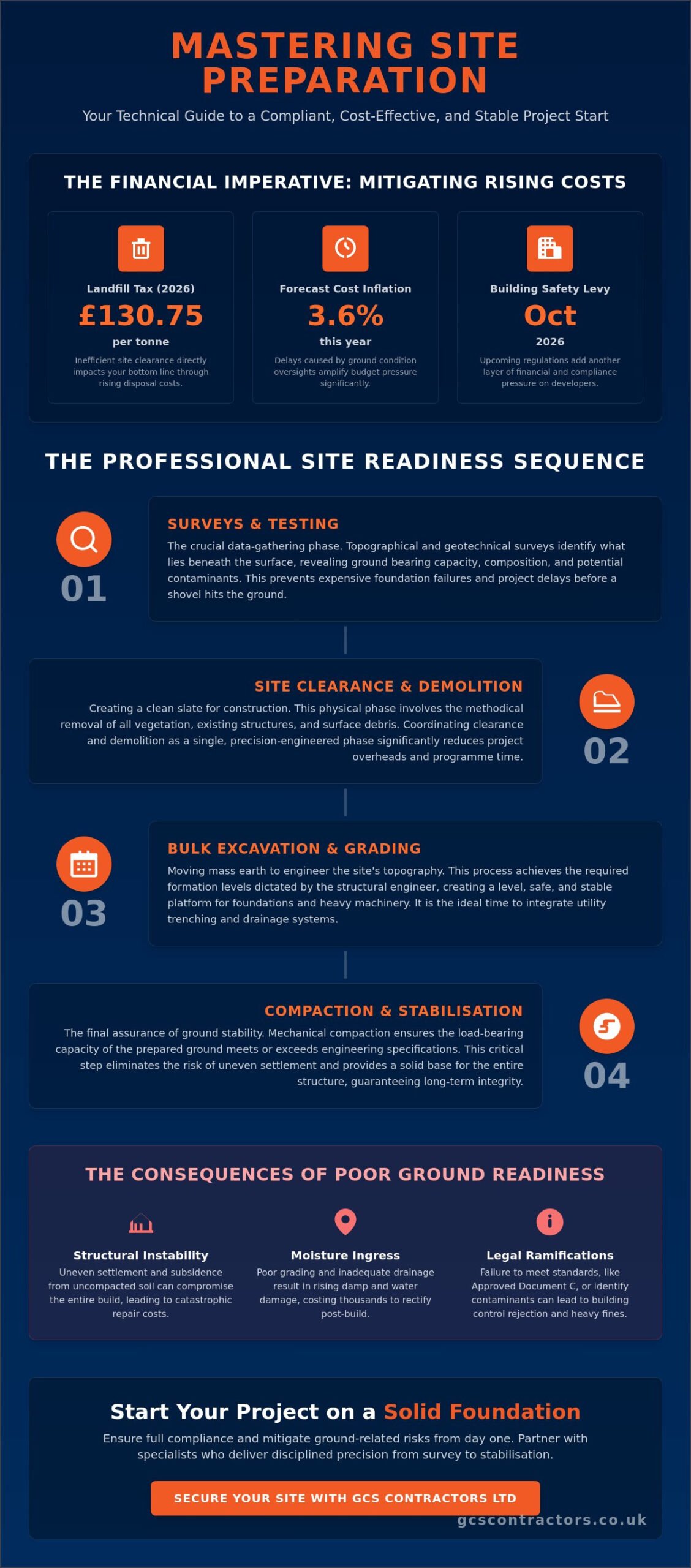
A Step-by-Step Guide to Professional Site Readiness
Professional Site Preparation follows a disciplined sequence designed to eliminate ground-related risks. It moves from data collection to physical earthworks, ensuring the build rests on a stable base. Following a step-by-step site preparation process is the only way to guarantee that no phase of the build is compromised by early oversights.
- Step 1: Surveys and Testing. Topographical and geotechnical surveys identify what lies beneath the surface before a shovel hits the ground.
- Step 2: Site Clearance and Demolition. This involves removing vegetation, old structures, and surface debris to create a clean slate.
- Step 3: Bulk Excavation and Grading. Mass earth is moved to reach the required formation levels dictated by the site engineer.
- Step 4: Compaction and Stabilisation. We ensure the load-bearing capacity meets engineering specifications through mechanical compaction.
Surveying and Soil Testing Protocols
A geotechnical report is the most important document in your site prep folder. It reveals the ground’s bearing capacity and chemical composition. Geotechnical investigation is the process of evaluating soil properties to prevent foundation failure. Identifying “made ground” versus natural strata is vital because it determines if you need standard strip foundations or deeper piling. If you’re managing a project in Cambridgeshire, consulting with professional groundworks specialists early can prevent costly design revisions later.
Managing Enabling Works and Infrastructure
Precision in the early stages involves more than just moving dirt. Integrating utility trenching and service ducting into the initial phase prevents the need for secondary excavation. Bulk excavation plays a critical role here by creating a level, safe platform for heavy machinery. It’s also the ideal time to organise drainage and attenuation systems whilst the ground is still open. This structured approach keeps the site efficient and ensures that all substructure services are in place before the main construction begins. For projects requiring significant earthmoving at depth, understanding deep excavation safety planning and shoring requirements is essential to maintaining compliance and protecting your workforce throughout this phase.
Overcoming Common Site Preparation Challenges
Every Site Preparation project faces unique regional hurdles that can disrupt timelines if not managed with technical expertise. In East England, the primary concern is often shrinkable clay. Professional earthworks contractors must evaluate soil plasticity to prevent foundation heave or subsidence during seasonal weather shifts. Failing to account for these volume changes in the soil leads to structural cracking that is expensive to remediate once the build is complete.
Contaminated land management is another significant challenge for brownfield developments. Handling hazardous materials requires strict compliance with environmental regulations to avoid substantial fines. With the standard rate for landfill tax on active waste at £130.75 per tonne in 2026, efficient soil segregation is vital for keeping costs under control. We also prioritise environmental protection by mitigating the impact on neighbouring properties and local ecosystems, especially in constrained urban environments like Cambridge or London where plant movement and noise levels are strictly monitored.
Moisture Control and Sub-soil Drainage
Managing high water tables is essential during the excavation process to maintain ground stability. We utilise techniques like well-pointing or sump pumping to keep the formation level dry whilst work progresses. Installing soakaways and temporary drainage prevents site flooding during heavy rainfall, which is a common cause of construction delays. Sub-soil drainage systems are installed to divert groundwater away from the substructure, effectively protecting foundations from hydrostatic pressure in accordance with BS 8102:2022 standards. Where excavations extend to significant depths, following a rigorous deep excavation safety checklist compliant with BS 6031:2009 is critical to preventing structural collapse and meeting HSE requirements.
Choosing the Right Site Preparation Contractor
Selecting a contractor with the right accreditations is the best way to ensure project success. CHAS Elite and ISO 9001 certifications are essential markers of a disciplined, safe, and compliant organisation. GCS Contractors Ltd manages complex site readiness across East England and the South East, providing a reliable, safe pair of hands for both domestic and commercial clients. Our “from foundations to finishing” service model reduces sub-contractor friction by keeping all ground-level responsibilities under one professional roof, ensuring your project moves from the initial dig to the final slab without technical compromise.
Secure Your Build with Precision Groundworks
Successful construction depends entirely on what happens before the first brick is laid. Mastering the technical sequence of Site Preparation ensures your project rests on a stable, compliant foundation that meets all statutory UK building standards. By conducting thorough geotechnical surveys and managing moisture control during the initial dig, you eliminate the structural risks that often lead to costly subsidence or moisture ingress later in the build cycle.
GCS Contractors Ltd provides the disciplined expertise needed to navigate these complex early stages with total confidence. As a CHAS Elite Approved Contractor with ISO 9001 Certified Quality Management, we’re specialists in Cambridge and East England groundworks. We understand the specific challenges of regional soil types, urban logistics, and the strict requirements of Approved Document C. Our “from foundations to finishing” approach ensures your site is ready for the next phase without friction, technical oversights, or unnecessary delays.
Ready to Start Your Project? Contact GCS Contractors Ltd for a Professional Site Survey
Your project deserves a safe pair of hands to turn raw land into a precision-engineered platform. We’re ready to help you get the job done correctly.
Frequently Asked Questions
How much does site preparation cost per square metre in the UK?
Costs vary based on soil type and the volume of waste. Land clearance averages £1,000 to £3,000 per acre according to 2026 industry data. General excavation projects typically range from £1,200 to £3,600 depending on the project’s scale. These figures exclude the £130.75 per tonne landfill tax for active waste disposal. Total Site Preparation expenditure is largely dictated by soil condition, the presence of contaminants, and the depth of the required formation levels.
Do I need planning permission for site clearance and excavation?
You usually don’t need separate permission if the work is part of an approved development. However, you must check for Tree Preservation Orders or conservation area restrictions before starting. A full planning application for a new dwelling currently costs £578 following the 2025 fee increase. You may also need to submit a Section 80 notice for demolition works. Ensure all pre-commencement conditions are cleared with your local authority before moving any heavy plant onto the site.
What is the difference between site clearance and bulk excavation?
Site clearance focuses on the removal of surface-level obstacles like vegetation, topsoil, and old structures. Bulk excavation is the technical process of moving large volumes of earth to achieve the precise formation levels required by engineers. While clearance provides a clean slate, bulk excavation prepares the ground for foundations and drainage systems. Both are distinct but essential stages of the Site Preparation process that dictate the structural integrity of the final build.
How long does the site preparation process typically take for a residential build?
Preparing a standard residential plot typically takes between one and two weeks. This window allows for clearing the area, completing bulk excavation, and finishing soil compaction. Larger sites or those requiring extensive utility trenching can take upwards of three weeks. Delays often stem from poor weather or the discovery of unrecorded underground services. Working with an experienced contractor ensures these timelines remain realistic whilst maintaining high safety standards throughout the duration of the dig.