Insurance in demolition works: the contractor’s guide
Insurance in demolition works is not a single policy but a structured package of specialist coverages designed to protect contractors and project managers from the severe financial risks unique to demolition activities. The industry term for this package is “demolition contractor insurance,” and it typically combines general liability, contractor’s pollution liability (CPL), workers’ compensation, and equipment insurance. UK demolition contracts routinely mandate £5 million minimum public liability cover, with higher thresholds on complex or sensitive sites. Getting this right from the outset protects your business, your workforce, and your ability to win contracts.
What are the key types of insurance coverage needed for demolition works?
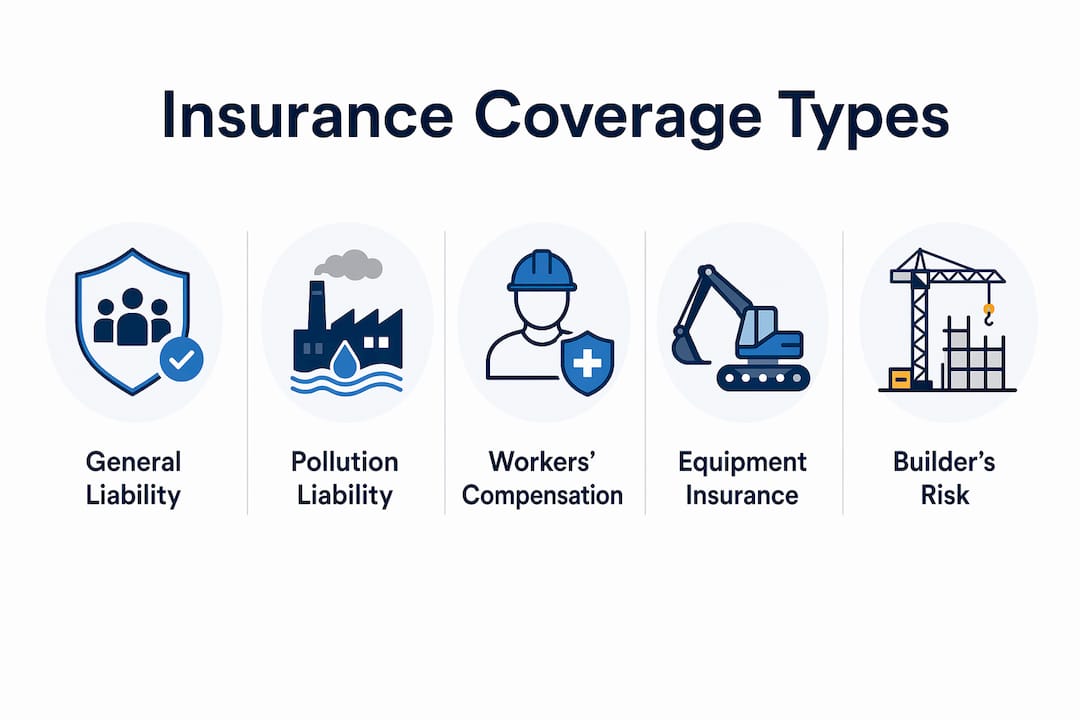
Demolition contractor insurance covers four distinct risk categories, each addressing a different exposure on site. Understanding what each policy does prevents the costly mistake of assuming one policy covers everything.
General liability insurance
General liability (GL) insurance covers third-party bodily injury and adjacent property damage caused by your demolition operations. If falling debris damages a neighbouring building or a member of the public is injured near your site, GL responds. GL limits range from £1 million/£2 million for small residential projects up to £2 million/£5 million or higher for commercial operations. Demolition subcontractors are often required to carry higher GL limits than other construction trades, reflecting the elevated risk profile of the work.
Standard GL policies also contain exclusions for “your work” and “damage to property in care, custody or control,” which require specific endorsements to cover demolition-related damages properly. Review these exclusions carefully before signing any contract.
Contractor’s pollution liability
Contractor’s pollution liability (CPL) is the coverage most frequently overlooked by contractors new to demolition. Standard GL policies exclude pollution events, meaning asbestos fibre release, lead dust migration, PCB disturbance, or fuel spills are not covered by GL alone. CPL fills that gap directly. For light commercial work, CPL limits typically start at £1 million/£2 million. Major commercial or institutional demolition frequently requires £5 million to £10 million in CPL coverage.
Pro Tip: If your project involves any structure built before 1985, treat CPL as non-negotiable. Asbestos and lead are present in the majority of pre-1985 UK buildings, and a single contamination claim without CPL cover can exceed the value of the entire contract.
Workers’ compensation insurance
Workers’ compensation covers your employees for injuries sustained during demolition operations. Demolition carries NCCI Code 5057 for workers’ compensation classification, among the highest base rates in the construction sector. That rating reflects the physical hazards involved: manual handling of heavy materials, operation of plant machinery, and exposure to hazardous substances. Premiums are calculated on payroll, so accurate employee classification directly affects your insurance cost.
Equipment and builder’s risk insurance
Equipment insurance, also called inland marine insurance, protects your plant and machinery from damage, theft, or breakdown on site. Builder’s risk insurance covers damage to the project’s own materials and structures during the works, whereas GL covers third-party losses. The two policies are complementary, not interchangeable. For demolition contractors operating excavators, high-reach machines, or specialist cutting equipment, equipment insurance is a practical necessity rather than an optional extra.
What are the typical coverage limits and regulatory requirements?
UK demolition projects operate within a defined set of insurance expectations set by both law and contract. The table below summarises the standard limits contractors and project managers should plan for.
| Coverage type | Small residential projects | Commercial demolition |
|---|---|---|
| Public liability | £5 million minimum | £10 million or higher |
| Contractor’s pollution liability | £1m/£2m | £5m to £10m |
| Workers’ compensation | NCCI Code 5057 (highest band) | NCCI Code 5057 (highest band) |
| Equipment/inland marine | Replacement value of plant | Replacement value of plant |
| General liability | £1m/£2m | £2m/£5m or higher |
UK demolition contracts commonly mandate £5 million public liability as a baseline, with £10 million or more required on large or sensitive sites such as hospitals, schools, or structures adjacent to live infrastructure. That threshold is not arbitrary. It reflects the scale of third-party losses that a structural collapse or significant contamination event can generate.
Commercial demolition subcontractors face an additional pressure. General contractors require significantly higher liability limits for demolition subcontractors compared to standard trades. Arriving on site with inadequate limits is a contractual breach and can result in immediate suspension of works.
Pro Tip: Request a copy of the main contractor’s insurance schedule before mobilising. Cross-reference the limits they require against your own policy. Gaps discovered on site cost far more to resolve than gaps identified during tender.
For compliance tips specific to demolition, including how insurance requirements interact with health and safety obligations, the regulatory picture is broader than insurance alone.
How does demolition insurance address structural collapse and hazardous materials?
Demolition is rated significantly higher risk than most other construction trades because of structural collapse, heavy equipment use, and falling debris. That risk rating is not a formality. It shapes every aspect of how underwriters price and structure demolition insurance policies.
The specific exposures that drive this elevated rating include:
- Unpredictable structural integrity. Older buildings may have undocumented modifications, hidden voids, or weakened load-bearing elements. The unpredictability of older structures means contractors face risks that no pre-demolition survey can fully eliminate.
- Asbestos and lead contamination. Disturbing these materials without CPL cover leaves the contractor personally liable for remediation costs, third-party health claims, and regulatory penalties.
- Heavy plant and falling debris. Excavators, high-reach machines, and wrecking equipment create significant third-party exposure on constrained urban sites.
- Environmental contamination. Fuel spills, disturbed ground contaminants, and dust migration can affect neighbouring properties and watercourses, triggering claims that standard GL will not cover.
“Comprehensive, tailored insurance coverage is not merely regulatory compliance. It is the primary financial safeguard that prevents a single unforeseen event from ending a demolition business.”
The pollution exclusion in standard GL policies is the most dangerous gap in demolition coverage. A contractor who disturbs asbestos on a commercial strip-out without CPL cover faces remediation costs, third-party health claims, and regulatory enforcement simultaneously. None of those losses fall within GL. Understanding demolition hazards in detail is the first step toward matching the right coverage to the right risk.
Accurate activity definition also matters at the claims stage. Insurance carriers underwrite specific activities, not job titles. A contractor who describes their work as “general construction” on an application but then performs mechanical demolition may find their claim denied on the grounds of misrepresentation.
What practical steps should contractors take to secure demolition insurance?
Securing the right demolition insurance policy requires preparation before you approach a broker. Rushed or incomplete applications produce policies with gaps that only become visible at the point of a claim.
- Define your demolition methods precisely. State whether work is manual, mechanical, or a combination. Specify whether you use explosives, high-reach excavators, or cutting techniques. Mistakes in identifying mechanical versus manual methods are a leading cause of denied claims.
- Document all plant and equipment. List every vehicle, excavator, and specialist machine by make, model, and value. Equipment insurance is priced on declared assets, and undeclared items are uninsured items.
- Classify your workforce accurately. Workers’ compensation premiums depend on correct employee classification. Misclassifying demolition operatives as general labourers understates your risk and creates a coverage gap.
- Work with a specialist demolition broker. General insurance agencies often misclassify demolition exposures. A specialist broker understands the difference between strip-out, structural demolition, and hazardous material removal, and prices each correctly.
- Review every exclusion in your quote. Pay particular attention to pollution exclusions, “care custody and control” clauses, and any activity-specific restrictions.
- Update your policy when scope changes. If you add mechanical plant, take on a larger project, or expand into hazardous material removal, notify your insurer immediately.
Pro Tip: Ask your broker to provide a coverage comparison showing exactly which scenarios are covered and which are excluded under each policy. A written schedule of coverage is far more useful than a verbal assurance.
For a fuller picture of how demolition safety precautions interact with insurance obligations on site, the two disciplines are closely linked and should be managed together.
Key takeaways
Demolition contractor insurance requires a structured combination of general liability, contractor’s pollution liability, workers’ compensation, and equipment coverage to protect against the full range of risks inherent in demolition works.
| Point | Details |
|---|---|
| Multi-policy structure | Demolition insurance is a package, not a single policy; each coverage addresses a distinct risk. |
| CPL is non-negotiable | Standard GL excludes pollution events; a standalone CPL policy is required for asbestos and lead risks. |
| UK liability thresholds | Public liability starts at £5 million and rises to £10 million or more on large or sensitive sites. |
| Accurate classification matters | Misclassifying demolition methods or workers on an application is the most common cause of denied claims. |
| Use a specialist broker | General brokers frequently misclassify demolition exposures; a specialist ensures complete and correctly priced cover. |
Why I think most demolition contractors underestimate their insurance exposure
After years of working in and around demolition and strip-out projects, the pattern I see most often is not recklessness. It is misplaced confidence in a policy that has never been properly tested.
Contractors assume their GL policy covers everything that happens on site. It does not. The pollution exclusion alone can leave a business exposed to six-figure remediation costs from a single asbestos disturbance. The “care, custody and control” exclusion can deny a claim for damage to an adjacent structure. These are not edge cases. They are standard policy language that applies to every standard GL form.
The contractors who manage demolition risk well treat insurance as a live document, not an annual box-tick. They update their policies when scope changes, they brief their site managers on what is and is not covered, and they work with brokers who understand the difference between a strip-out and a structural demolition. That level of engagement is what separates contractors who survive a major claim from those who do not.
My strong advice: review your current demolition insurance policy against the coverage categories in this article before your next project mobilises. If you cannot identify where your CPL cover sits, you probably do not have it.
— George
Gcscontractors: demolition expertise built on compliance
Gcscontractors delivers professional strip-out and demolition services with health, safety, and regulatory compliance at the centre of every project. The team works within live environments, managing risk and minimising disruption from the first site assessment through to final clearance.

Understanding insurance requirements is one part of responsible demolition project management. Gcscontractors brings the operational expertise to match, from site preparation and strip-out through to groundworks and civil engineering. For project managers planning a demolition programme, the demolition sequence guide sets out how each phase connects to the next, including the compliance checkpoints that affect your insurance obligations throughout.
FAQ
What insurance do demolition companies need in the UK?
Demolition companies in the UK require public liability insurance (minimum £5 million), contractor’s pollution liability, workers’ compensation, and equipment insurance as a minimum package. Larger or more complex sites typically require £10 million or more in public liability cover.
Does general liability insurance cover asbestos removal during demolition?
Standard general liability policies exclude pollution events, including asbestos fibre release and lead dust migration. A separate contractor’s pollution liability policy is required to cover these exposures.
What is the minimum public liability insurance for demolition in the UK?
UK demolition contracts typically mandate a minimum of £5 million in public liability insurance, rising to £10 million or higher on large, sensitive, or publicly accessible sites.
Why is workers’ compensation so expensive for demolition contractors?
Demolition is classified under NCCI Code 5057, which carries one of the highest base rates in the construction sector. The rate reflects the physical hazards of structural collapse, heavy plant operation, and hazardous material exposure.
What happens if I describe my demolition work inaccurately on an insurance application?
Inaccurate activity descriptions, such as listing mechanical demolition as general construction, give insurers grounds to deny claims at the point of loss. Precise classification of demolition methods and workforce is a legal and contractual requirement.