Groundworks safety tips for building contractors
Groundworks safety, defined by the UK Health and Safety Executive as the systematic management of hazards during excavation, foundation work, drainage, and earthworks operations, is the foundation of every compliant construction project. The consequences of getting it wrong are immediate and fatal. Trench collapses crush and suffocate workers in seconds, moving plant strikes without warning, and contact with buried utilities kills. These groundworks safety tips cover the engineering controls, site planning procedures, access requirements, and hazard controls that building contractors and construction managers must apply on every project, drawing on OSHA 29 CFR 1926 Subpart P, UK HSE guidance, and current practitioner standards.
1. Install the right trench protective system before anyone enters
The single most critical rule in excavation safety is this: no worker enters an unprotected trench. Trench collapse is not a gradual event. It happens without warning, and the weight of soil is sufficient to kill in under a minute. Engineering controls are the only reliable defence.
The four recognised protective systems are:
- Sloping: Cutting trench walls back at a safe angle based on soil classification. Type A soil (cohesive, stable) requires a 3:4 ratio; Type C (granular, wet, or unstable) requires a 1:1 ratio or shallower.
- Benching: Creating stepped horizontal levels in the trench wall. Permitted only in Type A soil and never in Type C.
- Shoring: Installing timber, hydraulic, or mechanical supports against trench walls to resist soil pressure.
- Shielding (trench boxes): Placing a pre-engineered steel or aluminium box inside the trench to protect workers within the shield zone.
Protective systems are mandatory for any trench 1.5 metres (5 feet) or deeper. This threshold triggers the full suite of OSHA 29 CFR 1926 Subpart P requirements, including competent person oversight and utility location. The choice of system depends on soil type, trench depth, surcharge loads from spoil heaps and plant, and groundwater conditions. A competent person, not a general site supervisor, must assess these factors and approve the selected system before excavation begins.
Pro Tip: Never assume that a previously stable trench remains safe after overnight rain or nearby vibration. Soil conditions change faster than most site managers expect.
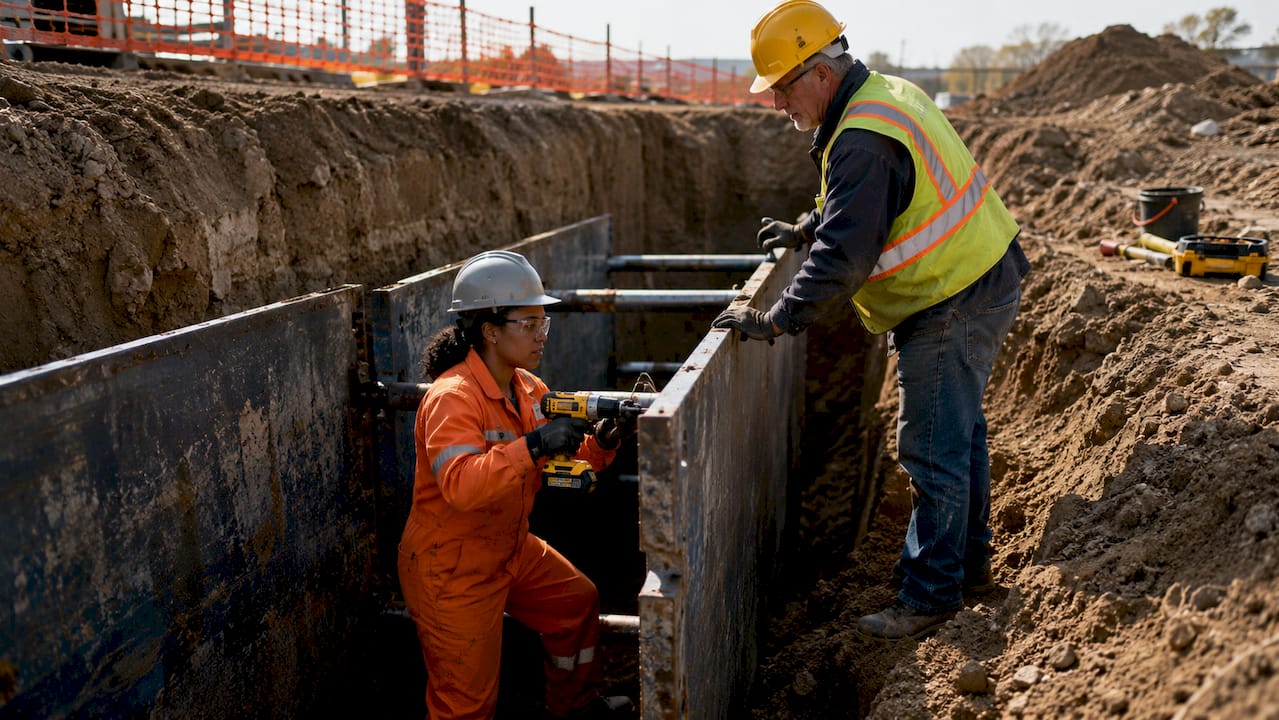
2. Appoint a competent person with genuine stop-work authority
A competent person is defined under OSHA and UK CDM Regulations as someone with the knowledge, training, and experience to identify existing and predictable hazards and the authority to take corrective action. On groundwork sites, this role is not administrative. It is operational and safety-critical.
Competent persons must have the authority to stop work immediately if trench stability or site conditions deteriorate. This means they cannot be overruled by a project manager chasing programme. The stop-work authority must be documented in the site-specific RAMS (Risk Assessment and Method Statement) and communicated to all operatives before work begins. Inspections should be shift-based and triggered by any change in conditions, including heavy rain, nearby vibration from compaction equipment, or changes in groundwater level.
3. Develop site-specific RAMS before breaking ground
Generic risk assessments do not satisfy UK HSE requirements and they do not protect your workforce. Compliance requires site-specific plans backed by verifiable records, not documents copied from a previous project. Every groundwork RAMS must address the specific soil conditions, utility layout, trench dimensions, and plant movements on that particular site.
A compliant RAMS for excavation work covers:
- Soil classification and the rationale for the chosen protective system
- Utility survey results and the location of all buried services
- Exclusion zones for moving plant and the method of enforcing them
- Spoil heap placement, confirming heaps are kept at least 1 metre from trench edges
- Emergency procedures including rescue from a collapsed trench
- Documented training records for all operatives working in or near the excavation
Pro Tip: Attach the utility survey certificate and soil investigation report to the RAMS as appendices. Inspectors and insurers will ask for them, and having them ready demonstrates genuine compliance rather than paper compliance.
4. Locate and mark all buried utilities before digging
Contact with buried electricity cables, gas mains, and water pipes is one of the leading causes of fatal and serious injury on groundwork sites. The UK equivalent of the US 811 system is the requirement to obtain utility records from asset owners through services such as Linesearch Before U Dig (LSBUD) and to carry out a cable avoidance tool (CAT) scan before any mechanical or hand excavation begins.
Employers must call utility locate services and maintain safe distances from utility lines as a mandatory requirement under OSHA 29 CFR 1926 Subpart P. In the UK, HSE guidance requires contractors to obtain drawings, use a CAT scanner, and hand-dig within the tolerance zone around marked services. Marking the ground with spray paint or flags before mechanical excavation starts is not optional. It is the minimum standard. For compliant site preparation, utility identification is always step one.
5. Control spoil heap placement and plant exclusion zones
Two of the most overlooked groundwork hazards are spoil heaps placed too close to trench edges and uncontrolled plant movement near open excavations. Both increase the risk of trench wall collapse through surcharge loading and vibration.
Physical barriers must be installed at least 1 metre back from trench edges, and spoil heaps must be kept at least 1 metre away to reduce surcharge loading on the trench wall. In practice, the further the better. On sites with loose or granular soils, even a 1 metre setback may be insufficient, and the competent person must assess the specific conditions. Plant exclusion zones should be marked with physical barriers such as Heras fencing or Armco barriers, not just cones. Industrial fencing for secure sites provides a practical reference for selecting and installing appropriate barriers on active construction sites.
6. Provide safe access and egress at regular intervals
Workers inside a trench must be able to exit quickly in an emergency. This is not a comfort measure. It is a life-safety requirement that is frequently under-specified on smaller groundwork projects.
Ladders must be placed no more than 15 metres apart along the length of a trench and must extend at least 1 metre above the trench edge to provide a secure handhold during exit. The ladder must be secured at the top and positioned on stable ground. Where trench boxes are in use, the ladder must be positioned within the shielded zone, not outside it. Access points must be kept clear of spoil, plant, and materials at all times. This requirement applies regardless of trench depth. A worker who cannot exit quickly in a partial collapse or flooding event faces the same risk as one in an unprotected trench.
7. Conduct daily inspections and record every finding
Daily inspection before work begins is a mandatory requirement under both OSHA and UK CDM Regulations, and it is the mechanism by which the competent person confirms that conditions remain safe. Daily inspections before work begins and after destabilising events such as heavy rain or vibration must be recorded in writing. A verbal check is not sufficient.
The inspection record must cover:
| Inspection item | What to check |
|---|---|
| Trench wall condition | Signs of cracking, bulging, or soil movement |
| Protective system integrity | Shoring, shielding, or sloping remains as designed |
| Water ingress | Standing water or seepage at the base or walls |
| Spoil heap and plant position | Maintained at required setback distances |
| Access and egress | Ladders in place, secured, and clear of obstructions |
| Utility markers | Ground markings visible and undisturbed |
Records must be retained and made available to the HSE or principal contractor on request. If the inspection identifies a hazard, work stops until the hazard is corrected and re-inspected.
8. Never treat shallow trenches as inherently safe
This is the assumption that kills. Even shallow trenches under 0.6 metres can collapse and kill, and the UK HSE applies a “no safe depth” principle to unsupported excavations. The collapse of a shallow trench in loose, wet, or disturbed ground can pin a worker’s legs and torso with enough force to cause crush injuries and asphyxiation.
Experienced supervisors do not use depth alone to decide whether support is needed. They assess soil stability, water content, nearby vibration sources, and the proximity of previous excavations. A trench dug adjacent to a recently backfilled service run is at higher risk than its depth suggests. The assessment must be made fresh on every excavation, on every site, every time.
9. Manage common site hazards beyond the trench
Groundwork hazard prevention extends well beyond the excavation itself. Falls from height, contact with electricity, struck-by objects, and moving plant are the leading causes of serious injury across construction sites, and all four are present on active groundwork sites.
Controls for each hazard category:
- Falls from height: Edge protection at all open excavations and elevated working platforms. No operative works near an unguarded edge.
- Moving plant: Segregated pedestrian and plant routes, banksmen for reversing vehicles, and physical barriers between work zones. Refer to demolition hazard guidance for detailed plant management controls.
- Struck-by objects: Hard hats mandatory in all groundwork areas. No materials stored at height above working operatives.
- Electrical contact: All buried services located and marked before excavation. Overhead lines identified and exclusion zones established.
- Water ingress: Pumping equipment on standby for trenches in high water table areas. No operative enters a water-filled trench.
Toolbox talks covering these hazards should be delivered at the start of each shift and recorded. They are the most cost-effective safety intervention available to a site manager.
Key takeaways
Effective groundworks safety requires engineering controls, site-specific documentation, competent person oversight, and daily recorded inspections working together as a system, not as isolated measures.
| Point | Details |
|---|---|
| Protective systems are non-negotiable | No worker enters any trench without an approved shoring, shielding, or sloping system in place. |
| Competent person authority is operational | The competent person must have documented stop-work authority and cannot be overruled on safety grounds. |
| Shallow trenches carry full risk | No excavation depth is inherently safe; soil conditions and surcharge loads determine risk, not depth alone. |
| Daily inspections must be written | Verbal checks do not satisfy OSHA or UK CDM requirements; written records must be retained and available. |
| Utility location precedes all digging | CAT scanning and utility records must be obtained and marked on the ground before mechanical excavation begins. |
What I have learned managing groundwork safety in practice
I have seen the same pattern repeat on sites across the UK. The trench protective system is correctly specified in the RAMS, the competent person is named on the paperwork, and then the pressure of programme starts to erode the practice. A shallow section gets left unsupported because it “looks fine.” The ladder gets moved to the far end of the trench because it is in the way of the next lift. The daily inspection gets done verbally over a cup of tea rather than recorded on the form.
None of these decisions feel dangerous in the moment. That is precisely what makes them so serious. Soil conditions change without visible warning, and the gap between a stable trench and a collapsed one can be measured in seconds. The competent person’s authority to stop work is only meaningful if the site culture actually supports it. When a project manager can informally override a safety call by expressing frustration, the entire system fails.
The practical lesson is this: the paperwork and the practice must match. If your RAMS says inspections are shift-based and triggered by rain, then that is what happens on site, regardless of programme pressure. If your competent person identifies a hazard, work stops. The civil engineering principles that underpin safe site preparation are not suggestions. They are the difference between a project that completes and one that results in a fatality investigation.
The other thing I would say to any contractor reading this: do not assume your operatives know what you know. Toolbox talks feel repetitive until the day they prevent a death. Run them every shift, record them, and make them specific to the conditions on that day’s work.
— George
How Gcscontractors supports safe groundwork compliance
Gcscontractors delivers groundworks and civil engineering services, including foundations, drainage, site setup, and roadworks, with health and safety compliance built into every phase of the project. The team works within live environments and applies site-specific risk management from initial planning through to completion.

For contractors and project managers who need a groundwork partner with documented compliance processes and experienced site supervision, Gcscontractors provides the expertise to keep projects moving safely. Explore the groundworks and civil engineering services available, or review the compliant site preparation steps that underpin every safe groundwork project. Contact Gcscontractors to discuss your project requirements and safety planning needs.
FAQ
What depth requires a trench protective system?
Any trench 1.5 metres (5 feet) or deeper requires a protective system under OSHA 29 CFR 1926 Subpart P. UK HSE guidance applies a “no safe depth” principle, meaning even shallower trenches require assessment and may require support depending on soil conditions.
Who is responsible for trench inspections on a groundwork site?
A competent person, as defined under OSHA and UK CDM Regulations, is responsible for conducting and recording daily trench inspections before work begins and after any destabilising event such as rain or vibration.
How far should spoil heaps be kept from a trench edge?
UK HSE guidance requires spoil heaps to be kept at least 1 metre from the trench edge to reduce surcharge loading on the trench wall. Physical barriers should also be installed at least 1 metre back from the edge.
What is the maximum spacing for ladders in a trench?
Ladders must be placed no more than 15 metres apart along the trench and must extend at least 1 metre above the trench edge to provide safe access and egress for operatives.
What should a groundwork RAMS document include?
A compliant RAMS must include soil classification, utility survey results, the chosen protective system with its rationale, exclusion zones, spoil heap placement, emergency procedures, and documented training records for all operatives.