Site hoarding regulations UK: what contractors must do
Yes, hoarding is a legal duty on most UK construction sites, not an optional extra. If your works affect the public or the highway, the principal contractor or site owner must act before the first fixing goes in.
- Secure the perimeter first. Any site accessible to the public needs a physical boundary before work starts.
- Check the highway question. If the hoarding sits on or over a public footway or road, you need a licence before you erect it, not after.
- Display the right notices. Site manager contact details and hazard warnings belong on the hoarding from day one.
These duties sit under the Health and Safety at Work etc. Act 1974, the Construction (Design and Management) Regulations 2015 (CDM 2015), and the Highways Act 1980, sections 172 and 173.
Key Takeaways
Site hoarding compliance in the UK rests on three pillars: the duty under health and safety law, the highway licence where public land is affected, and a documented maintenance routine that survives an enforcement visit.
| Point | Details |
|---|---|
| Licence trigger | Any hoarding on or over a public highway needs council approval before it goes up, not after. |
| Legal foundation | Highways Act 1980 sections 172 and 173 set the erection and secure fixing duties, backed by CDM 2015 risk assessments. |
| Typical costs | Council fees range from around £70 per week to £203 for 28 days, with penalties up to £404 for unlicensed hoarding. |
| Inspection discipline | Daily visual checks, weekly detailed checks and post-storm inspections, all logged with photos, protect you in enforcement or insurance disputes. |
| Support available | Gcscontractors builds licence support and installation oversight into its site setup and groundworks services across Cambridge and East Anglia. |
Table of Contents
- Which laws create the duty to erect hoarding?
- When do you need a hoarding licence?
- What are the design and structural requirements?
- Who maintains the hoarding once it’s up?
- What are the pedestrian and traffic management rules?
- What does non-compliance actually cost?
- How do you prepare a hoarding licence application?
- What should a site inspection checklist actually cover?
- Do you need public liability insurance for site hoarding?
- Are there environmental restrictions on site hoarding?
- What happens when hoarding needs to come down?
- What do real enforcement cases teach contractors?
- How GCS Contractors supports compliant hoarding and site setup
- Frequently asked questions
- Sources
Which laws create the duty to erect hoarding?
The Health and Safety at Work etc. Act 1974 puts a general duty of care on employers and contractors to protect anyone who might be affected by construction activity, workers and passers by alike. That duty doesn’t specify hoarding by name, but it’s the legal backbone behind every perimeter control decision you make.
CDM 2015 brings it into the construction phase plan directly, with guidance on fencing specification available in this parking lot fencing guide to help choose materials and fixings. Your principal contractor must assess site boundary risks as part of pre-construction planning, and that assessment has to result in physical measures where the risk warrants it. HSE guidance is blunt about this: fencing has to reflect the nature of the site and its surroundings, and a one-size-fits-all approach isn’t good enough. A site next to a primary school needs different thinking to a rural plot behind a locked field gate.
Where works touch the public highway, the Highways Act 1980 section 172 requires a close-boarded hoarding or fence before building works begin in a street, unless the authority dispenses with it. Section 173 goes further:
Hoardings must be securely fixed to the satisfaction of the appropriate authority, and a breach of that requirement is an offence liable to a fine under Highways Act 1980, section 173.
Liability usually lands on the principal contractor or whoever erected the structure, not the client.
When do you need a hoarding licence?
You need a licence from the local authority whenever hoarding sits on or over a public highway in England and Wales, according to Gov. Encroaching even a few centimetres onto a footway or verge triggers the requirement. Southwark Council is explicit that a licence can be refused even after payment. The hoarding cannot go up until the licence is actually issued, not just applied for.
Most councils ask for a similar document set:
- Scaled plans and elevation drawings showing exact highway encroachment.
- Evidence of public liability insurance.
- A method statement covering erection, maintenance and removal.
- Traffic management details and any parking suspension requests.
Processing times and fees vary by council, but the pattern is consistent enough to plan around.
| Local authority | Typical fee example | Notes |
|---|---|---|
| City of York | licence fees for hoardings with example surcharges and penalties | see City of York for details |
| Worcestershire | licence fees for hoardings with example surcharges | see Worcestershire Council for details |
| Hammersmith & Fulham | Typical processing takes several working days | Applicants must submit accurate drawings and never assume permission before the licence is issued |
Never treat submission as approval. Build at least five working days into your programme, and start renewal applications before the current licence expires, not after.
What are the design and structural requirements?
Hoarding height standards vary by context, but the construction industry generally works to around 2.4 metres, with 2.0 metres as a practical minimum on lower-risk sites. Higher or more robust hoarding may be needed near schools, in busy retail streets or wherever HSE guidance flags a higher likelihood of children or vulnerable pedestrians nearby.
Material choice depends on the site. Mesh panels ventilate well and suit low-risk rural plots, but they’re easy to see through and offer little acoustic buffering. Timber-faced plywood gives better security and a cleaner public-facing finish, useful on retail high streets. Proprietary steel hoarding panels are faster to erect and reuse across sites, which suits contractors running several jobs at once.

Wind load is where site teams most often come unstuck. Adding advertising graphics or debris sheeting to a hoarding run increases its surface area and the load on every fixing, sometimes significantly. Guidance from the Institution of Structural Engineers on temporary works notes that covered gates and sheeted sections often need increased kentledge or anchorage to compensate. HSE’s priced publication L153 sets out further technical expectations for safe erection and dismantling.
Before procurement, check:
- Confirmed height against site risk category, not just habit.
- Fixing and ballast specification matched to actual wind exposure.
- Supplier confirmation of load ratings if sheeting or signage will be added later.
Pro Tip: Ask your hoarding supplier for written wind-load data before you sign off the design, especially if you plan to add site branding or debris netting after installation. Retrofitting kentledge later costs far more than specifying it correctly up front.
Who maintains the hoarding once it’s up?
The licensee named on the local authority permit carries ongoing legal responsibility for maintenance, lighting and safety for the licence period, not just the installer. That’s a distinction worth checking before you sign anything, because it usually falls on the principal contractor even if a subcontractor physically built it.
- Run a daily visual check for damage, graffiti, or loose panels.
- Carry out a weekly detailed inspection covering fixings, lighting and signage legibility.
- Inspect again after any named storm or high wind event, before assuming everything survived intact.
- Log every check with date, inspector name and any defect found.
- Keep photographic evidence alongside written notes, and display the licence and site contact number where the public can see them.
If the council issues a defect notice, respond immediately rather than waiting for the next scheduled visit; enforcement officers note repeat non-compliance far more harshly than a single early lapse.
Pro Tip: Keep your inspection log in the site diary, not a separate spreadsheet nobody checks. When an enforcement officer visits unannounced, being able to show three months of consistent records is worth more than any verbal explanation.
What are the pedestrian and traffic management rules?
Councils commonly expect a minimum footway width of 1.2 metres past a hoarding, rising to 1.5 metres in busier areas with higher pedestrian footfall. Fall below that and you’ll likely need a temporary footway or a full footway closure instead.
Where a temporary footway pushes pedestrians onto the carriageway, you need a proper traffic management plan: barriers, directional signage and often a banksman during peak hours. Essential fixtures on or near the hoarding include:
- Site contact name and phone number, visible from the footway.
- Hazard warning signage at eye level.
- Adequate lighting along the full hoarding run after dark.
- Emergency contact details, separate from the general site number.
What does non-compliance actually cost?
City of York’s example fees run from £203 for 28 days up to a £404 penalty for unlicensed hoarding, and Worcestershire charges from £70 per week with a £25 urgency surcharge for rushed applications. Those figures are relatively modest against the risk of a stopped site.
- Fixed penalty notices for hoarding erected without a licence.
- A council-issued requirement to remove the structure immediately, at your cost.
- Prosecution under the Highways Act for insecure or unauthorised hoarding.
- Additional charges for rectifying defective panels the council has already flagged once.
Enforcement rarely starts with prosecution. It starts with a notice you ignored.
How do you prepare a hoarding licence application?
- Take independent, accurate measurements of the specific highway section, not generic photos or old site plans.
- Prepare scaled drawings and elevations showing exact encroachment.
- Gather public liability insurance evidence and a method statement.
- Confirm programme dates and apply for any parking suspensions needed.
- Submit with enough lead time for your council’s stated processing period.
Common mistakes that cause delay:
- Measurements taken from outdated online imagery rather than a site visit, a frequent cause of rejection according to Hammersmith & Fulham’s guidance.
- Missing or expired insurance documentation.
- Assuming a verbal nod from a planning officer counts as permission.
What should a site inspection checklist actually cover?
- Daily: locks secure, panels intact, no unauthorised access points.
- Weekly: fixings tight, lighting operational, signage legible and undamaged.
- Post-weather: full structural check after any named storm.
- Log every finding with photo reference and remedial action taken.
Sample log fields: date, inspector, defect noted, photo reference, remedial action, sign-off. Ask suppliers for fixing details, wind-load data and manufacturer installation instructions before delivery, not after a defect notice lands. Our construction site hoarding guide covers public protection measures in more depth.
Pro Tip: Photograph the hoarding from the same three angles every week. Consistent reference points make it obvious to an inspector, or to you, exactly what’s changed since the last check.
Do you need public liability insurance for site hoarding?
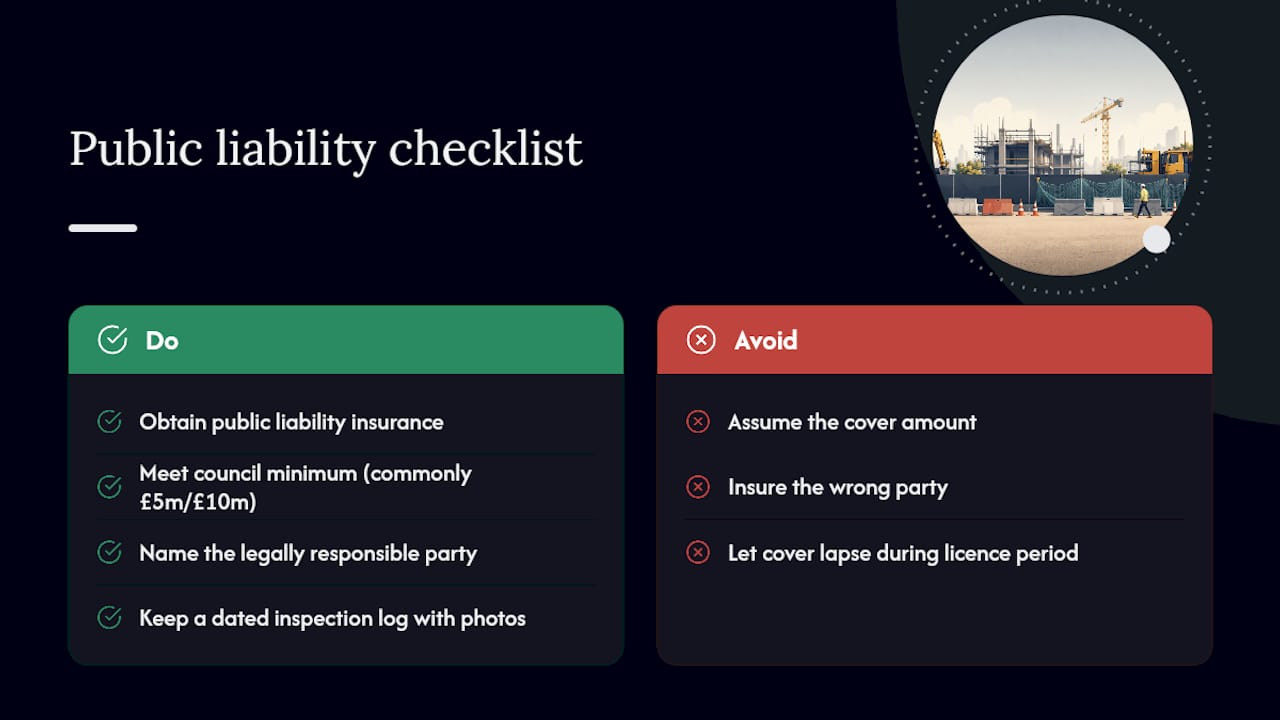
Public liability insurance is a near-universal requirement for hoarding licence applications, and for good reason: a hoarding failure that injures a pedestrian or damages adjoining property exposes the licensee to direct financial liability. Most local authorities specify a minimum cover level, commonly £5 million or £10 million depending on the site’s location and footfall, though the exact figure varies by council and should be confirmed on the application form rather than assumed.
The insurance needs to name the correct party. If a subcontractor erects the hoarding but the principal contractor holds the licence, cover arrangements need to reflect who actually carries the legal responsibility, because a gap between the licence holder and the insured party is exactly where claims get contested.
Accidents involving hoarding tend to fall into a few recurring categories: a panel blown loose in wind striking a pedestrian, a trip hazard where a temporary footway meets uneven ground, or a fixing failure after prolonged exposure without inspection. In each case, the inspection log becomes the evidence that decides whether the claim is treated as an unfortunate incident or a compliance failure. A well-kept log showing regular checks, dated photographs and prompt remedial action is often the difference between a manageable insurance claim and a prosecution under the Highways Act.
Renew insurance cover for the full licence period, including any extensions, and keep a copy displayed alongside the licence itself where a council officer can verify it without a site office visit.
Are there environmental restrictions on site hoarding?
Lighting is the environmental issue that catches most contractors off guard. Hoarding often needs illumination for public safety after dark, particularly where it narrows a footway, but poorly directed floodlighting spilling into neighbouring flats or houses generates genuine nuisance complaints to the local authority. Direct lighting downward and inward towards the hoarding face rather than outward towards residential windows, and use timers rather than leaving lights running all night unnecessarily.
Noise mitigation matters most during erection and dismantling rather than while the hoarding stands. Percussive fixing methods early in the morning or into the evening breach typical council-imposed working hours, usually 8am to 6pm on weekdays with tighter restrictions on Saturdays and none permitted on Sundays in most residential areas. Check your specific planning conditions before scheduling installation.
Where hoarding encloses waste storage, skips or salvaged materials, additional considerations apply around dust, odour and visual screening, particularly on sites near residential boundaries. Our guide to managing excavation spoil on site covers the overlap between hoarding, material storage and highway occupation in more detail. Some urban councils also now request hoarding designs incorporate a proportion of public-facing artwork or planting, less a legal requirement than a planning condition attached to larger commercial schemes, so check your specific consent before assuming standard plywood panels will suffice.
What happens when hoarding needs to come down?
Removal isn’t simply a case of taking the panels away once the project finishes. The licensee remains responsible for reinstating the highway or footway to its original condition, which means checking for surface damage, removing all fixings and ballast, and confirming the area is genuinely safe for unrestricted public use again.
Notify the local authority before removal if your licence terms require it, particularly where a temporary footway or parking suspension needs to be lifted in a coordinated sequence. Leaving a licence to simply lapse without formal closure can leave you liable if a defect is discovered later and traced back to incomplete reinstatement.
Site use changes mid-project are a common trigger for overlooked hoarding obligations. If a demolition phase hands over to a groundworks phase with a different footprint, the hoarding boundary often needs to move or extend, and that frequently means a licence variation rather than a fresh application from scratch. Contact the council early rather than assuming the original licence flexes automatically to cover a changed site layout.
Where hoarding secured salvaged materials or plant during the works, agree a removal sequence that doesn’t leave valuable items exposed on the highway during the changeover window, a surprisingly common source of theft on sites mid-dismantling.
What do real enforcement cases teach contractors?
Most enforcement doesn’t start with prosecution, it starts with a routine council inspection that finds a hoarding erected without a licence, or one that no longer matches the drawings submitted. Southwark Council’s own guidance makes clear that licences can be refused even after payment, and that officers retain the right to inspect behind the hoarding at any point during the licence period.
A recurring failure pattern involves contractors treating the licence application as a formality and beginning works before approval lands. Because a licence can legally be refused, that gamble occasionally backfires with a stop notice mid-project, costing far more in delay than the original application fee ever would have. Another common failure is hoarding that drifted from its approved footprint, often because a site team widened the compound for plant access without updating the drawings or notifying the council.
Fixing failures after storms are the third recurring theme. Where inspection logs show no post-weather check was carried out, councils and insurers alike treat resulting incidents as a foreseeable failure rather than genuine bad luck. The lesson across nearly every documented case is the same: the paperwork trail, drawings matching reality, insurance current, inspections logged, is what separates a defensible position from an indefensible one when something goes wrong.
A site manager’s perspective on hoarding pitfalls
I’ve seen a licence application rejected purely because the drawings used an old satellite image instead of a fresh site measurement. It cost us a week. Now I measure the footway myself, every time, before submitting anything.
How GCS Contractors supports compliant hoarding and site setup
Gcscontractors is the practical alternative to piecing together hoarding compliance yourself between subcontractors and council portals. We handle site surveys, licence application support, hoarding installation oversight and the ongoing inspection routine your council will expect to see evidenced, all as part of our wider site setup service across Cambridge and East Anglia.

Rather than juggling drawings, insurance evidence and a defect log on top of everything else a live site throws at you, our team builds hoarding compliance into the enabling works from day one, so it’s never the thing that stalls your programme. If you’re planning groundworks or a strip out and want the hoarding and site setup handled properly from the outset, get in touch about groundworks and site preparation in Cambridge and we’ll walk you through what your specific site needs before you apply for anything.
Frequently asked questions
Is site hoarding a legal requirement in the UK?
Yes, for most sites accessible to the public. The Health and Safety at Work etc. Act 1974 and CDM 2015 create a duty to control site boundaries, and the Highways Act 1980 mandates hoarding wherever works affect a public street.
Do I always need a licence for construction hoarding?
Only if the hoarding sits on or over a public highway, footway or verge. Hoarding entirely within your own site boundary usually doesn’t need council permission, but it still falls under health and safety duties.
How long does a hoarding licence take to process?
Allow at least five working days as a general guide, though this varies by council. Never assume approval before the licence is formally issued.
What height should site hoarding be?
Around 2.4 metres is the common industry expectation, with 2.0 metres as a practical minimum on lower-risk sites. Higher hoarding may be required near schools or busy pedestrian areas.
What happens if I erect hoarding without a licence?
You risk a fixed penalty, a forced removal order at your own cost, and potential prosecution under the Highways Act, alongside penalty charges some councils apply directly, such as York’s £404 example fee.
This article is general information, not a substitute for advice from a qualified lawyer. Consult a qualified legal professional about your own circumstances before acting on anything here.
Sources
- Gov
- Protecting the public – HSE
- Highways Act 1980, section 172
- Hoarding licence – City of York Council
- Scaffolding or hoarding licence | Southwark Council
Recommended
- Construction Site Hoarding: A Professional Guide to Safety and Compliance – GCS Contractors Ltd
- Site preparation: 8 essential steps for compliant UK projects
- The Essential Site Preparation Checklist for Self-Build Projects in the UK (2026) – GCS Contractors Ltd
- Managing Excavation Spoil on Site: UK Regulations and Best Practices 2026 – GCS Contractors Ltd