Construction compliance officer: what employers need to know
A construction compliance officer is the person on-site responsible for ensuring that every activity meets statutory health and safety requirements, environmental standards, quality specifications, and internal policies. On UK projects, the role is the practical difference between a project that runs to programme and one that faces a stop notice, an HSE prosecution, or costly rework. As a compliance officer, the core function is to develop internal controls, monitor their effectiveness, and report on compliance across the project lifecycle.
You should consider appointing a dedicated compliance officer when:
- The project involves demolition, strip-out, or groundworks in a live or occupied environment
- CDM 2015 applies and a principal contractor is formally appointed
- The site has multiple subcontractors working concurrently
- Environmental permits, waste licences, or hazardous material controls are required
- The project value or complexity places it above a straightforward single-trade job
The importance of compliance in construction cannot be overstated: clear processes, defined roles, and consistent communication are what prevent regulatory fines and legal challenges from derailing a project.
Table of Contents
- What does a compliance officer do on a construction project?
- Which UK laws and regulations must a compliance officer know?
- How do compliance officers translate law into on-site controls?
- A three-bucket model for structuring compliance activity
- What skills and qualifications do compliance officers need?
- Where does the compliance officer sit in a project structure?
- What are the consequences of poor compliance on a construction project?
- Practical checklist templates for audit-ready sites
- Key takeaways
- Why compliance officers change project outcomes
- Gcscontractors: compliance-aware contracting in Cambridge and East Anglia
- Useful sources and further reading
What does a compliance officer do on a construction project?
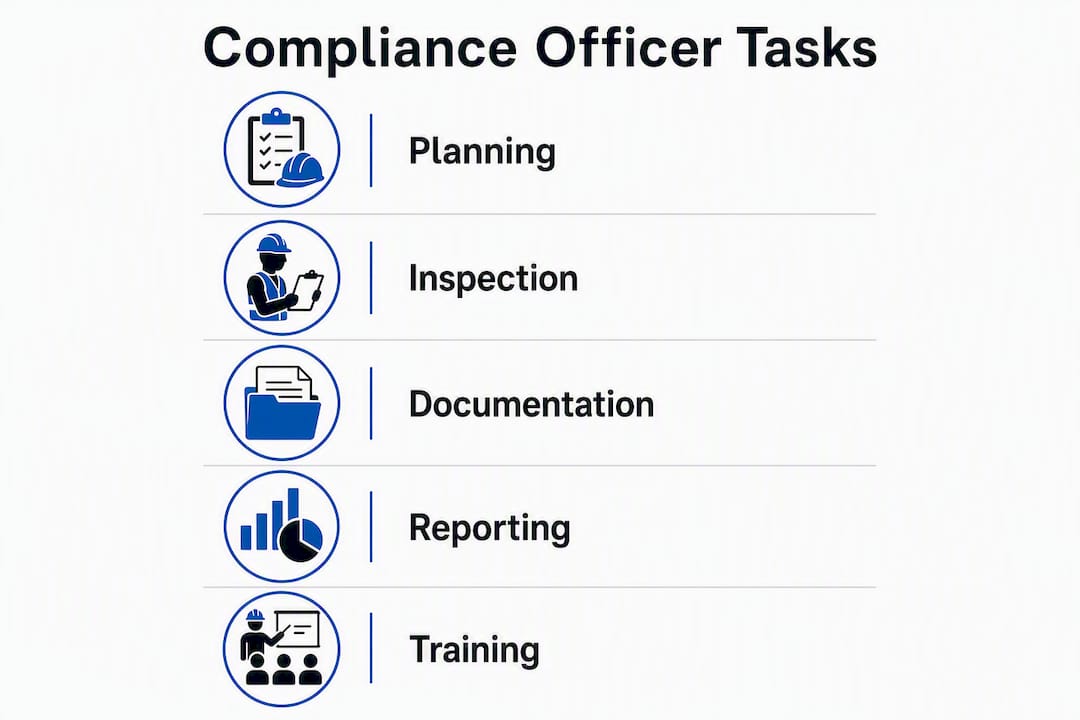
The role of compliance officer in construction is broader than most job titles suggest. According to Go Construct’s career guidance, a compliance manager conducts routine site inspections, collects evidence, and communicates with employees to confirm that the project meets both legislation and specifications. In practice, that translates into three overlapping areas of work.
Operational duties
- Carry out daily and weekly site inspections against method statements and risk assessments
- Review and approve method statements before work commences
- Manage permit-to-work systems for high-risk activities such as hot works, confined spaces, and excavations
- Control hold points: confirm that preceding work meets specification before the next phase begins
- Monitor PPE compliance, exclusion zones, and segregation of pedestrians from plant
Regulatory duties
- Apply CDM 2015 requirements across the project, including pre-construction information, construction phase plans, and health and safety files
- Interpret Building Regulations and confirm that structural, fire, drainage, and accessibility requirements are met
- Enforce environmental controls: waste segregation, duty-of-care documentation, and pollution prevention measures
- Monitor compliance with the Health and Safety at Work Act 1974 and associated regulations
Administrative duties
- Maintain audit-ready documentation: inspection logs, non-conformance reports, corrective action registers, and training records
- Investigate incidents and near-misses, producing written findings and recommended actions
- Deliver toolbox talks and site inductions to embed a culture of accountability
- Produce regular compliance reports for the principal contractor or client
On a medium-sized demolition or strip-out project, a typical week might include two full site inspections, one method statement review, a toolbox talk on asbestos awareness, updating the waste transfer note register, and closing out corrective actions from the previous week’s audit.
“Compliance officers carry out audits, provide training, investigate potential violations and specialise in fields such as environment or data protection when required.” — U.S. Bureau of Labor Statistics, Occupational Outlook Handbook
Pro Tip: When resources are limited, prioritise inspections at activity transition points — the moments when one trade hands over to another. These are where controls most often break down and where undocumented conditions create the greatest liability.

Which UK laws and regulations must a compliance officer know?
Construction compliance responsibilities in the UK sit across several statutes and regulatory frameworks. Officers need to know which apply to their project type and which duties are delegable.
Primary statutes and regulations
- Health and Safety at Work Act 1974 (HSAW): The overarching duty of care for employers and the self-employed; sets the legal baseline for all site safety obligations
- Construction (Design and Management) Regulations 2015 (CDM 2015): Allocates specific duties to clients, principal designers, principal contractors, designers, and contractors; requires a construction phase plan and health and safety file on notifiable projects
- Building Regulations 2010 (as amended): Sets minimum standards for structural integrity, fire safety, energy efficiency, drainage, and accessibility; enforced by building control bodies
- Environmental Permitting (England and Wales) Regulations 2016: Governs waste management, water discharge, and activities that could cause pollution; operators must hold the correct permit or exemption
- Control of Asbestos Regulations 2012: Requires surveys, licensed removal for certain asbestos types, and air monitoring on demolition and strip-out projects
- Control of Substances Hazardous to Health Regulations 2002 (COSHH): Applies to dust, chemicals, and biological agents encountered on site
Operational guidance and authoritative sources
- HSE guidance: HSE publishes approved codes of practice (ACOPs) and guidance notes that, while not law, carry significant weight in enforcement proceedings
- GOV.UK planning and building control pages: Primary reference for permitted development, prior approval, and building control procedures
- British Standards: BS 6187 (demolition), BS EN ISO 9001 (quality management), and BS 8000 series (workmanship on building sites) provide technical benchmarks
- Environment Agency guidance: Waste duty of care, waste transfer notes, and site waste management plans
A practical note on CDM delegation
Under CDM 2015, certain duties cannot be delegated away from the principal contractor: the construction phase plan, welfare provision, and site-wide coordination remain with them. The compliance officer typically supports the principal contractor in discharging these duties but does not replace them. Designers hold their own separate obligations, and the compliance officer’s role is to verify that those obligations have been met, not to absorb them.
How do compliance officers translate law into on-site controls?
Knowing the regulations is only half the job. The compliance officer’s practical value lies in converting legal requirements into controls that operatives can follow and that auditors can verify.
A typical control process
- Identify the risk: Review the method statement, walk the activity area, and confirm hazards match those assessed
- Confirm temporary controls are in place: Check barriers, exclusion zones, PPE, and permit conditions before work starts
- Conduct a verification check: Observe the activity in progress; confirm controls are functioning as planned
- Document the finding: Record the inspection date, location, operative names, conditions observed, and any non-conformances
- Report and escalate: Issue a corrective action notice for any breach; escalate to the site manager or principal contractor if the breach is serious or repeated
What auditors look for on a site visit
- Signed and dated method statements with named supervisors
- Completed permit-to-work forms with start, extension, and close-out signatures
- Hold-point sign-off sheets confirming inspection before work progressed
- PPE compliance records and photographic evidence
- Waste transfer notes and environmental monitoring logs
- Training records and toolbox talk attendance sheets
For demolition projects, a pre-demolition survey forms part of the audit trail, confirming that hazardous materials have been identified and controlled before structural work begins.
Pro Tip: Allocate no more than 60% of your working day to paperwork. The remaining time should be spent on the ground. Controls that exist only in documents are not controls — they are liabilities waiting to be discovered.

A three-bucket model for structuring compliance activity
Operational compliance work on a construction project naturally falls into three areas. Organising activity around these three buckets helps officers prioritise, delegate, and report more clearly.
| Bucket | Main deliverables | Typically responsible |
|---|---|---|
| Programme management (policy and controls) | Construction phase plan, method statements, risk assessments, permit-to-work system, hold-point schedule | Compliance officer with principal contractor sign-off |
| Evidence collection (audit trails and registers) | Inspection logs, non-conformance registers, corrective action trackers, waste transfer notes, photographic records | Compliance officer; site manager contributes daily records |
| Stakeholder engagement (training, communication, reporting) | Site inductions, toolbox talks, compliance reports to client, liaison with HSE or building control if required | Compliance officer; safety officer supports delivery |
On a strip-out project, for example, programme management means producing a detailed method statement for asbestos encapsulation before any ceiling removal begins. Evidence collection means photographing conditions before and after each work phase and logging waste tonnages against the site waste management plan. Stakeholder engagement means briefing operatives on the encapsulation procedure at the start of each shift and reporting weekly to the principal contractor on open corrective actions.
- The three buckets are interdependent: a gap in evidence collection undermines programme management, and poor stakeholder engagement means controls are not followed even when they are well designed
- Officers who treat the three areas as separate silos tend to produce thorough paperwork but miss live site conditions; those who integrate them catch problems earlier
Pro Tip: Build a simple weekly tracker with one row per bucket and a RAG status. It takes ten minutes to update and gives the principal contractor an instant compliance picture without requiring them to read every log.
What skills and qualifications do compliance officers need?
The construction compliance officer role is not entry-level. Compliance officer job descriptions consistently emphasise that experience, training, and a clear set of duties are expected, alongside continuous monitoring and reporting capability.
Core skills
- Risk assessment: Ability to identify hazards, evaluate likelihood and severity, and specify proportionate controls
- Technical knowledge: Working understanding of health and safety law, environmental regulations, and quality standards relevant to the project type
- Communication: Clear written and verbal communication with operatives, subcontractors, clients, and regulators
- Record-keeping: Disciplined approach to documentation; ability to produce evidence that withstands scrutiny
- Impartiality: Willingness to raise non-conformances regardless of commercial pressure or seniority of the person responsible
Qualifications and training routes
- NEBOSH National Certificate in Construction Health and Safety: The most widely recognised entry qualification for site-based compliance and safety roles
- IOSH Managing Safely or Working Safely: Shorter courses suitable for operatives and supervisors; IOSH membership supports career progression
- CSCS card: Required for site access; the appropriate card level depends on qualifications and role
- HNC/HND in Construction and the Built Environment: Provides technical grounding for officers working across quality and engineering compliance
- Degree-level study: BSc in Construction Management, Environmental Management, or a related discipline supports progression to senior compliance roles
- Apprenticeships: The Level 4 Construction Site Supervisor apprenticeship and emerging compliance-specific standards provide structured routes for those entering the industry
The National Careers Service lists construction-related training courses and can help candidates identify funded routes into compliance qualifications.
Salary expectations vary by project type and seniority. Entry-level compliance roles on smaller projects typically have moderate salaries; senior compliance managers on major infrastructure or demolition programmes can command higher salaries, particularly in London and the South East. These figures reflect general market positioning and will vary by employer, contract type, and location.
Where does the compliance officer sit in a project structure?
Placement matters. A compliance officer who reports to the commercial manager will face different pressures from one who reports directly to the safety lead or operates as an independent advisor. Each arrangement has genuine trade-offs.
Reporting line options
- Reports to the principal contractor’s safety lead: Closest to operational decisions; risk is that commercial pressure can influence findings if the safety lead is not sufficiently independent
- Reports directly to the project director or client: Greater independence; can be less effective at influencing day-to-day site behaviour without a direct line to the site team
- Independent third-party advisor: Maximum impartiality; higher cost and less continuous presence on site
Interaction with CDM roles
The compliance officer works alongside, not instead of, CDM duty holders. The principal designer holds design-phase obligations; the principal contractor holds construction-phase obligations. The compliance officer supports the principal contractor in meeting those obligations, coordinates with the site manager on daily controls, and liaises with subcontractors to confirm their method statements and risk assessments are in place before work starts.
Practical hiring criteria
When writing a job brief or contract for a compliance officer, include:
- Minimum qualification level (e.g. NEBOSH Construction Certificate as a baseline)
- Relevant site experience (specify project type: demolition, groundworks, civil engineering)
- Familiarity with CDM 2015 and the specific regulatory frameworks for the project
- Defined reporting line and escalation authority
- Expected deliverables: inspection frequency, report format, corrective action timescales
- Clarity on whether the role is site-based, visiting, or hybrid
Evaluating a demolition contractor’s compliance credentials follows a similar logic: the questions you ask a contractor about their compliance capability are the same ones you should ask when assessing a compliance officer candidate.
What are the consequences of poor compliance on a construction project?
Non-compliance carries consequences that extend well beyond a fine. The business case for appointing a compliance officer is partly about avoiding these outcomes.
Forms of consequence
- HSE prosecution: The Health and Safety Executive can prosecute both companies and individuals; fines are unlimited for the most serious breaches under the Health and Safety (Offences) Act 2008
- Fee for Intervention (FFI): Where HSE identifies a material breach, it recovers its investigation costs from the duty holder at a published hourly rate
- Improvement and prohibition notices: An improvement notice requires a breach to be remedied within a set period; a prohibition notice stops work immediately until the hazard is controlled
- Project delays: A stop notice or prohibition notice can halt a programme for days or weeks, with knock-on costs across the supply chain
- Costly rework: Failure to hold inspection points before covering up structural or drainage work can require demolition and reconstruction of completed elements
- Reputational damage: Prosecutions are public record; a conviction can affect a contractor’s ability to tender for public sector work or to obtain certain insurances
Brief examples of typical outcomes
A principal contractor that fails to produce a construction phase plan before work starts on a notifiable CDM project is in immediate breach. If HSE visits and identifies the absence, an improvement notice is likely, with FFI costs accruing from the point of the material breach. On a demolition project where asbestos controls are inadequate, a prohibition notice stops all work until licensed removal is completed and air clearance certificates are obtained. The delay alone can cost more than the entire compliance function for the project.
The demolition hazards guide produced by Gcscontractors sets out the specific hazard categories that most frequently trigger enforcement action on strip-out and demolition sites.
Practical checklist templates for audit-ready sites
A compliance officer’s output is only as useful as the documentation they produce. The following checklist structure covers the core documents a site should hold and what each record needs to contain to be verifiable.
Core document categories and required fields
- Permits to work: Activity type, location, date and time, named permit holder, hazards identified, controls confirmed, supervisor signature, close-out signature and time
- Inspection logs: Date, inspector name, area inspected, conditions observed, non-conformances noted, corrective action required, responsible person, target close-out date
- Method statements: Work activity, sequence of operations, plant and equipment, hazards and controls, named supervisor, review date, approval signature
- Risk assessments: Hazard description, persons at risk, likelihood and severity rating, control measures, residual risk rating, review trigger
- Hold-point registers: Hold-point reference, activity, inspection criteria, inspector name, date passed, sign-off authority
- Training records: Operative name, course or talk title, date, trainer name, attendance signature
- Waste transfer notes: Waste description, EWC code, quantity, carrier details, receiving site details, transfer date, signatures of both parties
- Toolbox talk records: Topic, date, location, presenter, attendee names and signatures
Adapting templates for project scale
| Document | Small project (1–5 operatives) | Large project (— operatives) |
|---|---|---|
| Inspection log | Single A4 sheet, weekly | Digital log, daily, with photo attachments |
| Method statement | Combined RAMS document | Separate method statement and risk assessment per activity |
| Hold-point register | Embedded in inspection log | Standalone register with QA sign-off column |
| Training records | Paper attendance sheet | Centralised training matrix by operative and competency |
| Waste transfer notes | Paper copies filed on site | Scanned and uploaded to project document management system |
For site preparation and compliance on UK projects, the document set above forms the minimum audit trail. Larger or more complex projects will add environmental monitoring records, structural inspection certificates, and third-party test reports to this baseline.
Key takeaways
The compliance officer role in UK construction is a structured, qualification-backed function that protects project timelines, legal standing, and commercial reputation across every phase of work.
| Point | Details |
|---|---|
| Core function | The compliance officer enforces safety, quality, and environmental controls through inspections, documentation, and training. |
| Three-bucket model | Organise compliance activity into programme management, evidence collection, and stakeholder engagement for clear accountability. |
| Minimum qualification | NEBOSH Construction Certificate is the recognised baseline; IOSH and CSCS are supporting requirements. |
| Consequences of inaction | Non-compliance risks HSE prosecution, prohibition notices, FFI costs, project delays, and reputational damage. |
| Gcscontractors | Gcscontractors delivers compliance-aware groundworks, strip-out, and demolition across Cambridge and East Anglia. |
Why compliance officers change project outcomes
The conventional view of a compliance officer is someone who checks boxes and files paperwork. That framing misses the point entirely. The officers who genuinely change project outcomes are the ones who treat their inspection rounds as intelligence-gathering exercises, not administrative obligations. They walk the site looking for the gap between what the method statement says and what is actually happening, and they act on it before the gap becomes an incident or a prohibition notice.
What project stakeholders often underestimate is the financial protection the role provides. A single prohibition notice on a demolition programme can cost more in delay, remobilisation, and supply chain disruption than a compliance officer’s entire annual salary. Contractors and developers who treat compliance as a cost centre rather than a risk management function tend to find this out the hard way. The smarter approach is to appoint early, brief clearly, and give the officer genuine authority to stop work when controls are not in place.
Gcscontractors: compliance-aware contracting in Cambridge and East Anglia
Gcscontractors brings compliance capability directly into its delivery model for groundworks, strip-out, and demolition projects across Cambridge and East Anglia. Every project is approached with health and safety, environmental controls, and Building Regulations compliance built into the programme from day one, not added as an afterthought.

Whether you need strip-out contractors in Cambridge who understand CDM obligations, or a groundworks team that can demonstrate audit-ready documentation on foundations and civil engineering works, Gcscontractors has the experience and the processes to deliver. The team works in live environments, coordinates with principal contractors and building control bodies, and maintains the full document trail that compliance audits require.
To discuss your project’s compliance requirements or to request a quotation for compliant groundworks, strip-out, or demolition works, contact Gcscontractors directly through the website.
Useful sources and further reading
The sources below are the primary statutory and authoritative references for construction compliance in the UK. Those marked as statutory are the legal baseline; the others are practical guidance.
- HSE: Construction (Design and Management) Regulations 2015 (statutory) — The primary CDM reference, including duty holder guidance and construction phase plan requirements
- HSE: Health and Safety at Work Act 1974 (statutory) — The overarching health and safety duty of care for employers
- HSE: Construction sector guidance (practical guidance) — Approved codes of practice, topic-specific guidance, and enforcement information
- GOV.UK: Building Regulations (statutory) — Building control procedures, approved documents, and exemptions
- Environment Agency: Waste duty of care (statutory) — Waste transfer note requirements and duty-of-care obligations
- Go Construct: Compliance manager career profile (practical guidance) — Industry career guidance on duties, qualifications, and progression routes
- National Careers Service: Find a course (practical guidance) — Funded training routes including NEBOSH and construction-related qualifications
- Gcscontractors: Compliance tips for demolition (practical guidance) — Contractor-level compliance guidance for demolition and strip-out projects