Roadworks safety checklist: the contractor’s guide
A roadworks safety checklist is a systematic verification tool used to confirm that all traffic control measures, worker protections, and hazard mitigations are in place and functioning during active construction operations. For safety managers and contractors, it is the difference between a compliant site and a costly enforcement action. UK roadworks operate under frameworks including Chapter 8 of the Traffic Signs Manual and NHSS 12 competence requirements, both of which shape exactly what your checklist must cover. A daily field-led inspection transforms this document from static paperwork into an active control tool. Paired with a solid groundworks safety foundation, it forms the backbone of construction site safety.
1. What are the essential components of a roadworks safety checklist?
A complete roadworks safety checklist covers six core categories: traffic control devices, barrier integrity, personal protective equipment, illumination, housekeeping, and emergency readiness. Missing any one category creates a compliance gap that inspectors and incidents will find. Daily work-zone inspections must verify that signs and channelising devices are correctly placed with intact reflective sheeting, barriers have no gaps, and end treatments are correctly installed.
Traffic control devices
- Sign order and spacing match the approved Traffic Management Plan
- Reflective sheeting on all signs is clean, undamaged, and facing the correct direction
- Cones are upright, correctly spaced, and free from damage
- Advance warning signs are positioned at the correct taper distance for the road speed
Barrier and worker protection
- No gaps in barrier lines that would allow vehicle intrusion
- Workers wear Class 2 or Class 3 high-visibility clothing appropriate to the speed zone
- Exclusion zones around plant and excavations are clearly marked and maintained
Illumination and housekeeping
- Night-time cone layouts require amber warning lights spaced every 9 metres, with flashing amber permitted only on roads at or below 40 mph with active street lighting
- Debris, spoil, and loose materials are cleared from the carriageway at the end of each shift
- Drainage channels are free from blockage caused by site waste
Emergency readiness
- First-aid kit is fully stocked and location is signed
- Emergency contact details for the responsible operative are posted on site
- Nearest hospital and emergency access route are documented in the site file
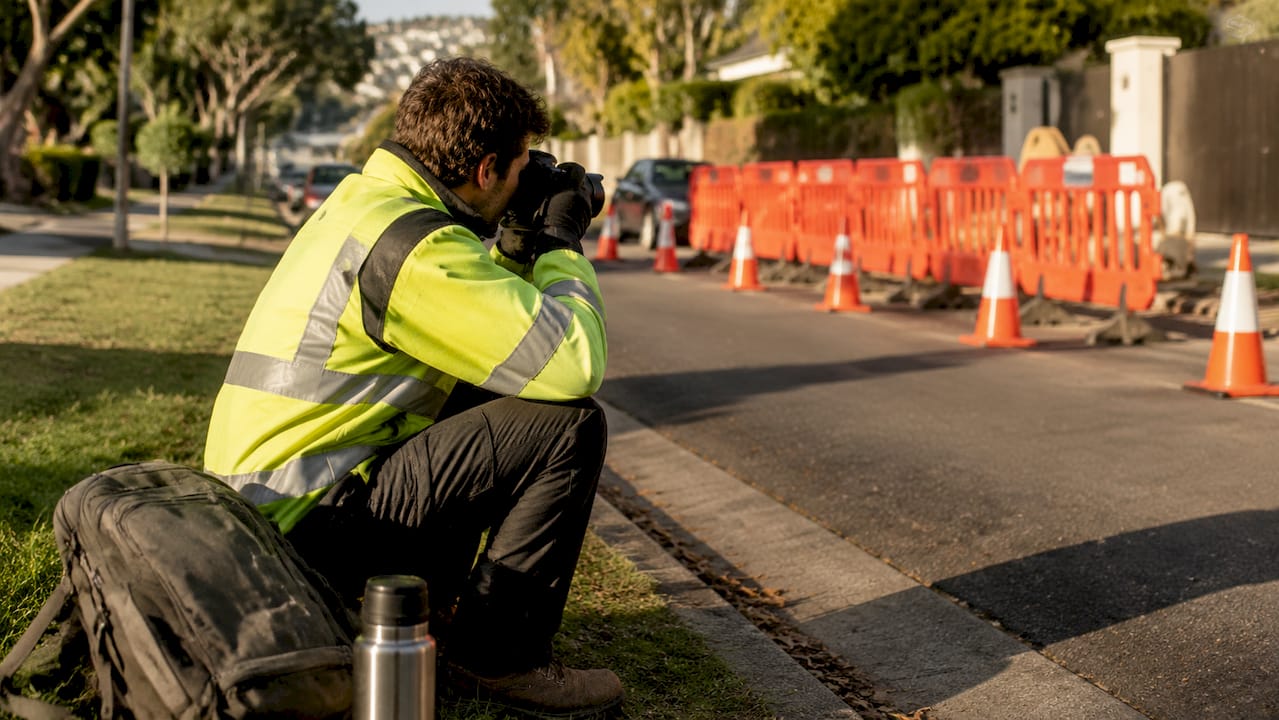
Pro Tip: Photograph every sign and barrier position at the start of each shift. This “as-installed” baseline record is your first line of defence during an audit or incident investigation.
2. How does regulatory compliance shape an effective roadworks safety checklist?
UK law mandates specific qualifications, approved plans, and documented procedures before any roadworks begin on a public highway. Your checklist must reflect these requirements directly, not as a separate document but as integrated verification steps. A Traffic Management Plan approved by the local highway authority is mandatory for any works altering public roads or footways, and it must specify diversion routes, pedestrian crossings, and safe access arrangements.
The following regulatory requirements must appear as checklist items:
- Confirm the TMP has been approved and is available on site before mobilisation begins.
- Verify that taper design, cone sizes, and signage placement comply with Chapter 8 specifications for the road type and speed limit.
- Check that all operatives responsible for installing or maintaining temporary traffic management hold valid NHSS 12 qualifications, renewed every five years, and matched to the road type complexity.
- Confirm pedestrian and cyclist safe routes are signed, surfaced, and free from obstruction.
- Document any stop-work triggers: conditions under which the site supervisor must halt operations and notify the highway authority.
NHSS 12 categories include 12AB, 12D, 12F, and 12G, each covering different road types and speed environments. Assigning an operative to the wrong category is a compliance failure even if the physical layout is correct. Your checklist must record each operative’s category against the road type on that specific site.
- Stop-work conditions include: barrier displacement by vehicle impact, sign knockdown, sudden deterioration in visibility, and unplanned utility strikes
- Any stop-work event requires a written record, a corrective action log, and sign-off before operations resume
- Pedestrian diversions must maintain a minimum clear width and be lit at night
For temporary traffic diversion compliance, the same principle applies globally: documented approval, signed routes, and verified layouts are non-negotiable before public exposure.
3. What is the role of hazard identification in the checklist?
A hazard identification checklist integrated into daily roadworks inspections converts reactive incident reporting into proactive risk control. Including hazard description, category, risk rating, existing controls, and recommended corrective actions within the checklist supports auditable risk management and gives you a defensible paper trail. Linking each hazard to an assigned owner and a due date strengthens accountability across the team.
The table below shows how to structure hazard entries within your daily checklist:
| Hazard | Category | Risk rating | Assigned owner | Due date |
|---|---|---|---|---|
| Cone displaced by HGV | Traffic control | High | Site supervisor | Same shift |
| Unlit barrier section at night | Illumination | High | Traffic marshal | Before dusk |
| Loose spoil on carriageway | Housekeeping | Medium | Labourer | End of shift |
| Overhead cable near plant | Electricity | High | Plant operator | Before next lift |
| Unsecured excavation edge | Falls | High | Site manager | Immediate |
SafeWork NSW identifies falls, electricity, and moving plant as the most common serious injury causes on construction sites. These cross-cutting hazards apply directly to roadworks environments involving excavation and heavy plant. Your checklist must extend beyond traffic management devices to capture them.
Pro Tip: Link your hazard register to your daily inspection log. A dual-record approach gives auditors a clear chain of evidence from hazard identification through to corrective action closure.
4. How to implement a daily operational workflow using the checklist
Treating the roadworks safety checklist as a lifecycle tool rather than a single daily form prevents the compliance drift that occurs mid-project. A comprehensive workflow spans pre-mobilisation through to site closeout, with distinct checklist stages at each phase. Each stage has its own verification requirements and documentation outputs.
- Pre-mobilisation. Confirm TMP approval, verify operative NHSS 12 categories against the road type, and check that all equipment meets Chapter 8 specifications before any vehicle or person enters the highway.
- Setup-day installation. Complete a full photographic log of sign positions, cone spacing, barrier alignment, and taper geometry immediately after installation. This baseline record supports every subsequent daily check.
- Daily operations inspections. Conduct a full device and personnel check at the start of each shift and after any significant weather event or vehicle impact. Record corrective actions with timestamps and responsible names.
- Change-control events. Any alteration to the approved layout, including lane width changes, extended working hours, or added pedestrian crossings, requires formal written approval before implementation. Checklists that lack stop-work triggers and change-control steps allow non-compliant layouts to persist undetected.
- Site closeout. Verify that all devices are removed, the carriageway is restored to its pre-works condition, and all inspection records are filed and signed off.
Supporting practices for each stage include:
- Briefing logs signed by all operatives at induction and at each change-control event
- Visual confirmation that layout continuity is maintained after each vehicle pass-through
- Pre-start qualification checks completed before the first operative enters the highway, not at the end of the day when an audit arrives
Pre-verifying NHSS 12 certification and assigning roles before mobilisation avoids last-minute qualification failures during inspections. This single step prevents the most common audit failure on UK roadworks sites.
5. What tools and best practices improve checklist effectiveness?
A written work-zone safety programme alone is insufficient. A daily, field-led verification routine is what drives consistent hazard minimisation through real-time oversight rather than static planning. The following practices raise checklist quality from adequate to audit-ready.
- Photo documentation. Capture as-installed baseline images at setup and after every change. Time-stamped photographs are accepted as evidence by highway authorities and insurers.
- Digital checklist applications. Tools such as digital inspection platforms allow real-time updates, automatic audit trail generation, and instant notification to supervisors when a critical item fails. Paper checklists remain legally valid but create transcription delays.
- Competency assessments. Schedule quarterly reviews of operative NHSS 12 certificates. Renewal is required every five years, but road type upgrades require immediate recertification.
- Stop-work authority. Every operative must know they have the authority to halt work if a safety breach occurs. This is not a management-only power. Documenting this authority in the checklist briefing record removes ambiguity.
- Housekeeping schedules. Assign a named operative to carriageway clearance at defined intervals, not just at shift end. Debris accumulation mid-shift is a live hazard.
- Emergency readiness drills. Test the emergency response procedure at least once per project phase. Confirm that all operatives know the nearest hospital route and can locate the first-aid kit without asking.
For deeper context on site-wide safety controls, the deep excavation safety checklist published by Gcscontractors covers overlapping hazard categories relevant to roadworks involving groundworks.
Pro Tip: Set a calendar reminder for NHSS 12 renewal dates six months in advance. Expiry mid-project forces a work stoppage and can trigger a highway authority notice.
Key takeaways
A roadworks safety checklist is only effective when it integrates device verification, hazard risk assessment, regulatory compliance, and a structured daily workflow across every phase of the project.
| Point | Details |
|---|---|
| Checklist scope | Cover traffic devices, barriers, PPE, illumination, housekeeping, and emergency readiness every shift. |
| Regulatory compliance | Verify TMP approval and NHSS 12 qualifications before any operative enters the highway. |
| Hazard identification | Record hazard category, risk rating, owner, and due date to create an auditable corrective action trail. |
| Lifecycle workflow | Run distinct checklist stages from pre-mobilisation through closeout to prevent mid-project compliance drift. |
| Stop-work authority | Document stop-work triggers and change-control approval steps to maintain layout integrity throughout operations. |
Why most roadworks checklists fail before lunchtime
The single most common failure I see on roadworks sites is a checklist completed at 7am and ignored for the rest of the shift. The document gets signed, filed, and forgotten. Then a cone gets knocked over at 10am, a barrier shifts after a heavy goods vehicle clips it at noon, and by the time the afternoon inspection happens, the layout no longer matches the approved TMP. Nobody recorded the change. Nobody triggered the stop-work protocol. The checklist said the site was safe, but the site had not been safe for hours.
The fix is not a better form. It is a different attitude to what the form is for. A roadworks safety checklist is a live control document, not a morning ritual. That means assigning a named operative to re-verify critical items after every significant event, not just at shift start. It means photographing the layout after a vehicle impact, not assuming it bounced back into position. It means treating the change-control section as a genuine gate, not a box to tick retrospectively.
The other failure I see regularly is checklist design that stops at traffic management and ignores the broader construction site hazards. Falls, electricity, and moving plant cause serious injuries on roadworks sites just as they do on building sites. A checklist that only covers cones and signs is incomplete by definition.
The contractors who get this right share one habit: they brief the checklist, not just distribute it. Every operative knows what the stop-work triggers are, who has the authority to call a halt, and what the escalation path looks like. That briefing culture is what separates a compliant site from a safe one.
— George
Gcscontractors: site setup and enabling works that support compliance
Gcscontractors delivers groundworks, civil engineering, and site setup services across Cambridge and the surrounding region, with a direct focus on health, safety, and local building regulations.

For projects requiring roadworks, drainage, or enabling works within live environments, Gcscontractors brings the operational discipline that checklist compliance demands. The team works to minimise disruption while maintaining full regulatory adherence from mobilisation through to closeout. Whether you need site setup and enabling works managed to Chapter 8 standards or groundworks delivered within a live traffic environment, Gcscontractors has the experience and certifications to support your project. Contact the team to discuss your site requirements and compliance obligations.
FAQ
What must a roadworks safety checklist include?
A roadworks safety checklist must cover traffic control device placement, barrier integrity, worker PPE compliance, night-time illumination, housekeeping, and emergency readiness. Each item requires a named responsible operative and a corrective action record.
How often should a roadworks site be inspected?
A full inspection is required at the start of every shift and after any vehicle impact, weather event, or layout change. Daily inspections alone are insufficient if significant events occur mid-shift.
What is NHSS 12 and why does it matter for the checklist?
NHSS 12 is the competence qualification required for operatives installing and maintaining temporary traffic management on UK roads. Checklists must verify that each operative holds the correct NHSS 12 category for the road type before work begins.
When is a Traffic Management Plan required?
A TMP approved by the local highway authority is required for any roadworks that alter public roads or footways. The plan must specify vehicle and pedestrian routes, crossing points, and safety layouts.
What triggers a stop-work order on a roadworks site?
Stop-work triggers include barrier displacement by vehicle impact, sign knockdown, sudden visibility loss, and unplanned utility strikes. Any stop-work event requires a written record and formal sign-off before operations resume.