Cess Pit Installation in Cambridge: A Comprehensive Guide & Comparison
Choosing the simplest tank to install often results in the highest operational costs for a Cambridgeshire site. While a cess pit requires no drainage field, making it a tempting choice for the heavy Gault Clay found across Cambridge, it remains a temporary holding solution with significant long term overheads. You likely already know that managing off-mains waste is a regulatory minefield, especially with the Environment Agency tightening its grip on local water quality.
This guide clarifies whether a cess pit is truly the right fit for your project or if a modern septic system offers a more sustainable path. We will break down the specific challenges of burying large tanks in difficult local soils and explain how to ensure your site meets the 2026 UK drainage standards. From foundations to finishing, you will gain a clear comparison of installation processes, emptying frequencies, and the essential compliance steps needed to avoid heavy fines from local authorities.
Key Takeaways
- Understand why a cess pit is classified as a “last resort” drainage solution and identify the specific site conditions where it remains the only viable choice for UK planning compliance.
- Compare the long-term cost and maintenance implications of holding tanks versus modern treatment plants to determine the most efficient system for your Cambridge project.
- Gain technical insights into the groundworks required for safe installation, including the use of reinforced concrete to mitigate the risk of tank floatation in local high-water-table areas.
- Follow a professional 5-step installation roadmap, ensuring every phase from bulk excavation to pipework connection meets rigorous civil engineering and safety standards.
Understanding the Cess Pit: A Last Resort for Cambridge Drainage?
A cess pit is a sealed, underground holding tank designed to collect and store raw sewage without any outlet for treated effluent. In the UK, planning authorities and the Environment Agency categorise these systems as a last resort. You should only consider one when a mains sewer connection, a septic tank, or a modern sewage treatment plant is technically impossible to install. What is a cesspit? In technical terms, it’s a containment vessel that requires regular emptying to remain functional and compliant with environmental standards.
In rural Cambridgeshire, specific site conditions often leave homeowners with few alternatives. Heavy clay soils with poor porosity or areas with high water tables prevent the use of traditional drainage fields. A specialised groundworks contractor is essential in these scenarios. They evaluate the site’s geology and ensure the installation meets the strict 1991 Building Regulations. Without a professional assessment, you risk environmental contamination or tank buoyancy issues in waterlogged ground.
To better understand this concept, watch this helpful video:
Cess Pit vs Septic Tank: Key Differences for Homeowners
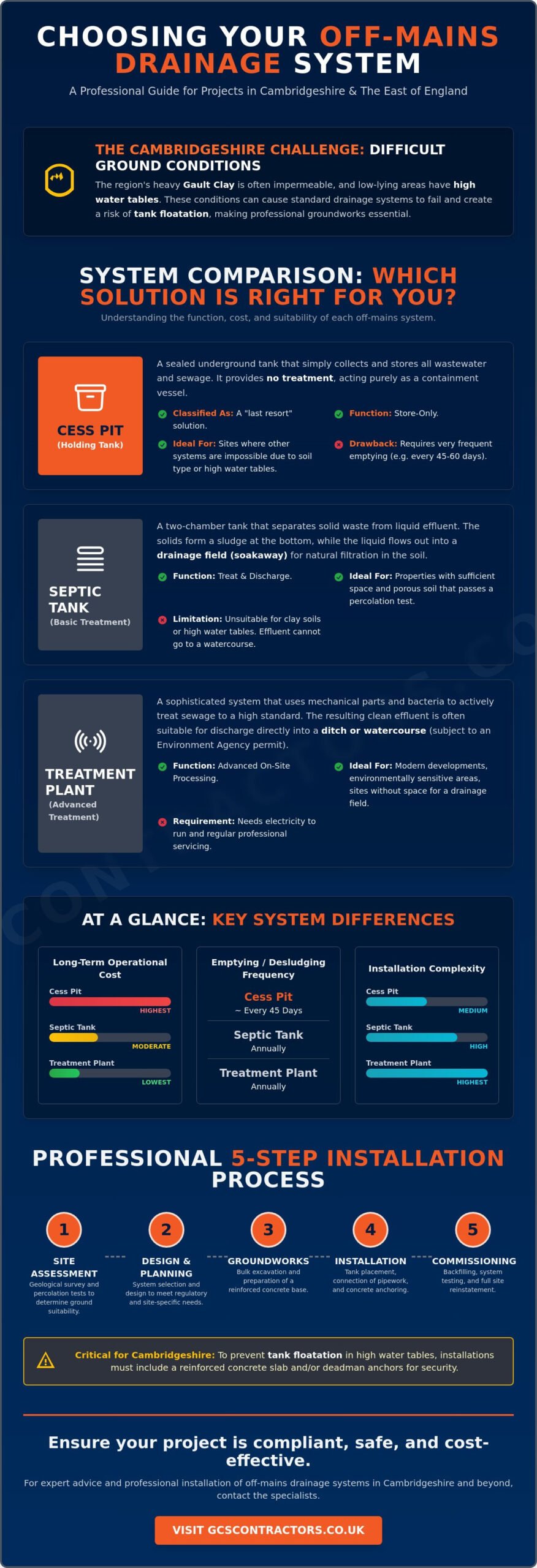
The main distinction is the “store-only” nature of the system. A septic tank uses a “treat-and-discharge” mechanism, separating solids and allowing liquid effluent to drain into a soakaway. A cess pit doesn’t treat waste; it holds everything until a vacuum tanker arrives. This creates significant maintenance implications. You’ll need a professional pumping service frequently, often every 45 days for a standard four-person household. This makes it the most expensive off-mains drainage option over a long-term period.
Terminology varies depending on the audience. Civil engineers and site managers typically use the word “cesspool” in technical specifications and S278 works. Homeowners usually prefer the popular term used in residential queries. Regardless of the name, the function remains a simple holding exercise. It’s a vital solution for difficult sites in Cambridge and Cambridgeshire where environmental protection is the priority. As a trusted local partner, we provide a safe pair of hands for these complex installs, managing everything from foundations to finishing.
Comparing Your Options: Cesspit vs Septic Tank vs Treatment Plant
Selecting the right off-mains drainage system depends on your site’s specific geology and the volume of waste produced. A cess pit serves as a fully sealed holding tank with no outlet, requiring regular emptying by a registered carrier. While the initial installation might be simpler than a complex treatment plant, the ongoing operational costs are significantly higher. In contrast, septic tanks and sewage treatment plants process waste on-site, but they require specific ground conditions to function correctly. For homeowners and developers planning new builds, our guide to residential drainage systems in Cambridge provides a comprehensive overview of all available options and the latest 2026 regulatory requirements.
From a groundworks perspective, installing a cess pit involves more than just digging a hole. Heavy excavation is required to accommodate tanks that can hold upwards of 18,000 litres for a standard family home. In Cambridgeshire, we often install these systems with reinforced concrete slabs and deadman anchors. This prevents hydrostatic uplift, where high groundwater levels can literally push an empty tank out of the ground. Proper site preparation is the difference between a system that lasts 40 years and one that fails in its first winter.
Evaluating Ground Conditions in Cambridgeshire and Essex
The local landscape presents unique challenges for drainage. Much of the region sits on Gault Clay, a dense, impermeable soil that frequently fails the standard percolation test (Vp). If your soil doesn’t allow water to drain at a rate between 15 and 100 seconds per millimetre, a traditional septic tank installation in Cambridge soakaway won’t work. In these instances, or in the low-lying Fens where water tables are naturally high, a sealed cess pit is often the only viable solution to meet UK government regulations.
For modern developments in Saffron Walden or Ely, sewage treatment plants are frequently preferred. They produce a higher quality of effluent that can sometimes be discharged directly into a watercourse, subject to Environment Agency approval. Understanding these technical requirements is vital before you break ground. You can find more detail in our guide to groundworks in Cambridge which covers site-wide preparation. If you’re unsure which system fits your plot, speaking with a specialist engineer can prevent costly mistakes during the planning phase.
Planning, Installation, and Regulations for East of England Projects
Installing a cess pit requires a disciplined approach to ensure long-term stability and environmental safety. At GCS Contractors, we follow a rigorous 5-step installation process: site survey, bulk excavation, tank positioning, backfilling, and final pipework connection. In the East of England, particularly in low-lying areas like Peterborough, high water tables are a common challenge. In these conditions, we implement reinforced concrete works to prevent “tank floatation,” where hydrostatic pressure can force an empty tank out of the ground. From foundations to finishing, our team ensures every stage meets CHAS Elite standards.
Navigating Environment Agency and Building Regulations
Compliance is non-negotiable for off-mains drainage. You must adhere to government cesspool regulations regarding maintenance and placement. Current Building Regulations dictate a “2-metre rule” from property boundaries and a “7-metre rule” from habitable buildings. Whilst the 2026 General Binding Rules focus on effluent discharge from septic tanks, a cess pit remains a zero-discharge solution that requires regular emptying. You’ll need planning permission and building control sign-off for all new installations to ensure the system doesn’t contaminate local groundwater.
The Role of Professional Excavation and Concrete Works
Site layout must account for the “honey wagon” or emptying tanker. These heavy vehicles require clear, hardstanding access within 30 metres of the tank. Professional bulk excavation is critical during the initial phase to avoid damaging existing utility trenching. We use specific backfill materials, such as pea shingle or lean-mix concrete, to protect the tank’s integrity. Using the wrong material leads to structural failure or “egging” of the tank walls. Our Cambridge-based specialists manage the entire technical scope to keep your project on track.
Ready to Start Your Project?
Consult GCS Contractors for your drainage installation to ensure your site is fully compliant and professionally engineered.
Secure Your Cambridge Drainage Infrastructure
Choosing the right off-mains drainage system requires a precise balance between site limitations and long-term maintenance requirements. Whilst a cess pit remains a functional solution for East of England sites with poor soil porosity or limited space, it requires strict adherence to Environment Agency General Binding Rules and local planning permissions. Selecting an unsuitable system can lead to environmental fines or structural failure, making professional site assessment vital before any groundworks begin.
GCS Contractors provides the technical expertise needed for complex infrastructure projects. As CHAS Elite approved groundworks specialists with ISO 9001 certification, we ensure every installation meets rigorous quality management standards. We’ve delivered drainage and civil engineering solutions across Cambridgeshire for over 14 years, managing everything from site clearance to final connection. From foundations to finishing, we handle the technical details so your project stays on track and remains fully compliant with current UK building regulations.
Ready to Start Your Drainage Project? Contact GCS Contractors Today
We look forward to helping you deliver a reliable, long-term drainage solution for your property.
Frequently Asked Questions
Do I need planning permission for a cess pit in Cambridge?
Yes, you usually need planning permission and Building Regulations approval for a new cess pit installation in Cambridge. Under the Building Regulations 2010 (Part H), all new drainage systems must comply with strict environmental and safety standards. You’ve got to ensure the tank meets the Environment Agency’s General Binding Rules. We recommend consulting with South Cambridgeshire District Council planners before starting work to confirm specific site constraints and environmental protections.
How often does a cesspit need to be emptied for a four-bedroom house?
For a four-bedroom house with five occupants, you’ll likely need to empty your tank every 4 to 6 weeks. This estimate assumes a standard 18,000-litre tank and an average daily water usage of 150 litres per person. If your household uses more water or has a smaller tank, this frequency increases. Regular monitoring is essential to prevent overflows and environmental contamination, which can lead to heavy fines under the Environmental Permitting Regulations 2016.
What is the average lifespan of a modern glass-reinforced plastic (GRP) cesspool?
A modern glass-reinforced plastic (GRP) cesspool has an average lifespan of 20 to 30 years. When installed correctly by specialists, these tanks are highly resistant to chemical corrosion and ground pressure. Some high-specification GRP units can last up to 50 years if they’re maintained properly and the surrounding ground conditions remain stable. This durability makes them a more reliable long-term solution than older brick or concrete structures that often crack over time.
Can I install a cess pit myself or do I need a specialised contractor?
You must hire a specialised contractor for a cess pit installation to ensure safety and legal compliance. Professional installers handle the complex excavation, ground stability assessments, and connection to your internal plumbing. GCS Contractors Ltd provides a safe pair of hands for these projects, ensuring all work meets ISO 9001 standards. Don’t risk a DIY installation as it often leads to structural failure, environmental leaks, and potential prosecution for breaching environmental laws.
Need drainage work in Cambridge? GCS Contractors Ltd installs soakaways, attenuation tanks and foul & surface water drainage to Building Regulations Part H. See our drainage services in Cambridge or call 07500 570 926 for a free quote.