Underpinning Footings: Stabilising Historic and Modern Foundations in Cambridge
A single centimetre of structural movement is often the difference between a routine maintenance task and a total building failure. In a city like Cambridge, where heavy Gault Clay often shifts beneath historic and modern properties alike, installing expert underpinning footings is the only way to guarantee long-term stability. You’re likely concerned about the disruption of deep excavation or the technical maze of Building Regulations and the Party Wall Act. It’s a high-stakes situation that requires a “safe pair of hands” to ensure your investment remains secure and compliant.
This article shows you how professional groundworks protect Cambridge properties from subsidence through precision engineering. As a CHAS Elite approved contractor, we prioritise a reliable, no-nonsense approach to structural repairs. You’ll discover the specific differences between mass concrete and piling methods, ensuring you choose the right fit for your site’s unique geology. We provide a clear roadmap for achieving a stable foundation that meets LABC standards, managing the entire process from foundations to finishing so you can move forward with confidence.
Key Takeaways
- Understand how Cambridge Gault Clay and seasonal moisture fluctuations lead to ground movement and why proactive foundation stabilisation is essential.
- Discover how professional underpinning footings secure your property by transferring structural loads to deeper, more stable soil strata.
- Evaluate the technical differences between traditional mass concrete pinning and piled underpinning to identify the superior solution for your site’s specific load requirements.
- Learn the importance of a rigorous structural survey and professional strip out in preparing a site for safe and efficient excavation.
- Explore the end-to-end process that takes a project from initial soil analysis to a fully stabilised handover, ensuring long-term structural integrity.
Understanding Underpinning Footings: Why Cambridge Foundations Fail
Underpinning is the technical process of strengthening an existing foundation. It involves extending the reach of the structure to a deeper, more stable soil stratum that can support the building’s load. For many property owners, understanding What is underpinning? becomes a priority when visible cracks appear or floors begin to slope. It’s a precise engineering solution designed to stop subsidence in its tracks and restore structural integrity.
To better understand this concept, watch this helpful video:
In Cambridge and the surrounding East of England, foundation failure often stems from the local geology. Ground movement isn’t just a possibility; it’s a seasonal reality. We frequently see underpinning footings required because the original foundations weren’t deep enough to bypass the active soil zone. Patching over cracks in historic centres like Ely or Saffron Walden is a high-risk strategy. If you don’t address the underlying footing failure, the structural safety of the entire build remains compromised.
The Science of Soil Settlement in Cambridgeshire
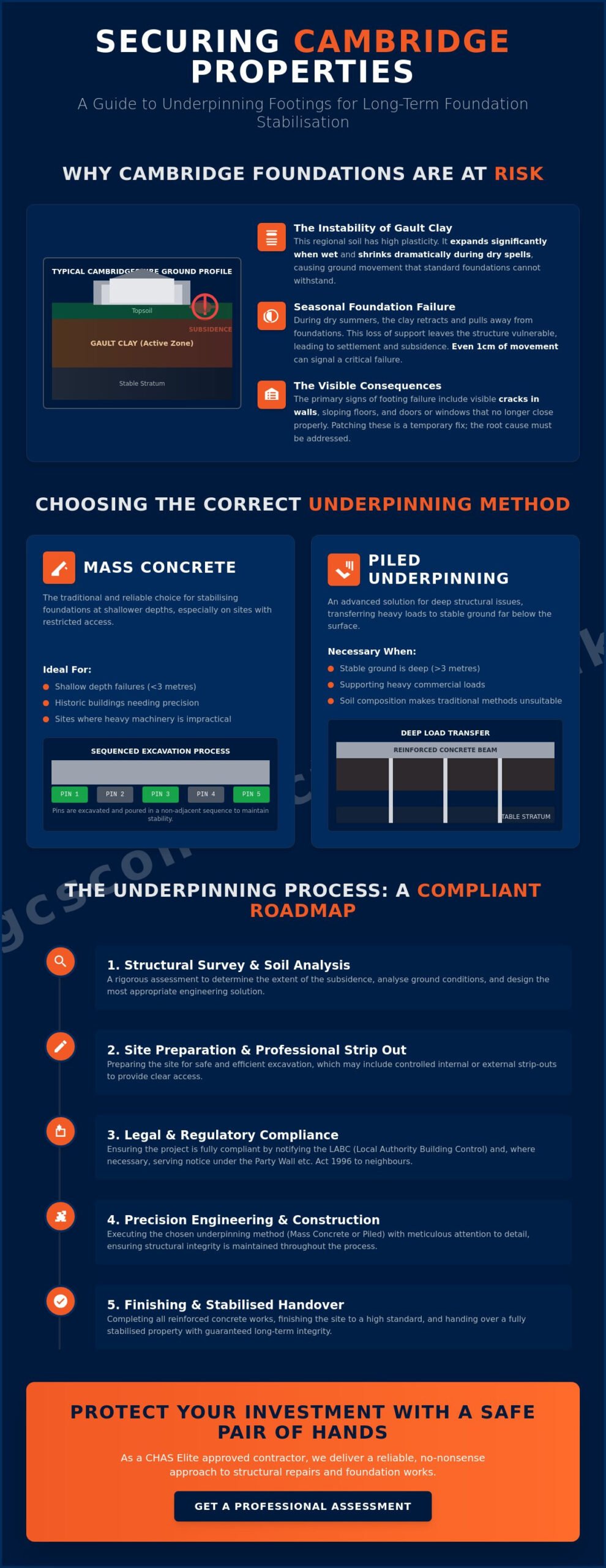
The region sits heavily on Gault Clay. This material has high plasticity, meaning it expands when wet and shrinks during dry spells. Gault Clay is a stiff, heavy-blue clay found across the East of England that dictates foundation depth requirements due to its extreme volume changes. During dry summers, the clay loses moisture and retracts, leaving footings unsupported. Professional bulk excavation during the initial build phase is the best preventative measure, but for existing structures, underpinning is the only permanent fix.
When is Underpinning Legally Required?
Underpinning is always classified as “notifiable work” under LABC Building Regulations. You must inform your local authority before work begins to ensure the solution meets current safety standards. In dense urban areas like Cambridge city centre, the Party Wall etc. Act 1996 also applies. This legislation requires you to serve formal notice to neighbours if your underpinning footings affect shared boundaries or are within 3 to 6 metres of their property. Compliance ensures the project is insured and legally sound. Understanding the full scope of construction foundations in Cambridge is essential before any notifiable work begins, particularly when Gault Clay soil conditions are a factor.
Comparing Underpinning Methods: Case Studies from the Field
Selecting the correct approach for underpinning footings depends on soil composition, depth of stable strata, and the existing structure’s load. We recently managed a project in Huntingdon involving a Victorian-era extension where traditional mass concrete was the primary solution. This method remains the standard for shallow depth failures. It involves excavating sections, or “pins,” in a controlled sequence to maintain structural integrity. By working in small, non-adjacent stages, we ensure the building stays stable throughout the process.
Traditional Mass Concrete: The Reliable Choice for Historic Renovations
When underpinning historic buildings, precision is vital. Each pin is excavated beneath the existing foundation and filled with high-grade concrete. Once cured, we use a dry sand-cement packing to transfer the structural load from the old footings to the new base. This technique is ideal for restricted access sites in Cambridge where heavy machinery isn’t an option. It’s a manual, labour-intensive process that protects the character of older properties whilst providing a permanent fix for subsidence.
Piled Foundations: Solving Deep Structural Issues
For more complex challenges, such as a 2023 commercial warehouse project in Peterborough, we transition to piled underpinning. This method is necessary when stable ground is located more than three metres beneath the surface. We use specialist rigs to drive or screw piles into the earth, which are then integrated with reinforced concrete works to create a robust support system. This setup handles heavy commercial loads that traditional underpinning footings cannot support. We act as a safe pair of hands, operating heavy machinery in tight residential spaces with minimal vibration.
The beam and base method often bridges the gap between these two techniques. It uses a reinforced concrete beam to support the existing wall, which then transfers the weight to mass concrete bases. It’s a versatile choice for varied soil conditions across Cambridgeshire. If you’re concerned about structural movement, our team can help you organise a technical site assessment to determine the most cost-effective path forward. Working with an experienced groundworks contractor in Cambridge who understands the region’s specific clay soil conditions is essential to selecting the right method and avoiding costly programme delays.
The Underpinning Process: From Site Preparation to Handover
Successful structural stabilisation in Cambridge relies on a disciplined, multi-stage methodology. Every project begins with a comprehensive structural survey and soil analysis—often conducted by experts like southsurveyors.co.uk—to determine the precise depth and load-bearing requirements for the new underpinning footings. We then move to site clearance and professional strip out, removing internal obstacles to ensure a clean, safe environment for the groundworks in Cambridge team.
- Phase 1: Sequential Excavation. We dig out sections, or “pins,” in a specific order. This prevents the building from shifting while the ground is open.
- Phase 2: Concrete Pouring. Once an excavation reaches the engineered depth, we pour high-grade concrete to create the new support. Selecting the appropriate foundations for Cambridge construction projects at this stage ensures the concrete specification meets both load requirements and local soil conditions.
- Phase 3: Curing and Inspection. Each pin must set correctly before the adjacent section is touched.
- Phase 4: Restoration. We complete the process with backfilling and site levelling, adhering to our “Foundations to Finishing” quality standard.
Safety and Compliance on Site
GCS Contractors organises site safety through rigorous CHAS Elite and ISO 9001 accredited standards. We don’t take risks with structural integrity. Our teams install heavy-duty temporary propping and lateral support systems to hold the building’s weight whilst work progresses. This controlled approach ensures that every operative and the property itself remain secure during the most volatile stages of the build. We maintain clear communication with building control throughout the project to ensure full compliance with current regulations.
Managing Site Waste and Infrastructure
We improve project efficiency by integrating drainage repairs and utility trenching during the underpinning footings phase. Combining these tasks reduces plant hire costs and shortens the construction programme. To ensure your property is fully protected from the elements during and after these works, visit CavClear for professional damp proofing and cavity wall maintenance. Our final site clearance removes all remaining spoil and debris. This leaves the Cambridge site clean and ready for the next stage of construction or internal fit-out. We focus on a “safe pair of hands” approach, ensuring the transition from heavy civil engineering to finishing works is seamless and cost-effective.
Securing the Future of Your Cambridge Property
Cambridge foundations face unique challenges caused by the heavy Gault Clay found throughout the region. Whether you’re managing a historic renovation or a new build, selecting the right method for underpinning footings is the only way to prevent structural failure. We’ve seen how reactive soil shifts lead to significant subsidence if the ground isn’t properly stabilised. It’s a technical process that requires precision and a deep understanding of local geology.
GCS Contractors delivers the expert oversight needed for these complex groundworks. We’re a CHAS Elite and ISO 9001 accredited firm, meaning our safety standards and quality management systems meet the highest industry benchmarks. We handle the entire programme, from the initial site preparation and groundworks through to the final handover. From foundations to finishing, our team provides end-to-end site management that keeps your project compliant and secure. When evaluating groundworks contractors near me for your Cambridge project, verifying accreditations and local soil expertise is as important as comparing quotes. You’ll have a safe pair of hands guiding your development to a successful completion.
Ready to stabilise your project? Contact GCS Contractors for expert underpinning in Cambridge
Your property deserves a foundation that stays solid for generations.
Frequently Asked Questions
How much does underpinning footings cost in the UK?
Underpinning footings typically costs between £1,000 and £2,500 per linear metre according to 2024 UK industry benchmarks. Total project expenditure depends on the specific method, such as traditional mass concrete or mini-piling. A standard semi-detached house requiring partial stabilisation often incurs costs ranging from £10,000 to £30,000. These figures include structural engineer fees and mandatory local authority building control inspections to ensure the work meets current standards.
Can I stay in my house whilst underpinning work is being carried out?
You can usually stay in your home whilst underpinning footings work takes place, provided the internal floors and load-bearing walls remain stable. Most stabilisation happens from the exterior, so your daily routine isn’t disrupted. We establish clear site boundaries to maintain safety and minimise dust. If the project requires internal piling or floor slab removal, you might need to vacate for 14 to 21 days to ensure your safety.
How long does the average underpinning project take to complete?
An average underpinning project takes between 3 and 6 weeks to complete from initial excavation to final sign-off. Traditional mass pour methods on a single wall usually finish within 15 working days. More complex schemes involving 10 or more piles require a longer schedule to allow for concrete curing and sequential digging phases. We provide a detailed programme of works before starting to ensure your project stays on track.
Does underpinning a property affect its future resale value or insurance?
Underpinning a property can reduce its market value by 20% to 25% if the work lacks a structural integrity guarantee and building control certificates. However, a fully documented repair often makes a house more structurally sound than its neighbours. You must disclose the work to insurers. Specialist providers report that 95% of underpinned properties remain insurable, though premiums might increase by 15% for the first three years.