Construction Foundations in Cambridge: A Professional How-To Guide (2026)
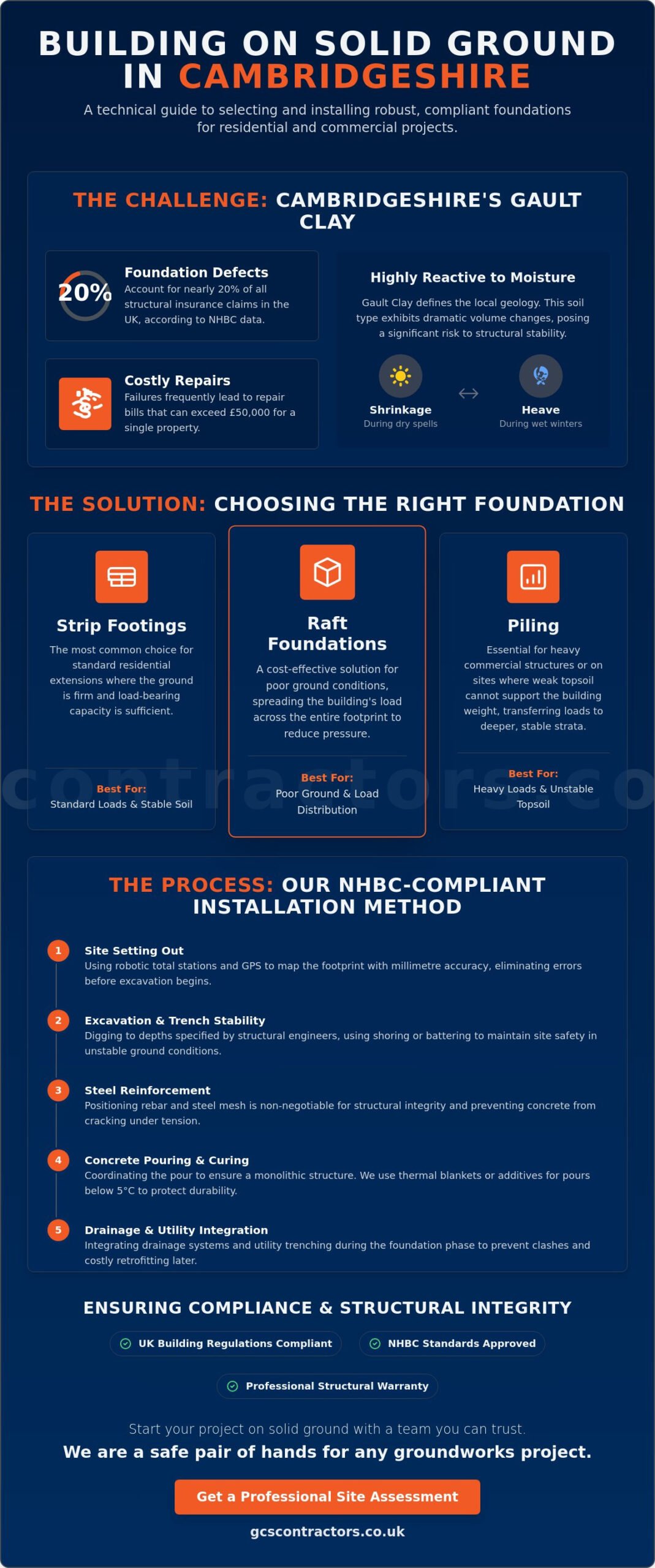
NHBC data shows that foundation-related defects account for nearly 20% of all structural insurance claims in the UK. These failures often lead to repair bills exceeding £50,000 for a single property. In Cambridge, the stakes are higher. The local gault clay is notoriously prone to volume changes, meaning your choice of foundations determines the long-term stability of your entire build. You probably agree that groundworks represent the most unpredictable phase of any construction project. Unexpected soil issues frequently lead to budget overruns and delays that stall your site before the first brick is even laid.
This guide shows you how to manage these risks. We’ll explain how to select and install the most robust groundworks for your residential or commercial project in 2026. You will discover how to meet strict UK building regulations, handle the specific demands of Cambridgeshire soil, and maintain a clear installation timeline. We provide a breakdown of the technical requirements for NHBC-compliant structures. You’ll learn how to achieve cost-effective results while ensuring your project remains in a safe pair of hands from the ground up.
Key Takeaways
- Understand the unique challenges of Cambridge’s high-shrinkage clay soil and how to select the right sub-structure for your specific site.
- Master the site-setting process using precision GPS and laser levels to organise a perfectly accurate construction footprint.
- Learn to execute the excavation phase safely whilst maintaining trench stability and reaching the required load-bearing depth.
- Ensure your foundations meet all UK Building Regulations and NHBC standards to secure a professional structural warranty.
Understanding Cambridge Soil and Foundation Selection
A building foundation is the critical sub-structure that transfers structural loads from the building to the ground. In Cambridge, Foundations are rarely straightforward. The local geology demands a technical approach that accounts for soil movement and load distribution. A professional site investigation is mandatory before any concrete is poured. Skipping this step risks subsidence or structural cracking within the first five years of completion.
To better understand this concept, watch this helpful video:
Foundations for new builds in the city centre require different specifications than extensions in historic areas like Ely or St Ives. Historic properties often have shallow, Victorian footings. Modern extensions must be engineered to interface with these older structures without causing differential settlement. We focus on ensuring the new sub-structure provides a stable platform that protects the integrity of the existing building.
The Impact of Gault Clay on Cambridgeshire Footings
Gault Clay defines the Cambridge landscape and presents a significant challenge for site managers. This soil type is highly reactive to moisture. It exhibits dramatic shrinkage during dry spells and heave during wet winters. To mitigate these risks, we often perform bulk excavation in Cambridge to reach stable strata. Excavating to depths beyond the influence of tree roots and seasonal weather is the only way to guarantee long-term stability.
Choosing Between Shallow and Deep Foundations
Selecting the right foundation type depends on the specific site data and the intended building load. We typically categorise these into three main types:
- Strip Footings: The most common choice for standard residential extensions where the ground is firm.
- Piling: Essential for heavy commercial structures or sites where the topsoil cannot support the building weight.
- Raft Foundations: These are often the most cost-effective solution for poor ground conditions, as they spread the load across the entire site footprint.
Our approach ensures that every project starts on solid ground. We use precise engineering to match the foundation type to the specific demands of the Cambridgeshire soil. This disciplined method is what makes us a safe pair of hands for any groundworks project.
A Step-by-Step Guide to Installing Foundations
Installing Foundations begins with high-precision site setting out. We use robotic total stations and GPS to map the footprint to within millimetre accuracy. This eliminates errors before the first bucket hits the soil. Excavation follows, where we dig to depths specified by structural engineers. Trench stability is a priority; we use shoring or battering where ground conditions are unstable to keep site teams safe. Every stage of our process aligns with the structural requirements detailed in Approved Document A to ensure full building control compliance.
Following excavation, we install steel reinforcement. Correct rebar positioning is non-negotiable for structural integrity. Once the steel is inspected, we coordinate the pour. Working with experienced concrete contractors in Cambridge ensures the mix arrives on schedule and meets the required strength class. This seamless coordination prevents cold joints and ensures a monolithic structure.
Technical Requirements for Reinforced Concrete
Steel mesh and bar reinforcement prevent the concrete from cracking under tension. In the British climate, curing is a critical phase. We monitor ground temperatures closely during winter pours. If temperatures drop below 5°C, we use thermal blankets or specific additives to prevent the water in the mix from freezing. This protects the chemical hydration process and maintains the long-term durability of the Foundations.
Managing Drainage and Utility Trenching
We integrate drainage systems during the foundation phase to prevent costly retrofitting. Precise utility trenching is essential for water, gas, and electric services. We map these routes early to ensure they don’t clash with structural elements or load-bearing walls. Getting this right during the initial groundworks saves significant time and budget later in the build. If you’re planning a complex site build, contact our team for a technical consultation on your groundworks requirements.
Ensuring Compliance and Structural Integrity
Every foundation in the UK must adhere to strict legal standards to guarantee long-term safety. Local authority Building Control or an approved inspector must sign off on excavations before any concrete is poured. For residential developers, following NHBC standards is a prerequisite for securing the 10-year structural warranty required by lenders. You can find specific technical requirements in the Building Regulations for Foundations, which details how soil type and proximity to trees dictate depth. Identifying failure early is vital; developers should monitor for diagonal cracks exceeding 3mm or subsidence in existing structures. GCS Contractors provides a safe pair of hands, ensuring every project meets these rigorous compliance benchmarks without delay.
Professional Piling and Underpinning Solutions
Standard footings are not always sufficient for the complex soil profiles found in East Anglia. When existing structures show signs of movement or new loads exceed soil capacity, underpinning footings are used to transfer weight to deeper, more stable strata. In central Cambridge, noise and vibration restrictions often make traditional driven piling impossible. We utilise Continuous Flight Auger (CFA) piling for urban sites. This technique is virtually vibration-free, making it ideal for projects adjacent to sensitive historic colleges or residential blocks. It ensures the structural integrity of the new build whilst protecting the neighbouring foundations.
Working with Groundworks Specialists in the East of England
Local knowledge is the most effective tool for reducing project risk. The terrain across Cambridgeshire, Essex, and London varies from heavy clay to sandy deposits, each requiring a different engineering approach. Developers should verify contractor credentials by looking for CHAS Elite and ISO 9001 certifications. These accreditations prove a commitment to safety and quality management. If you are searching for groundworks contractors near me, ensure they have a proven track record in the East of England. We manage everything from foundations to finishing, providing the technical expertise needed for large-scale commercial earthworks and residential infrastructure. Our team delivers disciplined, compliant results that keep your timeline on track. For a comprehensive overview of how to evaluate and select the right specialist for your development, our groundworks contractor professional reference guide provides the technical framework needed to make an informed decision.
Secure Your Cambridge Build with Expert Groundworks
Successful construction in Cambridgeshire depends on more than just high-quality materials. It requires a precise response to the local geology, particularly the high-shrinkage Gault Clay found throughout the region. Adhering to a rigorous installation sequence and current building regulations is the only way to guarantee structural integrity for the decades ahead. Choosing the right Foundations is the most critical decision you’ll make for your project’s longevity.
GCS Contractors Ltd provides the technical expertise needed to navigate these site-specific challenges. We’re a CHAS Elite and ISO 9001 certified team, meaning our safety and quality management systems meet the highest industry standards. We offer a comprehensive service from foundations to finishing, handling everything from initial excavation to the final site clearance. Our direct, professional approach ensures your development stays on schedule and within its technical requirements. We’ve built our reputation on being a safe pair of hands for both residential and large-scale commercial works across the county.
Ready to start your project? Contact GCS Contractors for expert foundation services in Cambridge
We look forward to helping you deliver a successful, compliant, and durable build.
Frequently Asked Questions
How deep do foundations need to be in Cambridge?
Foundations in Cambridge typically require a minimum depth of 1 metre, though the region’s heavy clay soil often necessitates depths of 1.5 metres or more. If your site is near existing trees, Building Regulations often mandate trenches reach 2.5 metres to prevent subsidence or heave. We follow NHBC Chapter 4.2 standards to ensure every project in Cambridgeshire remains structurally sound and compliant with local ground conditions.
What is the most common type of foundation for a house extension?
Trench fill foundations are the most common choice for house extensions because they simplify the construction process and save time on site. This method involves filling the excavated trench with concrete to within 150mm of the ground level, which eliminates the need for deep-trench bricklaying. It’s an efficient, “no-nonsense” approach that suits the majority of domestic projects we handle from foundations to finishing.
Can I pour my own foundations for a small building project?
You can legally pour your own foundations for minor outbuildings, but it’s a high-risk strategy that often leads to structural failure or legal complications during property sales. Every foundation requires a mandatory inspection from Building Control before you pour any concrete. If you lack professional laser-levelling equipment or CHAS Elite levels of safety training, you risk compromising the entire build’s integrity and failing your inspection.
How much does it cost to install foundations for a new build in 2026?
Based on 2026 industry forecasts, standard foundations cost between £130 and £190 per square metre of the ground floor area. These prices cover basic excavation and concrete but exclude specialist requirements like S278 highway works or complex attenuation systems. Final costs depend on your specific site survey, soil type, and the structural engineer’s load calculations for the new build.
What happens if the building inspector rejects my foundation trench?
If an inspector rejects your foundation trench, you must rectify the specific issues identified before you’re permitted to pour concrete. Common reasons for rejection include loose soil in the trench bottom, insufficient depth, or the presence of water and tree roots. You’ll need to clear the debris or dig deeper as instructed and schedule a follow-up inspection to secure the necessary sign-off for your project.
How long do concrete foundations take to set before I can build on them?
Concrete foundations typically take 24 to 48 hours to set enough for foot traffic and initial masonry work to begin. While the concrete reaches about 70 per cent of its compressive strength after 7 days, it takes a full 28 days to achieve its maximum design strength. We manage site schedules carefully to ensure no excessive loads are applied during the critical early curing phase of the foundations.