Groundworks Contractor in Cambridge: A Professional Reference Guide (2026)
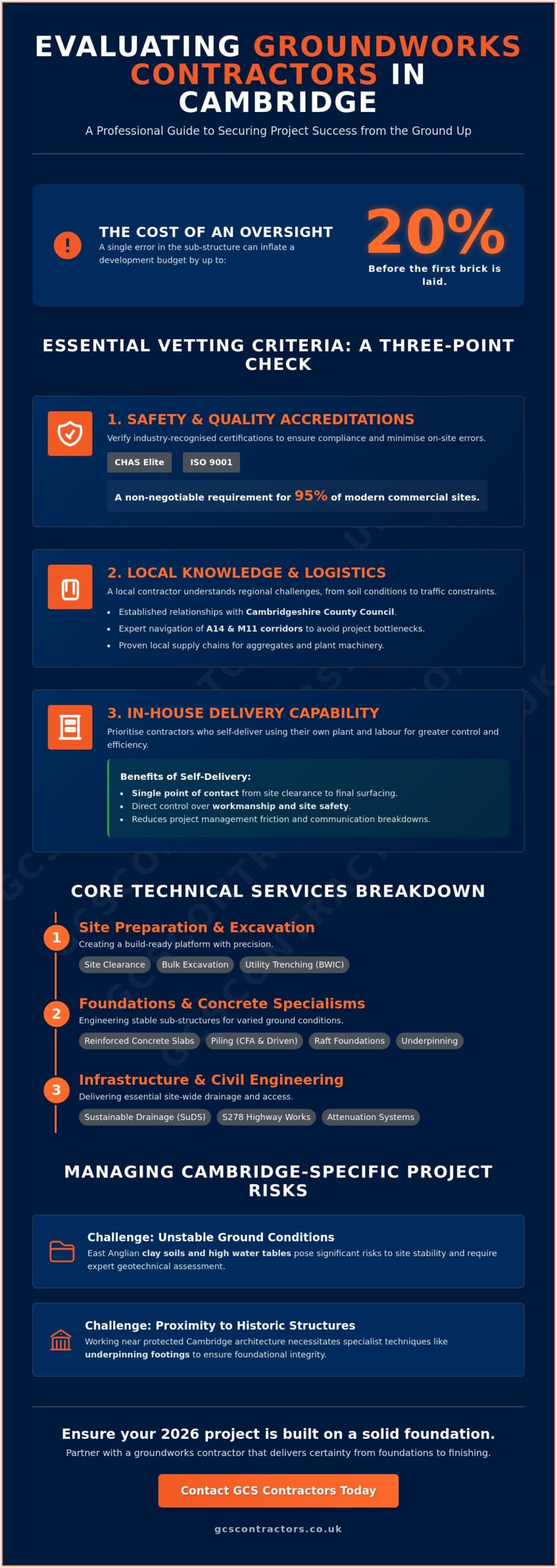
A single oversight in the sub-structure can inflate a Cambridge development budget by up to 20% before the first brick is even laid. You already know that site preparation is the most volatile phase of any construction project. Managing the specific clay soil conditions across Cambridgeshire or navigating complex S278 highway works requires more than just heavy machinery. It demands a groundworks contractor that functions as a disciplined partner rather than just another sub-contractor. You need absolute certainty that your foundations and drainage systems are installed correctly the first time to avoid the cascading costs of site delays.
This professional reference guide provides the technical framework required to evaluate, select, and manage groundworks specialists for your 2026 projects. We’ll outline how to verify essential safety accreditations like CHAS Elite and ISO 9001 whilst ensuring strict compliance with local authority standards. From initial site clearance to final attenuation systems, you’ll learn how to secure an end-to-end service that delivers infrastructure on time. We cover the critical benchmarks for site preparation, foundations, and civil engineering to ensure your project moves from foundations to finishing without unexpected interruptions.
Key Takeaways
- Verify industry-recognised accreditations like CHAS Elite and ISO 9001 to ensure safety compliance when selecting a groundworks contractor.
- Navigate the technical requirements for core project phases, including bulk excavation, piling, and complex S278 highway works.
- Mitigate project risks by identifying the specific challenges posed by East Anglian clay and high water tables on site stability.
- Assess the necessity of underpinning footings to ensure foundation stability near historic Cambridge structures.
- Optimise project efficiency by evaluating a contractor’s capacity for self-delivery versus a reliance on sub-contracted plant and labour.
Selecting a Groundworks Contractor in Cambridge: Key Evaluation Criteria
Selecting a groundworks contractor in Cambridge requires more than a cursory glance at a quote. You need a partner who understands civil engineering principles and applies them with precision to every site. The complexity of Cambridgeshire’s soil, combined with strict local planning regulations, makes the choice of contractor a critical risk management decision. Reliability starts with proven systems and a disciplined approach to site preparation.
To better understand the operational scale of these firms, watch this helpful video:
Safety and Quality Accreditations
CHAS Elite status is a non-negotiable requirement for 95% of modern commercial sites in the region. It proves the contractor meets the Common Assessment Standard, covering everything from financial standing to environmental impact. ISO 9001 certification further impacts the consistency of groundworks delivery. These standards ensure that foundation pouring and drainage installation follow a repeatable, high-quality process that minimises site errors and costly delays.
Local Knowledge and Logistics
Choosing a groundworks contractor near me simplifies complex muck-away logistics. Local firms have established tipping rights and understand the specific traffic constraints of the A14 and M11 corridors. They maintain strong relationships with Cambridgeshire County Council and local supply chains. This ensures that aggregates and plant machinery arrive on site exactly when needed, avoiding project bottlenecks.
A professional groundworks contractor prioritises self-delivery. By using their own plant and labour, they maintain direct control over site safety and workmanship. This “foundations to finishing” approach reduces project management friction. It provides a single point of contact for site clearance, BWIC, and S278 highway works. This end-to-end service model ensures the project moves from initial excavation to final surfacing without a breakdown in communication.
Technical Services Reference: From Bulk Excavation to S278 Works
Successful site delivery relies on a disciplined sequence of technical operations. An experienced groundworks contractor manages the transition from raw land to a build-ready platform. This starts with site clearance and bulk excavation, where precise volume calculations prevent costly soil disposal fees. Adhering to the UK Government’s Construction Playbook ensures that procurement and project delivery meet modern safety and value standards during these early phases.
Site readiness also includes utility trenching and service ducting. We handle the Builders Work In Connection (BWIC) to ensure that electricity, water, and data lines are correctly positioned before sub-structure completion. This coordination prevents delays during the later M&E stages of the build. Our approach ensures every trench is excavated to the exact depth and gradient required for long-term service stability.
Foundations and Concrete Specialisms
Cambridge developments face varied ground conditions, often requiring a choice between reinforced concrete slabs or deep piling. Commercial builds with high axial loads typically demand CFA (Continuous Flight Auger) or driven piles to reach stable strata. We work alongside specialist concrete contractors to install ground beams and pile caps that meet 2026 structural standards. For smaller footprints, raft foundations provide a cost-effective alternative by distributing weight across a larger surface area.
Infrastructure and Drainage Systems
Managing water is a critical technical requirement for any groundworks contractor. Modern infrastructure must incorporate Sustainable Drainage Systems (SuDS) to mitigate flood risks. This involves the installation of large-scale attenuation tanks and permeable paving to control flow rates into the local network.
When a project requires new access points, we manage the S278 highway works. This process involves strict compliance with local authority specifications for kerbing, surfacing, and tactile paving. We provide end-to-end solutions from foundations to finishing, ensuring every drainage run and highway connection meets exacting standards. If you need a reliable partner for your next development, contact our Cambridge office to discuss your technical requirements.
Managing Project Risks: Cambridge Soil and Site Constraints
Success for any groundworks contractor in the East of England depends on managing the unique geotechnical profile of the region. The prevalence of Gault Clay and high water tables across the Cambridgeshire Fens creates significant stability risks during the initial dig. We rely on the BS 5930 code of practice for site investigations to inform our approach to every project, ensuring that soil samples and site data dictate the engineering strategy. Failure to account for these specific conditions leads to long-term ground erosion and structural settlement.
Proximity to historic structures in the Cambridge city centre requires a specialist approach to underpinning footings. This process stabilises existing foundations whilst allowing for modern extensions or adjacent developments. Our team organises site clearance to minimise noise and dust disruption for neighbouring properties, maintaining strict 08:00 to 18:00 schedules to keep the project on track. Professional groundworks act as the first line of defence against structural failure. We deliver results from foundations to finishing, ensuring every site is prepared to the highest standards.
Geotechnical Considerations for East England
Cambridge silt and heavy clay deposits often necessitate foundation depths exceeding 2.5 metres to reach stable load-bearing strata. Seasonal weather patterns significantly impact Bulk Excavation schedules, as heavy rainfall can turn clay sites into unworkable ground. We manage muck-away logistics with precision to prevent site saturation and maintain operational momentum.
Environmental and Safety Compliance
Our no-nonsense approach to site safety is backed by our CHAS Elite and ISO 9001 certifications. A professional groundworks contractor must prioritise environmental mitigation to prevent hazardous material contamination during the clearance phase. We implement strict waste segregation and sediment control measures on every site. This disciplined focus ensures all works remain compliant with UK environmental regulations while protecting the local Cambridge ecosystem. We provide a safe pair of hands for even the most complex civil engineering challenges.
Secure Your Project’s Foundation with Technical Expertise
Successful construction in Cambridge requires more than basic excavation; it demands a deep understanding of local soil profiles and rigorous compliance with S278 highway standards. Choosing a certified groundworks contractor is the most effective way to mitigate site risks and ensure long-term structural integrity. Since 2017, GCS Contractors Ltd has supported developers across Cambridgeshire by delivering precise bulk earthworks and complex drainage solutions. We don’t just clear sites; we provide a disciplined framework for your entire build.
Our status as a CHAS Elite and ISO 9001 certified firm reflects our commitment to safety and operational excellence. We specialise in technical services including S278 works and BWIC, ensuring every phase from foundations to finishing meets professional benchmarks. We’ve built our reputation on being a reliable partner for both commercial and domestic infrastructure. Let’s get your site ready for the next stage of development with the efficiency your schedule requires.
Discuss your Cambridge project foundations with our experts today
We look forward to bringing our specialist expertise to your site.
Frequently Asked Questions
What should I look for when hiring a groundworks contractor in Cambridge?
When hiring a groundworks contractor in Cambridge, you must prioritise verified accreditations such as CHAS Elite status and ISO 9001 certification. These credentials prove the firm adheres to strict safety protocols and quality management systems required for modern construction sites. It’s also vital to check their local experience within Cambridgeshire to ensure they understand the specific soil conditions and drainage challenges of the region. A competent partner provides an end-to-end service from foundations to finishing, reducing the need for multiple subcontractors.
How much do groundworks typically cost for a commercial extension in East England?
Groundworks for a commercial extension in East England usually represent 10% to 15% of the total build cost according to industry data from the BCIS. For a standard 100-square-metre extension, prices fluctuate based on the depth of foundations required and the complexity of the drainage system. You’ll need a site-specific survey to determine if your land requires specialist piling or soil stabilisation. Always factor in a 10% contingency budget to account for unforeseen underground obstructions or archaeological requirements common in historic Cambridge areas.
Why is S278 compliance important for my construction project?
S278 compliance is mandatory because it grants legal permission to carry out permanent alterations to a public highway. This agreement, governed by the Highways Act 1980, ensures that any new junctions, footpaths, or cycle lanes meet the strict safety standards set by the local authority. If your groundworks contractor isn’t qualified for S278 works, you risk project delays and legal penalties. We ensure all highway works are executed to local council specifications, protecting your liability and ensuring the infrastructure is safe for public use.
What is the difference between bulk excavation and site clearance?
Site clearance is the initial phase where we remove surface-level obstacles including vegetation, fly-tipped waste, and redundant structures to create a clean slate. Bulk excavation is a more technical process that involves moving vast quantities of earth and rock to reach the required formation levels for the build. This often involves shifting over 500 cubic metres of material using heavy plant machinery. While clearance prepares the surface, excavation creates the actual footprint for foundations, basements, and attenuation tanks.