Six week draft secures Section 61 consent for UK contractors
Section 61 of the Control of Pollution Act 1974 lets contractors apply for prior consent to carry out noisy or vibration-heavy construction work. Get it granted and comply with the conditions, and your local authority cannot then serve a Section 60 notice for the same works. The next move is straightforward: draft your application and get it in front of the environmental health officer early, because the statutory clock runs to 28 days once a formal submission lands.
TL;DR:
- Applying early for Section 61 consent helps contractors secure lawful working conditions and avoid reactive noise restrictions through Section 60 notices.
- A comprehensive application must include sound modeling, detailed plant lists, proposed hours, monitoring plans, and resident notification strategies to meet approval criteria.
- Engaging in a drafted consultation six weeks prior to work start allows for adjustments based on environmental health officer feedback, increasing chances of approval.
- Changes to existing consents, such as extensions or temporary exceptions, require separate applications, with tracking and documentation crucial for defending against complaints.
- Success depends more on timing and being detailed and realistic in modeling than on the amount of paperwork completed.
Table of Contents
- What is Section 61 consent and why do contractors bother with it?
- Who applies for Section 61 consent and what they’re responsible for
- Building a Section 61 application that gets approved first time
- Draft-stage negotiation: the step contractors skip at their own cost
- Changing an existing consent: variations, dispensations and what happens if the council doesn’t respond
- A week-by-week checklist for your Section 61 application
- Where BS 5228 fits and what good monitoring looks like
- How Gcscontractors approaches Section 61 applications on live sites
- Where to find the official Section 61 guidance and standards
- Why the paperwork matters less than the timing
- Sources
What is Section 61 consent and why do contractors bother with it?
Section 61 gives contractors something rare in construction law: a way to get ahead of enforcement rather than react to it. The statutory provision allows an application for prior consent to carry out works likely to generate noise or vibration, and it is entirely voluntary. Nobody forces you to apply. But once a council grants consent and you stick to its terms, that consent becomes a shield.
Compare that with the alternative. A Section 60 notice is the council’s enforcement tool, imposed reactively once noise has already become a problem for neighbours. It can dictate working hours, ban certain plant, and cap noise or vibration levels, often at short notice and mid-programme. That is expensive to absorb once a piling rig is already on site.
Councils tend to expect a Section 61 application for piling, demolition, or heavy groundworks near residential or sensitive receptors, night-time or weekend working outside standard hours, multi-phase developments running for an extended period, and sites where an earlier project on the same street generated complaints

Contractors who apply early are not just ticking a box. They are buying certainty. Once consent is granted on agreed terms, the goalposts stop moving.
Who applies for Section 61 consent and what they’re responsible for
The application should come from whoever is actually running the site, not the developer’s head office. In practice, that means the principal contractor or a named company director or site manager with the authority to commit to the working methods described in the application. Councils want a real point of contact, not a generic company name.
Most local authority forms ask for:
- Full company name, registered address and company number
- Named applicant with direct contact details (phone and email that get answered)
- The relevant planning application reference, where one exists
- Site address and a description of the works
- Confirmation of who holds day-to-day responsibility for compliance
Signing the application does not end your obligations. The named applicant carries responsibility for every subcontractor working under that consent, which means piling subcontractors, demolition crews and even short-term plant hire firms all need briefing on the agreed hours, plant restrictions and monitoring commitments. Councils expect the principal contractor to retain monitoring records and daily logs for the life of the works, and to produce them on request. If an Environmental Health Officer turns up unannounced and asks for last week’s noise readings, “we’ll dig them out” is not a good answer.
Building a Section 61 application that gets approved first time
Applications get rejected or delayed for the same handful of reasons every time: missing technical detail, vague working hours, or no evidence that noise has actually been modelled. Councils are not looking for perfection. They are looking for proof you have thought it through.
A complete submission generally needs:
- Noise and vibration predictions modelled to BS 5228 methodology, with clearly identified receptor locations (the nearest homes, schools or offices likely to be affected)
- A full plant list with sound power levels for every major item, from excavators to generators, alongside method statements and a phased programme showing when each piece of plant is in use
- Proposed working hours, matched against the council’s standard construction hours, plus the Best Practicable Means (BPM) measures you will use to keep noise down
- A monitoring plan naming fixed or mobile monitoring locations, trigger and action levels that prompt a response, how often data gets reported, and how the council can access it
- Site plans and resident notification strategy, showing boundary hoarding, access routes, and how nearby residents will be told what is coming and when
The strongest applications treat resident notification as more than a legal nicety. A letter drop two weeks before piling starts, with a named contact number and expected duration, heads off complaints before they start.
Pro Tip: Model your worst-case scenario, not your average day. If your piling rig runs at full capacity for three consecutive days early in the programme, predict that scenario specifically rather than an averaged figure across the whole job. Councils spot averaged-down predictions immediately, and it undermines trust in the rest of your submission.
Draft-stage negotiation: the step contractors skip at their own cost
Submitting a final application cold, with no informal conversation first, is one of the most common mistakes contractors make. The three-stage process runs preparatory, draft, then final. Skip the draft stage and you are effectively asking the council to accept your working methods blind.
For anything beyond a small domestic job, submit a draft application roughly six weeks before works are due to start. That gives the Environmental Health Officer time to review your predictions, raise concerns, and propose draft conditions before anything is locked in statutorily.
- Treat the draft stage as a genuine conversation, not a formality to rush through
- Bring evidence rather than assurances: noise modelling outputs, BPM measures, and a monitoring commitment carry far more weight than a promise to “keep it quiet”
- Offering the council live access to your monitoring data during negotiation is often the single most persuasive move available
- Early engagement consistently produces less restrictive final conditions, because the EHO has had time to test your numbers rather than react to them
The 28-day statutory window only bites once you submit the formal, final application. Draft consultation sits outside that clock entirely, which is exactly why it is worth the extra weeks upfront. Rushing straight to a final submission without draft feedback is a false economy that regularly produces rejected applications or conditions far tighter than necessary.
Changing an existing consent: variations, dispensations and what happens if the council doesn’t respond
Projects change. Piling methods get revised, working hours shift, new plant arrives on site. A variation amends the terms of an existing consent, while a dispensation is a short-term, specific exception, typically used for a one-off event such as an unplanned overnight concrete pour or an urgent structural repair.
- Apply for a variation when the change is ongoing or programme-wide, such as extended hours for the remainder of a phase
- Apply for a dispensation when the departure is temporary and justified by a specific event, particularly a health and safety or engineering necessity
- Some councils, including Westminster, operate an emergency route allowing notice windows as short as 48 hours for genuine safety-critical works, though local rules vary and should be confirmed directly
- If a council fails to determine your application within the statutory period, or imposes conditions you consider unreasonable, the appeal route runs through the magistrates’ court, and time limits apply, so take advice promptly rather than letting the deadline lapse
- Keep a dated record of every variation, dispensation and resident notification issued during the works, because this paper trail is what protects you if a complaint escalates later
A week-by-week checklist for your Section 61 application
Treat the application as a programme milestone with its own lead time, not an afterthought bolted onto the works package.
- Weeks 1 to 2: Survey the site and its neighbours. Appoint an acoustic consultant if the works involve piling, demolition or heavy plant near sensitive receptors. Map who is likely to be affected and start informal contact with residents’ associations or adjoining businesses.
- Weeks 3 to 4: Compile the technical package: BS 5228 predictions, plant list, method statements, and a draft monitoring plan.
- Around 6 weeks before start: Submit the draft application to the local EHO and open the conversation on conditions.
- Following draft feedback: Revise predictions or mitigation measures based on what the council raises, then prepare the final submission.
- At least 28 days before works start: Submit the final, formal Section 61 application to trigger the statutory response window.
- On site: Implement Best Practicable Means, install monitoring equipment at agreed points, log daily readings, and issue the resident notification you promised in the application.
- Throughout the works: Respond to any complaint within 24 hours where possible. A fast, specific reply (what caused the noise, what you are doing about it) defuses far more disputes than silence ever does.
Pro Tip: Keep a single, dated complaints log from day one, even if you receive nothing in the first month. An empty log with consistent dates is stronger evidence of good management than no log at all if a dispute ever reaches a council review.
Where BS 5228 fits and what good monitoring looks like
Councils treat compliance with BS 5228, the Code of Practice for Noise and Vibration on Construction and Open Sites, as the baseline standard for any technical prediction in a Section 61 application. The standard covers both noise prediction methodology and vibration guidance, including annexes that many EHOs refer to directly when assessing submissions.
- Present predicted noise levels alongside recognised receptor thresholds, not in isolation, so the council can see the margin you are working to
- Set trigger and action levels that prompt a specific response, such as pausing a particular plant item, rather than a vague “we will investigate”
- Use monitoring equipment capable of continuous data logging, and offer the council remote or live access where practical
- A submission built on BS 5228 methodology, rather than generic assurances, is consistently what separates applications that clear the draft stage quickly from those sent back for revision
Real-world conditions show what councils actually accept in practice. One Cambridge planning condition specified preference for quieter CFA piling methods over percussive alternatives, alongside hoarding and phased sequencing to avoid running multiple noisy operations simultaneously. That is the level of specificity worth matching in your own submission.
How Gcscontractors approaches Section 61 applications on live sites
Gcscontractors has built a working checklist for every project where noise or vibration consent is likely to be needed, covering groundworks, demolition, and civil engineering packages across Cambridge and East Anglia. The approach starts at tender stage, not after mobilisation, because retrofitting a mitigation strategy onto an already-programmed job rarely works.
- Plant selection favours quieter methods where the ground conditions allow it, including CFA piling ahead of percussive alternatives
- Sequencing is built into the programme so that the loudest operations do not overlap, reducing cumulative noise at the nearest receptors
- Hoarding and monitoring stations go up before noisy work begins, not once a complaint arrives
- Resident notification is handled directly by the site team, with a named contact rather than a generic head office number
- Ongoing compliance monitoring feeds back into daily records, so if an EHO requests data mid-project, it is ready
Contractors managing their own Section 61 submission for the first time often underestimate the lead-in time, particularly around draft consultation. If you want a second opinion on your working methods or mitigation plan before submission, Gcscontractors’ strip-out and demolition guidance sets out the site preparation standards that typically underpin a strong application.
Where to find the official Section 61 guidance and standards
Start with the primary legislation and your specific local authority’s own template, since forms and expectations differ between councils.
- The statutory text itself sits on legislation.gov.uk, including the 28-day response provision
- Detailed contractor guidance is published by councils including LBHF, Tower Hamlets, Elmbridge and Westminster, each with slightly different form layouts
- Always check your specific local authority’s planning or environmental health pages for its own application form, since a template built for one council rarely transfers cleanly to another
- BS 5228 itself is available for purchase through BSI, and the Chartered Institute of Environmental Health publishes supporting guidance many councils reference directly
Why the paperwork matters less than the timing
Most guidance on Section 61 fixates on the form itself: what boxes to fill in, what plant list format to use. That misses the actual lever that determines whether an application succeeds. Timing does more work than paperwork ever will.
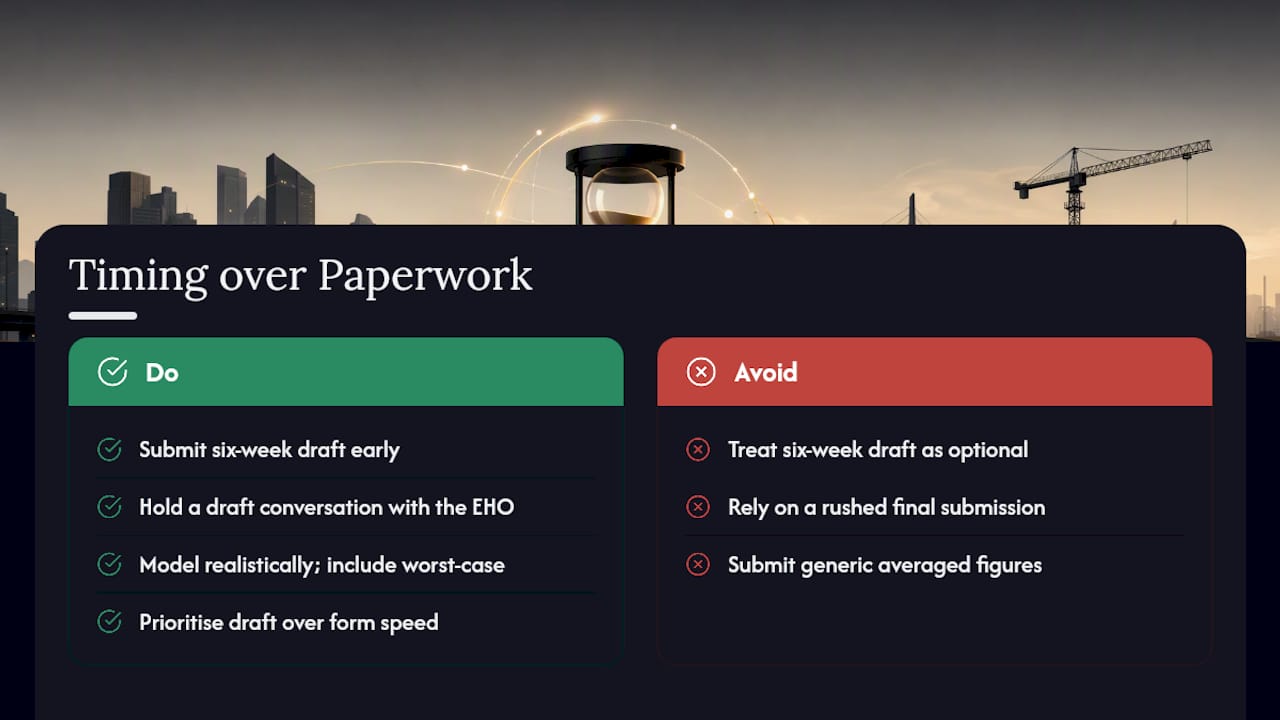
The six-week draft submission is routinely treated as optional by contractors under programme pressure, and that is the single biggest mistake in this entire process. A rushed final submission with no prior conversation puts the EHO in a defensive position: they have never seen your numbers before, so they impose the most cautious conditions available to them. A draft submitted early does the opposite. It turns the EHO into someone who has already tested your predictions and had a chance to push back before anything is fixed.
The other overlooked point is that BS 5228 compliance is not a compliance exercise, it is a negotiating asset. Contractors who model realistically, including worst-case scenarios rather than averaged ones, consistently secure looser conditions than those who submit generic figures and hope nobody checks. Prioritise the draft conversation and honest modelling over form-filling speed, and the rest of the process tends to fall into place.
— George
Sources
- Control of Pollution Act 1974, Section 61
- Contractor guidance note for Section 61 applications (prior consent) | LBHF
- Construction sites (Cambridge) — BS 5228 expectation
- Planning noise condition example — Cambridge document