Avoid Six Week Delays: UK Section 80 Demolition Notice for Contractors
You must give the local authority a section 80 demolition notice under the Building Act 1984 before demolishing all or a substantial part of a building. Do not start works until you receive a Section 81 counter-notice or six weeks have passed, whichever comes first. You must also notify adjacent occupiers and utility suppliers, and submit a site plan and supporting documents with the form.
TL;DR:
- A Section 80 demolition notice must be submitted to the local authority before starting any substantial demolition work, with delays or incorrect submissions risking legal penalties.
- Most councils require detailed plans, asbestos surveys, a method statement, and proof of notifications sent to adjacent occupiers and utility providers before approval.
- The six-week waiting period starts once the notice is received, but conditions attached to a Section 81 counter-notice may require upfront compliance with asbestos removal, site hoarding, and restricted hours.
- Fees vary between authorities, typically from £235 to £440, and starting work without a valid notice or before the expiry period can lead to fines and enforcement actions.
- Engaging experienced demolition contractors to handle paperwork, surveys, and logistics reduces delays and ensures full compliance from the outset.
Table of Contents
- What is a Section 80 notice and when does it apply?
- Who must submit the notice and when?
- How to prepare and submit a Section 80 notice
- What happens after you submit the notice?
- Practical compliance checklist before demolition starts
- Fees, penalties and mistakes that cost you time
- A contractor’s view on avoiding delays
- Get Section 80 compliance handled by experienced demolition contractors
- Where to find the official forms and guidance
- Sources
What is a Section 80 notice and when does it apply?
A section 80 demolition notice is the statutory mechanism under the Building Act 1984, Section 80 that requires anyone intending to demolish a building, or a substantial part of one, to inform their local authority before work begins. The legislation is deliberately blunt on timing: you cannot start until you’ve received a Section 81 notice from the council or the statutory period has run out.
Not every demolition job triggers the requirement. Common exemptions include:
- Structures with a volume of 50 cubic metres or less
- Internal demolition works inside a building that stays occupied throughout
- Certain agricultural buildings and minor outbuildings, such as small sheds or greenhouses
- Some temporary or ancillary structures, depending on the council’s interpretation
Section 80 sits entirely separate from planning permission. Demolishing a building without listed status or conservation area protection may not need planning consent at all, but it will almost always need a Section 80 notice if it exceeds the exemption thresholds. Confusing the two is one of the most common mistakes property owners make, and it’s worth checking party wall and planning obligations separately, since neither process replaces the other.
Who must submit the notice and when?
Responsibility for the notice usually falls to whoever is legally instructing the demolition, though the exact party can vary by project structure. Get this wrong and you risk an invalid submission just as your contractor is ready to mobilise.
- The building owner, their appointed agent, or the principal contractor can submit the notice, but the person named must have the authority to confirm the details are accurate.
- Submit the notice sufficiently before your intended start date to allow for the statutory waiting period. Some councils publish stricter internal processing targets, so check the local Hammersmith & Fulham demolition notice guidance or your own authority’s equivalent page for specifics.
- Expect councils to ask for an Ordnance Survey map or block plan at a standard scale, a proposed start date, and full contractor details before they’ll register the notice as complete.
Fees vary between authorities, and a notice submitted without the correct plan or contractor information typically gets bounced back for correction, which reduces the time available before demolition can start.
How to prepare and submit a Section 80 notice
Getting the paperwork right the first time saves weeks. Councils reject a surprising number of notices simply because a required attachment is missing, so work through this checklist methodically rather than treating the form as a formality.
- Complete the local authority’s Section 80 form. Every council has its own version, but most follow a similar structure, requesting a description of the works and confirmation of ownership or agency. Bradford Council’s demolition notice form is a useful example of the standard fields you’ll encounter.
- Attach an Ordnance Survey map or block plan at 1:1250 scale. This needs to clearly show the building’s boundary and its relationship to neighbouring plots.
- Commission an asbestos survey before you submit. Most councils, including Leicester City Council, explicitly require this alongside a demolition method statement, and HSE treats asbestos exposure as one of the highest-risk elements of any demolition project.
- Write a demolition method statement. This should cover sequencing, plant to be used, structural stability during works, and how you’ll manage dust and debris. A properly structured demolition method statement makes the difference between a smooth Building Control review and a stalled one.
- Notify adjacent occupiers and statutory undertakers. Gas and electricity suppliers need advance warning if there’s any chance of live services being affected, and you should keep proof of every notification sent.
- Pay the council fee and submit the pack. Most authorities now accept submissions through an online Building Control portal, though some still require a printed form and postal delivery.
- Build in contingency time. Assume the council may respond with conditions attached under Section 81, and don’t schedule your contractor’s mobilisation for the exact day the six weeks expires.
Pro Tip: Keep every notification as a dated record, whether that’s a recorded delivery receipt, a scanned letter, or a timestamped email. Building Control officers commonly ask to see this proof at their first site visit, and a missing paper trail can hold up an otherwise compliant project.
What happens after you submit the notice?
Once your section 80 demolition notice lands with the council, the six-week statutory period starts running, though the authority may respond much sooner. Local authority teams generally treat the counter-notice as an active safety control rather than a rubber stamp, and it’s common for conditions to arrive well before the six weeks are up.
Typical conditions attached to a Section 81 counter-notice include:
- Asbestos removal completed and verified before any structural work begins
- Site hoarding erected to a specified height along public-facing boundaries
- Dust suppression measures, particularly for sites near residential properties
- Restricted working hours to limit noise disruption to neighbours
- Traffic management plans where demolition affects a public highway
If you disagree with a condition, most councils allow informal discussion with the Building Control officer before you escalate further, and it’s usually faster to resolve disputes this way than through a formal appeal. Ignoring a counter-notice or starting work before the six weeks elapse without one exposes you to enforcement action, and it can jeopardise insurance cover if an incident occurs on an unauthorised site.
Practical compliance checklist before demolition starts
Section 80 covers the legal notification, but councils and inspectors expect a lot more on site before they’re satisfied a project is safely run. Building this into your pre-start planning avoids the scramble that often happens when a Building Control officer turns up unannounced.
- Confirm principal contractor duties are allocated correctly under CDM 2015, including who holds responsibility for the construction phase plan
- Check public liability and contractor’s all-risks insurance is current and covers demolition specifically, not just general building work
- Erect compliant site hoarding before any plant arrives, particularly where the site borders a public footway
- Secure highways permissions in advance if you need a road closure, a skip licence, or a temporary crossing for heavy plant
- Confirm your waste carrier holds a valid licence and that all demolition waste is documented through proper transfer notes; a partner resource on legal waste disposal covers the licensing requirements in more depth
- Rule out any on-site burning of demolition arisings, which most councils prohibit outright under local environmental controls
Pro Tip: Treat your asbestos survey and method statement as living documents. If the demolition sequence changes once work starts, whether due to an unexpected structural finding or a revised traffic management need, update the paperwork and keep Building Control informed rather than pressing ahead on the original version.
Fees, penalties and mistakes that cost you time
Council charges for processing a section 80 demolition notice vary by authority, with example forms showing minimum fees in the region of £235 to £440. Always check the fee schedule on your own council’s form rather than assuming a figure from a neighbouring authority.
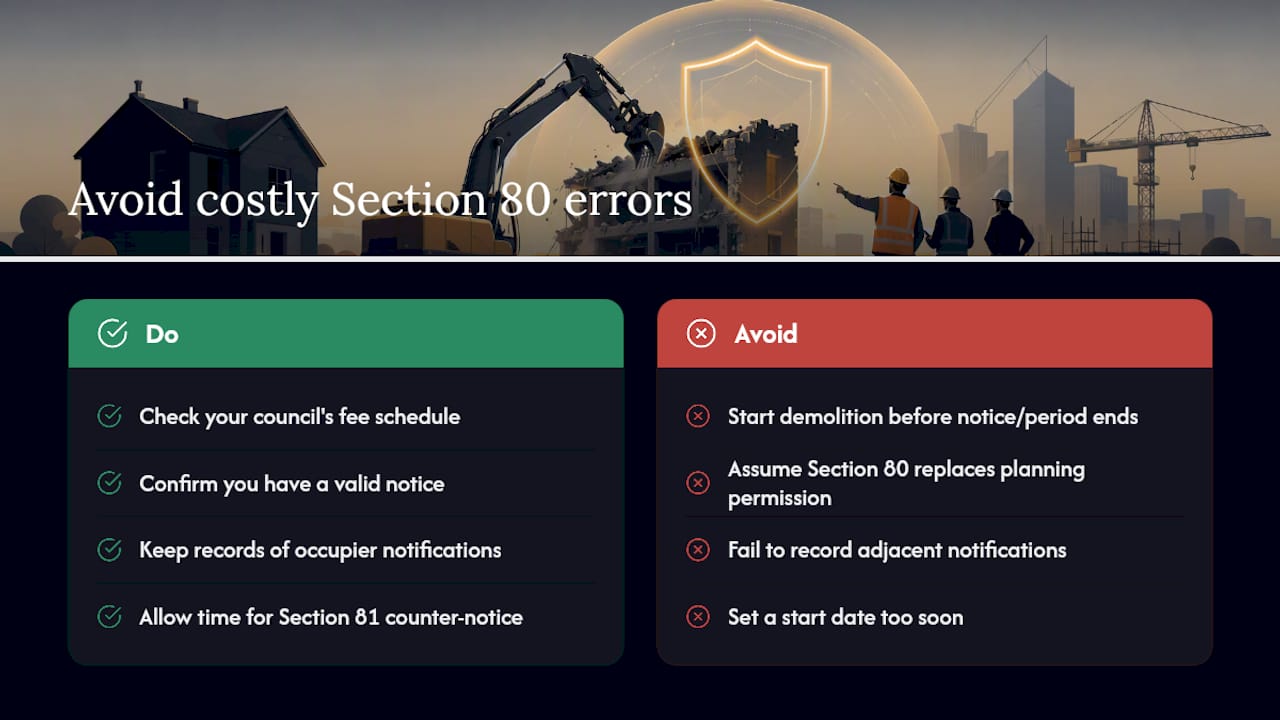
Starting demolition without a valid notice, or before the statutory period expires, is a criminal offence that can result in summary conviction and a fine. Beyond the legal exposure, the most frequent pitfalls are avoidable: assuming Section 80 substitutes for planning permission, failing to keep records of adjacent occupier notifications, and setting a start date that doesn’t allow for a Section 81 counter-notice to land in time.
A contractor’s view on avoiding delays
Every experienced demolition team learns the same lesson eventually: the six-week period is a planning gate, not a deadline to race towards. Building likely Section 81 conditions, asbestos clearance, hoarding, restricted hours, into the programme from day one avoids the scramble that happens when a council response lands three days before mobilisation.
The projects that run smoothly are the ones where the method statement accounts for realistic sequencing, notifications to utilities are documented properly, and surveys are commissioned early enough that results don’t hold up the submission itself. Co-ordinating those elements together, rather than treating each as a separate task, is what actually keeps a demolition programme on schedule.
— George
Get Section 80 compliance handled by experienced demolition contractors
Preparing a compliant section 80 demolition notice is straightforward on paper, but the surveys, method statements, and site logistics behind it are where projects usually slip. Gcscontractors handles the full sequence, from pre-demolition and asbestos surveys through to method statement preparation, site hoarding, and demolition delivery, so your notice goes in complete the first time and your programme doesn’t stall waiting on a Section 81 response.

Working with a contractor who has managed dozens of these notices across Cambridge and East Anglia means fewer surprises: conditions get anticipated rather than reacted to, and notifications to adjacent occupiers and utility suppliers are documented properly from the outset. If you’re planning a demolition project and want the regulatory and programme risk taken off your plate, get in touch with Gcscontractors and request a breakdown of your demolition sequence before you set a start date.
Where to find the official forms and guidance
Start with Building Act 1984, Section 80 and 81 for the statutory text, then check your local Building Control page for council-specific forms and fees. HSE’s demolition safety guidance covers the risk assessment expectations in detail.
Sources
- Building Act 1984, Section 80
- Demolition notices | London Borough of Hammersmith & Fulham
- Notice of demolition (Section 80) — Bradford Council (form PDF)
- Notice of demolition works — Leicester City Council (form PDF)
- Demolition — HSE