A professional manual dismantling tutorial: your compliance guide
A professional manual dismantling tutorial gives commissioners a regulated, documented plan for hand-led strip-out work that satisfies The Construction (Design and Management) Regulations 2015 from the first survey to final handover. It sits alongside HSE guidance on soft strip demolition, which sets out dust controls and a minimum level of Respiratory Protective Equipment with a high level of assigned protection factor. A genuine manual dismantling tutorial isn’t a how-to video. It’s a paper trail and a method that a competent contractor like Gcscontractors can produce or advise on. Expect it to cover:
- Pre-construction information and duty holder appointments
- A competent survey identifying stability-sensitive elements
- Demolition sequencing and temporary works design
- Dust suppression, extraction, and RPE requirements
- Inspection schedules and recordkeeping for the whole job
Key Takeaways
A compliant manual dismantling tutorial combines CDM 2015 duties, a competent survey, engineered temporary works, and documented dust and RPE controls, all backed by inspection records.
| Point | Details |
|---|---|
| Provide pre-construction information | Clients must share structural form, design assumptions, and existing surveys before work starts. |
| Require a competent survey | Insist on a written survey identifying stability-sensitive elements and a recommended sequence. |
| Specify designed temporary works | Require a documented design, installation checks, and a defined inspection regime. |
| Enforce dust and RPE controls | Water suppression or on-tool extraction plus RPE with an assigned protection factor of 20 or higher. |
| Choose a documented contractor | Gcscontractors delivers surveys, method statements, temporary works design, and inspection records as standard. |
Table of Contents
- Client and CDM duties before manual dismantling starts
- What must a competent survey and structural assessment cover?
- Choosing the right dismantling method and sequence
- How do you control dust during manual dismantling?
- Written safe systems of work and site controls
- How do you choose a competent strip-out contractor?
- What records should you keep during and after the job?
- What project managers get wrong about strip-out timing
- How Gcscontractors delivers manual dismantling with the paperwork to prove it
- Where to read further on manual dismantling compliance
- Frequently asked questions
- Sources
Client and CDM duties before manual dismantling starts
Under CDM 2015, commercial clients carry legal duties before a single partition comes down. The pre-construction information you hand to your contractor must describe the building’s structural form, significant design assumptions, and any existing surveys or historic records. HSE is explicit that clients shouldn’t assume contractors already hold this knowledge. You appoint a principal designer, a competent contractor, and, on anything involving structural alteration, a temporary works designer with a clear written brief.
Before work starts, insist on seeing:
- A refurbishment or demolition survey
- A Construction Phase Plan
- Risk assessments and a written method statement (RAMS)
Pro Tip: Ask to see fit-tested RPE records, the temporary works designer’s sign-off, and the surveyor’s full report before you agree a start date. If a contractor can’t produce these on request, treat that as a red flag, not a paperwork delay.
What must a competent survey and structural assessment cover?
HSE guidance on structural stability during demolition is unambiguous: a competent person must survey the structure before any potentially load-bearing element is touched. That survey needs to identify:
- Structural form and load paths
- Stability-sensitive elements such as cores, shear walls, arches, and overhangs
- Previous alterations and hidden voids
- Materials requiring specialist handling
A competent surveyor, structural engineer, or temporary works designer produces the written output. Expect your survey deliverables to include:
- A survey report with inspection photographs
- Drawings marking stability-critical elements
- A recommended demolition sequence
- A clear statement of limitations and unknowns
That last point matters more than it sounds. A survey that admits what it couldn’t verify (because access was restricted, or records were incomplete) is more useful than one that pretends certainty it doesn’t have. Our structural integrity guide covers this scoping process in more depth.
Choosing the right dismantling method and sequence
Method choice isn’t a preference, it’s an engineering decision. HSE guidance on demolition notes that top-down methods reduce debris spread and often suit constrained urban sites, while high-reach approaches can work where access and exclusion zones genuinely allow it. Selective hand-dismantling sits between the two, useful where retention of the structural frame or adjacent live areas rules out anything more aggressive.
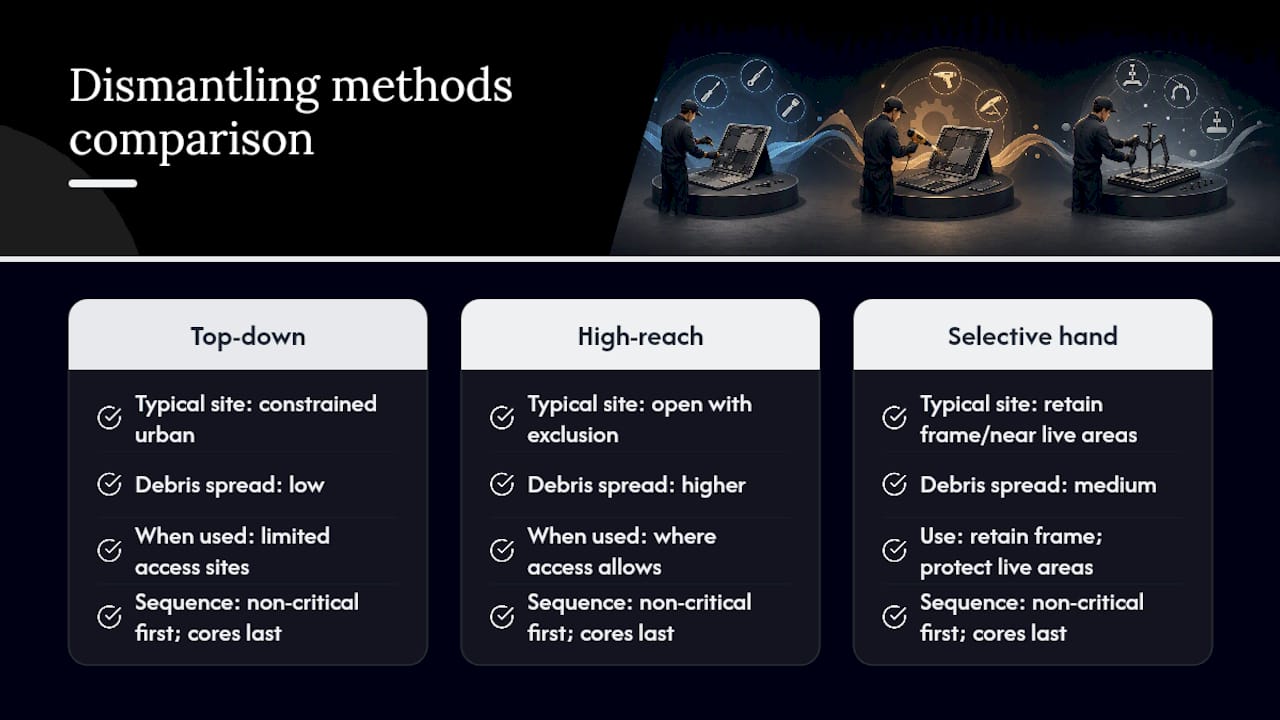
Sequencing reduces collapse risk. Non-critical elements come out first; work progresses towards stiff cores and load-bearing zones last, following the surveyor’s recommended order rather than whatever’s most convenient to reach.
Temporary works designers carry real responsibility here. Your specification should require a designed scheme, documented installation checks, and a defined inspection regime, not a verbal assurance that “it’ll be propped as needed.”
Pro Tip: On anything with an ambiguous structural history, get an independent third-party check on the temporary works design before installation. It costs little against the downside of a collapse.
How do you control dust during manual dismantling?
Soft strip demolition generates high dust levels, and HSE’s guidance is specific about the hierarchy of control: avoid the hazard where possible, contain it, suppress what remains, ventilate the space, and use PPE as the last line of defence, not the first.

In practice that means water suppression or on-tool extraction wherever the task allows it, adequate ventilation, and fit-tested RPE with a high level of assigned protection factor, typically FFP3 or P3 filters, with powered hoods for extended tasks. HSE research on respirable crystalline silica found manual demolition activities can show higher exposures than some mechanical methods, which is exactly why manual work needs its own tailored controls rather than borrowed mechanical-demolition assumptions.
Extraction equipment needs periodic testing, not a one-off check at delivery. HSE recommends competent examination at regular intervals where thorough examination applies. Contractors should be able to demonstrate:
- Water suppression or on-tool extraction in active use
- Correctly fitted, tested RPE with current fit-test records
- A maintenance and testing log for extraction equipment
Repeated silica exposure without proper controls contributes to long-term lung disease, which is precisely why fit testing isn’t a box-ticking formality.
Written safe systems of work and site controls
A safe system of work should set out the sequence of operations, control measures, required PPE, lifting and lowering procedures for heavy components, and the competence level expected of each role. Our method statement guide breaks down what a compliant document actually contains.
On site, that translates into physical measures:
- Exclusion zones around active work areas
- Barriers, hoardings, and covered walkways for pedestrian routes
- Protection for adjacent structures and traffic management where the site borders a live road or occupied building
Supervision closes the loop. Daily briefings, toolbox talks, and supervisor sign-off give the client something to check against, rather than trusting that the method statement is being followed off the page.
How do you choose a competent strip-out contractor?
Experience and paperwork both matter, but paperwork proves the experience is real. Look for:
- Demonstrable experience on comparable structures
- Suitable insurance cover for the scale of works
- In-house or subcontracted temporary works capability
- Trained, supervised staff with documented competency
At tender stage, ask direct questions:
- Can you provide previous survey reports and method statements?
- Who is your temporary works designer, and can we contact them?
- What are your RPE fit-test records and inspection schedules?
- How do you segregate and document waste disposal?
Build the answers into the contract itself: responsibility for temporary works, waste segregation and disposal routes, inspection regimes, and a schedule for document delivery. Our contractor compliance guide sets out clauses worth insisting on.
What records should you keep during and after the job?
Inspection isn’t a single event. It runs daily through the works and continues after handover.
Expect these on a working schedule:
- Daily supervisor inspections of the working area
- Weekly reviews by a competent person covering temporary works and controls
- Periodic testing of dust extraction equipment and RPE fit
- Particulate monitoring on higher-risk tasks
Retain the paper trail once work finishes: survey reports, method statements, RAMS, inspection logs, test certificates, and handover documentation. If a dispute or HSE enquiry ever arises, this is what demonstrates the job was run properly, not assumed to be.
What project managers get wrong about strip-out timing
Delays on strip-out jobs rarely come from the demolition itself. They come from missing pre-construction information and services nobody flagged as live before the tools came out. A drawing that says a riser is dead, when it isn’t, stops a crew cold and rightly so.
The fix is coordination, not extra manpower. Sequence isolation of live services with the relevant trades before the first fixture comes off the wall, not during. Gcscontractors has built its demolition sequencing approach around exactly this kind of pre-emptive checking, because a day spent confirming services saves a week spent recovering from an assumption that was wrong.
How Gcscontractors delivers manual dismantling with the paperwork to prove it
Where other contractors hand you a quote and a start date, Gcscontractors hands you the survey, the method statement, and the temporary works sign-off before anyone picks up a tool. We handle strip-out and demolition, temporary works coordination, and dust control as a connected package, drawing on direct experience working within live, occupied environments where disruption has to stay minimal.

Engage us and you can expect a competent survey, a written method statement matched to your structure, a designed temporary works scheme where one’s needed, and inspection records delivered as standard rather than on request. If you’re commissioning strip-out or manual demolition on a live or commercial site, start with our strip-out and demolition guide and request a project walk-through to see exactly how we’d sequence and document your job.
Where to read further on manual dismantling compliance
For primary guidance beyond this tutorial, check:
- HSE guidance on soft strip demolition for dust control requirements
- HSE demolition guidance for CDM duties and method selection
- Gcscontractors’ safety precautions guide for site-level controls
Ask any contractor tendering for your project to reference these sources directly in their method statement.
Frequently asked questions
Is a manual dismantling tutorial the same as a method statement?
No. A tutorial explains the wider process, duties, and controls; the method statement is the specific written document a contractor produces for your job, referencing the survey and sequence agreed for that structure.
Who is legally responsible for pre-construction information?
The commercial client holds that duty under CDM 2015, though a principal designer typically coordinates gathering and issuing it to the appointed contractor.
What RPE protection factor should manual dismantling require?
HSE guidance sets a minimum assigned protection factor of 20, generally met with fit-tested FFP3 or P3 filters, with powered hoods recommended for extended tasks.
How often should dust extraction equipment be tested?
HSE recommends competent examination and testing at least every 14 months where thorough examination requirements apply, alongside routine maintenance checks during the works.
Does manual dismantling need a temporary works designer?
Wherever structural or stability-sensitive elements are involved, yes. A competent temporary works designer should produce the design, and installation should be checked and inspected against it throughout.
This article is general information, not a substitute for advice from a qualified doctor. Consult a qualified healthcare professional about your own circumstances before acting on anything here.