Excavation safety tips every site team must follow
No one enters an excavation until five things are confirmed: a competent person has inspected it, a protective system or safe slope is in place, access and egress are secure, the atmosphere has been checked where needed, and an emergency plan is ready. Miss any one of those five and you are gambling with a hazard that kills faster than almost anything else on a construction site.
That single verdict sits behind every piece of HSE guidance on excavations, and it is the standard Gcscontractors applies on every groundworks project across Cambridge and East Anglia. Before anyone steps down, run this checklist:
- Competent person has inspected the excavation this shift and after any event affecting stability
- A protective system (shoring, shielding, battering or trench box) matches the soil and depth
- Spoil and plant are kept well back from the edge, with barriers where people could fall
- Access and egress points are secure, stable and within safe travel distance
- Underground and overhead services have been located and confirmed
- Atmospheric testing has been carried out where depth or contamination warrants it
- A written risk assessment and RAMS (risk assessment and method statement) are on site
- Rescue equipment and a named, trained rescue contact are ready before work starts
One point worth repeating: NIOSH data on trenching fatalities in the US recorded 373 deaths between 2003 and 2017, almost all of them preventable through planning, protective systems, or avoiding entry altogether. That is not a historical footnote. It is the reason every item on that checklist exists.
Key takeaways
Excavation safety depends on a competent person’s inspection, a protective system matched to depth and soil, secure access and egress, and a tested emergency plan before anyone enters.
| Point | Details |
|---|---|
| Competent person inspects first | No entry until a competent person has confirmed the excavation is safe this shift. |
| Match protective system to depth | Use shoring, shielding, sloping or trench boxes based on soil type and the 1.5 m trigger depth. |
| Keep spoil and plant off the edge | Position spoil heaps and exclusion zones well back from the excavation lip. |
| Secure access and egress | Fit ladders or ramps that extend above the landing point and stay clear of spoil. |
| Test the atmosphere where relevant | Check for low oxygen or fumes on deep, contaminated or confined-space-like excavations. |
| Record every inspection in writing | Log date, time, inspector and condition notes, and stop work on any fault. |
| Consider trenchless at design stage | Directional drilling or pipe jacking can remove entry hazards entirely on suitable projects. |
| Gcscontractors builds this in as standard | Groundworks and excavation projects across Cambridge and East Anglia follow this inspection and protective-system sequence throughout. |
Table of Contents
- Excavation safety tips start with knowing the real hazards
- Plan and prepare: risk assessment, competent person, locating services
- Choosing the right protective system for depth and soil type
- Edge protection, spoil placement and keeping plant clear
- Getting people in and out of an excavation safely
- Atmospheric hazards: when to test and how to control fuelled plant
- Inspection regime: what to check and how to record it
- Training, toolbox talks and PPE that actually matter
- Emergency planning: the rescue kit and drills you need ready
- Should you avoid the excavation altogether? Trenchless methods at design stage
- What years on site actually teach you about excavation risk
- How Gcscontractors reduces excavation risk on your project
- Sources
Excavation safety tips start with knowing the real hazards
Trenches and excavations don’t fail gradually. They fail in seconds, which is exactly why they catch experienced crews off guard. Understanding what actually kills people on a dig changes how you plan the job, not just how you react once you’re in the hole.
The hazards that dominate incident reports are consistent across almost every excavation site:
- Collapse or cave-in — the single biggest killer, because a cubic metre of soil can weigh well over a tonne and bury a worker in seconds
- Falling or dislodged material — spoil, tools or fragments of the excavation face landing on people below
- Falls into the excavation — workers, visitors or plant operators stepping or driving too close to an unprotected edge
- Undermining nearby structures — foundations, walls or roads losing support as the excavation removes ground beneath them
- Underground and overhead services — striking gas, electricity or water lines, or contacting overhead power with plant
- Water ingress — rain or groundwater changing soil cohesion and adding hydrostatic pressure against excavation walls
- Hazardous atmospheres — low oxygen, trapped gas or fumes accumulating in confined or low-lying excavations
No excavation depth is automatically safe. Even a shallow trench can be lethal if the soil is unstable, waterlogged, or sitting close to underground services. Treat every excavation as a hazard until it has been properly assessed. That is the working assumption behind HSE’s own guidance, and it is the assumption every competent person should carry onto site.
Cave-in risk deserves particular attention because of how quickly it becomes unsurvivable. Soil this heavy compresses the chest and prevents breathing well before rescue teams can dig a casualty free, which is why prevention through protective systems always outperforms rescue after the fact. Electrocution from buried cables carries the same brutal logic: there is no margin for a “probably fine” assumption when a service strike can be instant and fatal.
Plan and prepare: risk assessment, competent person, locating services
Every safe excavation is decided before the first bucket of soil moves. The planning stage is where most fatal mistakes actually originate, not on the dig itself, because a poor decision on paper becomes a physical hazard the moment digging starts.
A competent person — someone with the training, knowledge and experience to identify excavation hazards and specify the right controls — must be involved from day one. Their sign-off on the risk assessment and RAMS is not paperwork for its own sake; it is the legal and practical safeguard that keeps everyone accountable when ground conditions change unexpectedly.
Work through planning in this order:
- Survey the site and record existing structures, loads, traffic routes and access constraints nearby
- Classify the soil — cohesive clay behaves very differently under load compared with loose sand or made-up ground
- Locate and verify underground services using utility owner records, then confirm them physically rather than trusting plans alone
- Set spoil and plant exclusion zones before digging starts, not once material is already piled at the edge
- Confirm temporary support equipment is available on site, sized correctly for the expected depth and soil type
- Write the risk assessment and RAMS, and brief every operative on it before work begins
Locating services properly is where projects most often cut corners, and it’s the step Gcscontractors treats as non-negotiable on every utility trenching project in Cambridge, where buried gas, water and telecoms lines are a constant reality.
Pro Tip: Never rely on historical site plans alone to find underground services. Combine plans with a CAT (cable avoidance tool) scanner or ground-penetrating radar, then confirm with trial holes dug using non-powered tools. Plans go out of date the moment someone adds an unrecorded connection, and that gap is exactly where strikes happen.
Choosing the right protective system for depth and soil type
Get this decision wrong and every other precaution on site becomes irrelevant. Four protective approaches cover almost every excavation scenario, and picking between them comes down to depth, soil type, space on site and how long the excavation will stay open.
| Protective system | Best suited to | Key limitation |
|---|---|---|
| Sloping/battering | Wide sites with room to cut back excavation walls at a stable angle | Needs significant extra space; impractical in tight urban sites |
| Benching | Similar to sloping but stepped, used where full battering isn’t practical | Requires careful step calculation for soil type; still space-hungry |
| Shoring (hydraulic or timber) | Narrow trenches, utility work, confined urban sites | Needs correct sizing and installation sequence to be effective |
| Shielding/trench boxes | Pipe-laying and linear trenching where the box moves with the work | Protects workers inside the box only, not the open ends |
OSHA’s trenching and excavation guidance sets depth triggers: protective systems are required for trenches deeper than a certain threshold unless the excavation sits in stable rock. For much deeper trenches, an engineer must design the protective system rather than relying on standard tables. Treat these figures as a floor, not a target. Ground conditions, nearby vibration from plant, and water table levels can all demand a stronger system well before the statutory depth is reached.
Sequencing matters as much as the system itself. A trench box installed too late, after workers have already entered an unprotected section, defeats its own purpose entirely.
Pro Tip: When using a trench box on a moving pipe-laying job, install it before excavation reaches full depth at that section, and never allow anyone to enter ahead of the box’s leading edge. Move it as a unit with the excavator, not as an afterthought once the trench is already open.
Gcscontractors’ work on temporary support in demolition and construction follows the same sequencing logic: supports go in before the hazard exists, not after someone has already been exposed to it.
Edge protection, spoil placement and keeping plant clear
Most excavation edge incidents share a common thread: something got too close that shouldn’t have. Spoil piled at the lip, plant tracking along the edge, or a missing barrier where the public or other trades pass by.
Practical edge control on any live site comes down to a short set of rules:
- Keep spoil heaps back from the excavation edge by a distance that reflects depth and soil angle, never stacked right against the lip
- Fit toeboards or projecting sheets to stop loose material rolling or falling into the excavation
- Install substantial barriers or guard rails anywhere people could walk or fall into the excavation, particularly near walkways and site entrances
- Define plant exclusion zones and mark them physically, not just on a drawing pinned in the site office
- Route haul roads and delivery vehicles away from excavation edges wherever the site layout allows it
- Brief every driver and operator on exclusion zones as part of the daily toolbox talk, not just at induction
HSE guidance is explicit that edge protection and spoil control are essential wherever people are liable to fall into an excavation. This is one area where Gcscontractors’ own spoil management practices reflect the same principle: distance from the edge is decided at planning stage, not adjusted on the fly once the digger operator has already piled material where it’s convenient.
Getting people in and out of an excavation safely
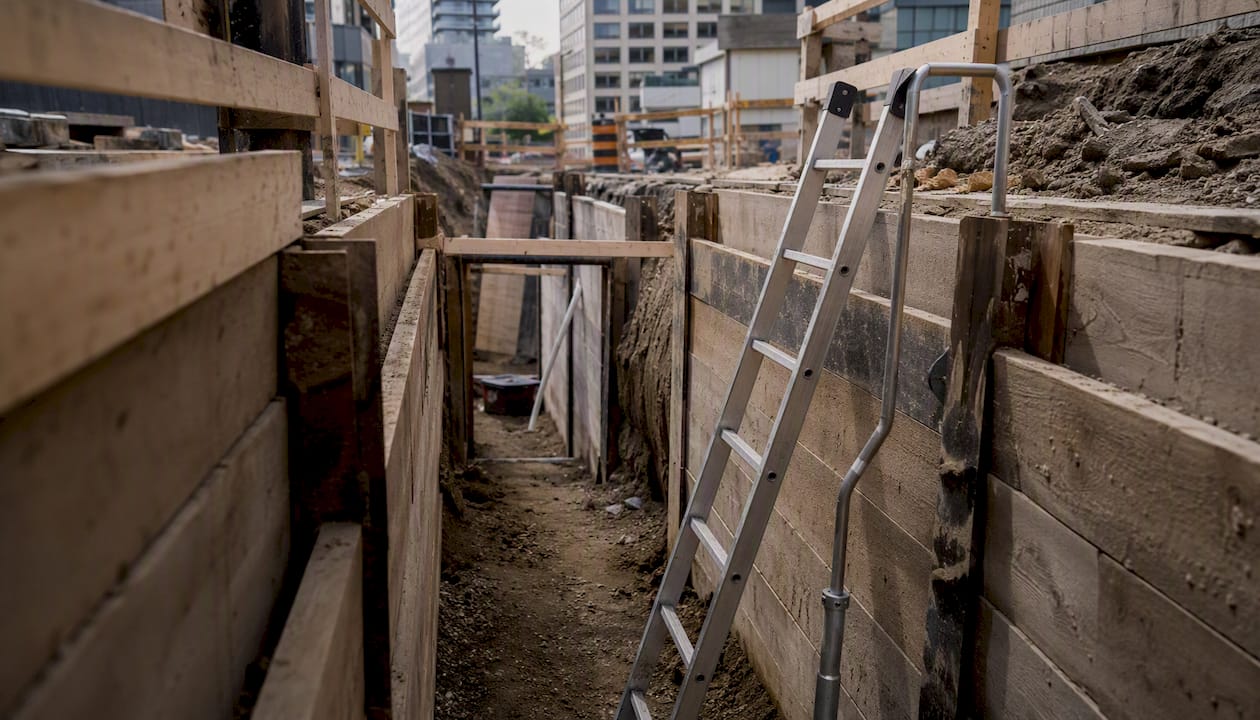
Access and egress sound like the least glamorous part of excavation safety, and that’s exactly why they get overlooked. A ladder that’s slightly too short, or a single access point on a fifty-metre trench, causes exactly the kind of incident that never makes the safety briefing until after it’s happened.
The accepted methods for safe access are straightforward:
- Ladders, ramps or steps, chosen to suit the depth and duration of the work
- Ladders must be secured, footed on a firm base, and extend at least 1 metre above the landing point where used as a main access route
- Access points on long trenches should be spaced so no one has to walk more than a short, safe distance to reach one in an emergency
- Routes to and from access points must stay clear of spoil, plant and stored materials at all times
- Ramps for wheeled access need a gradient suited to the equipment using them, checked before first use
Site safety guidance from Oregon OSHA reinforces that access and egress sit alongside atmospheric testing and protective systems as core excavation requirements, not optional extras bolted on afterwards.
Pro Tip: On trenches with frequent foot traffic, fit a temporary handhold or handrail at the ladder landing point. It sounds minor, but the moment where someone steps from a ladder rung onto uneven ground at the top of a trench is one of the more common slip points on busy sites.
Atmospheric hazards: when to test and how to control fuelled plant
Low oxygen and toxic fumes don’t announce themselves. That’s precisely what makes atmospheric hazards in excavations so dangerous compared with a visible risk like an unstable wall.
Test the atmosphere whenever an excavation is deep, close to underground services, sited on contaminated ground, or shows any characteristic of a confined space, such as poor natural airflow. Depth alone isn’t the only trigger. A shallow excavation over a leaking gas main or decomposing organic material can be just as hazardous as a deep shaft.
One rule that gets broken more often than it should: never site petrol or diesel-engine plant in or right at the edge of an excavation. Exhaust gases collect in low-lying, poorly ventilated trenches and can build to dangerous concentrations quickly, particularly in still weather. If fuelled equipment must run nearby, exhaust needs to be ducted away from the excavation or the area needs forced ventilation.
Where forced ventilation is used, position gas monitoring sensors near the working area, not just at the entrance, since fumes can settle unevenly along a trench’s length. NIOSH’s trenching safety data reinforces the same underlying message as the fatality figures already covered: prevention through planning beats intervention after exposure, every time.
- Test before entry whenever depth, contamination or confined-space characteristics are present
- Never run petrol or diesel plant at the excavation edge without ducted exhaust or forced ventilation
- Position gas sensors along the trench, not only at the access point
- Re-test after any break in work longer than a shift change
Inspection regime: what to check and how to record it
An excavation that was safe yesterday is not automatically safe today. That single fact drives the entire inspection requirement, and it’s the part of excavation safety most likely to slip when a project is running behind schedule.
HSE requires a competent person to inspect excavation supports or battering at the start of every shift, and again after any event that could affect stability. Rain is the most common trigger overlooked on site, because water changes soil cohesion and increases hydrostatic pressure against excavation walls almost immediately. Vibration from nearby piling, a plant strike on the excavation face, or any fall of material should trigger the same re-inspection before anyone re-enters.
| Inspection trigger | Minimum action required | Record fields to capture |
|---|---|---|
| Start of every shift | Competent person inspects supports, battering and edges | Date, time, inspector name |
| After heavy rain | Re-inspect before resuming work; check for water ingress | Condition notes, water levels observed |
| After plant strike or vibration nearby | Stop work; inspect for cracking or movement | Actions taken, whether work was halted |
| Any fall of material | Full re-inspection before re-entry | Cause identified, corrective action recorded |
Written inspection records aren’t a bureaucratic afterthought. They are the mechanism that stops work continuing on autopilot when conditions have quietly changed. If the record shows a fault, work must stop until the fault is fixed, no exceptions for schedule pressure.
- Inspect before every shift begins, with no exceptions for “quick” jobs
- Re-inspect after rain, vibration, or any material fall
- Record findings in writing, including inspector name and time
- Stop work immediately if the record shows an unsafe condition
- Only resume once the competent person confirms the fix in writing
Gcscontractors’ own deep excavation safety and planning checklist sets out printable inspection fields site teams can adapt directly for this purpose.
Training, toolbox talks and PPE that actually matter
Kit alone doesn’t prevent incidents. The training behind it does, and toolbox talks are where that training gets reinforced in the moments that actually count.
Core training every excavation crew needs:
- Competent person training for whoever is signing off inspections and protective system decisions
- RAMS briefings before work starts, not a signature on a form nobody actually read
- Toolbox talks covering changing site conditions, including what to do if weather or ground conditions shift mid-shift
- Emergency procedure briefings, so everyone knows the rescue plan before they need it, not during an incident
PPE requirements for excavation work go beyond the standard site kit:
- Hard hats and hi-vis as standard for anyone within the exclusion zone
- Safety boots rated for the site’s ground conditions
- Gloves suited to handling shoring equipment and site materials
- Gas monitors and breathing protection where atmospheric testing indicates a risk
Refresher training should happen at set intervals, not only when an incident forces the issue, and every session needs a written record. Readers responsible for waste handling alongside excavation work may also find the certificate in removing non-hazardous wastes a useful accredited option for site teams needing broader compliance training.
Emergency planning: the rescue kit and drills you need ready
An emergency plan written after an incident is worthless. The whole point of preparing one in advance is that decisions get made calmly, before anyone is standing at the edge of a collapsed trench with a colleague trapped inside.
A workable trench emergency plan needs:
- A pump or de-watering equipment ready to hand where water ingress is a realistic risk
- Trained rescue personnel identified before work starts, not sourced after an incident begins
- A clear communication plan, including who calls emergency services and what information they give
- Rescue equipment kept immediately accessible at the excavation, not stored in a site cabin five minutes away
Rescue equipment to have on hand includes a harness and retrieval line, atmosphere monitoring kit, and additional shoring material in case the rescue itself requires stabilising the excavation further. The first instinct for any untrained responder should never be to climb into a collapsed trench. A second casualty helps no one, and it happens more often than site teams expect when panic overrides training.
Before work begins each day, test the plan against a simple checklist: is rescue equipment present, is a trained contact named and reachable, and does everyone on site know the call procedure if something goes wrong?
Should you avoid the excavation altogether? Trenchless methods at design stage
The safest excavation is sometimes the one that never gets dug. That’s not a throwaway line. It’s a genuine design-stage decision that removes entry-related hazards entirely rather than managing them once work is underway.
Common non-entry alternatives worth considering before committing to open-cut excavation:
- Directional drilling — installs pipework or cabling beneath the surface without a continuous open trench
- Pipe jacking — pushes new pipe sections through the ground from a launch pit, avoiding a long open cut
- Pipe relining — rehabilitates existing pipework from within, avoiding excavation for replacement altogether
NIOSH’s guidance on trenching safety specifically recommends considering trenchless techniques at the design stage as one of the most effective ways to prevent trenching deaths, precisely because they remove the hazard rather than mitigating it.
The trade-off is cost and schedule. Trenchless techniques typically carry a higher upfront cost and need specialist plant, so they’re most feasible on longer utility runs, congested urban sites, or where reinstatement costs above ground would otherwise be significant. Short domestic connections or simple foundation digs rarely justify the expense. Guidance on funding infrastructure and development projects can help contractors weigh these upfront costs against a project’s wider budget before committing either way.
Pro Tip: Bring the competent person and the client into this conversation early, ideally at tender stage. Trenchless feasibility is far easier to build into a budget and programme before groundworks start than to retrofit once excavation is already the assumed method.
What years on site actually teach you about excavation risk
The incidents that stick with you aren’t the dramatic ones. They’re the small oversights that almost went unnoticed. Spoil piled a little too close to the edge because there wasn’t quite enough room on a tight urban site. A re-inspection skipped after a light shower because it “wasn’t really rain.” Those are the moments where excavation safety tips on a laminated sheet meet the reality of a site running to a tight programme.
What consistently prevents incidents isn’t a longer checklist. It’s a competent person with the authority to stop work and the backing to make that decision stick, even when it costs a morning’s productivity. On more than one project, that authority has meant halting a pour or a dig because ground conditions shifted overnight in a way the previous day’s inspection couldn’t have predicted. Every one of those stoppages looked expensive in the moment. None of them looked expensive compared with the alternative.
The uncomfortable truth is that most excavation fatalities trace back to a decision made under time pressure, not a lack of knowledge. Everyone on a UK construction site knows shoring exists. Not everyone insists on it when the schedule is tight and the trench “probably” won’t need it. That gap between knowing and insisting is where the proactive find and fix approach earns its reputation: it works because it gives inspection and stoppage the same authority as the programme itself, rather than treating safety as something that happens after the real decisions are made.
How Gcscontractors reduces excavation risk on your project
Reading a checklist is one thing. Having a groundworks contractor who applies it as standard practice on every dig is another. Gcscontractors builds competent person inspections, protective system selection and written RAMS into every excavation and groundworks project across Cambridge and East Anglia, rather than treating them as separate compliance steps bolted onto the programme.

Our teams handle site setup, temporary support installation, spoil management and drainage works on live sites, which means the safety checks covered in this article aren’t theoretical for us. They’re the sequence we follow before a single trench opens. If you’re planning groundworks and want a site safety pre-start review or help preparing a RAMS document before your project begins, get in touch through our groundworks and site preparation services page to arrange a review before your excavation work starts.
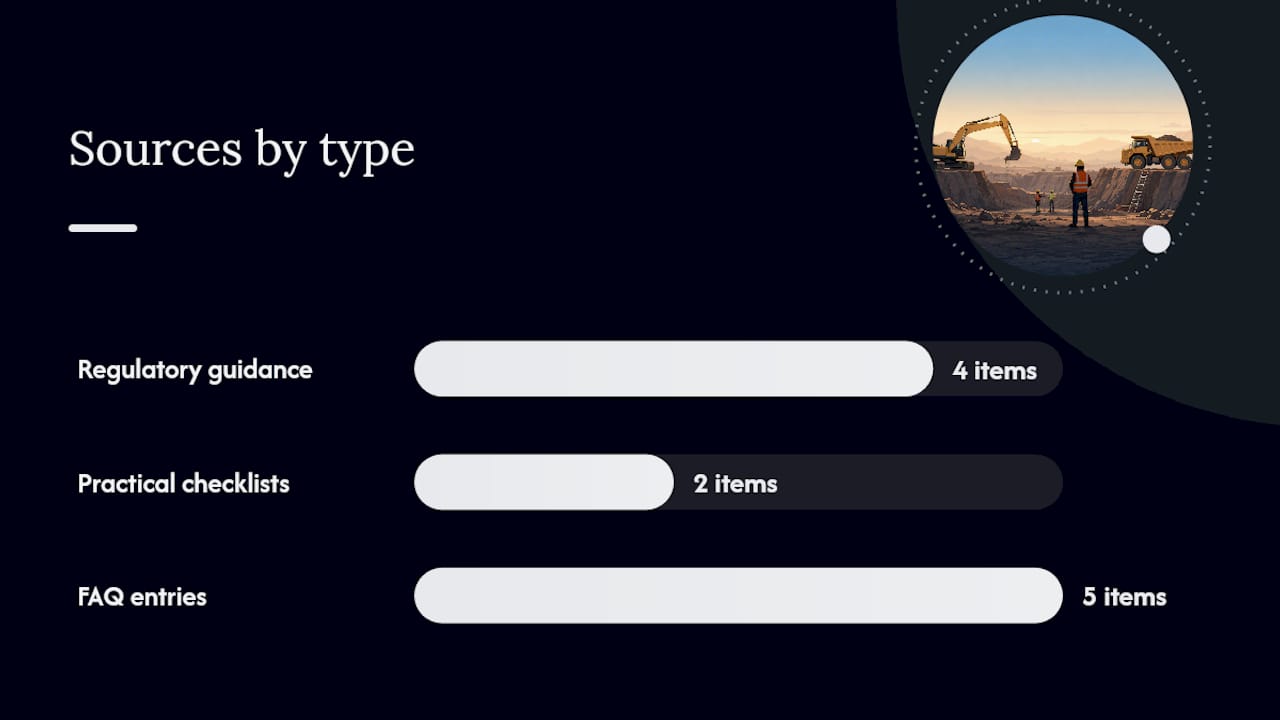
Sources
For readers who want the primary regulatory detail behind these excavation safety tips, these sources set out the underlying legal and technical requirements in full:
- Excavations – HSE
- Trenching and Excavation Safety | NIOSH (CDC)
- Trenching and Excavation Safety – OSHA fact sheet
- The ABCs of construction site safety – Oregon OSHA (PDF)
For practical checklists and templates you can adapt on site, Gcscontractors’ deep excavation safety and planning checklist and groundworks safety tips for building contractors cover the same ground with downloadable inspection fields.
FAQ
What is the minimum depth at which an excavation needs a protective system?
OSHA guidance sets the trigger at 1.5 metres (5 feet) unless the excavation is in stable rock, though many competent persons apply protective measures earlier depending on soil type and site conditions.
How often must an excavation be inspected?
A competent person must inspect at the start of every shift and again after any event that could affect stability, including heavy rain, nearby vibration or a fall of material, per HSE requirements.
Can petrol or diesel plant be used near an open excavation?
Only if exhaust gases are ducted away from the excavation or forced ventilation is in place. Fumes can otherwise collect in the trench and create a hazardous atmosphere.
What should be in a written excavation inspection record?
Date, time, inspector name, condition notes, and any actions taken or faults identified, along with confirmation that work was halted until the fault was resolved.
Are trenchless methods always cheaper or safer than open-cut excavation?
Not always cheaper, since they typically need specialist plant and carry higher upfront costs, but they remove entry-related hazards entirely and are worth assessing at design stage for longer or more congested runs.