Land drainage Cambridgeshire: a property owner’s guide
Land drainage in Cambridgeshire is defined as the regulated management of surface water, groundwater, and watercourse flows through consented engineering works to reduce flood risk and protect property. The county sits across two distinct flood environments: the low-lying Fenland to the north, managed by Internal Drainage Boards (IDBs) and major pumping stations, and the River Cam catchment to the south, where sustainable drainage systems dominate. Getting drainage right here is not simply a technical matter. It requires navigating a layered regulatory structure involving Cambridgeshire County Council, the Environment Agency, and more than twenty active IDBs, each with their own consent requirements and discharge restrictions.
What are the land drainage consent requirements in Cambridgeshire?
Land Drainage Consent is required from Cambridgeshire County Council before carrying out any works that affect an ordinary watercourse outside IDB areas. An ordinary watercourse is any channel that carries water but is not classified as a main river by the Environment Agency. This includes ditches, streams, culverts, and field drains that cross or border many Cambridgeshire properties.
Cambridgeshire County Council acts as the Lead Local Flood Authority, regulating surface water and ordinary watercourse drainage. The Environment Agency leads on main rivers, while IDBs cover the Fenland drainage boards. This three-tier structure means you may need consent from more than one authority depending on where your site sits.
Works that typically require consent include:
- Culverting or piping an open watercourse
- Altering the bed, banks, or flow of a ditch
- Installing new outfalls or discharge points
- Erecting structures within or over a watercourse
Failure to obtain Land Drainage Consent is a regulatory violation. Cambridgeshire County Council can require you to remove unauthorised works and restore the watercourse at your own cost. In Fenland, the relevant IDB must also approve any works affecting their drainage network, and they set strict discharge rate limits that directly shape your drainage design.
Pro Tip: Contact the relevant IDB at the earliest stage of any Fenland project. Their discharge rate limits will determine your attenuation storage requirements, and discovering this late forces expensive redesigns.
How does flood risk affect drainage planning for development?
Flood risk assessment, known as an FRA, is a formal document that maps the flood sources affecting a site and demonstrates how a proposed development manages surface water safely. Flood Risk Assessments and surface water drainage strategies must comply with 2025 national SuDS standards and local policies for developments over 1 hectare or in Flood Zones 2 or 3. That threshold catches a significant proportion of Cambridgeshire development sites.
Cambridgeshire’s planning framework references three flood zones:
- Flood Zone 1 covers land with a low probability of flooding. Standard drainage design applies, though surface water management is still required.
- Flood Zone 2 carries a medium probability of river or sea flooding. An FRA is mandatory, and the Sequential Test must show no suitable lower-risk sites exist.
- Flood Zone 3 carries a high probability of flooding. The Exception Test also applies, requiring proof that the development provides wider sustainability benefits and remains safe for its lifetime.
The Greater Cambridge Strategic Flood Risk Assessment updates have refined zone boundaries across the county, so checking current mapping before purchasing land is non-negotiable.
| Flood zone | FRA required? | Sequential Test | Exception Test |
|---|---|---|---|
| Zone 1 | Only above 1 ha | No | No |
| Zone 2 | Yes | Yes | No |
| Zone 3 | Yes | Yes | Yes |
The Cambridgeshire Flood and Water Supplementary Planning Document adds local requirements on top of national SuDS standards. It specifies how surface water runoff rates must be calculated and what maintenance arrangements must be in place before planning approval is granted.
Pro Tip: Commission your FRA and drainage strategy together from the same consultant. Separate appointments often produce documents that contradict each other, triggering planning objections that delay consent by months.
What drainage solutions work for Cambridgeshire’s soils and conditions?
The right drainage solution depends entirely on where in Cambridgeshire your site sits. Fenland soils with high water tables and clay frequently disallow infiltration drainage such as soakaways, because they fail the BRE 365 percolation test. A soakaway that works perfectly in south Cambridgeshire chalk will simply fill up and overflow in peat and clay Fenland ground.
The standard hierarchy of drainage strategies runs as follows:
- Infiltration first: Only viable where ground conditions pass percolation testing. Rare in Fenland but common in parts of the River Cam catchment.
- Attenuation with restricted discharge: Water is stored on site in tanks, basins, or swales and released slowly to a watercourse at a rate approved by the IDB or Lead Local Flood Authority.
- Pumped discharge: Where gravity outfall is not possible, pumping stations move water to the receiving watercourse. The Middle Level Commissioners and more than twenty IDBs operate extensive pumping networks across the Fens, including St Germans, the largest land drainage pumping station in the UK.
Sustainable Drainage Systems (SuDS) are expected on all major developments. They integrate four key pillars: water quantity management, water quality improvement, amenity, and biodiversity. In Fenland, SuDS schemes must attenuate runoff and discharge at restricted rates to drainage board watercourses rather than relying on infiltration. In the River Cam catchment, infiltration SuDS such as permeable paving and rain gardens are far more achievable.
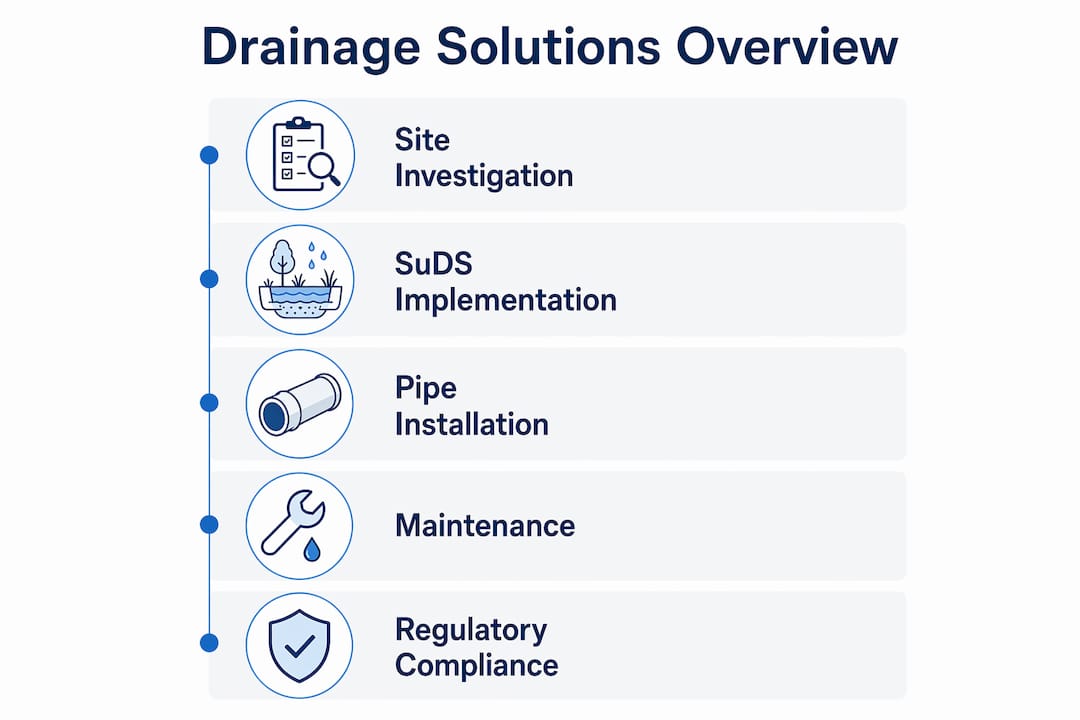
Early ground investigation is the single most important step before committing to any drainage design. A site investigation that includes trial pits, groundwater monitoring, and percolation testing will tell you which drainage hierarchy tier is realistic. Skipping this stage and assuming infiltration will work is the most common and most costly error on Cambridgeshire sites.
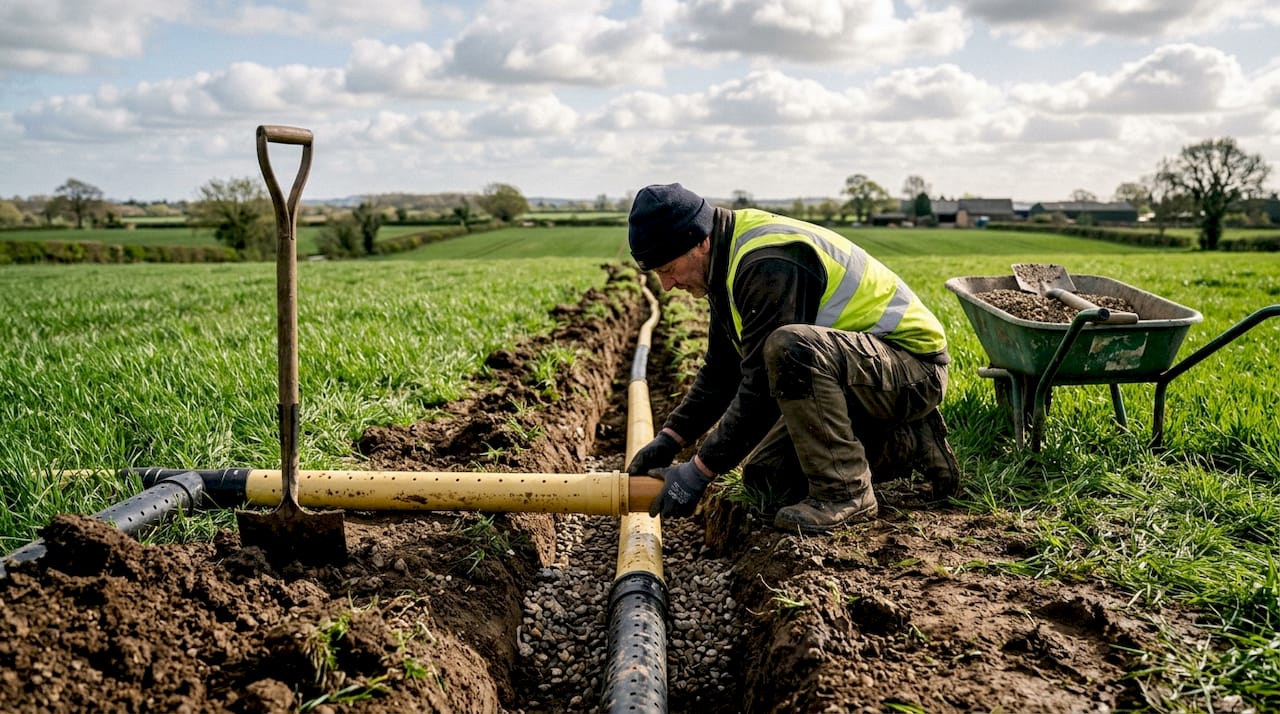
For land drain installation in agricultural or development contexts, perforated pipe systems laid in gravel-filled trenches remain the standard approach for intercepting shallow groundwater before it reaches structures or cultivated land.
How can diagnostics help identify drainage problems on your property?
Recurring drainage problems are rarely caused by a single blockage. Slow drainage, surface flooding, and repeated blockages typically signal structural faults such as root ingress, pipe collapse, or incorrect pipe fall. Treating the symptom with jetting alone without investigating the cause leads to the same problem returning within weeks.
CCTV drain surveys are the standard diagnostic tool for identifying these faults without excavation. A camera is passed through the drain network and records the condition of every pipe, joint, and connection. The survey report identifies the exact location and nature of any defect, giving you a precise scope of works before any ground is broken. This approach protects you from paying for unnecessary excavation and from missing faults that a visual inspection cannot detect.
For CCTV drain surveys and drainage installation in Cambridge and the surrounding area, Gcscontractors provides non-invasive diagnostics as a first step before any repair or installation work begins.
Pro Tip: Book a CCTV survey before purchasing any property with a history of drainage complaints. The survey costs a fraction of what a collapsed pipe or root-damaged sewer repair will set you back after completion.
Common indicators that a CCTV survey is overdue include:
- Gurgling sounds from drains or toilets after rainfall
- Persistent damp patches on ground floors or in basements
- Slow-draining sinks or gullies that do not respond to jetting
- Visible subsidence near drain runs or inspection chambers
What steps should property owners take to manage drainage compliance?
Effective drainage management follows a clear sequence. Skipping any stage creates gaps that regulators or future buyers will identify.
- Identify your regulatory authority early. Determine whether your site falls within an IDB area, under Cambridgeshire County Council’s jurisdiction, or both. Contact the relevant body before any design work begins to confirm consent requirements and discharge limits.
- Commission a site investigation. Ground conditions, groundwater levels, and percolation test results must inform your drainage design. Do not rely on desk study alone.
- Prepare an FRA and drainage strategy together. Both documents must align with 2025 national SuDS standards and the Cambridgeshire Flood and Water SPD. Submit them as a coordinated package with your planning application.
- Select a contractor with local experience. A contractor familiar with groundworks in Cambridgeshire will understand IDB requirements, local soil conditions, and the installation standards expected by the Lead Local Flood Authority.
- Plan for ongoing maintenance from day one. Drainage systems require regular inspection and clearance to perform as designed. Include a maintenance schedule in your planning submission and keep records of all inspections and works carried out.
Documentation is not optional. Cambridgeshire County Council and IDBs can request evidence of consent compliance at any time. Keeping a complete file of consents, drainage design drawings, inspection records, and maintenance logs protects you from enforcement action and supports future planning applications or property sales.
For complex projects involving site preparation alongside drainage works, construction scheduling software helps coordinate groundworks, drainage installation, and regulatory sign-off stages without programme conflicts.
Key takeaways
Effective land drainage in Cambridgeshire requires early regulatory engagement, site-specific ground investigation, and drainage designs that reflect the fundamental differences between Fenland and River Cam catchment environments.
| Point | Details |
|---|---|
| Consent is mandatory | Obtain Land Drainage Consent from Cambridgeshire County Council or the relevant IDB before any watercourse works begin. |
| Flood zone determines requirements | Sites in Flood Zones 2 and 3 require a formal FRA, Sequential Test, and in Zone 3, an Exception Test. |
| Infiltration rarely works in Fenland | High water tables and clay soils mean attenuation with restricted IDB-approved discharge is the standard approach. |
| Diagnostics before excavation | CCTV drain surveys identify structural faults accurately and prevent unnecessary and costly groundworks. |
| Maintenance records protect you | Documented inspection and maintenance logs satisfy regulatory compliance and support future planning or sale. |
Why I think most Cambridgeshire drainage projects go wrong before they start
The most consistent mistake I see is treating Cambridgeshire as a single drainage environment. Developers who have worked successfully in south Cambridge assume the same infiltration SuDS approach will work on a Fenland site. It will not. Ignoring the fundamentally different drainage controls between Fenland areas needing IDB consent and south Cambridge favouring SuDS infiltration is the greatest error developers make. The planning objections that follow are entirely avoidable.
The second mistake is leaving regulatory engagement too late. IDB discharge rate limits are not negotiable. If you design a drainage scheme without knowing the permitted discharge rate, you may need to triple your attenuation storage volume. That changes your site layout, your build costs, and sometimes your viability entirely.
My honest advice is to spend money on ground investigation and regulatory pre-application meetings before you spend anything on drainage design. The information you gather in those early stages is worth more than any amount of redesign later. Experienced drainage contractors in Cambridge will tell you the same thing: the sites that run smoothly are the ones where the groundwork, literally and figuratively, was done first.
— George
How Gcscontractors supports drainage and groundworks projects in Cambridgeshire
Gcscontractors delivers groundworks, civil engineering, and drainage system installation across Cambridgeshire, with direct experience of the regulatory requirements that govern both Fenland and River Cam catchment sites. The team works within live environments and coordinates with Local Flood Authorities and IDBs to keep projects on programme and compliant.

Whether you need site preparation, drainage installation, or a full civil engineering and drainage service for a development project, Gcscontractors brings the local knowledge and technical capability to deliver to the required standard. Contact Gcscontractors to discuss your site requirements and get a clear plan in place before work begins.
FAQ
What is Land Drainage Consent and when do I need it in Cambridgeshire?
Land Drainage Consent is formal permission required before carrying out any works affecting an ordinary watercourse. In Cambridgeshire, you must obtain it from the County Council or the relevant Internal Drainage Board before culverting, altering, or discharging to any ditch or stream.
Do I need a Flood Risk Assessment for my development site?
An FRA is required for any development over 1 hectare or located in Flood Zone 2 or 3. Cambridgeshire’s 2025 SuDS standards and local SPD also require a surface water drainage strategy to accompany the FRA in most planning applications.
Why do soakaways fail on Fenland sites?
Fenland soils combine high water tables with clay and peat, which means they fail the BRE 365 percolation test required to approve infiltration drainage. Attenuation with restricted discharge to IDB watercourses is the standard alternative.
What does a CCTV drain survey involve?
A CCTV drain survey passes a camera through your drain network to record the condition of pipes, joints, and connections. It identifies structural faults such as root ingress or pipe collapse without excavation, giving you an accurate repair scope before any groundworks begin.
Who regulates drainage in the Cambridgeshire Fens?
The Middle Level Commissioners and more than twenty Internal Drainage Boards regulate drainage across the Fens, setting discharge rate limits and approving works on their watercourses. Cambridgeshire County Council acts as Lead Local Flood Authority for surface water and ordinary watercourses outside IDB areas.
Recommended
- Drainage installation Cambridge: the homeowner’s guide
- Residential Drainage Systems: A Guide for Homeowners and Developers in Cambridge – GCS Contractors Ltd
- Drainage Contractors in Cambridge: A Professional Guide to Commercial Infrastructure – GCS Contractors Ltd
- Land Drain Installation Contractors Huntingdon: Professional Groundworks & Drainage (2026) – GCS Contractors Ltd
Need drainage work in Cambridge? GCS Contractors Ltd installs soakaways, attenuation tanks and foul & surface water drainage to Building Regulations Part H. See our drainage services in Cambridge or call 07500 570 926 for a free quote.