Climate considerations in groundworks: 2026 guide
Climate considerations in groundworks are defined as the systematic integration of projected climate change impacts into the design, planning, and execution of foundations, earthworks, drainage, and site preparation. The CIRIA 2026 good practice guide connects projected climate impacts directly with geotechnical risks across the full land development lifecycle, covering flood risk, shifting groundwater, and clay shrink-swell behaviour. For building contractors and civil engineers, these are no longer peripheral concerns. The UK Climate Change Committee’s adaptation framework and Environment Agency flood damage data confirm that climate factors now shape every stage of groundwork delivery, from site selection through to long-term maintenance.
How do climate risks affect ground conditions and construction?
Climate change is shifting extreme weather event frequency from 1-in-100 year events to 1-in-10 year occurrences. That compression of return periods means soil and foundation performance face more frequent and more severe stresses than historical design assumptions ever anticipated.
Increased rainfall and prolonged wet periods raise groundwater tables, saturate cohesive soils, and reduce bearing capacity. Clay soils in particular exhibit pronounced shrink-swell behaviour as moisture cycles become more extreme. During dry spells, clay shrinks and cracks; during wet periods, it swells and loses stiffness. Both conditions compromise foundation performance and increase the risk of differential settlement.
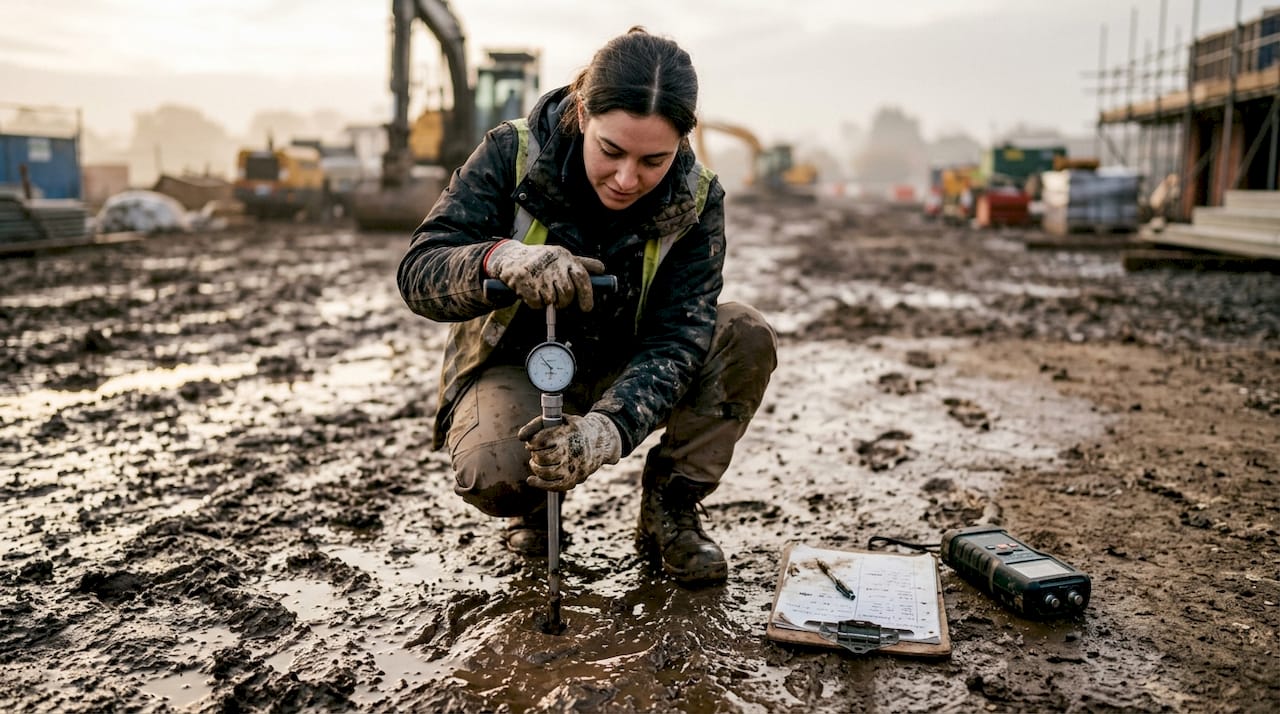
Drought conditions present an equally serious challenge. Prolonged dry summers accelerate desiccation cracking in clay-rich subgrades, which then become highly susceptible to rapid saturation when rainfall returns. This cycle of desiccation and re-wetting is now a design parameter rather than an exceptional event, and geotechnical design must adapt accordingly.
Construction sequencing is directly affected too. Wetter conditions shorten workable periods, increase spoil management complexity, and raise the cost of temporary works. Earthmoving plant operating on saturated ground causes subgrade damage that can compromise the entire foundation programme. Scheduling contingencies that once covered a few wet days per season now need to account for extended disruption windows.
| Condition | Traditional assumption | Climate-adjusted scenario |
|---|---|---|
| Groundwater level | Seasonally stable | Elevated year-round with flash peaks |
| Clay soil behaviour | Predictable shrink-swell cycle | Accelerated cycles, deeper desiccation |
| Extreme rainfall frequency | 1-in-100 year event | 1-in-10 year event |
| Workable construction days | Broadly predictable | Reduced and less predictable |
| Foundation design life | Based on historical data | Requires iterative climate-adjusted modelling |
Pro Tip: Run a climate risk screening at feasibility stage, not just at detailed design. Identifying high-shrink-swell clay or high flood-probability zones early avoids costly redesign once contracts are awarded.
What sustainable groundworks solutions address climate impacts?
Sustainable groundworks combine ground improvement techniques, drainage design, and material choices that reduce carbon output while building long-term resilience. The most widely discussed approaches in 2026 include microbially induced calcite precipitation (MICP), biopolymer stabilisation, and alkali-activated binders. These methods offer lower embodied carbon than traditional cement-based stabilisation, but sustainable binders lack large-scale field validation, particularly in organic soils. Laboratory results are promising; field performance under UK climate variability remains to be fully verified.
Sustainable Drainage Systems (SuDS) are the most mature and widely adopted tool for managing surface water in a changing climate. Permeable paving, swales, detention basins, and infiltration trenches each reduce peak runoff and recharge groundwater slowly. The flood risk economics strengthen the business case for SuDS investment: the Environment Agency estimates annual average damages of £1.2 billion from surface water flooding alone. That figure gives contractors a concrete number to present to clients and insurers when justifying additional drainage capacity.
Foundation design for climate resilience requires adjusting bearing pressure calculations, pile depths, and raft configurations to account for variable moisture regimes. Deeper foundations in shrink-swell clay zones, wider pile caps to distribute load across potentially weakened subgrades, and flexible raft designs that tolerate modest differential movement are all practical responses.
Key sustainable groundworks techniques for climate adaptation:
- SuDS and permeable surfaces: Reduce peak runoff, support groundwater recharge, and meet planning requirements for flood risk management. Best suited to sites with adequate percolation rates.
- Alkali-activated binders: Lower embodied carbon than Portland cement stabilisation. Performance in organic or highly plastic clays requires site-specific testing before specification.
- Biopolymer soil stabilisation: Xanthan gum and guar gum-based treatments improve cohesion with minimal chemical toxicity. Limited long-term durability data under UK freeze-thaw cycles.
- MICP (microbially induced calcite precipitation): Binds granular soils biologically. Highly promising for loose sands but not yet proven at scale for UK groundworks projects.
- Geosynthetic reinforcement: Geogrids and geotextiles improve subgrade load distribution and reduce aggregate depth requirements, cutting material use and carbon.
Pro Tip: When specifying a low-carbon binder, request third-party durability data under conditions matching your site. A binder that performs well in a laboratory at 20°C may behave differently in a waterlogged UK subgrade through a wet winter.
How are UK regulations shaping climate-resilient groundworks?
The regulatory framework governing environmental factors in groundwork has strengthened considerably. CIRIA advises integrating projected climate impacts with geo-risk management rather than treating climate change as a separate overlay. That principle is now embedded in how leading contractors approach site investigation briefs and geotechnical interpretive reports.
The UK Climate Change Committee requires climate risk assessment updates every five years to reflect evolving climate projections. For long-duration infrastructure projects, this means design assumptions made at planning stage may need revisiting before construction completes. Engineers must build iterative review points into project programmes, not treat climate data as a fixed input.
Building regulations covering overheating, flood risk, and sustainable drainage continue to tighten. Planning Policy Statement 25 successor policies require sequential and exception tests for development in flood zones. Schedule 3 of the Flood and Water Management Act 2010, now fully commenced in England, mandates SuDS approval for most new developments. These are not optional enhancements; they are compliance requirements.
| Regulation or framework | Scope | Relevance to groundworks |
|---|---|---|
| CIRIA 2026 climate risk guide | Geotechnical risk across land development | Site investigation, foundation design, drainage |
| UK CCC five-year risk review | National climate adaptation assessment | Iterative design updates over project lifetime |
| Environment Agency flood guidance | Surface water and fluvial flood risk | Drainage design, SuDS sizing, flood resilience |
| Building Regulations Part H | Drainage and waste disposal | Infiltration drainage feasibility and design |
| Flood and Water Management Act 2010 (Schedule 3) | SuDS approval for new developments | Mandatory SuDS for most new construction |
What practical steps deliver climate-resilient groundwork projects?
Climate adaptation in geotechnical projects requires cross-disciplinary planning across design, site safety, procurement, and operations. No single team owns climate resilience; it must be embedded across the project delivery chain from the outset.
The following steps outline a structured approach for contractors and engineers:
-
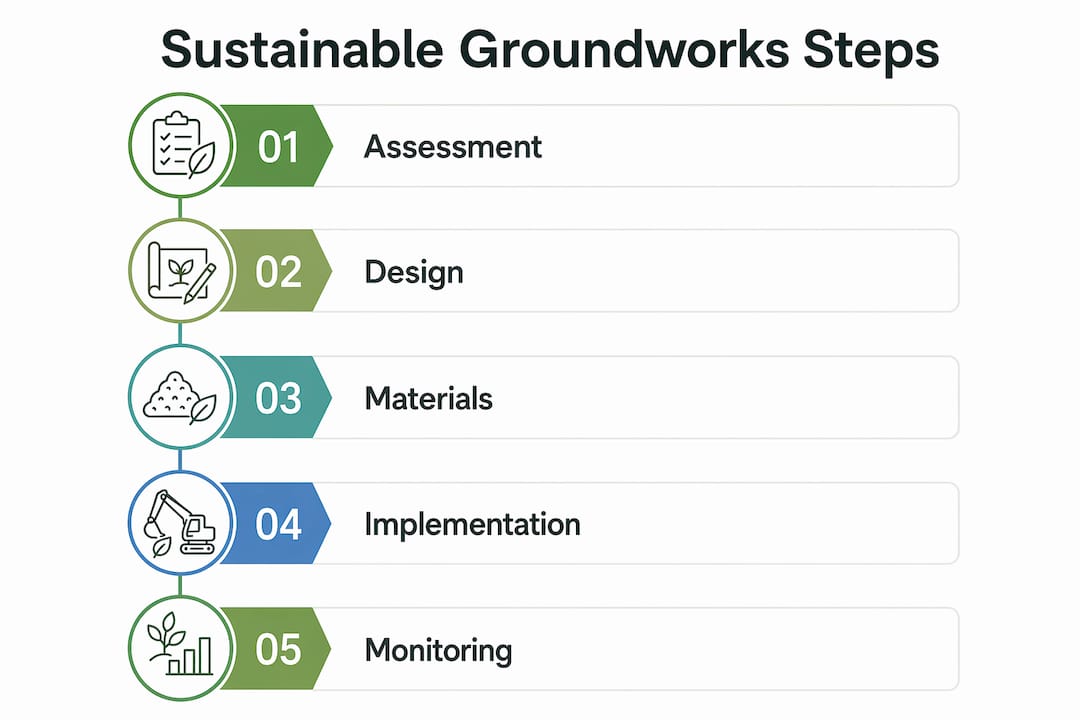
Conduct a climate risk screening at feasibility stage. Use CIRIA guidance and Environment Agency flood maps to identify site-specific risks before committing to a design approach. Review site preparation steps to confirm climate inputs are captured in the early project checklist.
-
Commission a thorough site investigation with climate-adjusted parameters. Standard borehole logs and laboratory testing must be supplemented with groundwater monitoring over multiple seasons. Shrink-swell potential assessments for clay soils are non-negotiable on sites with plasticity index above 20%.
-
Carry out percolation testing for infiltration drainage feasibility. UK guidance specifies percolation rates of 15 to 100 seconds per millimetre for infiltration systems, with engineered amendments required if rates fall below 15. Test in winter or early spring when groundwater is at its seasonal high.
-
Adjust construction sequencing for weather variability. Build extended weather contingency into programmes. Identify critical path activities that are weather-sensitive and develop mitigation plans, including covered working areas, temporary drainage, and subgrade protection measures.
-
Align material procurement with sustainability and resilience goals. Specify materials with verified performance under UK climate conditions. Prioritise suppliers with documented supply chain resilience to avoid delays caused by extreme weather events affecting logistics.
-
Embed a post-construction monitoring plan. Climate-resilient design does not end at practical completion. Drainage performance, settlement monitoring, and SuDS maintenance schedules should be agreed before handover.
Reviewing groundworks safety guidance alongside these steps confirms that climate-related site hazards, including waterlogged excavations and unstable slopes, require specific risk assessments that go beyond standard method statements.
What challenges remain in climate-adaptive groundworks?
The most significant gap in sustainable groundworks practice is the absence of large-scale field evidence for novel binders. Low-carbon binders do not guarantee low whole-life carbon unless verified for long-term durability under actual site conditions. Laboratory successes need field trials to confirm practical sustainability benefits, and those trials take years to produce meaningful data.
Uncertainties in long-term climate projections compound the challenge. Design assumptions based on current UKCP18 climate projections may require revision as updated scenarios are published. The CCC’s five-year review cycle means that a project designed today could face materially different climate assumptions by the time it reaches detailed design or construction.
Site permeability and groundwater variability add further complexity. Percolation testing conducted in summer may significantly overestimate infiltration capacity compared to winter conditions. Seasonal groundwater variation often leads to the need for engineered ground improvements to meet regulatory thresholds, adding cost and programme time that clients may not have anticipated.
Pro Tip: Set client expectations on climate contingency costs at project inception. Presenting quantified flood damage data, such as the Environment Agency’s £1.2 billion annual surface water flooding figure, reframes resilience spending as risk mitigation rather than a cost premium.
Key takeaways
Climate considerations in groundworks require early integration of flood risk, soil behaviour, and regulatory compliance into every stage of project design and delivery.
| Point | Details |
|---|---|
| Early climate risk screening | Identify flood zones and shrink-swell soils at feasibility stage to avoid costly redesign. |
| Regulatory compliance is mandatory | CIRIA 2026, CCC five-year reviews, and Schedule 3 SuDS approval are compliance requirements, not optional guidance. |
| Sustainable binders need validation | Novel low-carbon binders show promise but require site-specific durability testing before specification. |
| Percolation testing timing matters | Test in winter or early spring to capture worst-case groundwater conditions for drainage design. |
| Cross-disciplinary delivery is required | Climate resilience must span design, procurement, site operations, and post-construction monitoring. |
Why climate resilience in groundworks cannot be an afterthought
I have worked on projects where climate risk was treated as a planning checkbox rather than a genuine design input. The consequences are predictable: drainage systems sized on historical rainfall data that fail in the first wet winter, foundations in clay that show differential settlement within five years, and clients facing remediation costs that dwarf the original groundworks budget.
What has changed my approach is treating climate projections as a live design parameter rather than a fixed assumption. On a recent civil engineering project in the East Midlands, we revised the foundation specification mid-design when updated groundwater monitoring revealed seasonal fluctuations far greater than the initial site investigation suggested. That revision added cost at design stage. It avoided a far larger cost in remediation.
The multidisciplinary point from the Ground Engineering guidance resonates with my experience. Climate resilience breaks down when the geotechnical engineer, drainage designer, and site manager are working from different assumptions. A shared climate risk register, reviewed at each project stage, is the most practical tool I have found for keeping those assumptions aligned.
The honest challenge is that some clients still see climate contingency as a cost to be value-engineered out. The Environment Agency’s flood damage figures help. Framing a SuDS upgrade as insurance against a statistically likely flood event, rather than a sustainability aspiration, tends to land better in a commercial conversation.
— George
How Gcscontractors supports climate-resilient groundworks
Gcscontractors brings direct experience in climate-adaptive groundwork and civil engineering to projects across the UK. From compliant site preparation that integrates flood risk and drainage feasibility from day one, to foundation and drainage solutions aligned with CIRIA 2026 guidance and Environment Agency requirements, the team delivers groundworks built for long-term performance.

Whether you are managing a new development in a flood-sensitive zone or specifying ground improvement on a clay-rich site, Gcscontractors provides the technical expertise and regulatory knowledge to deliver compliant, resilient results. Contact the team at Gcscontractors to discuss your project requirements and how climate considerations can be embedded into your groundworks programme from the outset.
FAQ
What are climate considerations in groundworks?
Climate considerations in groundworks are the integration of projected climate change impacts, including flood risk, groundwater changes, and soil behaviour variability, into the design, planning, and execution of foundations, drainage, and earthworks. CIRIA’s 2026 guide provides the primary UK framework for this approach.
How does climate change affect soil conditions for construction?
Climate change accelerates shrink-swell cycles in clay soils, raises groundwater tables during wet periods, and causes deeper desiccation during droughts. These changes directly affect bearing capacity, foundation performance, and construction workability.
What regulations govern climate resilience in UK groundworks?
Key requirements include CIRIA’s 2026 climate risk guide, the UK Climate Change Committee’s five-year adaptation reviews, Environment Agency flood guidance, and Schedule 3 of the Flood and Water Management Act 2010, which mandates SuDS approval for most new developments in England.
Are sustainable binders ready for use in UK groundworks projects?
Sustainable binders such as MICP and biopolymers show strong laboratory results but currently lack large-scale field validation, particularly in organic soils. Site-specific durability testing is required before specification on live projects.
When should percolation testing be carried out for drainage design?
Percolation testing should be conducted in winter or early spring when groundwater is at its seasonal high. Testing in summer risks overestimating infiltration capacity, which can lead to undersized drainage systems that fail under wet-season conditions.