Working with live electrics: a safety guide for contractors
Where site supplies must stay live, proceed only under a documented safe system of work built on three pillars: planning, positive location of buried services, and safe digging practices. This is the framework HSG47 sets out, and it applies whether you’re stripping out a live commercial unit or excavating around a working substation feed.
The Electricity at Work Regulations 1989 create a statutory duty under Regulation 4(3) to prevent danger from electrical systems, with further precautions under Regulations 12 to 14 where live conductors cannot be avoided. HSE guidance in HSG47 and HSG141 sits underneath this legal duty and tells you how to meet it in practice.
Before any tool touches the ground:
- Stop and request full cable records and plans from the DNO and utility owners.
- Appoint a competent locator to survey the working area.
- Agree isolation, or a documented alternative safe method, with the service owner in writing.
One fine, £210,000: that’s what one contractor paid after a worker died from arcing burns following contact with an 11,000 V cable, according to a case study in HSG47. That figure alone should settle any debate about cutting corners on live-site groundworks, as it highlights the critical construction hazard examples every Singapore site must address.
Key Takeaways
Working with live electrics safely on a construction site depends on documented planning, positive service location, and safe digging carried out under a formal permit to work.
| Point | Details |
|---|---|
| Follow the three-pillar system | Plan the works, locate services positively, then dig safely, as set out in HSG47. |
| Isolate wherever practicable | Regulation 4(3) makes isolation the default; live work needs written, agreed alternative controls. |
| Never trust plans alone | Use locators repeatedly and confirm with trial holes before any excavation reaches the service. |
| Use permits and prove dead | Written permits, proved test instruments, and signed records are the backbone of a safe system. |
| Bring in a single accountable contractor | Gcscontractors manages live-site strip-out, groundworks, and temporary distribution under one contract. |
Table of Contents
- Planning live-site work: roles, information and timing
- How do you locate buried electrical services safely?
- What are the safe digging practices near live cables?
- Should you isolate the supply or work with it live?
- Temporary distribution and equipment for live sites
- Who is competent to work near live electrics?
- On-site checklist for site managers
- How Gcscontractors supports groundworks around live electrics
- Sources
Planning live-site work: roles, information and timing
Working with live electrics safely starts long before the first machine arrives. Responsibility is shared across the client, the principal designer (where appointed), the principal contractor, any electrical contractor, the DNO or network operator, and specialist contractors such as Gcscontractors carrying out the physical works.
Before pricing or programming the job, gather:
- Cable plans and as-built drawings from every service owner.
- Contact details for DNOs and utility owners, plus known isolation points.
- Records of past works, alterations, and any associated asbestos or structural hazards.
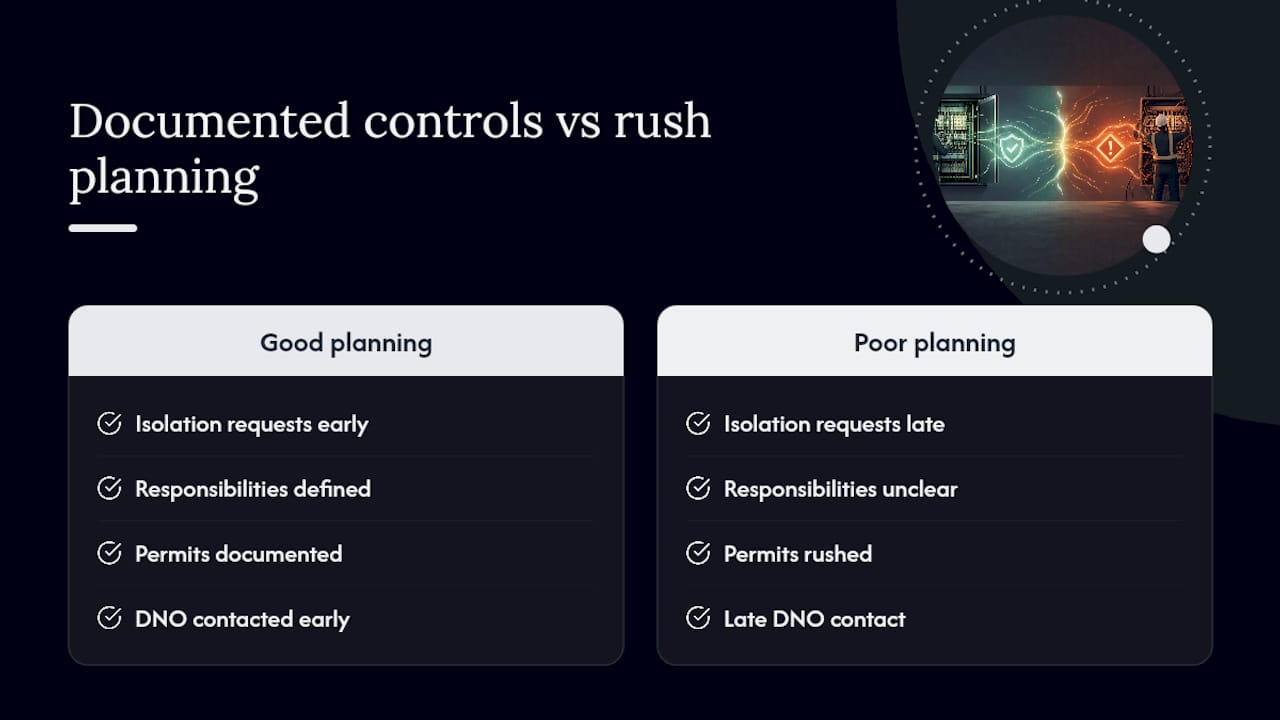
Timing matters more than most programmes allow for. DNOs often need considerable notice to arrange an isolation or temporary bypass, and requesting this late routinely derails procurement and site set up. Build isolation requests into the programme at tender stage, not after mobilisation.
- Record every decision on services and isolations in a written plan.
- Circulate that plan to all contractors through signed briefings and toolbox talks.
- Update it whenever new information (a trial hole, a DNO response) changes the picture.
Project teams who nail down electrical systems and isolation points during pre-construction routinely dodge the late-stage surprises that derail programmes and cause safety incidents.
How do you locate buried electrical services safely?
Treat every metre of ground as though a live cable runs through it until you’ve proven otherwise. HSE guidance is blunt on this point: underground services are widespread, and plans should be treated as indicative rather than definitive.
- Obtain plans from every DNO and service owner, but never rely on them alone. Cables move, get diverted, and get mislabelled.
- Use an electronic cable locator, operated by a trained person, and sweep the area repeatedly rather than once. HSE guidance is explicit that locators need to be used more than once and interpreted against the plans, not in isolation.
- Dig trial holes to positively locate any cable. A reading on a locator is a strong indication, not proof.
- Complete final exposure by horizontal hand digging alongside the service, never over it.
- Mark the confirmed route clearly, record exact depth and position, and update the site’s live services register so every trade working nearby can check before they dig.
Even a “positively located” cable deserves caution. Incidents frequently involve cables that weren’t reported, or that sat somewhere nobody expected, and extra care is still needed for adjacent or deeper runs once the first cable is exposed, per HSG47.
Pro Tip: Number your marker posts and keep a simple on-site register linking each post to a depth, a service type, and the date it was confirmed. Subcontractors arriving mid-project can then check locations in seconds instead of guessing.
What are the safe digging practices near live cables?
Once a service is marked, how you dig around it decides whether the day ends with a cup of tea or an ambulance call. Excavate alongside the service, never above it, and complete the final approach by hand rather than machine.
- Use insulated hand tools for any digging within the exclusion zone around a confirmed cable.
- Avoid powered hand tools near identified lines. In some situations they carry more risk than a plant strike, because there’s less warning before contact.
- Use vacuum excavation where the ground and access allow it. It removes soil without the penetration risk of a spade or breaker.
- Set a hard exclusion zone around any exposed cable and keep plant traffic away from it, using temporary bridging or ground beams to span the service if vehicles must cross nearby.
If a cable is struck: stop work immediately, isolate any plant involved, cordon the area, and keep everyone clear until the service owner or a competent person confirms it’s safe to approach. Don’t assume a cable is dead just because power appears to have tripped. Call the network operator before anyone goes near it.
The consequences of getting this wrong are severe and not theoretical. The HSG47 case study of the £210,000 fine involved arcing burns covering 60% of a worker’s body, a stark reminder that electrical arcing from a cable strike behaves nothing like a domestic shock.
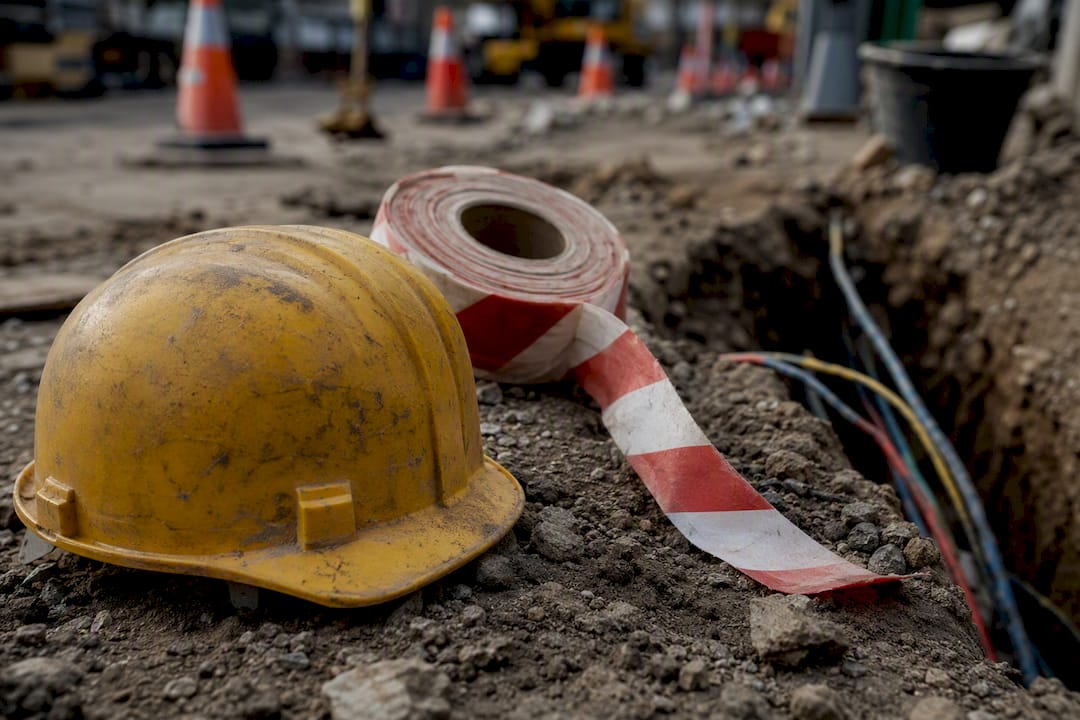
Pro Tip: Brief plant operators specifically on exclusion zones before they start, not as a general safety talk weeks earlier. A five-minute reminder at the excavation face costs nothing and catches the operator who’s forgotten where the marker posts are.
Should you isolate the supply or work with it live?
The decision isn’t really a choice between two equally valid options. Regulation 4(3) of the Electricity at Work Regulations makes prevention of danger the starting point, and HSE guidance is consistent that isolating or disconnecting a supply is the safest route wherever it’s reasonably practicable, as set out in HSG141.
- Assess whether isolation is feasible given the effect on other users of the supply, the project schedule, and whether an alternative route or temporary bypass exists.
- Contact the DNO or service owner early to establish notice periods. Isolation requests submitted at the last minute frequently push the whole programme back.
- Where isolation genuinely isn’t practicable, agree a written alternative safe method with the owner before any work starts. That agreement should define exclusion zones, tool restrictions, and who supervises the work.
Work with cables live should only happen if making them dead is unreasonable in the circumstances, and then only under agreed precautions with the cable owner involved from the outset.
That’s not a technicality to work around. It’s the test HSE expects you to have honestly applied before a single spade goes in the ground.
Temporary distribution and equipment for live sites
When building circuits sit close to your working area, running site power off a temporary distribution system is nearly always safer than tapping into existing building circuits, which weren’t designed with construction loads or plant in mind.
- Specify 110 V AC or battery-powered tools wherever practical. Reduced voltage doesn’t eliminate shock risk, but it significantly cuts the severity of an injury if contact occurs, a point HSG141 makes directly.
- Fit RCD protection throughout the temporary system, and have it tested before energising.
- Design and install temporary distribution to BS 7375 for site distribution and BS 7671 for the low-voltage installation itself, using a competent electrical contractor rather than a general labourer with a socket board.
- Confirm the earthing arrangement (TT or TN-S) with the DNO. Some networks specify which arrangement they require for a temporary connection, and getting this wrong undermines the whole protective system.
Pro Tip: Keep inspection and test certificates for the temporary distribution board in the same folder as your permits. Insurers and HSE inspectors both ask for them, usually at the least convenient moment.
Who is competent to work near live electrics?
Competence isn’t a badge, it’s a demonstrable combination of training, experience, and understanding of what can go wrong. A competent operative for locating and exposing services understands locator limitations, knows when a reading needs a trial hole to confirm it, and knows when to stop and call in a qualified electrical contractor or the DNO instead of pushing on.
- Confirm who on site holds the competence to locate, expose, and sign off services before work starts.
- Issue a written permit to work covering the identified hazards, the permitted activities, the controls in place, current isolation status, and the criteria for re-energisation.
- Prove circuits dead using a test instrument that’s itself been proved before and after use, with results recorded and signed off. HSG47 treats this as standard practice for hazardous excavation work.
- Re-check locations regularly during prolonged works, not just once at the start.
- Suspend digging and re-survey if ground conditions or scope change unexpectedly.
On-site checklist for site managers
A permit and a survey mean little if the checklist gets skipped on a busy Monday morning. Keep this close to the excavation face.
Before you start:
- Plans obtained from all service owners and DNOs.
- Competent locator booked and briefed.
- Permit to work issued and signed.
Before digging:
- Cable positively located via trial hole, not just locator reading.
- Route marked with numbered posts and logged in the register.
- Exclusion zones set, insulated tools issued, plant kept clear.
During works:
- Re-check locations at regular intervals, not just at the start.
- Require supervisor sign-off before any change of scope or excavation extent.
- Stop immediately on any unexpected obstruction, damage, or discoloured soil that could indicate a previous strike.
If a cable is struck: cordon the area, stop all plant, contact the service owner immediately, provide first aid if needed, and report the incident through your usual channels.
Why documented controls make live-site projects faster, not slower
Every delay I’ve seen on a live-site project traces back to the same root cause: isolation requests submitted too late, or responsibilities left unclear until something went wrong. Contractors who treat planning as paperwork to rush through are the ones who end up with a stalled programme, or worse, a Regulation 4(3) breach to explain. Gcscontractors has built its groundworks and strip-out practice around exactly this discipline, because clear permits and early DNO contact save weeks, not just accidents.
How Gcscontractors supports groundworks around live electrics
Gcscontractors is the practical alternative to juggling a full electrical shutdown against your project deadline. Where a full disconnection isn’t possible or would blow the programme apart, we run live-site strip-out, positive service location, and supervised excavation under a single accountable contract, so you’re not coordinating separate locating contractors, electricians, and groundworks teams yourself.

Our teams work permit-to-work systems as standard, install temporary distribution to BS 7375 and BS 7671 where a site needs it, and schedule isolation requests early enough that they don’t become the reason your programme slips. That experience with live-environment strip-out and groundworks around active services means one point of contact carries the risk assessment through from survey to sign-off, rather than passing it between subcontractors. If your next project needs excavation, strip-out, or demolition carried out without a full shutdown, get in touch for a site survey and we’ll map out the safe system of work before a single spade goes near the ground.
Sources
- Avoiding danger from underground services (HSG47)
Keep these in the project file and reference them directly when requesting isolations or drafting permits.
This article is general information, not a substitute for advice from a qualified lawyer. Consult a qualified legal professional about your own circumstances before acting on anything here.