Working in live environments: the contractor’s practical guide
Construction can proceed safely inside live, operational buildings — provided the project team treats operational continuity as a design constraint from day one, not an afterthought. The first actions that determine whether a live-environment project succeeds or fails happen before a single operative sets foot on site.
Your initial days of mobilisation should cover:
- Map all critical services (electrical distribution, medical gases, data infrastructure, fire suppression) and agree isolation protocols with the client’s facilities manager before any enabling works begin.
- Appoint a CDM advisor or dedicated site liaison whose primary responsibility is occupant protection and operational continuity, not just programme delivery.
- Agree a phased handback programme in writing with the client, including daily and nightly reinstatement obligations and clear acceptance criteria for each phase.
- Confirm emergency escalation contacts on both sides: who calls whom, and within what timeframe, if an incident affects building operations.
- Carry out a pre-start survey with photographic record of all existing finishes, services and access routes.
Pro Tip: Start with a high-visibility, low-risk “proof-of-approach” phase. Completing a contained, well-communicated early task on time and with zero operational impact builds stakeholder confidence faster than any programme document, and gives the team a tested template for the phases that follow.
Early collaboration, rigorous phasing and proactive stakeholder communication are the key factors preventing critical service interruptions on live projects.
Table of Contents
- Which sectors most often require live-environment working?
- Key risks and UK regulatory duties you must meet
- How to build a programme that keeps the facility operational
- Stakeholder engagement: who to involve and when
- Site protection, containment and environmental controls
- Managing deliveries, lifts and constrained access on busy sites
- On-site safety systems specific to live environments
- Handover, validation and aftercare to restore spaces to operation
- How Gcscontractors delivers live-environment work
- Detailed methods for noise and dust control in occupied buildings
- How to monitor live building systems during construction
- Best practice case studies and lessons learned from live projects
- Key takeaways
- What live-environment projects have taught us
- Gcscontractors: live-environment packages for Cambridge and East Anglia
- Useful sources and further reading
Which sectors most often require live-environment working?
Working in dynamic settings is not confined to one industry. The sectors below each impose distinct constraints that should shape your programme from the outset.
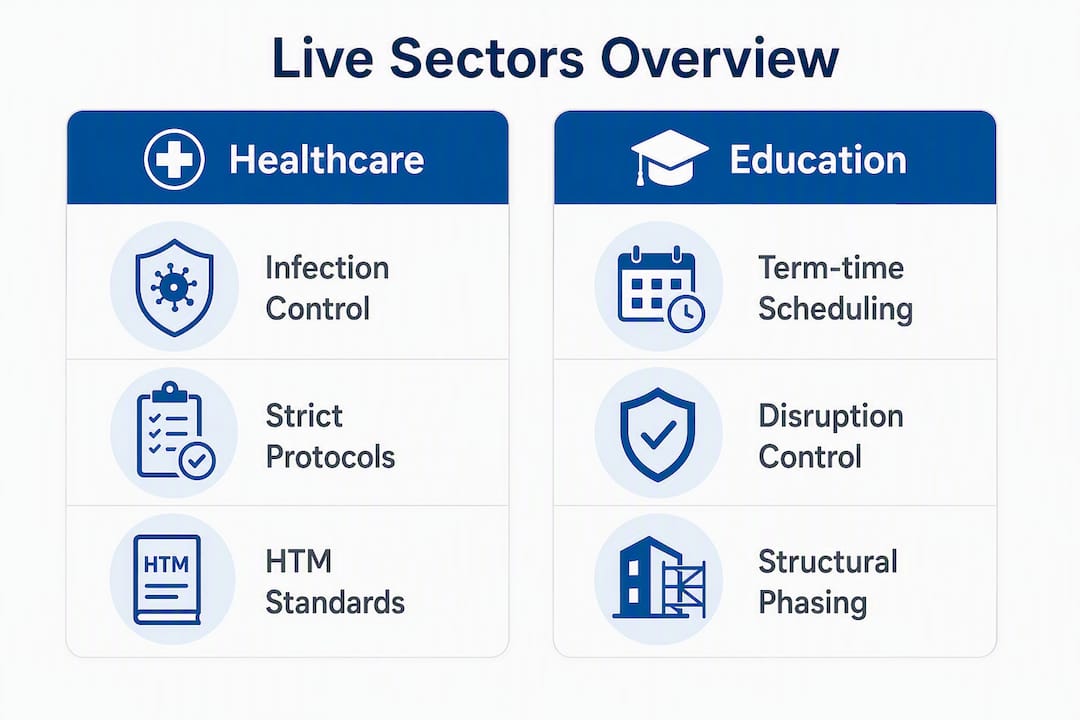
Healthcare is the most demanding. Infection control under NHS Health Technical Memoranda (HTM 01-06, HTM 03-01) and Health Building Notes (HBN) governs everything from hoarding specification to air-pressure differentials. Critical services — medical gases, nurse-call systems, emergency power — cannot be interrupted without a validated isolation and reinstatement procedure agreed with the estates team. Night shifts are common, but even out-of-hours work must respect ward handover periods.
Education projects are largely governed by term-time sequencing. The most disruptive phases (structural alterations, mechanical plant replacement) are scheduled during summer or half-term breaks, while lower-impact enabling works proceed during term time under strict safeguarding controls. Access routes must remain separate from pupil circulation at all times, and DBS-checked operatives are typically required on any site where pupils are present.
Commercial offices introduce business-continuity and data-security considerations. Tenants may be running 24/7 operations; server rooms and comms rooms require specific isolation procedures and often a witnessed, documented handback before re-energisation. Working hours are frequently restricted to evenings and weekends to protect productivity.
Residential and mixed-use sites present access and welfare challenges. Residents need continuous access to their homes, which means temporary access routes, protected stairwells and agreed quiet periods. Where temporary decanting is unavoidable, the programme must account for the time and cost of rehousing arrangements.
Transport hubs and retail share a common priority: passenger or customer safety. Handback schedules are tied to operational timetables, and any overrun carries contractual and reputational consequences. Temporary wayfinding, barrier management and public-facing communications are as important as the construction programme itself.
Quick-reference controls by sector:
- Healthcare: negative-pressure enclosures, HTM-compliant hoarding, validated service isolations, infection-control audits
- Education: term-time phasing, DBS checks, safeguarding-compliant access routes, noise curfews during exams
- Offices: out-of-hours working, data-room protocols, tenant communication plans, dust-free reinstatement
- Residential: continuous resident access, welfare provisions, agreed quiet hours, decant planning where required
- Transport/retail: passenger safety barriers, operational timetable alignment, public-facing signage, rapid reinstatement
Key risks and UK regulatory duties you must meet
The challenges of live environments fall into four operational categories: safety, contamination, service continuity, and reputational or contractual exposure. Understanding which risks are legally mandated and which are best practice determines where your budget and management attention go first.
Primary risks grouped by impact:
- Safety: shared circulation between operatives and building users; plant movements near pedestrians; overhead work above occupied areas; fire-route obstruction
- Contamination: dust migration into clinical or food-preparation areas; asbestos disturbance during strip-out; water ingress from wet works
- Service continuity: unplanned interruption to power, data, heating or medical gases; fire-alarm false activations; lift outages affecting mobility-impaired users
- Reputational and contractual: noise complaints triggering local authority enforcement; programme overruns affecting tenant leases; failure to meet sector-specific standards
Regulatory duties you must act on:
Under the Construction (Design and Management) Regulations 2015 (CDM 2015), the principal contractor must prepare and maintain a Construction Phase Plan that specifically addresses the risks posed by the live environment. The Health and Safety Executive’s guidance on construction site safety requires clear separation of plant operations from pedestrian routes and documented traffic management arrangements. In healthcare settings, NHS HTM and HBN standards carry quasi-regulatory weight and are routinely written into contract specifications.
Local authority noise restrictions under the Environmental Protection Act 1990 and the Control of Pollution Act 1974 set permitted working hours; breaching them risks enforcement notices that can halt the programme entirely. Planning conditions may impose additional restrictions specific to the site.
Pro Tip: Obtain a copy of any planning conditions and the client’s own operational risk register before writing your Construction Phase Plan. Conditions that restrict working hours or require acoustic monitoring are far easier to programme in advance than to manage reactively.
Credentials matter to clients. SSIP-assessed schemes such as CHAS, Constructionline Gold, and ISO 45001 certification are the baseline clients in healthcare, education and public-sector work expect to see before appointment. They signal that your safety management system has been independently verified, not self-declared.
For demolition and strip-out compliance specifics, Gcscontractors’ demolition compliance guide sets out the practical checklist in detail.
How to build a programme that keeps the facility operational
Successful live-environment projects are built around the client’s day-to-day operations rather than a standard construction timeline. The programme must define critical-service windows, agree daily and nightly handback routines, and gate each phase on verified acceptance criteria.
Phase sequencing template:
| Phase | Typical duration | Disruption profile | Acceptance test | Required sign-off |
|---|---|---|---|---|
| Early works / survey | 1–2 weeks | Minimal — survey and mapping only | Services confirmed, survey complete | Client FM + CDM advisor |
| Proof-of-approach | 1–3 weeks | Low — contained, high-visibility task | Zero operational impact confirmed | Client representative |
| Low-impact enabling | 2–6 weeks | Low to medium — hoardings, access routes, service diversions | Containment verified, access routes agreed | Principal contractor + FM |
| High-impact / night-shift works | Variable | High — structural, mechanical or demolition activities | Systems reinstated and tested before occupation | Client FM + specialist commissioning |
| Progressive handbacks | Rolling | Reducing — spaces returned incrementally | Pre-occupancy check, user acceptance test | Client, FM, and end-user representative |
Numbered steps for gating each phase:
- Issue a phase-start safety brief to all operatives and confirm receipt in writing.
- Verify containment is in place and signed off by the CDM advisor before any intrusive work begins.
- Confirm the client communications update has been issued to all affected users.
- Complete systems isolation under a controlled works permit, witnessed by the client’s FM team.
- Carry out test and verification of all reinstated services before the phase closes.
- Obtain written sign-off from the client representative before moving to the next phase.
Checklist for each phase gate:
- Safety brief issued and acknowledged
- Containment inspected and approved
- Client communication sent
- Controlled works permit in place
- Systems isolation documented
- Reinstatement tested and verified
- Written client sign-off obtained
Pro Tip: For the most invasive activities — structural penetrations, service diversions, asbestos removals — run a short trial on a non-critical area first. Incremental experiments validate your mitigation approach before you commit to the full scope, and the evidence from that trial is far more persuasive to a sceptical client than a method statement alone.
The Gcscontractors site setup checklist provides a practical mobilisation template that can be adapted directly to live-environment phase gating.
Stakeholder engagement: who to involve and when
Communication is the thread that holds a live-environment project together. Regular coordination meetings, clear phasing diagrams and contingency plans are consistently cited as critical success factors — not because they are procedurally required, but because they prevent the operational surprises that derail programmes.
Stakeholder map:
- Client senior team: programme approval, budget sign-off, escalation authority
- Facilities managers: day-to-day operational interface, service isolation sign-off, access control
- End users (patients, students, staff, residents): advance notice of disruption, feedback channel, acceptance sign-off
- Emergency services: pre-notification of works affecting fire routes or access; updated site plans
- Local authority officers: planning condition compliance, noise monitoring, public-realm works
- Supply-chain partners: delivery time-slotting, method statement alignment, permit-to-work coordination
Channels and cadences that work:
- Daily pre-start briefing (10 minutes, on-site): operative safety brief and operational update
- Weekly written update to client FM and senior team: programme status, upcoming high-impact activities, any deviations
- Targeted user communications 48–72 hours before any activity that affects their area: what is happening, when, and who to contact
- Escalation route for urgent incidents: named contacts on both sides, agreed response time (typically 30 minutes for anything affecting critical services)
- Scheduled public notices for external works affecting pedestrian routes or parking
Pro Tip: Identify an operational champion within the client team — a ward sister, a school business manager, a building supervisor — who understands both the construction programme and the day-to-day operational pressures. That person shortens decision loops dramatically. A question that might take three days to resolve through formal channels often takes three minutes when there is a trusted internal advocate who can give a practical answer on the spot.
Site protection, containment and environmental controls
Containment is the physical expression of your operational continuity commitment. Getting it right from day one prevents the dust, noise and access complaints that consume management time and damage client relationships.
Containment options by risk level:
- Standard hoarding: 2.4m plywood or proprietary hoarding systems for general separation; suitable for low-contamination-risk works in offices and education
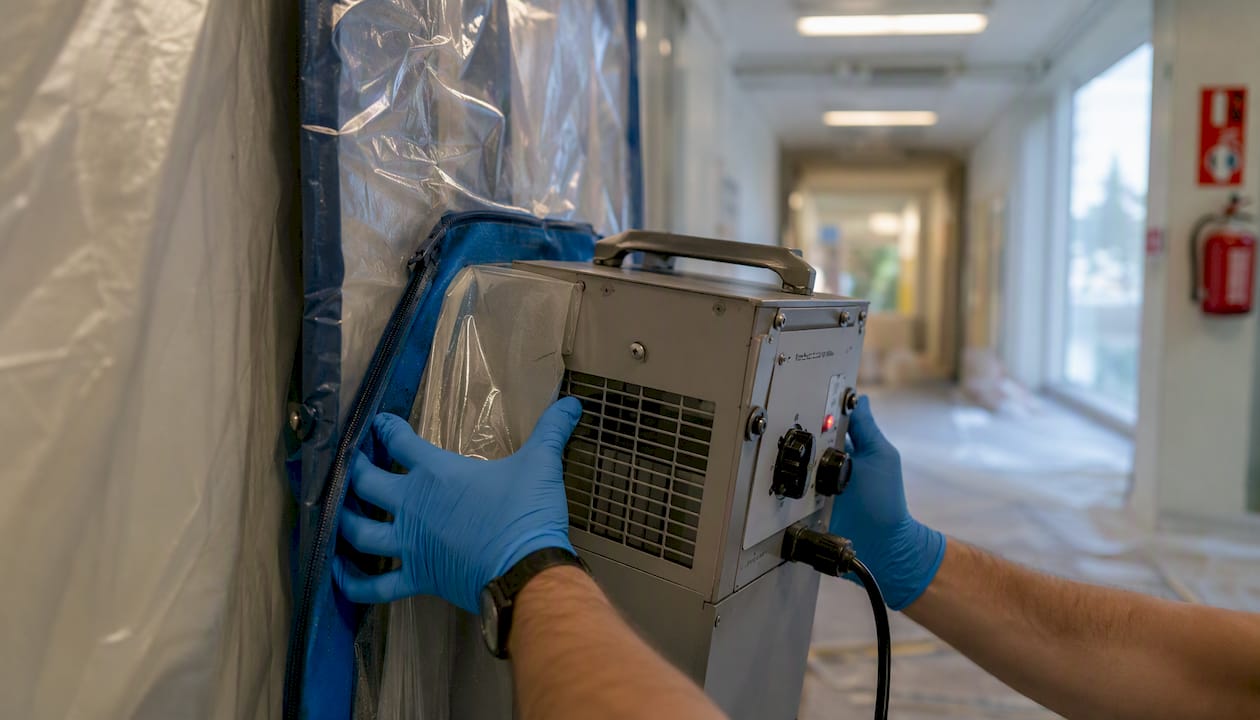
- Negative-pressure enclosures: required for any works generating dust in clinical areas or where asbestos is present; maintained at a pressure differential of at least 5 Pa below the adjacent occupied space
- Controlled access zones: colour-coded access passes, swipe-card or key-fob entry, and a visitor log for all personnel entering the construction zone
- Sealed segregation for wet works: waterproof membranes, temporary drainage and bunded containment for demolition involving wet services
Dust and air-quality controls:
HEPA-filtered extraction units (H14 class for clinical environments) should be positioned at source, not just at the boundary. Validated cleaning regimes — damp-wiping rather than dry sweeping — prevent secondary dust migration. Coordinate with the building’s HVAC team to confirm that supply-air intakes are not drawing from the construction zone; temporary blanking of grilles adjacent to works is standard practice in healthcare.
Noise mitigation:
Schedule all high-noise activities (breaking out, core drilling, mechanical demolition) during agreed off-peak windows, confirmed in writing with the client. Acoustic screening panels around fixed plant and temporary acoustic enclosures for adjacent sensitive spaces reduce transmitted noise significantly. Equipment selection matters: hydraulic rather than pneumatic breakers, and battery-powered tools where practicable, reduce both noise and vibration at source.
Pro Tip: Keep a simple daily environmental log: noise readings at the boundary, dust-monitoring results and any complaints received. It takes five minutes a day and provides the documentary evidence you need if a local authority or client raises a concern.
Managing deliveries, lifts and constrained access on busy sites
Logistics on a live site are not just a construction problem — they are an operational one. Every delivery vehicle, crane lift and materials movement is a potential disruption to the people using the building.
Delivery management:
- Time-slot all deliveries to agreed windows that avoid peak operational periods (school drop-off, clinical handover, rush-hour pedestrian flow).
- Use an off-site holding yard or consolidation centre where site storage is severely constrained; this is common on hospital and city-centre office projects.
- Brief all drivers on site rules, access routes and emergency procedures before their first delivery; a signed driver briefing sheet is the minimum record.
- Prohibit unannounced deliveries; any supplier who cannot comply should be replaced.
Plant and lifting operations:
Plan all crane lifts to agreed handback times, with a rehearsal lift (where practicable) before the critical lift. Interface with site operations to confirm that the lift zone is clear of building users for the duration. For tight-access sites, Gcscontractors’ restricted-access piling solutions demonstrate how foundation work can be delivered in constrained, occupied environments.
Materials storage and waste removal:
- Apply just-in-time sequencing: materials arrive for the phase in progress, not three phases ahead.
- Protect storage areas in circulation routes with proprietary barriers and anti-trip matting.
- Schedule waste collections during low-occupancy periods; skips and waste containers must not obstruct fire exits or emergency vehicle access at any time.
Logistics contingency checklist:
- Nominated logistics coordinator on site during all delivery windows
- Alternative access route identified and agreed in advance
- Emergency contact for building operations manager
- Protocol for a failed or delayed delivery that affects the programme
On-site safety systems specific to live environments
Safety governance on a live site requires a more structured approach than a cleared construction site. The presence of building users — some of them vulnerable — changes the risk profile of almost every activity.
Safety governance structure:
- Appoint a dedicated CDM advisor or site liaison whose primary role is occupant protection and operational continuity. This person attends daily pre-start briefings, reviews all method statements for occupant impact, and has authority to stop work if a safety concern arises.
- Issue controlled works permits for all intrusive tasks: service isolations, structural penetrations, hot works, and any activity in a confined space.
- Conduct daily pre-start briefings covering the day’s activities, any changes to the operational environment, and the emergency escalation procedure.
Safeguarding vulnerable occupants:
- Establish and enforce exclusion zones with physical barriers, not just signage.
- Implement a traffic management plan that separates plant movements from all pedestrian routes, including temporary routes created by the works.
- Verify the competency of all operatives for the specific tasks they are performing; a generic CSCS card is not sufficient for specialist activities such as asbestos removal or work on live electrical systems.
- Carry out enhanced DBS checks for any operative working in a school, children’s hospital or similar setting.
Incident response and escalation:
- Immediate handback procedure: if an incident affects building operations, the site liaison contacts the client FM within 15 minutes, work stops in the affected zone, and a written incident report is submitted within 24 hours.
- Stand-by protocols: for planned high-risk activities, agree a stand-by arrangement with the client’s emergency team before work starts.
- Post-incident review: every incident that affects building operations triggers a brief lessons-learned review before work resumes.
Pro Tip: Display your SSIP, CHAS and ISO credentials at the site entrance and in your pre-construction information pack. Clients in healthcare and education procurement are required to verify these; having them visible from day one removes a friction point and signals that your safety culture is embedded, not performed.
For groundworks-specific safety controls, the Gcscontractors groundworks safety guide covers the controls relevant to constrained and occupied sites.

Handover, validation and aftercare to restore spaces to operation
A live-environment project is not complete when construction finishes. The space must be verified, documented and handed back in a condition that allows immediate, safe occupation.
Handover pack contents:
- As-built drawings reflecting any changes made during construction
- Test certificates for all reinstated or new mechanical, electrical and plumbing systems
- Cleaning and decontamination records, including air-quality test results where required
- Operation and maintenance manuals for all new plant and equipment
- Photographic record of the completed works and any agreed snagging items
Practical validation steps:
- Pre-occupancy check: a joint walkthrough with the client FM and end-user representative to confirm the space is clean, safe and fit for purpose
- Systems commissioning: witnessed testing of all reinstated services, with results recorded and signed off by the client’s appointed engineer
- User acceptance test: the end user confirms the space meets the agreed specification before the contractor’s liability for that phase reduces
Aftercare and defects management:
A short-term support window of 4–12 weeks post-handback, with a named contact and a guaranteed response time for critical systems, is standard on live-environment projects. Schedule a post-handover review at four weeks to capture any operational issues before the defects period closes.
How Gcscontractors delivers live-environment work
Gcscontractors operates across Cambridge and East Anglia, delivering strip-out, demolition, groundworks, drainage and enabling works packages on projects where the building remains in use throughout. The delivery model is built around three principles: plan around the client’s operations, phase to protect critical services, and communicate proactively at every stage.
Client-facing deliverables on live projects:
- Phasing diagrams showing operational impact, handback dates and acceptance criteria for each phase
- Site setup and mobilisation checklists adapted to the specific operational constraints of the project
- CDM liaison and Construction Phase Plan preparation, including occupant-protection measures
- Aftercare agreements with defined response times for critical systems in the defects period
- Pre-start and post-completion photographic surveys
Gcscontractors’ live-site demolition guide sets out the sequencing and temporary-works approach used on occupied projects, and the temporary support in demolition guide covers the structural safety controls applied when working in occupied buildings.
Pro Tip: Ask your contractor for a phasing diagram before appointment, not after. A contractor who cannot produce one at tender stage is unlikely to manage operational continuity effectively once on site.
Detailed methods for noise and dust control in occupied buildings
Noise and dust are the two most common causes of operational complaints on live projects, and both are controllable with the right methods applied consistently.
Noise control methods:
Scheduling is the most effective control. Agree permitted working hours in writing with the client and the local authority before mobilisation; for healthcare and education, these windows are often narrower than standard Environmental Protection Act limits. Within those windows, sequence the noisiest tasks (core drilling, breaking out, mechanical demolition) to the periods of lowest occupancy — early morning in offices, weekend nights in hospitals.
Equipment selection reduces noise at source. Hydraulic breakers produce significantly lower peak noise levels than pneumatic equivalents. Battery-powered tools eliminate compressor noise entirely and are now capable enough for most light demolition and fixing tasks. Where fixed plant (generators, compressors) must run continuously, acoustic enclosures reduce radiated noise by 10–15 dB.
Acoustic screening panels, positioned between the noise source and the sensitive receiver, are effective for external works. For internal works, temporary acoustic partitions in adjacent corridors or rooms protect occupants during high-noise phases.
Dust control methods:
Source suppression is always preferable to boundary control. Wet-cutting rather than dry-cutting for masonry and concrete reduces airborne dust by a substantial margin. Local exhaust ventilation (LEV) with HEPA filtration captures dust at the point of generation; units should be positioned within 500mm of the cutting or breaking activity.
In clinical environments, validated cleaning regimes must be documented. Damp-wiping of all surfaces within the containment zone before each handback, combined with air-quality monitoring using particle counters, provides the evidence base clients and infection-control teams require. Coordinate with the building’s HVAC team to confirm that construction dust cannot enter the supply-air system; temporary blanking of adjacent grilles is standard practice.
How to monitor live building systems during construction
Monitoring live building systems during construction prevents the unplanned service interruptions that cause the most serious operational disruption.
Monitoring techniques and technologies:
Building Management System (BMS) integration is the most effective approach on larger projects. Request read-only access to the client’s BMS so the site team can monitor HVAC performance, temperature, humidity and alarm status in real time. Any deviation from normal parameters during construction activities is immediately visible, allowing the team to respond before an occupant notices.
Temporary sub-metering on electrical distribution boards adjacent to the works allows the site team to detect unexpected load changes that might indicate a service has been inadvertently affected. Clip-on current transformers can be installed without interrupting supply and removed at handback.
Vibration monitoring is required on any project involving piling, heavy breaking or mechanical demolition near sensitive equipment or structures. Continuous vibration loggers with alert thresholds set below the limits specified in BS 7385 and BS 5228 provide a real-time record and trigger an automatic alert if thresholds are approached.
Air-quality monitoring using calibrated particle counters (measuring PM2.5 and PM10) at the containment boundary gives a continuous record of dust levels. In healthcare settings, results should be logged and shared with the infection-control team at agreed intervals.
Fire-alarm interface: agree a protocol with the client’s fire-alarm maintenance contractor before any hot works or dust-generating activities begin. Temporary isolation of detectors in the immediate work zone, with a compensatory watch arrangement, prevents false activations that disrupt the entire building.
Best practice case studies and lessons learned from live projects
The most instructive lessons from live-environment projects are rarely about technical failures. They are almost always about communication gaps, phasing assumptions that did not hold, or risk controls that worked on paper but were not maintained consistently on site.
Lesson 1: Start small and prove the approach
On projects where the most invasive phase (a structural alteration or a major service diversion) is preceded by a contained, well-documented proof-of-approach phase, the subsequent phases run more smoothly. Picking easy, high-visibility problems first creates quick wins, builds trust and produces the learning cycles needed to scale up riskier phases safely. The evidence from that early phase — noise readings, dust logs, handback times — becomes the basis for client confidence in the larger works.
Lesson 2: Decentralise decision-making on site
On complex live projects, the speed of decision-making is as important as the quality of the decision. Decentralised decision rights and quick feedback loops increase resilience and delivery speed in volatile or constrained settings. Empowering the site liaison to make operational decisions — adjusting a delivery window, pausing a noisy activity, rerouting a pedestrian flow — without waiting for approval from a remote project manager prevents the small delays that compound into programme overruns.
Lesson 3: Logistics assumptions are the most common source of overruns
Constrained access sites consistently expose the gap between the planned logistics model and site reality. Delivery time-slotting and off-site consolidation are effective mitigations, but they require buy-in from every subcontractor and supplier from the outset. A single unannounced delivery that blocks an emergency vehicle route can trigger a formal incident, a programme pause, and a client complaint — all from one avoidable event.
Lesson 4: Handback quality determines client satisfaction
The final impression a client takes from a live-environment project is almost always formed at handback. A space returned clean, fully commissioned and with a complete documentation pack — on the agreed date — is remembered positively regardless of the difficulties encountered during construction. A space returned late, with outstanding snagging and incomplete test certificates, is remembered negatively regardless of how well the construction phase was managed.
Key takeaways
Working in live environments demands that operational continuity is treated as a design constraint from the first day of planning, not a risk to be managed reactively once work begins.
| Point | Details |
|---|---|
| Plan around operations, not the programme | Map critical services, agree handback routines and phase around the client’s operational calendar before mobilisation. |
| Gate every phase on verified acceptance | Written sign-off from the client FM and CDM advisor is required before any phase progresses; no exceptions. |
| Communication prevents critical interruptions | Daily briefings, 48-hour user notices and named escalation contacts on both sides stop operational surprises before they become incidents. |
| Start small to de-risk large phases | A proof-of-approach phase produces evidence that builds client confidence and validates mitigation before the most invasive works begin. |
| Gcscontractors delivers phased live-environment packages | Strip-out, groundworks and enabling works in Cambridge and East Anglia, with phasing diagrams, CDM liaison and aftercare agreements included. |
What live-environment projects have taught us
The conventional wisdom in construction is that a tight programme and a detailed method statement are the foundations of a successful live-environment project. They are necessary, but they are not sufficient. The projects that go well are the ones where the site team genuinely understands that they are guests in a functioning facility — and behaves accordingly.
The most common mistake is treating the proof-of-approach phase as a formality. Teams that rush through it to get to the “real” work miss the point. That early phase is where you discover that the agreed delivery window clashes with a clinical handover, or that the hoarding specification does not meet the infection-control team’s requirements, or that the local authority noise restriction is two hours shorter than the programme assumed. Finding those things out in week two, on a low-risk task, is manageable. Finding them out in week eight, during a structural alteration, is not.
The other underestimated factor is the operational champion inside the client team. No amount of formal communication replaces the value of a trusted internal contact who can give a practical answer quickly, translate construction language into operational terms, and flag a concern before it becomes a complaint. Identifying that person at the start of a project, and investing time in that relationship, consistently produces better outcomes than any formal governance structure alone.
Gcscontractors: live-environment packages for Cambridge and East Anglia
Gcscontractors offers contractors and developers a direct route to specialist live-environment delivery across Cambridge and East Anglia. Where other approaches require multiple subcontractors to coordinate strip-out, groundworks and enabling works separately, Gcscontractors packages those scopes under a single point of responsibility, with phasing diagrams, CDM liaison, and aftercare agreements built in from the start.

The practical difference for clients is fewer handover gaps between trades, a single escalation contact for operational concerns, and a contractor whose strip-out and site preparation methodology is designed around occupied buildings. For projects in Cambridge and the surrounding area, the site setup and enabling works service covers the full mobilisation scope, from temporary works and hoardings through to phased groundworks and drainage.
To get started, request a phased programme review or download the live-environment site setup checklist directly from the Gcscontractors website. Contact the team to discuss your project’s operational constraints and agree a scope that protects the facility from day one.
Useful sources and further reading
The sources below are the primary references for planning, compliance and sector-specific guidance on live-environment construction in the UK.
For early planning and regulatory compliance:
- HSE Construction (Design and Management) Regulations 2015 guidance: the primary source for CDM duties, Construction Phase Plan requirements and principal contractor obligations
- Go Construct: construction sites overview: accessible guidance on traffic management, site safety and segregation controls
- NHS Health Technical Memoranda (HTM) and Health Building Notes (HBN): sector-specific standards for infection control, ventilation and critical services in healthcare settings; available via NHS England’s estates and facilities portal
For stakeholder engagement and programme management:
- Iconic Project Management: managing construction in live environments: practitioner perspective on phasing, communication and operational continuity
- Spring & Co: challenges of live-environment construction: practical analysis of communication and collaboration as success factors
For logistics and subcontractor coordination:
- Subascent: resolving subcontractor scheduling conflicts: proven steps for delivery time-slotting and logistics coordination on constrained sites
Gcscontractors practical resources:
- Live-site demolition process guide: sequencing and temporary-works approach for occupied projects
- Site setup checklist: mobilisation template adaptable to live-environment phase gating
- Groundworks safety tips: safety controls for constrained and occupied sites
- Demolition compliance guide: practical checklist for regulatory compliance during strip-out and demolition
Pro Tip: Consult the HSE CDM guidance and your sector’s HTM/HBN standards at the earliest planning stage, before the Construction Phase Plan is drafted. Retrofitting compliance into a programme that has already been agreed with the client is significantly more difficult than building it in from the start.