Surface water management: a practical guide for UK professionals
Surface water management is the systematic process of assessing, planning, and controlling runoff from rainfall to reduce flood risk, protect water quality, and build long-term resilience. In the UK, it is delivered primarily through Surface Water Management Plans (SWMPs) and Sustainable Drainage Systems (SuDS), working together as a strategic and physical toolkit. If you are commissioning or updating a scheme, the first three steps are clear:
- Commission a local flood risk mapping exercise using Environment Agency flood maps and your Local Lead Flood Authority’s (LLFA) existing SWMP data within the first four weeks.
- Engage your LLFA and relevant water company (such as Anglian Water or Thames Water) early to confirm adoption routes and statutory consultee requirements.
- Appoint a maintenance lead and agree ownership of long-term management before detailed design begins, not after.
Getting these three things right before a spade enters the ground prevents the majority of delays and mid-life failures seen on UK drainage schemes.
Key takeaways
Effective surface water management in the UK depends on early governance decisions, proportionate assessment, and maintenance planning that begins at the design stage, not after handover.
| Point | Details |
|---|---|
| Start with risk mapping | Commission Environment Agency flood maps and LLFA SWMP data before any design work begins. |
| Engage LLFA and water company early | Pre-application engagement reduces approval timescales and surfaces adoption constraints before they affect design. |
| Design for maintainability | Accessible silt traps, simple vegetation regimes, and clear asset registers prevent mid-life failures. |
| Secure funding early | Developer contributions, FCERM Grant in Aid, and water company partnership funding all require early application. |
| Gcscontractors for delivery | Gcscontractors delivers groundworks, SuDS installation, and drainage works across Cambridge and East Anglia under a single contract. |
Table of Contents
- What Surface Water Management Plans are and why they matter in the UK
- What SuDS are, how they work, and the co-benefits they deliver
- How to assess surface water flood risk for a site or area
- Planning, governance, and standards: who does what and which guidance to follow
- Practical design and delivery steps for an on-site scheme
- Costs, surface water drainage charges, and funding routes
- Maintenance, monitoring, and long-term management
- Practical on-site implementation checklist for contractors and developers
- Why most surface water schemes fail, and how to avoid it
- Gcscontractors delivers drainage and groundworks across Cambridge and East Anglia
- Sources
What Surface Water Management Plans are and why they matter in the UK
A Surface Water Management Plan is a risk-based strategic document that assesses the probability of surface water flooding, identifies the range of management options available, and provides the evidence base that local authorities, water companies, and planners need to make investment and consenting decisions. As the Local Government Association confirms, SWMPs are non-statutory but function as a vital evidence base for local flood risk management strategies and planning consent.
SWMPs were developed under Defra’s framework following the Flood and Water Management Act 2010, which established LLFAs as the lead body for local flood risk. They sit directly beneath the National Planning Policy Framework (NPPF), which requires that development does not increase flood risk and that SuDS are incorporated where practicable. In practice, an SWMP gives a planning authority the technical evidence to apply those NPPF requirements consistently across a catchment.
The gov.scot SWMP guidance makes the point plainly: enlarging sewer infrastructure alone is not a sustainable long-term approach. Integrated drainage planning, anchored in an SWMP, is the recognised best practice for identifying measures that work across short and long timescales.
Who uses SWMPs and how
| Organisation | Primary role in surface water management |
|---|---|
| Local Lead Flood Authority (LLFA) | Leads SWMP production, coordinates partners, holds local flood risk strategy |
| Water company (e.g. Anglian Water, Thames Water) | Manages public sewers, provides sewer capacity data, statutory consultee on drainage |
| Highway authority | Responsible for highway drainage; coordinates on road runoff and gully maintenance |
| Planning authority | Uses SWMP evidence to determine planning applications and apply NPPF drainage policy |
SWMPs are most powerful when treated as strategic alignment documents rather than compliance checklists. They identify Critical Drainage Areas (CDAs), map preferred management strategies, and provide the coordination mechanism that allows LLFAs, water companies, and highway authorities to pool investment rather than act in isolation.
What SuDS are, how they work, and the co-benefits they deliver
Sustainable Drainage Systems manage rainfall by slowing, storing, treating, and infiltrating water as close to where it falls as possible. Anglian Water’s guidance describes the approach as managing water where it falls using techniques including swales, basins, ponds, water butts, and rain gardens. The CIRIA SuDS Manual (C753) remains the principal technical standard for design, treatment trains, and maintenance expectations across England and Wales.
The common SuDS types, and where each sits in a scheme, are:
- Swales: shallow vegetated channels that convey and filter runoff; typically the first element in a treatment train.
- Infiltration trenches and soakaways: subsurface features that allow water to percolate into the ground; suitable where ground conditions permit.
- Permeable paving: allows rainfall to pass through the surface into a sub-base reservoir; used in car parks, driveways, and lightly trafficked roads.
- Rain gardens and bioretention cells: planted depressions that filter and attenuate runoff; deliver strong amenity and biodiversity value.
- Detention basins and ponds: above-ground storage features that attenuate peak flows and provide treatment through settlement and biological processes.
- Green roofs: vegetated roof systems that retain rainfall at source; reduce runoff volumes from buildings significantly.
- Attenuation tanks: below-ground storage used where above-ground space is constrained; less visible but harder to inspect.
- Rainwater harvesting systems: capture roof runoff for reuse in WCs or irrigation, reducing both runoff volumes and potable water demand.
The treatment train concept sequences these elements so that water is first managed at source (green roofs, permeable paving), then conveyed and treated (swales, rain gardens), and finally attenuated and discharged at a controlled rate (basins, ponds, tanks). Susdrain’s guidance stresses managing water on the surface wherever feasible, because above-ground features are easier to inspect, maintain, and adapt, and they deliver co-benefits that underground tanks simply cannot.
Those co-benefits matter when making the case in planning applications or funding bids. Well-designed SuDS contribute to biodiversity net gain, urban cooling, improved water quality, accessible green space, and community amenity. A roadmap on sustainable water management recommends treating water as a resource and designing ‘water-positive’ systems that link drainage with wider urban regeneration outcomes.
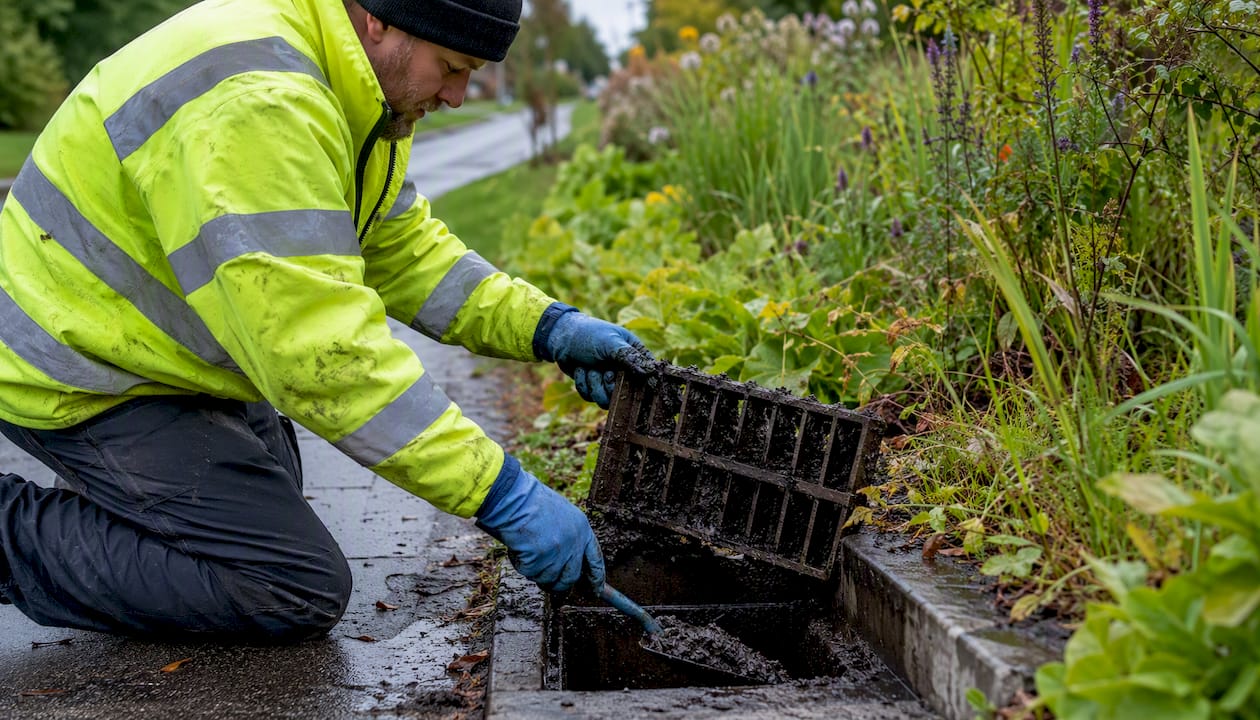
Pro Tip: When selecting SuDS types, prioritise features with accessible silt traps and straightforward vegetation regimes. A swale with a simple grass sward and clearly marked inspection points will be maintained reliably for decades. A bespoke bioretention cell with specialist planting and buried chambers will be neglected within five years.
How to assess surface water flood risk for a site or area
A proportionate, stepwise assessment is the foundation of any credible SWMP or drainage strategy. The depth of modelling should match the complexity of the risk, not the ambition of the consultant.
Step 1: Desktop scoping
- Download the Environment Agency’s Flood Map for Planning and the updated Long Term Flood Risk maps to identify whether the site falls within a Critical Drainage Area.
- Request the local authority’s existing SWMP data and any catchment-level hydraulic models held by the LLFA.
- Obtain sewer network records and capacity assessments from the relevant water company.
- Review historical flood incident reports, insurance claims data, and local authority records for the catchment.
- Check planning history for any drainage conditions or Section 106 obligations attached to adjacent sites.
Step 2: Site survey and infiltration testing
- Carry out a topographic survey to understand flow paths, low points, and existing drainage infrastructure.
- Conduct infiltration tests to BRE Digest 365 methodology at proposed SuDS locations to determine whether soakaway-based solutions are viable.
- Walk the site during or after rainfall to observe actual flow behaviour, ponding locations, and overland flow routes.
Step 3: Hydraulic modelling and climate change scenarios
- For low-complexity sites, a rapid appraisal using standard runoff coefficients and the Wallingford Procedure may be sufficient.
- For sites within CDAs, adjacent to watercourses, or with significant downstream receptors, commission a 1D/2D hydraulic model (InfoWorks ICM or MIKE FLOOD are widely used in the UK) to test performance under the 1-in-100-year event plus a climate change uplift of at least 40% on peak rainfall intensity, as required by current Environment Agency guidance.
- Model exceedance scenarios: what happens when the drainage system is overwhelmed? Exceedance routes must be designed to direct water safely away from buildings and critical infrastructure.
Pro Tip: Do not commission a detailed 2D model for a small residential site where a simple soakaway calculation will satisfy the LLFA. Proportionate assessment saves time and cost. Reserve detailed modelling for sites where the downstream consequence of failure is significant.
Planning, governance, and standards: who does what and which guidance to follow
Getting the governance right early is what separates schemes that reach adoption smoothly from those that stall for years in approval loops.
Responsibilities at a glance
- LLFA: Leads local flood risk strategy, reviews and approves surface water drainage strategies for major planning applications, and is the statutory consultee for SuDS on new developments in England.
- Water company: Statutory consultee on connections to public sewers; holds adoption responsibility for sewers that serve multiple properties; provides capacity data and connection agreements.
- Planning authority: Applies NPPF drainage policy, imposes drainage conditions, and requires compliance with the LLFA’s technical standards before granting consent.
- Highway authority: Responsible for drainage of adopted highways; must be engaged where runoff from roads contributes to the catchment or where new roads will be adopted.
Essential guidance to reference
The CIRIA SuDS Manual C753 is the technical bible for design. Defra’s policy framework and the NPPF set the planning context. For Scotland, the gov.scot SWMP guidance provides the equivalent framework. The Local Government Association’s SWMP guidance is the practical reference for LLFAs coordinating multi-agency plans.
Local authority SWMPs such as Essex County Council’s SWMP demonstrate how these frameworks translate into practical local delivery, identifying preferred strategies, coordination mechanisms, and investment priorities at county level.
Typical consenting timeline
A straightforward drainage strategy for a major planning application can take several weeks from submission to approval, assuming pre-application engagement with the LLFA has already taken place. Factors that include this are: absence of an existing SWMP for the catchment, disputed adoption responsibility between the water company and LLFA, ground conditions that rule out infiltration without detailed testing, and late submission of hydraulic model outputs.
Engage statutory consultees, particularly the LLFA and water company, at pre-application stage. This single step consistently reduces approval timescales and surfaces adoption constraints before they become design problems.
Practical design and delivery steps for an on-site scheme
A well-sequenced delivery process reduces approval delays, protects the works during construction, and produces a handover pack that a maintenance team can actually use.
- Site appraisal and SuDS selection: Confirm ground conditions, infiltration rates, available above-ground space, and downstream discharge points. Select SuDS types that match site constraints and LLFA technical standards.
- Hydraulic design: Size all SuDS elements to manage the 1-in-100-year event plus climate change uplift. Design exceedance routes to convey flows safely across the site without entering buildings.
- Detailed design and specification: Produce construction drawings, geotextile specifications, inlet/outlet details, and maintenance access arrangements. Reference CIRIA C753 for design metrics and material standards.
- Pre-construction checks: Confirm all planning conditions relating to drainage are discharged before breaking ground. Agree a temporary drainage strategy to protect excavations and adjacent land during construction.
- Site set-up and temporary works: Install silt fencing, temporary settlement ponds, and wheel wash facilities before any earthworks begin. Protect proposed SuDS formation levels from compaction by construction traffic.
- Installation and quality checkpoints: Lay geotextiles to specification, compact sub-base layers to the required density, and install inlet and outlet structures to drawing. Record as-built dimensions at each stage.
- Commissioning and testing: Carry out infiltration tests on completed soakaways and permeable paving sub-bases. Test flow control devices and confirm outlet rates match the consented discharge. Document all test results.
- Handover pack preparation: Compile the Operation and Maintenance (O&M) manual, as-built drawings, asset register, inspection schedule, and adoption agreement. The commercial drainage solutions guide provides a useful reference for adoption documentation requirements on larger schemes.
Pro Tip: Design maintenance access into the scheme from the outset. Every silt trap, inspection chamber, and flow control device should be reachable by a standard maintenance vehicle without crossing private land or requiring specialist equipment. Features that cannot be reached will not be maintained.
Costs, surface water drainage charges, and funding routes
Cost planning for surface water schemes requires separating capital delivery costs from ongoing maintenance liabilities, and understanding how on-site SuDS can reduce or remove surface water drainage charges.
Anglian Water’s guidance confirms that property owners and developers who implement on-site sustainable drainage can reduce or remove surface water drainage charges by preventing runoff from entering the public sewer. For large commercial sites, this can represent annual savings that strengthen the business case for SuDS investment.
Indicative cost drivers
| Cost element | Typical driver |
|---|---|
| Drainage strategy and hydraulic modelling | Depends on site complexity and model type |
| SuDS installation (swales, basins, permeable paving) | Varies with area, ground conditions, and SuDS type |
| Below-ground attenuation tanks | Depends on volume required and access constraints |
| Adoption and commuted sums | Based on adopting authority requirements |
| Annual maintenance | Depends on SuDS type, accessibility, and vegetation regime |
These represent typical cost drivers; obtain site-specific quotes from qualified contractors and drainage engineers.
Common funding routes
- Developer contributions: Section 106 agreements and Community Infrastructure Levy (CIL) receipts can fund off-site drainage improvements and SWMP updates.
- Water company grants and partnership funding: Some water companies offer funding for schemes that reduce sewer surcharge risk or deliver water quality benefits.
- Local authority capital programmes: LLFAs can allocate capital to SWMP-identified priority areas, particularly where multiple properties are at risk.
- Flood and Coastal Erosion Risk Management (FCERM) Grant in Aid: Environment Agency-administered funding available for schemes that meet benefit-cost ratio thresholds.
Pro Tip: When preparing a funding bid, quantify the biodiversity net gain uplift, the amenity value of new green space, and the urban cooling benefit alongside the flood risk reduction. Linking SuDS to wider regeneration outcomes significantly strengthens bids to Homes England, the UK Shared Prosperity Fund, and local growth programmes.
Maintenance, monitoring, and long-term management
The most common reason surface water schemes underperform is not a design flaw. As practitioners and researchers confirm, failure stems from weak accountability and inadequate maintenance planning. A scheme with a clear owner, a funded maintenance regime, and a documented inspection schedule will outperform a technically superior scheme with no one responsible for it.
Maintenance tasks by SuDS type
- Swales: Annual vegetation cut, silt removal from inlet zones every 2–5 years, check for erosion after significant rainfall events.
- Permeable paving: Vacuum sweeping twice per year, inspect sub-base drainage annually, replace blocked aggregate sections as required.
- Detention basins and ponds: Inspect inlet and outlet structures after every major storm, remove accumulated silt every 5–10 years, manage vegetation to prevent blockage of outlets.
- Green roofs: Inspect twice per year, remove self-seeded woody plants, check drainage layer outlets annually.
- Attenuation tanks: CCTV inspection every 3–5 years, check flow control devices annually, remove silt from pre-treatment chambers.
Monitoring metrics to collect post-installation
- Inflow and outflow rates during and after rainfall events, compared against the consented discharge rate.
- Vegetation condition scores at each inspection, recorded against a simple baseline photograph set.
- Sediment depth in silt traps and pre-treatment chambers, measured at each inspection.
- Infiltration rate checks on permeable surfaces and soakaways every 3–5 years to confirm performance has not degraded.
- Incident log recording any flooding, blockages, or structural defects observed between scheduled inspections.
Handover checklist for adoption
- Completed O&M manual with maintenance frequencies and responsible party identified for each asset.
- Full set of as-built drawings and a georeferenced asset register.
- Inspection regime agreed with the adopting authority or management company.
- Defined maintenance fund or service charge mechanism to cover annual costs.
- Adoption agreement signed before practical completion, not retrospectively.
Practical on-site implementation checklist for contractors and developers
This checklist reflects the on-the-ground delivery sequence that experienced groundworks contractors follow to reduce risk, protect quality, and produce a handover pack that satisfies LLFA and water company requirements. For SuDS drainage installation in Essex and across East Anglia, the sequence below applies consistently regardless of scheme scale.
Site set-up and temporary works
- Install silt fencing and temporary settlement ponds before any earthworks begin.
- Establish wheel wash and vehicle crossing points to prevent silt migration to public roads.
- Protect proposed SuDS formation levels with exclusion zones; prohibit construction traffic from crossing them.
- Confirm temporary drainage routes so that storm events during construction do not undermine excavations.
Installation steps and quality checkpoints
- Excavate to formation level and confirm ground conditions match the design assumptions; notify the engineer immediately if conditions differ.
- Lay geotextile separation and filter layers to specification, lapping joints by the minimum required distance.
- Install inlet and outlet structures to drawing, checking invert levels against the hydraulic design before backfilling.
- Compact sub-base layers in lifts to the specified density; record compaction test results for the handover pack.
- Install flow control devices and confirm orifice or weir dimensions match the consented discharge calculation.
- Complete surface finishes (grass seeding, planting, permeable surfacing) to specification and protect from traffic until established.
Commissioning and testing
- Carry out post-installation infiltration tests on soakaways and permeable paving sub-bases; compare results against design assumptions.
- Test flow control devices by introducing a controlled flow and measuring the outlet rate against the consented figure.
- Inspect all inlet and outlet structures visually and by CCTV where access is limited.
- Record all test results with date, operative, and equipment reference; include in the handover pack.
Client handover
- Submit the completed O&M manual, as-built drawings, asset register, test certificates, and photographic record.
- Walk the client or adopting authority representative around the scheme, demonstrating maintenance access points and inspection procedures.
- Confirm the adoption agreement is in place and the maintenance fund is established before handing over keys.
Why most surface water schemes fail, and how to avoid it
The technical design of a surface water scheme rarely causes its failure. Poor maintenance planning, late engagement with water authorities, and designs that prioritise visual complexity over practical operability are the three causes that appear repeatedly on schemes that underperform or fail within a decade of installation.
The sustainable water management roadmap is direct on this point: weak accountability is the primary driver of failure, not hydraulic design error. A scheme where no one knows who is responsible for clearing the silt trap will block. A scheme where the LLFA was not engaged until planning submission will face adoption disputes that drag on for years.
Three focused tips to avoid these outcomes:
- Appoint a maintenance lead before detailed design begins. The identity of the long-term owner should influence design decisions, particularly around access, vegetation choice, and asset complexity.
- Engage the LLFA and water company at pre-application stage. Early engagement surfaces adoption constraints, confirms technical standards, and reduces the risk of a drainage strategy being rejected at planning.
- Design for the maintenance operative, not the design review panel. A scheme that looks impressive on a drawing but requires specialist contractors to inspect it will be neglected. Straightforward, accessible, and robust beats bespoke every time.
Gcscontractors has delivered drainage and groundworks schemes across Cambridge and East Anglia, working within live environments and coordinating directly with LLFAs and water companies to resolve adoption and consenting issues before they affect programme. That experience consistently shows that the schemes which perform best over time are the ones where governance was agreed before the first drawing was produced.
Gcscontractors delivers drainage and groundworks across Cambridge and East Anglia
Gcscontractors provides groundworks, civil engineering, and drainage installation services for developers, building contractors, and property owners across Cambridge and East Anglia. Where other routes require you to coordinate multiple subcontractors across design, excavation, SuDS installation, and handover, Gcscontractors delivers the full physical works package under a single contract, with direct accountability for quality and programme.

Delivery strengths include:
- Experienced installation of SuDS drainage systems, attenuation tanks, permeable paving, and associated civil works.
- Compliance with CIRIA C753, LLFA technical standards, and health and safety requirements on every scheme.
- Capability to work within live environments with minimal disruption to adjacent occupiers and operations.
- Coordination with LLFAs, water companies, and highway authorities throughout the consenting and adoption process.
To discuss a drainage or groundworks package for your next scheme, contact Gcscontractors directly or visit the drainage services page for Cambridge to outline your project requirements and request a programme.
Sources
The following authoritative references are the starting point for any SWMP or SuDS project in the UK:
- Surface water management plans (SWMPs) | Local Government Association
- CIRIA (Construction Industry Research and Information Association)
- Roadmap on sustainable water management | IOPscience
- Gov
- Surface Water Management Plans – Essex flood and water
- Managing water on the surface | Susdrain
For local precedents, Bath and North East Somerset Council’s SWMP and the Essex County Council SWMP are both publicly available and provide detailed examples of how catchment-level risk assessment translates into prioritised investment programmes.
Recommended
- Surface Water Drainage Solutions: A Comprehensive Guide for UK Developers (2026) – GCS Contractors Ltd
- Building Regulations for Residential Drainage UK: The 2026 Compliance Guide – GCS Contractors Ltd
- Garden drainage tips: your practical UK guide for 2026
- Commercial Drainage Solutions UK: The Definitive Civil Engineering Guide 2026 – GCS Contractors Ltd