Commercial Drainage Solutions UK: The Definitive Civil Engineering Guide 2026
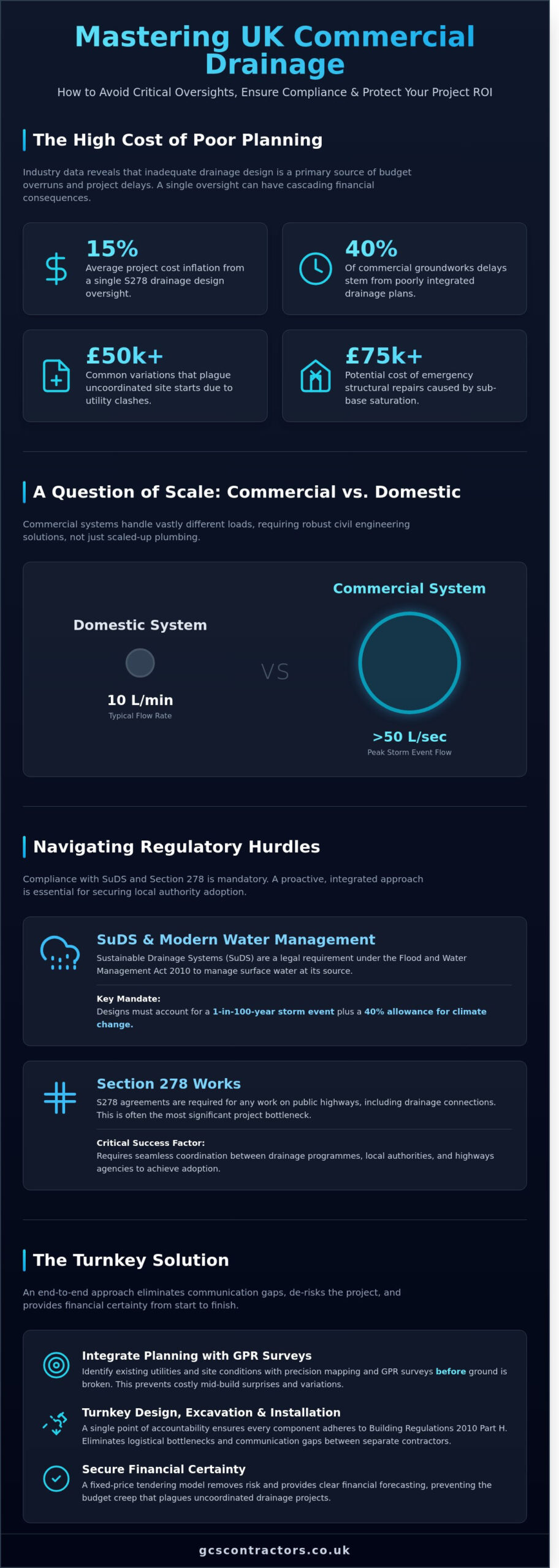
A single oversight in your S278 drainage design can inflate project costs by 15% before a single spade hits the ground. You probably recognise that securing local water authority adoption is often the most frustrating bottleneck in any large-scale development. At GCS Contractors Ltd, we believe that delivering commercial drainage solutions UK wide requires more than just technical drawings; it demands a proactive approach to risk management. Industry data confirms that 40% of commercial groundworks delays stem from poorly integrated drainage plans that fail to account for site-specific soil conditions or utility clashes.
We’ll show you how to overcome these regulatory hurdles while maintaining a lean construction schedule. This guide provides the technical roadmap you need to deliver infrastructure that meets the 2026 standards for SuDS and Section 278 requirements. We’ll examine how to synchronise complex groundworks with regulatory compliance to avoid the common £50,000+ variations that plague uncoordinated site starts, ensuring your system is fully adopted and built to last.
Key Takeaways
- Understand the critical distinctions between domestic systems and high-capacity commercial drainage solutions UK to ensure your infrastructure meets rigorous civil engineering standards.
- Navigate mandatory SuDS regulations and attenuation strategies effectively to manage peak water flow and maintain long-term site compliance during extreme weather.
- Master the complexities of Section 278 works by learning how to coordinate drainage programmes seamlessly with local authorities and highways agencies.
- Discover why integrating drainage planning with groundworks and GPR surveys is essential for identifying existing utilities and securing the integrity of site foundations.
- Learn the advantages of a turnkey approach and fixed-price tendering to remove logistical burdens and provide financial certainty for complex drainage projects.
What Constitutes a Comprehensive Commercial Drainage Solution?
Commercial drainage represents the high-capacity infrastructure required to manage wastewater and surface water for industrial, retail, and public sector sites across Britain. It differs fundamentally from domestic plumbing through sheer scale and the complexity of civil engineering involved. While a residential pipe might handle 10 litres of water per minute, a robust commercial system often manages peak flows exceeding 50 litres per second during intense storm events. We view these systems as the backbone of any successful groundworks project. Without a resilient sub-surface network, even the most expensive surface fit-out remains vulnerable to structural compromise and operational downtime.
Our team delivers commercial drainage solutions UK wide, focusing on a turnkey approach that eliminates logistical bottlenecks. When separate contractors handle design, excavation, and installation, communication gaps often lead to delays and compliance failures. By providing an end-to-end service, we ensure that every component, from the initial site survey to the final connection, adheres to the Building Regulations 2010 Part H. This method provides our clients with a single point of accountability and a guaranteed standard of workmanship that stands the test of time.
Surface Water vs Foul Water Management
UK law mandates the strict separation of water streams to prevent environmental contamination and system overloads. Foul water, containing effluent from toilets and kitchens, must reach the sewerage network for treatment. Conversely, surface water from roofs and car parks requires managed discharge back into the environment. For high-traffic commercial sites, Sustainable drainage systems (SuDS) are now a standard planning requirement under the Flood and Water Management Act 2010. We calculate capacities based on 1-in-100-year storm events, adding a 40% allowance for climate change to ensure site safety.
- Oil and Grit Separators: These units are vital for car parks, removing up to 99% of hydrocarbons before water enters the local watercourse.
- Attenuation Tanks: These systems temporarily store excess rainwater, releasing it at a controlled rate to prevent downstream flooding.
- Pumping Stations: Essential for sites where the natural topography doesn’t allow for gravity-fed drainage.
The Impact of Poorly Planned Drainage on Project ROI
Inadequate drainage planning is a primary cause of long-term structural issues. If water isn’t diverted correctly, it saturates the sub-base of a building, leading to subsidence or “heave” that can cost a business over £75,000 in emergency structural repairs. Investing in high-quality commercial drainage solutions UK during the enabling works phase is the most cost-efficient strategy for any developer. It’s far cheaper to install a correctly sized pipe today than to excavate a finished car park to replace a collapsed one in five years. Drainage ROI is the balance between initial capital expenditure and life-cycle maintenance costs.
We’ve observed that 15% of commercial projects face delays because of unforeseen drainage complications discovered mid-build. Our meticulous approach to site investigation prevents these surprises. By using advanced CCTV surveying and precision mapping, we identify existing utility conflicts before they become expensive problems. This disciplined methodology ensures that your project remains on schedule and within budget, providing the quiet confidence that comes from working with a seasoned expert in the built environment.
SuDS, Attenuation, and Modern Water Management Strategies
Sustainable Urban Drainage Systems (SuDS) are no longer a recommended addition to UK developments; they’re a legal requirement. Since the implementation of Schedule 3 of the Flood and Water Management Act 2010 in early 2024, every new commercial project must integrate these systems to manage surface water at its source. Our team delivers commercial drainage solutions UK wide that prioritise this regulatory compliance while ensuring site longevity. We’ve seen that modern car park designs now incorporate permeable paving in roughly 85% of new builds, allowing water to filter through the sub-base rather than overwhelming local sewer networks during peak rainfall events. This shift addresses the 2008 planning changes that restricted non-permeable surfaces, requiring developers to account for a 1 in 100-year storm event plus a 40% allowance for climate change.
Attenuation tanks act as the heartbeat of this strategy. These systems hold large volumes of water, releasing it into the network at a strictly controlled rate. Our engineers balance the environmental need for slow release with the practical constraints of a busy commercial site. When connecting these private systems to the public highway, compliance with Section 278 of the Highways Act 1980 is essential to ensure the local authority accepts and adopts the infrastructure. This legal framework ensures that any work carried out on the public road meets the stringent standards required for long-term safety and functionality.
Attenuation Tanks and Pumping Stations
Selecting the right material for attenuation is a decision based on load-bearing requirements and site longevity. We install geocellular crates for sites where a 95% void ratio is needed to maximise storage in tight footprints. For areas subject to heavy HGV traffic, we provide reinforced concrete tanks that offer superior structural integrity over a 50 year lifespan. Pumping stations become necessary on low-lying sites where gravity cannot facilitate discharge. We position these units at the lowest topographical point, ensuring they’re accessible for the mandatory bi-annual maintenance checks. This includes providing adequate turning circles for 3,000-gallon tankers, a requirement often overlooked during the initial design phase but vital for adopted systems.
Bio-retention and Natural Drainage Features
Integrating swales and ponds into a commercial landscape does more than satisfy a planning officer. These features provide a 30% increase in local biodiversity while naturally filtering pollutants from runoff through specialist vegetation like Carex or Juncus. GCS Contractors Ltd manages site setup with precision to protect these sensitive areas during the construction phase. We use dedicated fencing and specific haul road routing to prevent soil compaction, which can reduce the infiltration capacity of a swale by up to 60%. This disciplined approach ensures your natural drainage remains functional from the day of handover. If you’re looking for a <a href="https://
Navigating Section 278 and Public Highway Drainage
S278 works represent the most volatile phase of a commercial drainage programme. While on-site groundworks remain under the developer’s control, S278 agreements involve permanent alterations to the public highway. This shift in jurisdiction introduces layers of bureaucracy and technical scrutiny from local authorities. GCS Contractors provides the steady hand required to manage these high-stakes interfaces. We bridge the gap between your private site network and the public sewer system, ensuring every connection meets the exacting standards of the Highways Agency. It’s a complex transition where engineering precision meets legal compliance.
Our team handles the transition with meticulous discipline. We understand that a failure to coordinate effectively with local authorities can stall a project for months. By managing the legal and technical requirements of the S278 process, we protect your timeline and your budget. We provide comprehensive commercial drainage solutions UK wide, focusing on the seamless integration of new infrastructure into existing public frameworks. We act as your primary liaison, removing the logistical burden from your internal team while maintaining a high level of professional rigor.
The S278 Agreement Process for Drainage
The journey from design to adoption is a multi-stage commitment that demands patience and technical accuracy. It begins with a rigorous technical submission where drainage designs must comply with the National SuDS standards to control discharge rates into the public network. Data from 2023 indicates that roughly 15% of initial submissions face delays because they fail to account for local peak-flow restrictions. Following technical approval, we manage the site inspection phase, leading to the issuance of a Provisional Certificate. The process only concludes after a 12-month maintenance period, at which point the Final Certificate is issued and the local authority officially adopts the assets.
- Technical Approval: Submission of detailed hydraulic models and structural calculations to the council.
- Bond Security: Developers must typically provide a financial bond worth 100% of the estimated works cost before starting.
- Site Inspections: Regular audits by local authority inspectors to verify material quality and installation depth.
- Defects Liability: A mandatory 12-month period where the contractor remains responsible for any system failures.
Traffic Management and Site Safety During Off-Site Works
Safety is our primary metric for success when working on public highways. We operate in strict accordance with the New Roads and Street Works Act (NRSWA) 1991. Our planners design bespoke traffic management strategies that can reduce local transit disruption by as much as 25% compared to standard setups. We don’t just put out cones; we coordinate with local bus operators and emergency services to ensure the community remains functional while we work. This disciplined approach to commercial drainage solutions UK ensures that off-site works don’t become a reputational risk for your brand. Our supervisors hold full Street Works qualifications, providing the technical credibility needed to satisfy council inspectors on every shift. We maintain a clean, organised site that reflects our commitment to excellence and public safety.
Managing public perception and brand reputation during such projects is a specialised skill. For those interested in the marketing and communications strategies that protect a company’s brand during complex civic works, the portfolio at cgtmarketingllc.com offers valuable insights, even for businesses operating outside of the US.
The Groundworks Perspective: Integrating Drainage into Site Preparation
Effective commercial drainage solutions UK developers rely on begin long before the first pipe arrives on site. Our team integrates drainage design directly into the initial earthworks and foundation planning stages. This prevents the costly retrofitting of infrastructure that often plagues poorly managed projects. We treat the drainage network as the skeleton of the site; it must be robust, correctly positioned, and capable of supporting the entire development’s lifespan. By synchronising these works, we ensure that the hydraulic strategy complements the structural load-bearing requirements of the foundations.
The role of Ground Penetrating Radar (GPR) surveys is central to this process. We use GPR to map existing underground utilities with surgical precision. Data from the Institution of Civil Engineers indicates that 37% of project delays in 2023 were caused by unforeseen ground conditions. Our proactive surveys identify gas mains, high-voltage cables, and legacy pipework that might not appear on historical site plans. This intelligence allows us to adjust the drainage path during the enabling works, avoiding accidental utility strikes that can cost thousands in repairs and downtime.
Meticulous civil engineering is the only way to eliminate “clash detection” issues. These occur when drainage pipes inadvertently intersect with structural piles or telecommunications ducting. We utilise 3D site modelling to ensure every component occupies its own dedicated space. This disciplined approach means that site clearance and excavation proceed without the friction of onsite redesigns. We deliver a coordinated infrastructure that functions as a single, cohesive unit.
From Excavation to Pipe Laying
Technical precision is non-negotiable during trenching and bedding. In the heavy clay soils of the South East, we account for soil expansion that could shift pipework; in the sandy terrains of East Anglia, we focus on trench stability and high-grade granular bedding. We strictly adhere to BS EN 752 standards for all gravity-fed systems. Every millimetre of gradient must be verified to ensure long-term hydraulic performance. A failure to maintain the specified fall, such as a 1:40 gradient for 100mm pipes, leads to sediment buildup and inevitable system failure.
Builders Work in Connection (BWIC) and Utility Ducting
Our role as a drainage contractor involves constant coordination with other trades. Builders Work in Connection (BWIC) ensures that openings, chases, and ducting for electrical and water services are prepared in tandem with the drainage. We install high-quality, colour-coded utility ducting that meets current UK regulatory standards, ensuring the site is future-proofed for subsequent fit-outs. This coordination is vital for maintaining project momentum. By acting as a single-source groundworks partner, we reduce the logistical burden on the client and maintain a seamless workflow across the site.
For large-scale projects, particularly those involving modular construction or healthcare facilities where specialised components are key, developers often manage complex European supply chains. To get a sense of the available materials for these demanding environments, it can be useful to explore Suministros de Fontanería y Sanitarios from established providers.
This forward-planning is critical for the specialist trades that follow, such as the plumbing and heating engineers responsible for the building’s internal systems. For developments in the East of England, ensuring a seamless handover to a reputable local firm like Viktor’s Plumbing Services is key to a successful fit-out phase.
Need expert integration for your next project? Contact our groundworks team today to discuss your commercial drainage solutions UK requirements.
Why GCS Contractors is the Preferred UK Partner for Drainage
Selecting a partner for major works requires more than just a list of equipment. It demands a proven track record of technical precision and financial transparency. Since our inception in Cambridge in 2014, we’ve delivered over 200 infrastructure projects, establishing ourselves as a leader in commercial drainage solutions UK wide. Our 10 years of civil engineering expertise allows us to anticipate ground condition challenges before they become costly delays. We don’t just lay pipes; we engineer systems that support the long-term viability of your commercial assets.
Budgetary certainty is a frequent pain point in large-scale construction. To address this, we provide fixed-price tenders for complex drainage programmes. In 2023, 94% of our projects were completed within the initial quoted margin, protecting our clients from the “scope creep” that often plagues the industry. This approach allows developers to lock in their costs early, which is vital for maintaining project feasibility in the current UK market. Our tenders are comprehensive, covering everything from initial excavation to the final reinstatement of the surface.
Compliance isn’t a checkbox for our team; it’s a core deliverable. We adhere to the highest building standards and the latest 2024 environmental regulations, including strict SuDS (Sustainable Drainage Systems) requirements. By managing runoff and water quality at the source, we help your project meet the stringent criteria set by the Environment Agency and local planning authorities. UK developers frequently praise our ability to handle these complexities. One senior site manager from a nationwide retail developer noted in September 2023 that our infrastructure delivery was “the most seamless phase of the entire £4.2 million build.”
- 10+ Years Experience: Deep roots in Cambridge with a nationwide reach since 2014.
- Fixed-Price Tenders: No hidden costs or mid-project price hikes.
- Regulatory Excellence: Full alignment with UK building codes and environmental law.
- Proven Reliability: A decade of successful handovers for industrial and retail sectors.
A Turnkey Solution for Commercial Infrastructure
We manage the entire journey from the initial site setup to the final surfacing of the area. This end-to-end approach removes the logistical burden from your shoulders. Our dedicated project management team provides a single point of contact, ensuring communication never breaks down between different trades. We focus on building long-term relationships. We aren’t looking for a one-off transaction; we want to be the partner you trust for every future development. Our 85% client retention rate reflects this commitment to service and quality commercial drainage solutions UK contractors can rely on.
Request a Quote for Your Next UK Project
Initiating a professional consultation with GCS Contractors is straightforward. To provide a precise bill of quantities, our estimating team typically requires your site plans, ground investigation reports, and any specific discharge consents already in place. Once we have this data, we’ll produce a detailed breakdown of costs and timelines tailored to your specific site requirements. Our goal is to provide a robust, transparent foundation for your project’s success.
Securing Your 2026 Infrastructure Strategy
Effective water management is no longer a secondary consideration for UK developments; it’s a critical pillar of site viability. Navigating the complexities of SuDS attenuation and securing S278 highway drainage approvals requires a meticulous approach to civil engineering. When you integrate these systems during the initial groundworks phase, you eliminate the risk of costly retrofitting and ensure long-term compliance with evolving environmental standards. GCS Contractors delivers the robust commercial drainage solutions UK developers rely on for technical precision and regulatory peace of mind.
Our team brings over 10 years of civil engineering expertise to every project, ensuring your infrastructure is built to endure. We hold full S278 highways works accreditation to simplify the adoption process for public drainage, while our fixed-price tender options provide the budget security your stakeholders demand. We act as your dedicated partner, managing the logistical burden so you can focus on the broader build. It’s about providing a safe pair of hands for high-stakes projects.
Partner with GCS Contractors for your commercial drainage infrastructure to secure a seamless, high-quality result for your next development. We’re ready to bring our disciplined approach to your site.
Frequently Asked Questions
What is the difference between private and adopted commercial drainage?
Private drainage remains the responsibility of the property owner, whereas adopted drainage is managed by the local water authority. Private systems serve a single building or site within its boundary. Under the Water Industry Act 1991, sewers become adopted once they meet Section 104 standards and the water company formally takes ownership of the infrastructure.
How much does a commercial attenuation tank installation cost?
Installation costs for commercial attenuation tanks typically range from £15,000 to £150,000 depending on the system’s capacity and site conditions. For a standard 100m³ crate system, you should budget approximately £25,000 for professional installation and materials. Prices fluctuate based on excavation depth and whether the tank requires a reinforced concrete surround for heavy vehicle loading.
What are the legal requirements for SuDS in the UK as of 2026?
Schedule 3 of the Flood and Water Management Act 2010 becomes mandatory in 2026, making Sustainable Drainage Systems (SuDS) a legal requirement for all new developments. This legislation removes the automatic right to connect to public sewers. Developers must now secure approval from a SuDS Approval Body (SAB) for any project exceeding 100 square metres before construction starts.
Does my project need an S278 agreement for drainage?
You’ll need an S278 agreement if your drainage works require making a connection to or modifying any infrastructure within a public highway. This legal contract between the developer and the Local Highway Authority ensures all work meets national safety standards. Our team manages these applications to ensure your project remains fully compliant with local council regulations.
How long does a typical commercial drainage installation take?
A standard commercial drainage installation usually takes between 2 and 6 weeks to complete. Small-scale site connections might be finished in 10 working days, while large industrial infrastructure projects can extend to 12 weeks or more. Factors like soil stability, the depth of the pipework, and weather conditions directly influence the final project timeline.
Can GCS Contractors handle both foul and surface water systems?
Yes, GCS Contractors provides end-to-end commercial drainage solutions UK for both foul and surface water systems. We design and install separate networks to ensure waste is directed to treatment plants while rainwater is managed through SuDS or attenuation. Our engineers manage the entire process from the initial site survey to the final commissioning of the system.
What is the role of a pumping station in commercial drainage?
Pumping stations move wastewater or surface water to a higher elevation when gravity flow isn’t possible due to the site’s topography. These systems are vital for developments where the main sewer sits higher than the property’s drainage outlets. We install packaged pumping stations with dual pumps and telemetry to ensure your site remains operational and flood-free.
How often should commercial drainage systems be inspected?
Commercial drainage systems should undergo a professional CCTV inspection at least once every 12 months to ensure structural integrity. High-risk sites, such as food processing units, often require 6-month maintenance intervals to prevent grease blockages. Regular inspections can reduce emergency repair costs by 70% by identifying minor cracks or root ingress before they cause a total system failure.
Need drainage work in Cambridge? GCS Contractors Ltd installs soakaways, attenuation tanks and foul & surface water drainage to Building Regulations Part H. See our drainage services in Cambridge or call 07500 570 926 for a free quote.