Professional Roadworks Contractors in Cambridge: A Developer’s Guide to Infrastructure Excellence
A single non-compliance notice from Cambridgeshire County Council can stall a multi-million pound development for weeks, often adding upwards of £5,000 per day in liquidated damages and standing plant costs. You know that the friction between groundworks, surfacing, and strict S278 regulations represents the most volatile stage of any regional build. Securing professional roadworks contractors Cambridge developers trust is the most effective way to mitigate these risks and maintain project momentum from the outset.
Our team delivers the technical precision required to ensure your infrastructure is completed without delay or hidden costs. This guide shows you how to master the complexities of road construction, S278 compliance, and high-quality surfacing through a dedicated, turnkey partner. You’ll learn how an integrated approach eliminates the burden of managing multiple subcontractors while guaranteeing full adherence to Chapter 8 safety standards. We’ll outline the path to achieving fixed-price certainty and physical results that stand the test of time.
Key Takeaways
- Understand how elite roadworks contractors Cambridge manage the transition from urban constraints to rural arterial routes while maintaining site safety and project momentum.
- Follow the complete project lifecycle from essential enabling works and bulk earthworks through to the establishment of a robust sub-formation.
- Master the intricacies of S278 agreements to ensure seamless legal compliance when integrating new development access with the existing public highway network.
- Evaluate high-performance surfacing materials, including the application of permeable options to meet modern sustainability requirements in East Anglian developments.
- Learn why a turnkey approach to civil engineering provides a dedicated, reliable partnership that reduces the logistical burden for commercial developers.
What Defines Elite Roadworks Contractors in Cambridge?
Elite roadworks contractors Cambridge serve as the technical backbone of regional mobility, moving beyond simple tarmac laying to provide comprehensive infrastructure management. Our role involves the precise orchestration of excavation, drainage, and the application of durable surface materials to ensure long-term structural integrity. For any project within the 1,500 miles of highway maintained by the local authority, the contractor acts as a critical link between civil engineering theory and the physical reality of a safe, functional road network.
Cambridge presents a distinct set of challenges that test the limits of standard contracting. The city centre’s historic, narrow streets require meticulous logistics to manage high pedestrian volumes, while rural arterial routes like the A10 or A14 demand high-speed efficiency and heavy-duty load-bearing capacities. We recognise that a one-size-fits-all approach fails here. A project’s success depends on a contractor’s ability to pivot between these environments without compromising on safety or quality. During the 2024/25 Highways Capital Programme, the emphasis has shifted heavily toward preventative maintenance, requiring contractors who understand how to extend the lifecycle of existing assets through technical precision.
Choosing a dedicated civil engineering partner over a basic surfacing company is a vital distinction for project stakeholders. While a surfacing firm might focus solely on the top layer, a full-service partner manages the entire project lifecycle, including Section 278 and Section 38 agreements. Our team delivers a turnkey solution that encompasses initial site surveys, utility diversions, and complex drainage installations. This end-to-end capability removes the logistical burden from the client and ensures that every layer of the road, from the sub-base to the binder course, meets the rigorous specifications set out in the Cambridgeshire County Council Design Guide.
- Strategic Planning: We integrate traffic management and utility coordination from day one to prevent costly delays.
- Technical Expertise: Our engineers apply advanced material science to select the right asphalt grades for specific traffic loads.
- Regulatory Alignment: We ensure every project complies with the New Roads and Street Works Act 1991 (NRSWA).
The Cambridge Landscape: Geography and Ground Conditions
The local geology is a primary factor in road failure across East Anglia. Cambridge clay is notorious for its high shrink-swell capacity, which leads to seasonal movement and surface cracking if the foundations aren’t correctly engineered. We adapt our groundworks strategies to account for these high water tables, often incorporating geo-textile membranes and enhanced sub-base depths to provide a stable platform. Groundworks is the foundational engineering of the sub-grade and sub-base layers that prevents structural failure and surface cracking.
Compliance and Standards: Beyond the Surface
Safety and legal compliance form the bedrock of our operations. We maintain strict adherence to the Chapter 8 Traffic Signs Manual to protect both our workforce and the public during live roadworks. While being a council-approved contractor is a baseline requirement, we distinguish ourselves through elite accreditations including CHAS and SMAS. These certifications aren’t just badges; they represent a disciplined commitment to a culture of safety and professional rigor that guarantees your project stays on the right side of Health and Safety Executive (HSE) regulations.
The Lifecycle of a Road Construction Project: From Enabling to Surfacing
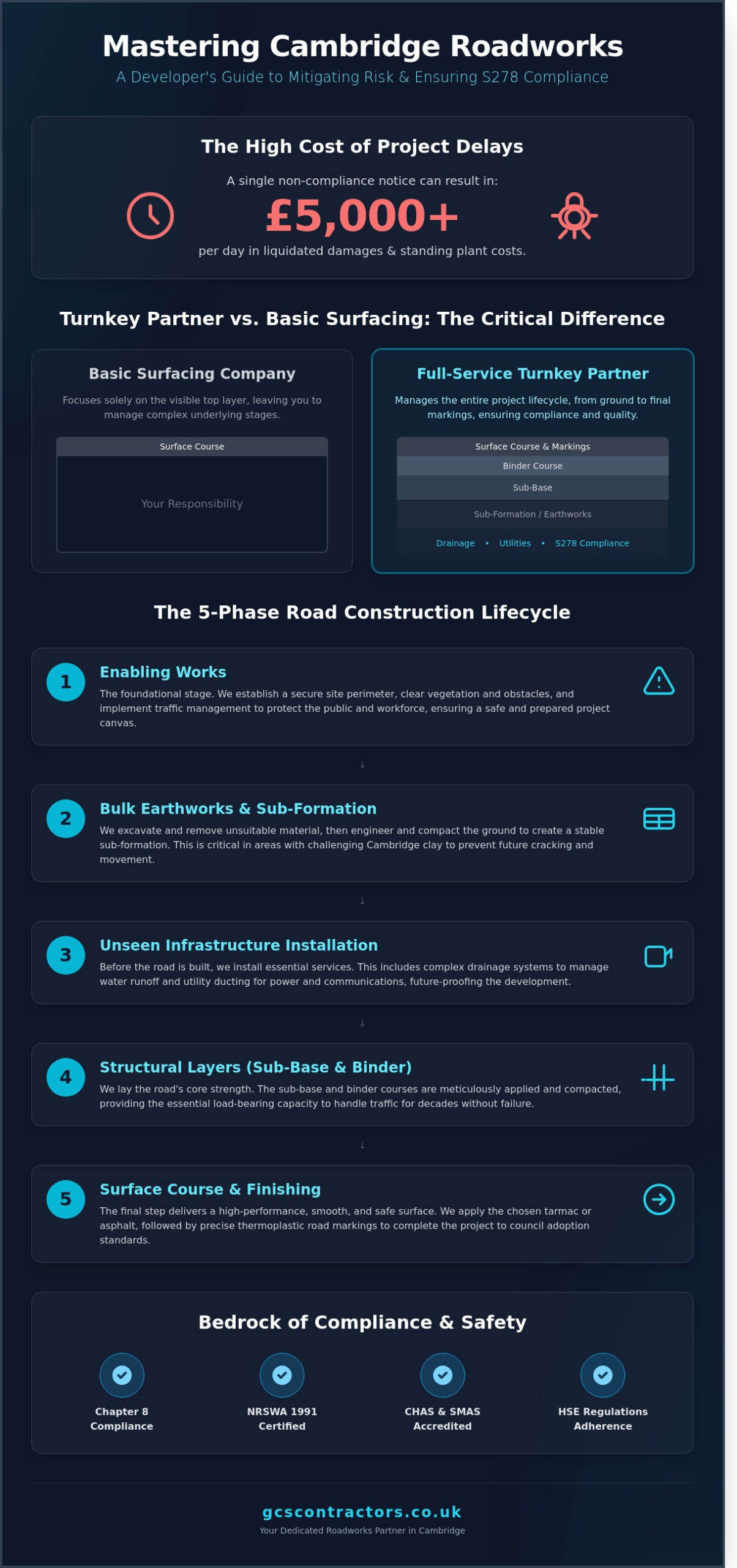
Every successful infrastructure project follows a meticulous sequence. We break this down into five distinct phases to ensure quality control at every junction. This structured approach prevents common pitfalls such as surface cracking or drainage failure that often plague poorly managed sites.
Phase 1 begins with enabling works. This is where we clear the site and establish a secure perimeter to protect the public. Phase 2 involves bulk earthworks. Our teams remove unsuitable material and level the ground to create a stable sub-formation. During Phase 3, we install the unseen infrastructure. This includes complex drainage systems and utility ducting that keep the road functional for decades. Phase 4 moves into the structural layers. We lay the sub-base and binder courses, which provide the essential load-bearing capacity. Finally, Phase 5 delivers the surface course and thermoplastic road markings to provide a safe, smooth finish.
Enabling Works: The Foundation of Success
Site clearance and Ground Penetrating Radar (GPR) surveys are non-negotiable first steps. In a historic city like Cambridge, hitting an unmapped utility line can cause immediate project suspension and repair costs exceeding £15,000. GPR surveys identify these hazards before a single bucket hits the soil. We also manage site hoarding and logistics, which is vital in sensitive locations such as the Silicon Fen or near the University. Clear site boundaries protect pedestrians and keep the project compliant with health and safety regulations. You can read more about our specific approach in our supporting article on Enabling Works.
Part of comprehensive site clearance, especially on undeveloped land, involves professional tree and vegetation removal to ensure root systems won’t compromise future sub-base layers. To get a sense of the expertise required for such tasks, you can learn more about CDA TREE AND UTILITY, a company that specialises in this field.
Drainage and Infrastructure Integration
Modern road design must account for the 2024 revisions to Sustainable Drainage Systems (SuDS) standards. We integrate attenuation tanks to manage surface water runoff, preventing local flooding during peak rainfall events. Coordinating Builders Work in Connection (BWIC) ensures that electricity, water, and data ducts are installed simultaneously with the drainage. This prevents the need for costly re-digs later in the schedule.
As established roadworks contractors Cambridge clients rely on, we ensure foul and surface water systems remain entirely separate. This precision meets the environmental standards set by Anglian Water and the Environment Agency. When these projects connect to the existing public highway, we manage the technical requirements of Section 278 of the Highways Act 1980. This legal framework ensures that any changes to the public road network are built to the local council’s exacting specifications.
The final stages of the lifecycle focus on durability. We test the sub-base for a 95% compaction rate before laying the binder course. This provides the structural integrity needed for heavy goods vehicles. The final surfacing uses high-quality asphalt, followed by precision road markings to guide traffic safely. Our team delivers these results through a transparent process that keeps your project on track. If you’re planning a new development, our team can provide a bespoke infrastructure consultation to help you map out these critical phases.
Navigating S278 Agreements and Highways Works
Developers in East Anglia face complex legal and technical hurdles when a project requires changes to the existing road network. This is where Section 278 of the Highways Act 1980 becomes the central focus. It’s the primary legal mechanism that allows a developer to carry out works on a public highway, such as creating new junctions, installing roundabouts, or adding traffic calming measures. Choosing experienced roadworks contractors Cambridge developers can rely on is vital because any errors in compliance or execution lead to significant financial penalties and project delays.
Modifying a public highway is far more demanding than internal site surfacing. It requires a contractor who understands the stringent standards set by Cambridgeshire County Council. The process involves precise technical approvals, where every drainage pipe and kerb line is scrutinised. We’ve seen projects delayed by up to 16 weeks simply because the initial technical submission lacked the required detail or failed to account for existing utility depths. To avoid these pitfalls, we recommend early engagement with both your engineers and local authorities to ensure the design meets all adoption criteria from the outset.
The setting out engineer plays a critical role in this precision. They translate complex CAD drawings into physical reality with millimetre accuracy. In an S278 environment, a deviation of just 15mm in a drainage invert level or a slight error in a kerb radius can result in the local authority refusing to adopt the road. Our team uses the latest robotic total stations and GPS technology to ensure every level is perfect. This level of accuracy protects the developer’s bond and ensures the infrastructure is fit for purpose for decades.
The S278 Process for Cambridge Developers
The journey begins with technical approval, followed by the securing of a bond, which typically covers 100% of the estimated construction costs to protect the public purse. Once the legal agreement is signed, construction begins under strict local authority inspection regimes. After completion, a 12-month maintenance period follows. Our role as roadworks contractors Cambridge is to manage these transitions seamlessly, ensuring the final handover is successful. For a deeper dive into these requirements, see our S278 Highways Works pillar article.
Highways Maintenance and Refurbishment
Infrastructure longevity relies on a balance between routine maintenance and major upgrades. While road patching addresses immediate safety issues like potholes, full resurfacing is often necessary to restore structural integrity. In 2023, GCS Contractors executed several fixed-price infrastructure projects where we delivered high-quality surfacing that extended the asset life by an estimated 15 years. This proactive approach prevents the need for emergency repairs, which often cost 3 times more than planned maintenance. We focus on delivering durable results that withstand the heavy traffic loads common in growing urban areas like the Cambridge Northern Fringe.
Selecting the Right Materials: Tarmac, Asphalt, and Sustainable Options
Choosing the correct surfacing material isn’t just about aesthetics; it’s a critical engineering decision that dictates the lifespan of your infrastructure. As experienced roadworks contractors Cambridge, our team evaluates the specific load-bearing requirements of every site before recommending a specification. Tarmacadam remains a cost-effective choice for low-traffic areas like private car parks, offering a smooth finish and quick installation. However, asphalt, specifically Stone Mastic Asphalt (SMA), provides superior resistance to the shearing forces generated by heavy goods vehicles. While tarmacadam might save 10% on initial material costs, SMA typically lasts 5 to 7 years longer in high-stress environments, reducing the total cost of ownership for the client.
Our team delivers tailored solutions based on the following criteria:
- Traffic Volume: High-frequency routes require polymer-modified binders to prevent rutting.
- Load Requirements: Industrial yards need thicker base layers, often exceeding 100mm, to support 44-tonne haulage vehicles.
- Climate Resilience: We select materials that withstand the temperature fluctuations common in East Anglia to prevent surface cracking.
Sustainable construction is no longer optional. In 2023, 65% of our commercial clients in the region requested carbon-conscious solutions. We utilise warm-mix asphalts that are produced at temperatures 20 to 40 degrees lower than traditional mixes; this cuts carbon emissions by approximately 15% per tonne. We also incorporate recycled asphalt planings into sub-base layers to divert waste from landfills and lower the project’s overall environmental footprint. These practices ensure compliance with evolving UK environmental standards while maintaining high-quality results.
The Case for Permeable Paving
Cambridge faces unique challenges with surface water management due to its flat topography and increasing urban density. Permeable paving allows water to infiltrate the ground directly, which significantly reduces the pressure on local sewer systems during heavy rainfall. Maintenance involves annual vacuum sweeping to prevent silt from clogging the voids and ensuring the system remains effective for decades. Investing in sustainable drainage systems provides a high ROI by mitigating the risk of site closures due to flooding and lowering the requirement for complex underground attenuation tanks.
Industrial and Commercial Surfacing
Distribution centres along the A14 and M11 corridors require surfacing that survives constant heavy-duty vehicle movements. We install heavy-duty asphalt solutions designed for high-torque environments like haulage yards and loading bays. Our team also manages precision kerbing and ironworks to ensure commercial sites remain both functional and visually professional for visitors and staff. We handle the technical complexities of Section 278 works, ensuring a seamless transition between private commercial entrances and public highways. This meticulous approach prevents future structural failures at the point where private and public infrastructure meet.
Our experts provide the technical guidance needed to select the most durable materials for your specific site requirements. Consult with our Cambridge roadworks team to secure a high-quality finish for your next project.
GCS Contractors: Your Dedicated Roadworks Partner in Cambridge
GCS Contractors Ltd operates as a comprehensive turnkey partner for civil engineering and surfacing projects across the region. Since 2011, our team has delivered infrastructure solutions that prioritise longevity and structural integrity. As leading roadworks contractors Cambridge, we understand the unique logistical challenges of working within a historic city that sees over 8 million visitors annually. Our 12 years of East Anglian experience allows us to navigate local planning requirements and environmental constraints with precision. We don’t just lay asphalt; we build the foundations for the city’s continued growth.
We eliminate the financial uncertainty often associated with large-scale groundwork. Our team provides fixed-price tenders based on a transparent bill of quantities, ensuring every tonne of aggregate and hour of labour is accounted for before work begins. This level of detail prevents the 15 per cent cost overruns common in poorly planned infrastructure projects. We provide a definitive roadmap for your budget, allowing developers and local authorities to allocate funds with total confidence. Our estimates are final, which means you won’t face unexpected variations midway through the project.
Safety remains our primary metric for success. Every site setup follows the strict guidelines of the Traffic Signs Manual Chapter 8. We conduct daily risk assessments and tool-box talks to ensure 100 per cent compliance with Health and Safety Executive (HSE) standards. This meticulous approach protects our operatives, your site visitors, and the general public throughout the project lifecycle. We maintain a clean, organised site, which is essential for projects located near high-traffic areas like the Cambridge Science Park or the city centre.
Turnkey Project Management
We act as a safe pair of hands by managing every phase of the construction programme. Our end-to-end service delivery means you don’t have to coordinate multiple sub-contractors or juggle different points of contact. We organise complex site logistics, such as phased closures and night shifts, to minimise disruption to the local transport network. By handling everything from initial excavation and drainage installation to final line marking, we reduce the administrative burden on your project managers by approximately 40 per cent. We take full responsibility for the site, allowing you to focus on your broader commercial objectives.
Get Started with GCS Contractors Ltd
Requesting a detailed tender for your project is a straightforward process. Once you make an enquiry, we’ll arrange a site visit within 48 hours to assess the specific requirements of your location. Our senior engineers will then produce a comprehensive proposal that outlines timelines, material specifications, and fixed costs. We believe in clear communication and professional rigour from the very first meeting. You can contact our Cambridge team for a fixed-price roadworks quote today to begin your consultation and secure a reliable partner for your next infrastructure project.
Securing Long-Term Success for Your Cambridge Development
Navigating the complexities of highway infrastructure requires more than just technical skill; it demands a partner who understands the local regulatory landscape. From securing S278 and S38 agreements to delivering precise surfacing with high-quality materials, every stage of the project lifecycle impacts your final delivery date. GCS Contractors brings over 10 years of civil engineering expertise to the table, ensuring your project meets strict UK building standards without unnecessary delays. We prioritise transparency through our fixed-price tender reliability, removing the financial uncertainty often associated with large-scale infrastructure works.
As leading roadworks contractors Cambridge developers trust, we provide a turnkey service that manages everything from initial enabling works to final maintenance. Our team delivers physical results that stand the test of time, allowing you to focus on the broader goals of your site development. For developers seeking comprehensive project management that extends beyond roadworks, our commercial civil engineering services East Anglia approach provides the integrated groundworks and infrastructure solutions needed for complex developments. We’re ready to bring our disciplined approach and technical rigor to your site, providing the steady hand needed to complete your infrastructure safely and efficiently.
Partner with GCS Contractors for your next Cambridge infrastructure project
The same eye for detail and appreciation for robust engineering required in civil projects often translates into other pursuits. For professionals who enjoy precision on a different scale, hobbies that involve assembling complex systems, such as creating detailed OO9 locomotive kits, can offer a rewarding way to apply these skills outside of work.
Frequently Asked Questions
How long does a typical S278 roadworks project take to complete?
A typical S278 roadworks project usually takes between 4 and 12 weeks to complete on-site, though the pre-construction legal phase often requires 3 to 6 months for local authority approval. We manage the entire timeline to ensure your project stays on track. Our team works closely with Cambridgeshire County Council to streamline the technical audit and bonding process so your development isn’t delayed.
What qualifications should roadworks contractors in Cambridge hold?
Professional roadworks contractors Cambridge should hold New Road and Street Works Act (NRSWA) accreditation and CHAS Elite status to ensure safety and compliance. GCS Contractors maintains ISO 9001 certification and ensures 100% of our site staff carry valid CSCS cards. These credentials prove our commitment to rigorous building standards and safe working practices on every infrastructure project we undertake.
Can you handle both private site surfacing and public highway connections?
We deliver end-to-end solutions that cover both internal private site surfacing and formal connections to the public highway. Our team manages the transition between your private development and the existing road network seamlessly. This integrated approach reduces your logistical burden by using a single, dedicated partner for the entire infrastructure package, from the initial site clearance to the final wearing course.
How much does it cost to install a new access road under an S278 agreement?
Installing a new access road under an S278 agreement typically costs between £50,000 and £250,000 depending on the junction complexity and utility diversions. Smaller bell-mouth entrances often sit at the lower end of the scale, while signal-controlled junctions involve higher technical costs. We provide detailed, transparent quotations based on your specific Section 38 or Section 278 requirements to ensure financial clarity.
Do you provide traffic management services as part of your roadworks package?
Our comprehensive roadworks package includes full traffic management services designed in accordance with Chapter 8 of the Traffic Signs Manual. We deploy temporary signals, lane closures, and pedestrian diversions to maintain site safety and public flow. This ensures your project complies with all local authority regulations without requiring you to coordinate with separate subcontractors, keeping the project management process simple.
What is the difference between tarmac and asphalt for commercial roads?
Asphalt is generally preferred for high-traffic commercial roads because its Stone Mastic Asphalt (SMA) composition offers greater durability than traditional tarmacadam. While tarmac remains a cost-effective choice for smaller private car parks, asphalt provides superior resistance to heavy goods vehicle (HGV) movements. We specify the correct material based on your predicted traffic load and 20-year maintenance plan to ensure long-term performance.
How do you manage environmental compliance during site clearance and demolition?
We manage environmental compliance by implementing a Site Waste Management Plan (SWMP) that targets a 95% diversion from landfill for all demolition materials. Our team uses on-site crushing and screening technology to repurpose concrete and brick as certified sub-base material. This disciplined approach follows the Environmental Protection Act 1990 and significantly reduces the carbon footprint of your Cambridge construction project.
What areas of East Anglia do GCS Contractors cover for roadworks?
GCS Contractors provides roadworks and surfacing across the entirety of East Anglia, including Cambridgeshire, Norfolk, Suffolk, and Essex. As leading roadworks contractors Cambridge developers trust, we regularly operate within a 60-mile radius of our regional hubs. Our fleet is fully equipped to reach sites in Peterborough, Ely, and Huntingdon with consistent efficiency and professional rigour.