S278 Highways Works Contractors: A Guide to Section 278 Agreements
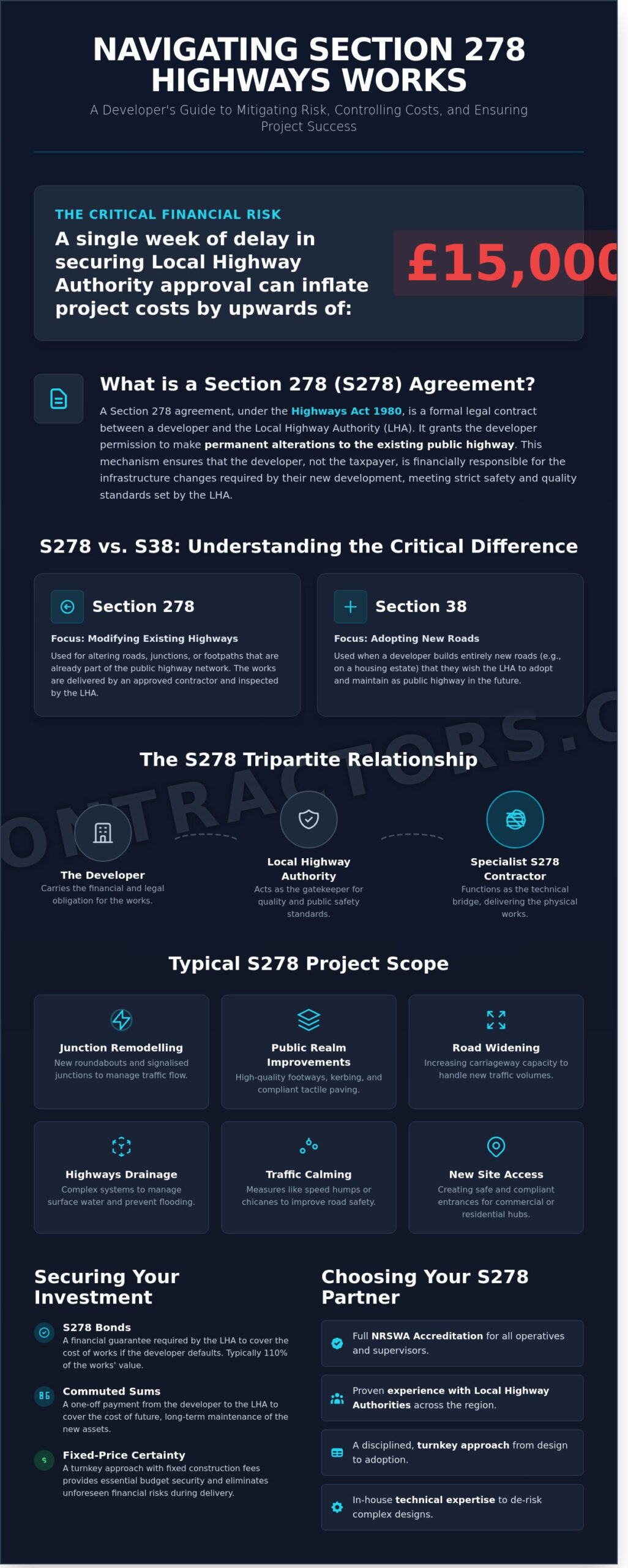
A single week of delay in securing Local Highway Authority approval can inflate project costs by upwards of £15,000 for a standard commercial development. You likely already feel the pressure of bridging the gap between private site works and public highway adoption; it’s often where the most significant financial risks reside. Our team understands that managing these legalities requires a meticulous and disciplined partner. Selecting specialist S278 highways works contractors is the most effective way to ensure your project moves from a construction site to a functional public asset without costly interruptions.
This guide provides a clear roadmap for managing Section 278 agreements with precision and quiet confidence. We’ll show you how to secure fixed-price certainty while addressing the complexities of commuted sums and strict highways standards. We’ve outlined the entire adoption process to give you a sense of security and professional rigour throughout your build. By following this structured approach, you’ll gain the technical insights needed to deliver high-quality infrastructure that stands the test of time.
Key Takeaways
- Understand the legal framework of Section 278 of the Highways Act 1980 to ensure your development meets all statutory requirements for public highway modifications.
- Gain clarity on the technical scope of infrastructure projects, from complex junction remodelling to public realm enhancements such as kerbing and tactile paving.
- Learn how to manage financial risks by navigating the complexities of S278 bonds and accurately calculating commuted sums for long-term maintenance.
- Identify the essential criteria for selecting specialist S278 highways works contractors, focusing on NRSWA accreditation and proven experience with Local Highway Authorities.
- Discover how a turnkey, end-to-end approach with fixed-price construction fees can streamline your project delivery and provide essential budget security.
What are Section 278 Highways Works?
Section 278 works represent a critical legal mechanism within the Highways Act 1980 that allows developers to make permanent alterations to the existing public highway. When a new development requires changes to the road network to accommodate increased traffic or ensure safety, the developer must enter into a formal agreement with the Local Highway Authority (LHA). Our team delivers the technical expertise required to execute these works, ensuring every modification meets the exacting standards set by council engineers and national safety regulations.
The legal framework exists to protect the public purse. It ensures that the cost of modifying infrastructure remains the responsibility of the developer rather than the taxpayer. Because these works involve breaking into live, public roads, the LHA maintains strict control over the design and execution phases. Specialist S278 highways works contractors act as the delivery partner, translating approved technical drawings into physical infrastructure while managing the significant risks associated with working on active carriageways.
Developers often confuse S278 agreements with Section 38 agreements. While both fall under the same Act, they serve distinct purposes. A Section 38 agreement relates to the construction of entirely new estate roads that the LHA will eventually adopt as public highway. In contrast, Section 278 focuses exclusively on modifications to the existing network. This might include a new junction on a 60mph A-road or the installation of a signalised crossing on a busy high street. The LHA’s role is to provide technical approval, inspect the works during construction, and ultimately issue a certificate of completion once the 12-month maintenance period concludes.
When is an S278 Agreement Required?
An S278 agreement is usually triggered by a specific condition in the planning permission, often linked to a Section 106 agreement. You’ll need this framework for projects such as creating new site access points for commercial hubs, road widening to improve capacity, or the installation of traffic calming measures. For example, a 2023 retail development might require a new roundabout to handle a 25% increase in local traffic volume. Other common requirements include the construction of cycle lanes or the upgrading of existing footpaths to meet modern accessibility standards.
The Tripartite Relationship: Developer, LHA, and Contractor
Success in highways infrastructure depends on a disciplined relationship between the developer, the LHA, and the contractor. The developer carries the financial and legal obligation to the public, while the LHA acts as the gatekeeper for quality and safety standards. Our role as the contractor is to function as the technical bridge. We manage the logistical burden, from securing Street Works licences to coordinating with utility providers. Early engagement with our highways engineers, often 6 months before the planned start date, allows us to identify potential conflicts in the design and prevent costly delays during the construction phase. We provide the reassurance that the project will meet the LHA’s stringent Stage 3 Road Safety Audits without the need for expensive remedial work.
Technical Scope of S278 Infrastructure Projects
The technical requirements for modifying a public road are extensive and require a disciplined approach to engineering. Every modification must adhere to the legal framework provided by Section 278 of the Highways Act 1980, ensuring that all alterations to the public road network meet the rigorous standards set by the local authority. Experienced S278 highways works contractors understand that these projects involve more than just resurfacing. They require a complete transformation of the existing environment to accommodate new developments safely.
Junction remodelling sits at the heart of most infrastructure agreements. This often involves converting existing T-junctions into 3-arm or 4-arm roundabouts or installing sophisticated signalised junctions. Each element, from the radius of a kerb to the timing of a traffic light, is calculated to maintain traffic flow and safety. Public realm improvements are equally vital. We install high-quality footways, durable kerbing, and tactile paving that complies with BS 8300 standards to ensure accessibility for all users.
The infrastructure below the surface is just as critical as the tarmac above it. Our teams manage complex highways drainage systems, often designing bespoke solutions to integrate site runoff with existing public sewers. This ensures that even during a 1-in-100-year storm event, the highway remains clear of standing water. We also handle the installation of street lighting and signage, ensuring every column and plate meets the specific authority specifications for the region.
Civil Engineering Challenges in Highways Works
Managing underground assets is one of the most significant hurdles in any project. We frequently coordinate S50 street works to divert or protect existing gas, water, and fibre optic lines, a process that typically requires a 12-week lead time for coordination. Precision is non-negotiable when it comes to drainage. We achieve exact gradients, often between 1:40 and 1:80, to facilitate proper water runoff while keeping the surface level for pedestrians. Material selection is also strictly governed. We use specific bitumen blends and high-PSV (Polished Stone Value) aggregates to ensure the road surface can withstand the 20,000 or more vehicle movements common on UK A-roads.
Traffic Management and Public Safety
Maintaining safety on a live carriageway is a core responsibility. As leading S278 highways works contractors, we deploy Chapter 8 compliant traffic management for every project. This isn’t just about cones; it involves complex logistics like night-time road closures between 20:00 and 06:00 to minimise peak-hour disruption. We’re committed to keeping the community moving, which means creating 1.5-metre wide temporary footways to maintain pedestrian access throughout the construction phase. Our team acts as a dedicated partner for infrastructure delivery, ensuring every technical specification is met without compromise to safety or quality.
Managing Financial Risk: Bonds and Commuted Sums
Financial exposure is a primary concern for developers entering into an agreement under the Highways Act 1980. This legal framework requires the developer to fund all alterations to the existing public road network. Before a single spade hits the ground, the Local Highway Authority (LHA) requires a financial bond. This bond usually covers 100% of the estimated construction costs plus a 10% contingency fee. For a £500,000 junction improvement, this means £550,000 is tied up, which directly impacts your liquid capital and project cash flow.
Beyond the immediate construction price, you must account for commuted sums. These are one-off payments to the LHA to cover the future maintenance of new assets for a set period, often ranging from 20 to 60 years. If your project introduces complex infrastructure like signalised crossings or sustainable drainage systems (SuDS), these costs escalate quickly. A single new street light might carry a commuted sum of £1,500; a complex drainage attenuation tank could require £25,000 or more. Experienced S278 highways works contractors provide accurate early-stage estimates to prevent these figures from derailing your budget during the later stages of the build.
The project doesn’t end when the tarmac is laid. Once works are physically complete, the scheme enters a 12-month maintenance period. During this time, the developer remains legally responsible for any defects. It’s a period of active liability where 50% of your bond usually remains held by the LHA. Only after a successful final inspection and the issuance of the Final Certificate of Completion is the remaining bond released. Our team delivers meticulous quality control to ensure this transition is seamless.
Understanding Highway Bonds
The LHA demands a financial guarantee to protect public funds. If a developer becomes insolvent, the bond ensures the highway can be finished or reinstated without cost to the taxpayer. We’ve seen projects where poor documentation led to bond retention for 24 months beyond the expected date. We mitigate this risk by hitting technical milestones accurately. This allows for the phased reduction of the bond value, typically dropping by 50% once the Provisional Certificate is issued.
Maintenance and Adoption Process
The path to adoption begins with the Provisional Certificate. This marks the point where the public can use the new road, but the LHA hasn’t yet taken ownership. Highways engineers perform rigorous site visits to check for surface course integrity and drainage functionality. As S278 highways works contractors, we manage these relationships directly, ensuring every snag is addressed before the 12-month anniversary. Final adoption only occurs when the LHA is satisfied that all standards are met, transferring all future liability to the public sector.
Criteria for Selecting S278 Highways Works Contractors
Choosing a delivery partner for infrastructure projects requires a meticulous assessment of technical capability and legal standing. You aren’t just hiring a builder; you’re appointing a representative to work on the public highway on your behalf. Experienced S278 highways works contractors mitigate the risk of project delays and budget overruns by ensuring every technical specification meets the exacting standards of the relevant Local Highway Authority (LHA). A safe pair of hands is essential when dealing with public assets and high-speed traffic environments.
Legal and Safety Accreditations
Compliance starts with the New Roads and Street Works Act (NRSWA) 1991. Every member of the site team must hold the correct credentials to work on the UK road network. We ensure all supervisors and operatives carry valid cards registered with the Street Works Qualifications Register (SWQR). Without these, work cannot legally take place on a public road, and the council can shut down the site immediately. Safety isn’t just about cards; it’s about financial protection. Most Local Highway Authorities demand a minimum of £10 million in public liability insurance for S278 works. This protects the developer if a utility main is damaged or if a member of the public is injured during the construction phase.
The legal processes following an injury on a construction site can be incredibly complex. While laws differ between the UK and the US, it can be useful to see how specialist firms operate in this area; you can learn more about GLG Personal Injury Lawyers to understand the support available for accident victims.
Under the Construction (Design and Management) Regulations 2015, your contractor must be capable of assuming the Principal Contractor role. This means they take full responsibility for the health and safety of the entire site. They manage the construction phase plan and ensure every subcontractor adheres to rigorous standards. We maintain a SafeContractor status to provide independent verification of our safety protocols. This accreditation confirms that a business has been audited against the highest standards of health and safety management, reducing the administrative burden on the developer.
Part of managing a site effectively involves coordinating logistics, including the transportation of specialist teams to and from the location. For large projects, reliable group transport is essential. To see an example of a company that handles such logistics, you can learn more about EC Minibus.
- Current NRSWA Supervisor and Operative cards for all site personnel.
- Public Liability Insurance with a minimum indemnity of £10 million.
- Verified SafeContractor or CHAS accreditation.
- Proven track record acting as Principal Contractor under CDM 2015.
The Value of Local Authority Experience
Technical variations across the UK are common. A pavement design approved by Hampshire County Council might be rejected by Birmingham City Council due to different local drainage requirements or preferred materials. Contractors who’ve spent decades working with specific authorities understand these local preferences. This knowledge speeds up the technical approval process. In a 2023 analysis of UK infrastructure projects, teams with local experience secured technical sign-off 22% faster than those entering a new region for the first time.
Long-standing relationships with council inspectors also pay dividends during the final site visit. When an inspector trusts a contractor’s track record, the communication during the maintenance period is significantly more efficient. This prevents the project from stalling during the final handover, ensuring the bond is released on schedule and without unexpected remedial costs.
Financial stability is the final pillar of selection. You should look for contractors who provide fixed-price tenders for civil engineering works. Groundworks are notoriously unpredictable. However, a contractor who conducts a thorough site survey and utility search can price the risk accurately. In 2024, fixed-price models saved developers an average of £14,000 per project by preventing the “unforeseen” variations that often arise once the first spade hits the ground. Our team delivers these fixed-price civils tenders to give you total cost certainty from day one.
Secure your project’s success by partnering with our S278 highways works contractors for a fixed-price, compliant delivery.
GCS Contractors: Your Partner for Turnkey Highways Infrastructure
GCS Contractors Ltd delivers a comprehensive, end-to-end solution for developers who require high-quality civil engineering and groundworks. We manage the entire lifecycle of a project. This begins with initial site clearance and extends through to the final application of wear-course surfacing. As experienced S278 highways works contractors, we understand that budget certainty is a primary concern for our clients. We address this by providing fixed-price construction fees. This approach eliminates the financial volatility often associated with complex groundworks. It allows project managers to forecast their 2024 and 2025 expenditures with absolute precision, ensuring that infrastructure costs don’t spiral out of control.
Our team provides an integrated suite of services that simplifies the construction process. We handle every stage in-house. This includes:
- Initial site setup and temporary works.
- Deep drainage installation and utility ducting.
- Sub-base preparation and kerbing.
- Final road surfacing and white lining.
By centralising these services, we remove the logistical friction of managing multiple sub-contractors. We’ve delivered over 150 successful projects across the United Kingdom. While we’re deeply rooted in the Cambridge area, our operational reach extends nationally. Our 2023 performance data shows that 98% of our projects reached practical completion within the original project timeline. We take pride in this efficiency. It’s a result of our meticulous planning and our refusal to cut corners on quality or safety.
A Safe Pair of Hands for Complex Projects
We’ve built our reputation on professional rigor and technical credibility. Navigating the requirements of a Local Highway Authority (LHA) is often a logistical minefield for developers. We take over this burden entirely. Our team manages every aspect of LHA liaison to ensure that technical approvals and bonds are secured without unnecessary delays. We don’t just act as a third-party supplier; we function as a dedicated partner for UK property developers. Our long-term relationships with major housebuilders are a testament to our reliability. We ensure that every metre of highway we construct meets the exacting standards required for adoption under the Highways Act 1980. This commitment to compliance reduces the risk of future maintenance liabilities for our clients.
Start Your Infrastructure Project with GCS Contractors Ltd
Efficiency begins during the tendering phase. Our estimators conduct a meticulous review of your bills of quantities and technical drawings. This ensures that our quotes are accurate and reflect the true scope of work from day one. We aim to provide a detailed response to all tender invitations within five working days. While our central office is located in Cambridge, our personnel are equipped to support sites across the country. We’re ready to deploy our plant and expert teams to support your next development. You can Enquire about our S278 highways services today to secure a partner who values precision and transparency. We’re here to ensure your infrastructure is built to last.
Securing Success for Your Infrastructure Projects
Navigating the complexities of Section 278 agreements demands a partner who understands both the technical specifications and the legal obligations involved. Managing commuted sums and financial bonds is critical to protecting your investment; it’s why project visibility and fixed-price certainty are essential from day one. By selecting experienced S278 highways works contractors, you ensure that every aspect of the road adoption process meets stringent local authority standards without compromising your timeline.
GCS Contractors brings over 10 years of civil engineering expertise to every project. Our NRSWA accredited team specialises in delivering high-quality, fixed-price groundworks and highways infrastructure that stand the test of time. We act as a dedicated partner, managing the entire turnkey process so you can focus on the broader goals of your development. Our commitment to safety and professional rigor ensures your project remains compliant and cost-effective throughout its lifecycle.
Partner with GCS Contractors for your next S278 project and benefit from our proven track record of reliability and precision. We’re ready to help you build the foundations of a successful development.
Frequently Asked Questions
What is the difference between a Section 278 and a Section 38 agreement?
A Section 278 agreement covers alterations to an existing public highway, whereas a Section 38 agreement relates to the adoption of new roads. Developers use Section 278 to modify junctions or install crossings on the current network. Section 38 ensures that a newly constructed road meets local authority standards so it can be maintained at the public expense in the future.
How long does it typically take to get an S278 agreement approved?
Obtaining a formal S278 agreement typically takes between 6 and 12 months from the initial design submission. This timeline accounts for technical audits, legal reviews, and the finalisation of the bond. We recommend starting this process early because work cannot commence on the public highway until the legal document is fully executed by all parties.
Who pays for the S278 highways works?
The developer or the organisation proposing the highway changes pays the full cost of the S278 works. These expenses include the physical construction, local authority administrative fees, and technical audit costs. Our team provides detailed costings at the outset to ensure your project budget remains transparent and predictable throughout the construction phase.
Can any civil engineering contractor carry out S278 works?
No, only accredited S278 highways works contractors with public liability insurance of at least £10 million can perform these specific tasks. Local authorities maintain strict lists of approved contractors who have demonstrated technical competence and adherence to health and safety regulations. We hold the necessary certifications to ensure your project meets every legal and safety requirement.
What are commuted sums in a highways agreement?
Commuted sums are one-off payments made to the local authority to cover the future maintenance of non-standard highway assets. These payments usually cover a 15-year or 20-year period for items like traffic signals, soakaways, or decorative paving. The authority calculates these figures based on the expected lifecycle and repair costs of the materials used in your specific scheme.
What happens if S278 works are not completed to the required standard?
The local authority will use the S278 bond to fund remedial works if a contractor fails to meet the approved specifications. If the work doesn’t pass the final inspection after the 12-month maintenance period, the authority won’t issue the Final Certificate. This means the developer remains legally and financially responsible for the site until all defects are corrected.
How much does an S278 bond cost?
An S278 bond typically costs between 1% and 10% of the total works value, depending on the developer’s financial standing. The bond itself must represent 100% of the estimated construction costs plus a 10% contingency fee for the local authority. This financial guarantee protects the public by ensuring funds are available to complete the works if the developer faces insolvency.
Do I need an S278 agreement for a private driveway access?
You usually require a Section 184 licence rather than a full S278 agreement for a standard domestic driveway crossover. Section 278 agreements are reserved for larger projects that change the highway’s layout or increase its capacity. However, if your development requires a new bellmouth junction or significant kerb realignment, the local authority will mandate a formal S278 agreement.