Avoid Service Strikes: UK Permit to Dig with 500mm Safe Dig Rule
A permit to dig is required whenever excavation carries a credible risk of striking buried services or causing ground collapse. That risk, not a fixed depth, is the trigger. Under CDM 2015, excavations demand competent inspection, and HSE HSG47 sets the safe digging expectations behind that permit. If you’re unsure whether the ground you’re breaking qualifies, stop and arrange a survey before starting excavation.
TL;DR:
- A permit to dig is necessary when there is a credible risk of hitting buried services or causing ground collapse, regardless of excavation depth.
- It must include detailed information such as precise location, depth, method, utility references, and verification evidence like CAT scans and trial holes.
- Pre-start checks involve obtaining up-to-date utility drawings, conducting scans, confirming with trial holes, and coordinating with service owners for written agreements.
- Ongoing inspection at every shift, after stability changes, and following material falls is mandatory to maintain permit validity and safety.
- Common failures include relying on outdated drawings, broad permits, neglecting reissuance during progress, and skipping verification steps, which increase incident risk.
Table of Contents
- What is a permit to dig and when do you need one?
- The UK legal framework behind every permit
- Pre-start checks that make a permit defensible
- Building the permit: fields, authorisation and close-out
- Running the permit safely once digging starts
- Where permits go wrong on real sites
- A worked example from the field
- Why disciplined permitting protects the whole project
- Get compliant groundworks support from GCS Contractors
- Sources
What is a permit to dig and when do you need one?
A permit to dig is a site specific document that records where buried services have been located, what controls are in place, and who has authorised the work to proceed. It’s the paperwork that turns “we think it’s safe” into “we’ve proven it’s safe” — and it’s the first thing an HSE inspector will ask to see after an incident.
You need one for more jobs than most site managers assume. PermitPad’s guidance treats the permit as necessary whenever there’s a credible chance of hitting services or triggering a collapse, regardless of depth. That covers:
- Mechanical excavation of any kind, including trenching and foundation digging
- Hand digging near suspected services, even shallow work with a spade or fork
- Fence post holes, bollard installations, and signage footings near utility corridors
- Piling operations and any work adjacent to roads or known service runs
A shallow garden trench in genuinely virgin ground with no service history might not need one. Anything near a road, a building, or an area with any recorded utility presence does.
The UK legal framework behind every permit
Three separate regimes govern excavation, and mixing them up is where contractors get caught out. CDM 2015 Regulation 22 requires “all practicable steps” to prevent collapse and mandates inspection by a competent person at the start of every shift, after any event likely to affect stability, and after any unintended fall of material. Excavation collapse still contributes to roughly five deaths and hundreds of serious injuries annually in UK construction, which is why this duty carries real weight rather than being a box-ticking formality.
Statistic to remember: HSG47 restricts mechanical excavation to within 500mm of any detected service, beyond which you must switch to hand digging or vacuum excavation.
The safe digging hierarchy that underpins any credible permit runs:
- Obtain up to date service drawings from every relevant utility owner
- Scan the area with a cable avoidance tool and signal generator (CAT and Genny)
- Mark confirmed routes on the ground and hand dig within the 500mm buffer
Where work touches the public highway, you need a separate street works licence under NRSWA, which carries its own notice periods and conditions. Some local authorities also publish permit guidance for works affecting the highway from private land. Building Regulations add another layer: certain groundworks need advance notice to the local authority before excavations or drains are covered over, under regulation 16 of the Building Regulations 2010.
Pre-start checks that make a permit defensible
A permit is only as good as the verification behind it. Skip the checks and you’ve written a piece of paper that won’t hold up under scrutiny, let alone protect your team. Work through these steps in order before anyone signs off:
- Pull utility drawings from every service owner and log the version and issue date on the permit itself. Drawings older than a year deserve extra scepticism.
- Run a CAT and Genny scan across the full dig footprint, and record who operated the equipment, what model was used, and the readings obtained.
- Dig trial holes or inspection pits to physically confirm depths and positions before any mechanical plant touches the ground.
- Contact service owners directly where drawings are ambiguous or the corridor is congested, and get written safe working agreements where they’ll attend site.
Pro Tip: Never let a trial hole finding contradict the drawing without escalating it. If the pit shows a service 400mm off the drawn position, treat the whole drawing as unreliable until the owner confirms otherwise.
Our utility trenching guidance for Cambridge walks through this verification sequence in more depth if you’re setting up the process for the first time.
Building the permit: fields, authorisation and close-out
A permit that doesn’t specify exactly where and how deep the dig goes is barely worth issuing. Industry templates build in fields for buried services checks, shoring requirements, atmospheric testing, emergency rescue arrangements, and a daily inspection log to satisfy CDM 2015.
The permit needs to capture:
- A precise dig description, referenced against gridlines or fixed offsets, not a vague area outline
- Depth, method, and expected duration of the work
- Utility drawing references with dates, plus CAT/Genny evidence attached
- Trial hole findings recorded against the drawing predictions
| Field category | What it must record |
|---|---|
| Authorisation | Competent person signature, responsible supervisor, permit validity dates |
| Revision control | Version number and reason for any reissue as the dig advances |
| Close-out | Daily inspection sign-offs, completion confirmation, record retention period |
Validity matters as much as content. A permit issued for one working area shouldn’t silently cover a different face further along the trench. It needs reissuing or formal amendment as the dig progresses, so the CAT results and trial holes on file actually match the ground being worked.
Running the permit safely once digging starts
Issuing the permit is the easy part. Keeping it valid through the working day is where discipline slips. CDM 2015 Schedule 2 inspection timing applies here directly: a competent person checks the excavation at the start of every shift, after anything that might affect stability (heavy rain, nearby vibration, a change in load), and after any fall of material.
- Record each inspection with time, findings, and the inspector’s name, not just a tick
- Decide on support method (battering, benching, or shoring) based on ground conditions, water, and adjacent loadings rather than depth alone
- Trigger atmospheric testing wherever confined space conditions are plausible, including deep or enclosed trenches
- Know the immediate response for a service strike: stop work, isolate where safe, and notify the asset owner before continuing
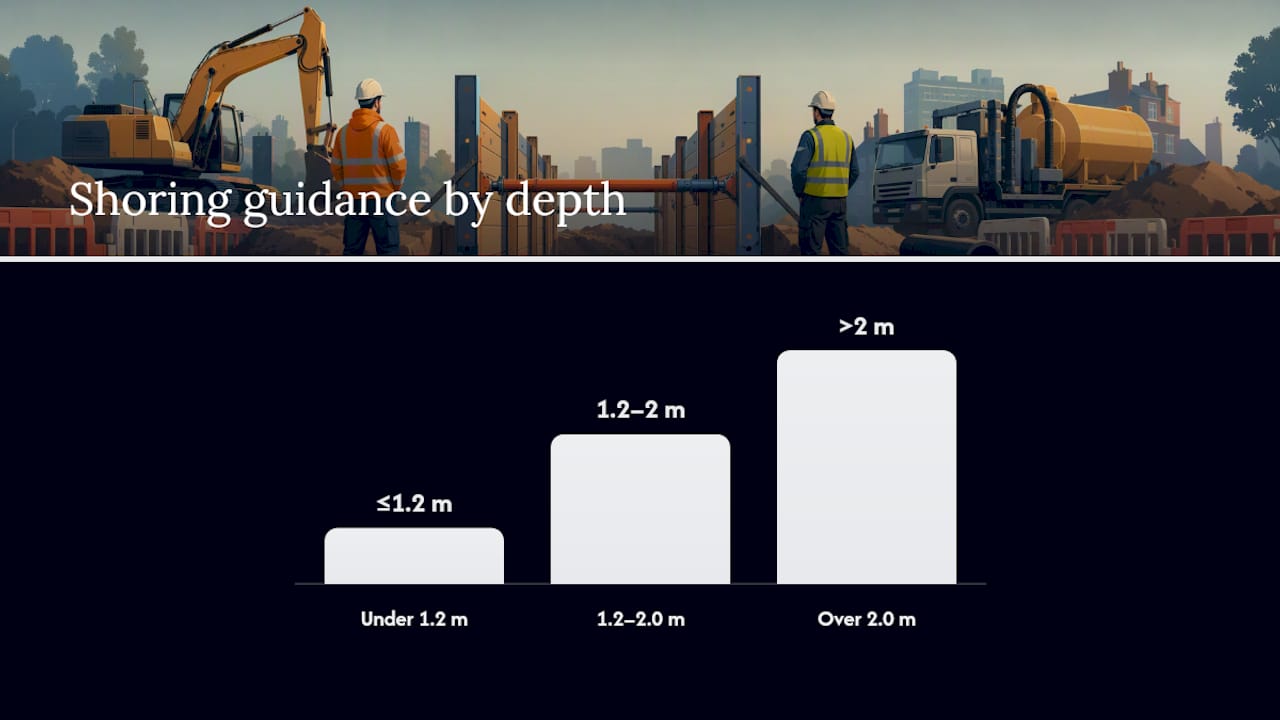
Pro Tip: As a rough guide, excavations under 1.2 metres in stable ground may not need formal shoring, 1.2 to 2 metres calls for a proper assessment, and beyond 2 metres you’re almost always into engineered support territory. Soil type and water table override the numbers every time.
Our excavation safety guidance and deep excavation checklist both expand on shoring decisions and inspection records if you’re building this into a site procedure.
Where permits go wrong on real sites
Most excavation incidents trace back to a handful of repeatable failures, not exotic bad luck. Recognise these patterns and you’ll catch the mistake before it becomes an incident report.
- Relying on a drawing without a trial hole, because the drawing “looked recent enough”
- Treating emergency works as exempt from CAT/Genny and trial hole checks. They aren’t. Emergency status changes the urgency, not the duty to locate services safely
- Writing a permit for a broad area rather than a specific task, which lets crews drift into unchecked ground
- Failing to reissue the permit as the excavation moves along a trench, leaving stale evidence attached to live work
Every one of these is an administrative shortcut that feels harmless until a machine bucket meets a gas main. Digital permit systems are closing this gap by making it easier to attach CAT photos, timestamp inspections, and flag when a permit needs reissuing rather than quietly extending.
A worked example from the field
On a recent Cambridge groundworks package, our supervisors ran the desktop review first: utility drawings pulled and dated, then a full CAT and Genny sweep of the trench line before any plant arrived. Trial holes at three points confirmed a gas service sat 300mm off the drawn position, which triggered a written safe working agreement with the utility owner before digging resumed.
What made the permit auditable wasn’t the paperwork alone. It was the evidence attached to it:
- CAT scan photos and Genny readings filed against the permit reference
- Drawing extracts annotated with trial hole findings
- Daily inspection sign-offs logged against Regulation 22 timing
- A revised permit issued when the trench advanced past the surveyed section
Our site preparation guide covers how this fits into the broader pre-start sequence for compliant UK projects.
Why disciplined permitting protects the whole project
I’ve seen enough groundworks packages to know that permits rarely fail because teams don’t understand the rules. They fail because someone decided the drawing was “close enough.” Good permitting isn’t paperwork for its own sake. It cuts programme delays, avoids the claims that follow a service strike, and protects a contractor’s reputation with the client long after the trench is backfilled. If your team needs support building that discipline into daily practice, GCS Contractors can help.
— George
Get compliant groundworks support from GCS Contractors
Gcscontractors gives you what a generic checklist can’t: supervisors who have actually issued and closed out excavation permits on live Cambridge and East Anglia sites, working alongside utility owners rather than around them.

We support permitted digs with competent supervisors trained against CDM 2015 Regulation 22, ready-built permit templates covering CAT/Genny evidence and trial hole records, and direct liaison with service owners where drawings need clarifying. Whether you’re planning trenching, foundations, or roadworks, we handle the pre-start surveys and daily inspection regime so your programme doesn’t stall waiting on paperwork. For deeper groundworks, our groundworks and foundation services in Cambridge page covers the full scope. If a specialist earthing or drilling issue turns up mid-dig, Indelec’s deep earth grounding services are worth knowing about too. Get in touch for a quote on your next excavation package and we’ll talk through what permitting support your site actually needs.
Sources
- The Construction (Design and Management) Regulations 2015
- HSG47 Avoiding danger from underground services
- Street works licence (England, Scotland and Wales)
- When Do You Need a Permit to Dig? (UK Guide) | PermitPad
- Excavation Permit Template | Safe Digging Permit Form