Commercial Drainage Contractors in St Neots: Civil Engineering & Groundworks
Relying on standard soakaways in St Neots isn’t just optimistic; it’s a structural risk that ignores the physical reality of Oxford Clay. Most developers understand the frustration of standing water that refuses to drain, especially when temporary fixes fail to handle the region’s unique geography. You know that the local soil, characterised by its fine, non-permeable particles, demands more than a simple pipe and gravel approach. Finding reliable commercial drainage contractors St Neots requires identifying specialists who treat water management as a core civil engineering challenge rather than a quick maintenance task.
We agree that a waterlogged site is a liability for both foundation safety and regulatory compliance. This article explains how professional groundworks and engineered drainage systems solve the specific challenges of the Great Ouse floodplain. You’ll learn how to achieve a dry, compliant site that meets the latest Cambridgeshire Building Regulations whilst protecting your development’s structural integrity. We will preview the technical requirements for modular attenuation, the necessity of the 30% climate change allowance in modern design, and why a groundworks-first strategy is essential for long-term success.
Key Takeaways
- Understand why the non-permeable nature of St Neots’ Oxford Clay makes standard soakaways ineffective for commercial developments.
- Discover how expert commercial drainage contractors St Neots use engineered attenuation systems to manage high-volume storm runoff.
- Learn why integrating drainage into the initial groundworks and bulk excavation phase is critical for maintaining soil structure and site stability.
- Gain insights into meeting the latest Cambridgeshire Building Regulations, including the mandatory 30% climate change allowance for drainage design.
- Identify the “gold standard” drainage solutions that ensure long-term structural integrity and a dry, compliant site year-round.
Commercial Drainage Contractors in St Neots: Solving the Oxford Clay Challenge
Commercial drainage isn’t a secondary concern for St Neots developments; it’s a fundamental structural requirement. The town’s expansion faces a persistent geological obstacle that standard plumbing cannot address. For developers, hiring experienced commercial drainage contractors St Neots is the only way to ensure site stability against a backdrop of non-permeable soil and flood-prone geography. Drainage must be designed as a core component of the infrastructure to prevent long-term site failure.
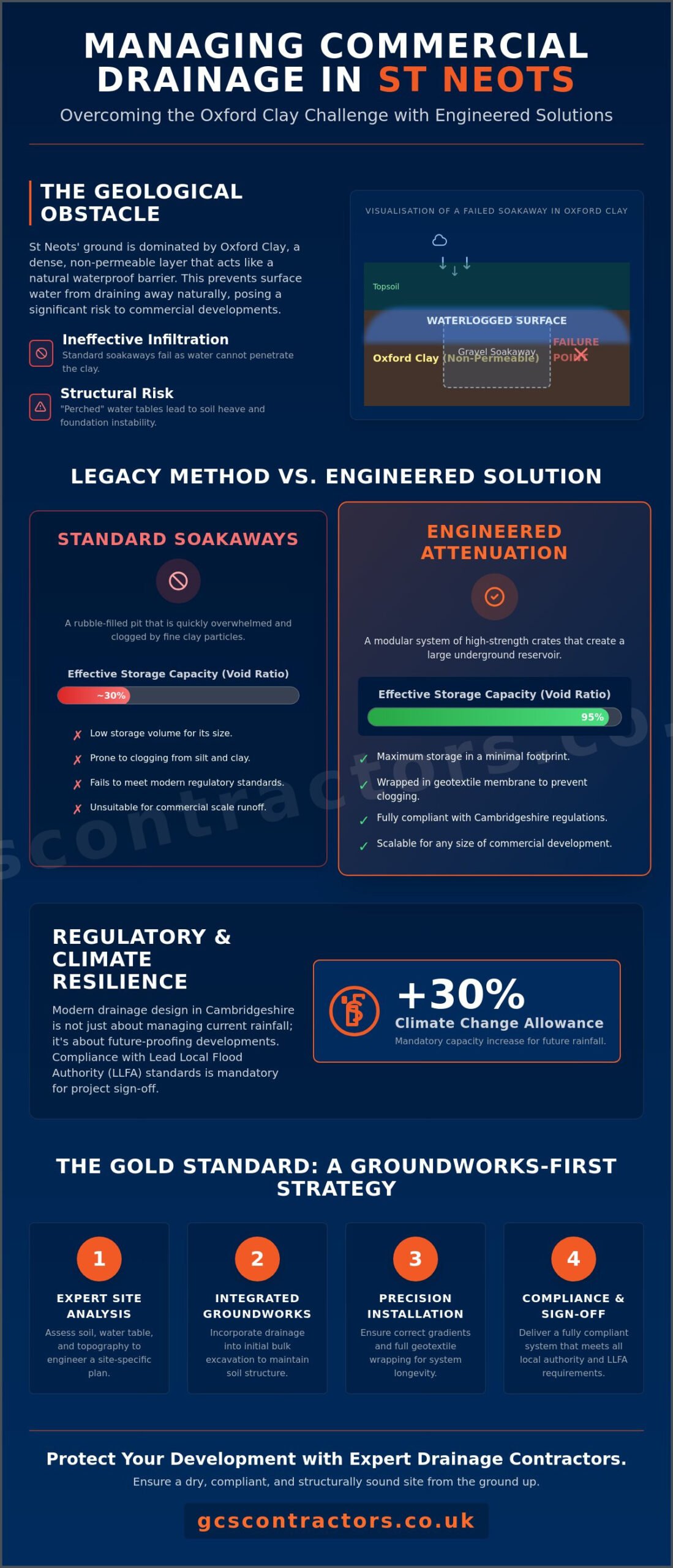
The primary challenge lies in the Oxford Clay formation. This geological layer acts as an almost entirely waterproof barrier, preventing surface water from infiltrating the ground naturally. When combined with the high water table of the River Great Ouse, especially during wet Cambridgeshire winters, sites quickly become saturated. Without professional-grade groundworks, standard drainage solutions like simple soakaways are effectively useless in these conditions.
To better understand the technical precision required for these installations, watch this video on high-capacity drainage components:
The Impact of Oxford Clay on Local Developments
Oxford Clay leads to the formation of “perched” water tables. This occurs when water sits on top of the clay layer rather than draining through it, leaving sites waterlogged for days after rainfall. This isn’t just a nuisance for site access; it’s a structural threat. Poorly managed runoff causes soil heave and foundation instability, potentially compromising the long-term integrity of the entire build. Systems must be engineered to move water away from the structure immediately.
Regulatory Compliance and Flood Risk
Modern drainage systems must comply with strict local authority standards and Lead Local Flood Authority (LLFA) requirements. In St Neots, this means designing systems that protect not only the development but also the town’s wider infrastructure. Effective site drainage prevents excessive discharge into the local sewer network, reducing the overall flood risk for the community during extreme weather events. Compliance isn’t optional; it’s a prerequisite for project sign-off.
Engineered Solutions: Attenuation Tanks and High-Capacity Systems
Managing storm runoff on Oxford Clay requires moving away from traditional rubble-filled soakaways. These legacy systems often fail because the surrounding clay quickly clogs the gaps between stones, rendering the pit useless. Experienced commercial drainage contractors St Neots utilise modular attenuation crates instead. These modern systems offer a 95% void ratio, providing significantly higher storage capacity than stone-based pits. This efficiency is vital for high-volume water management on commercial sites where space is at a premium.
The longevity of these systems depends on technical precision. We use non-woven geotextile membranes to wrap attenuation structures, preventing fine silt from the clay soil from entering and compromising the tank. Equally critical is the engineering of “falls” or gradients. Even a slight error in the pipework gradient can lead to stagnation or backflow. Accurate surveying ensures water moves efficiently away from site structures and toward the designated discharge point.
French Drains vs. Attenuation Crates
French drains are effective for perimeter protection and intercepting surface runoff before it reaches a building’s foundations. However, for site-wide runoff management, attenuation crates are superior. Their modular nature allows for custom configurations that handle massive volumes of water during peak storm events. Whilst French drains are limited by the volume of their gravel trench, crates provide a dedicated subterranean reservoir that can be scaled to the development’s specific requirements.
Integrating Sustainable Drainage Systems (SuDS)
Planning requirements in Cambridgeshire strictly enforce the non-statutory technical standards for SuDS. These regulations mandate that new developments manage surface water at the source. Attenuation systems act as a slow-release mechanism, holding peak storm volumes and discharging them into the local sewer network at a controlled rate. Current standards require these systems to be designed for 1-in-100 year storm events plus a 30% climate change allowance. If you need technical advice on system selection, you can view our full range of drainage installation services to find a solution that fits your site’s specific footprint.
The GCS Approach: Professional Groundworks and Installation
Effective water management begins with professional groundworks. For any St Neots development, drainage installation is the critical first phase that dictates the stability of every subsequent structure. We don’t view drainage as a utility to be buried and forgotten; it’s a precision-engineered system integrated into the initial site preparation. As experienced commercial drainage contractors St Neots, we ensure every run is calculated for maximum efficiency and long-term durability.
Site preparation often involves significant bulk excavation. Handling Oxford Clay requires specialised machinery and technical expertise to avoid over-compacting the soil. Excessive compaction further reduces the soil’s natural permeability, making drainage even more difficult. Our team uses laser-guided equipment to maintain perfect gradients across large areas. This no-nonsense engineering approach ensures runoff moves according to the design, preventing the saturated site conditions that lead to project delays.
Our 5-Step Installation Framework
- Step 1: Topographical survey and soil porosity testing to determine the most effective system for the specific site geology.
- Step 2: Precision excavation using laser-guided plant to ensure exactly calculated gradients and “falls.”
- Step 3: Installation of high-grade pipework, shingle bedding, and modular attenuation structures.
- Step 4: Backfilling with specific permeable aggregates to maintain consistent water flow toward the drainage system.
- Step 5: Final site restoration and rigorous testing to verify the system performs under peak load conditions.
Why Engineering Expertise Outperforms General Landscaping
Aesthetic fixes might hide standing water temporarily, but they don’t solve the underlying structural threat to your foundations. Choosing a qualified civil engineering firm ensures your project adheres to the technical rigour found in The SuDS Manual. This industry-standard guidance is the foundation of our work, providing the technical framework for attenuation and slow-release systems. We focus on structural integrity and regulatory compliance, protecting your development from the risks of soil heave and foundation damage caused by poor runoff management.
Securing Your Development’s Structural Integrity
Effective site management in St Neots depends on addressing the non-permeable reality of Oxford Clay. We’ve explored why modular attenuation systems are the gold standard for high-volume runoff and how precision gradients protect foundations from soil heave. Relying on general landscaping fixes often leads to standing water and regulatory failure. Instead, successful developments integrate drainage into the primary civil engineering phase to ensure long-term stability and compliance with Cambridgeshire standards.
GCS Contractors Ltd provides the technical rigour required for these complex environments. As accredited specialists in reinforced concrete and civil engineering, we bring extensive experience with St Neots geology and the unique challenges of the Great Ouse floodplain. Our team operates a modern fleet of excavation and laser-levelling machinery to deliver exact results on every project. Choosing the right commercial drainage contractors St Neots ensures your infrastructure remains dry and structurally sound year-round.
Take the first step toward a compliant, well-engineered site today. Request a Technical Drainage Assessment from GCS Contractors Ltd and secure your project’s future with confidence.
Frequently Asked Questions
Do I need planning permission for new commercial drainage in St Neots?
Planning permission is typically required for new commercial drainage systems, particularly when they involve major developments or new connections to the public sewer network. Local authorities, such as Huntingdonshire District Council, require detailed Sustainable Drainage Systems (SuDS) proposals for most commercial applications. You should consult with the Lead Local Flood Authority (LLFA) to ensure your design complies with regional flood risk management policies and technical standards.
Will a standard soakaway work in the heavy clay soil found in St Neots?
A standard rubble-filled soakaway will almost certainly fail in St Neots because of the non-permeable Oxford Clay geology. Fine clay particles prevent natural infiltration, meaning water cannot escape the pit and will eventually back up toward your foundations. Professional commercial drainage contractors St Neots recommend engineered attenuation systems that hold water securely before discharging it at a controlled rate into the wider network.
What are the benefits of attenuation tanks for commercial developments?
Attenuation tanks provide a controlled, slow-release mechanism for storm runoff, which is essential for preventing downstream flooding. These systems allow developers to meet mandatory requirements, including designing for 1-in-100 year storm events plus a 30% climate change allowance. By managing peak water volumes effectively, attenuation tanks protect the structural integrity of your site whilst ensuring the development remains compliant with current UK building regulations.
How long does a professional drainage installation typically take?
The timeline for a professional drainage installation varies based on site scale, but most commercial projects are completed within one to four weeks. Factors such as the depth of bulk excavation required and the complexity of the modular attenuation structure will influence the schedule. Using a structured framework, including precision laser-guided excavation and rigorous final testing, ensures the project remains on track without compromising on engineering safety or durability.
Need drainage work in Cambridge? GCS Contractors Ltd installs soakaways, attenuation tanks and foul & surface water drainage to Building Regulations Part H. See our drainage services in Cambridge or call 07500 570 926 for a free quote.