Bulk Excavation Rates per m3 UK 2026: A Complete Guide to Earthworks Costs
In 2026, the true cost of moving earth is no longer defined by how fast you can dig; it is defined by how accurately you can classify what comes out of the ground. Calculating bulk excavation rates per m3 UK 2026 requires looking far beyond the excavator bucket to account for the volatile realities of waste management and soil swell. Most developers already know that a single miscalculation in soil volume or a surprise contamination report can decimate a project’s contingency fund before the first foundation is even poured.
You need a pricing strategy that accounts for every variable to keep your site on track and your budget intact. This guide ensures you master the complexities of earthworks pricing, from managing swell factors to navigating the latest muck-away disposal rates. We will break down the impact of waste classification, provide a reliable framework for your 2026 budgeting, and explain how to select a groundworks contractor who prioritises technical precision over optimistic guesswork. By the end of this article, you will have the clarity needed to manage your site preparation with professional confidence.
Key Takeaways
- Differentiate between “In-Situ” and “Bulked” volumes to prevent inaccurate waste removal estimates and budget overruns.
- Benchmark bulk excavation rates per m3 UK 2026 by analysing the integrated costs of plant, labour, and initial site haulage.
- Assess the financial impact of soil classification, noting the significant price gap between inert and hazardous waste disposal.
- Account for site-specific constraints in urban centres that increase logistical complexity and operational rates.
- Adopt an integrated earthworks strategy to streamline the transition between site clearance, bulk digging, and foundation preparation.
Analysing Bulk Excavation Rates per m3 in the UK (2026)
Estimating bulk excavation rates per m3 UK 2026 requires a granular view of site logistics. A standard rate is not just a single figure; it incorporates plant hire, skilled labour, and initial haulage costs. Since the red diesel subsidy withdrawal, fuel prices have remained a volatile factor in earthworks budgeting. Professional contractors now include maintenance cycles and environmental compliance in their base rates to ensure machinery reliability on high-stakes projects.
To see these principles in action on a large-scale project, watch this video:
Bank vs Loose Volume: The Swell Factor Impact
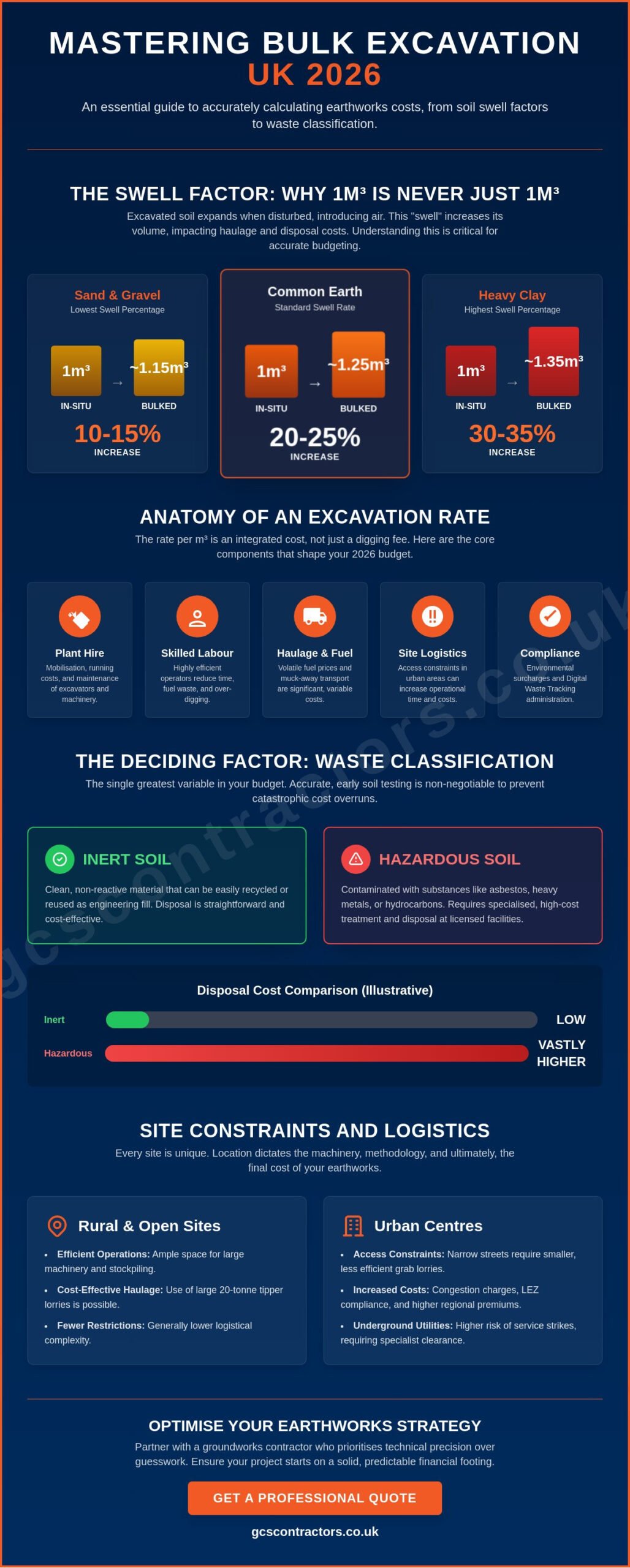
Soil in its natural, compacted state is known as “bank” volume. Once the excavator bucket breaks the ground, the soil “swells” as air is introduced. This creates a “loose” volume that determines the number of muck-away loads required. Failing to account for this expansion leads to immediate budget overruns. A deep understanding earthworks engineering is vital for accurate volume forecasting.
| Material Type | Typical Swell Factor |
|---|---|
| Sand and Gravel | 10% – 15% |
| Common Earth | 20% – 25% |
| Heavy Clay | 30% – 35% |
Typical Cost Components for Bulk Earthworks
Getting a 20-tonne 360-excavator to your site involves mobilisation fees that vary based on distance and access. Highly skilled operators might command higher daily rates, but their efficiency reduces the overall bulk excavation rates per m3 UK 2026 by minimising over-digging and fuel waste. In 2026, you must also account for regional premiums. Projects in London or Cambridge face higher costs due to congestion, LEZ compliance, and limited disposal capacity in the immediate vicinity. Environmental surcharges for carbon offsetting and site-specific compliance are now standard additions to most professional quotes.
Key Factors Influencing Your 2026 Earthworks Budget
The cost of earthworks is rarely a flat rate. In 2026, the regulatory environment and logistical constraints play a larger role than the physical digging. According to the UK construction material price indices, material costs have seen steady shifts that directly impact the bottom line for bulk excavation rates per m3 UK 2026. Developers must now account for new Digital Waste Tracking requirements. This system adds administrative overhead but ensures full compliance with environmental standards, preventing the risk of heavy fines for improper disposal.
Waste Classification and Disposal Fees
Soil testing is the most critical step in your pre-construction phase. The price gap between inert and hazardous waste is vast. Inert soil is clean and recyclable; hazardous soil requires specialised treatment or containment. Muck-away rates are typically quoted by the tonne or cubic metre. Tonnage depends on density and moisture content. Wet clay weighs more than dry sand, which increases haulage costs significantly. Early testing prevents “hazardous surprises” that can stall a project and inflate your bulk excavation rates per m3 UK 2026 unexpectedly. Accurate classification is the only way to maintain a predictable budget.
Site Conditions and Access Constraints
Logistics vary by location. In rural sites, 20-tonne tippers are efficient and cost-effective. In congested areas like London or the historic centre of Cambridge, 8-wheel grab lorries are often necessary to navigate narrow streets and load over walls. Access constraints directly inflate your operational costs because they slow down the cycle times of machinery. Underground utilities also present significant risks. Specialist utility trenching and site clearance expertise are required to avoid costly service strikes. In towns like Stevenage, managing site boundaries and local traffic is essential for a disciplined operation. Choosing a contractor who understands these regional nuances ensures your site preparation remains efficient and safe.
Optimising Excavation Strategy with GCS Contractors Ltd
Efficient earthworks depend on a disciplined, integrated strategy. When you combine demolition, site clearance, and bulk digging into a single package, you eliminate the friction between different subcontractors. This approach ensures that bulk excavation rates per m3 UK 2026 remain manageable by streamlining the transition from a cleared site to a prepared sub-base. GCS Contractors Ltd has extensive experience across Cambridge and Essex, proving that early coordination prevents the costly rework often seen when site preparation is treated as an isolated task. Local expertise ensures we maintain strong relationships with regional tip sites, which is vital for securing reliable disposal windows.
Integrated Groundworks: From Dig to Drainage
Bulk excavation is the foundation of every successful build. By linking the initial dig with the drainage systems residential developers rely on, we prevent site flooding and soil saturation during the construction phase. This technical foresight prepares the ground for concrete contractors to install reinforced slabs or foundations with total structural integrity. Getting the level right during the bulk dig reduces the volume of expensive concrete required later; it’s a simple way to protect your margins.
Securing a Precise Quote for Your 2026 Project
To provide accurate bulk excavation rates per m3 UK 2026, we require a comprehensive data set. This includes soil reports, topographical surveys, and site access plans. A site walk-over by an experienced groundworks specialist from GCS Contractors Ltd is non-negotiable for identifying hidden logistical hurdles before they become expensive delays. We leverage our local presence across the East of England to provide a service that is both accessible and highly regulated. Our team is results-driven, disciplined, and focused on delivering high standards for every commercial and domestic client. Contact GCS Contractors Ltd today to request a detailed site assessment and a professional quote for your upcoming earthworks project.
Securing Your Site’s Financial Foundation
Managing bulk excavation rates per m3 UK 2026 effectively means looking beyond the excavator bucket. Success lies in the details of soil swell factors, precise waste classification, and compliance with the latest digital tracking regulations. You now have the technical framework to protect your project’s contingency fund by accounting for these variables during the tender stage. Accurate volume forecasting is the first step toward a disciplined and profitable site.
GCS Contractors Ltd brings over 9 years of regional expertise to your project. We are specialists in complex basement excavation and piling, serving clients across Cambridge, Essex, and London with grounded operational standards. As a fully accredited partner for civil engineering and infrastructure works, we ensure your site is compliant, safe, and ready for the next phase of construction. Request a Professional Bulk Excavation Quote for Your 2026 Project and let’s get your project moving with technical certainty. We’re ready to help you deliver a high-standard build from the ground up.
Frequently Asked Questions
What is the average bulk excavation rate per m3 in the UK for 2026?
Bulk excavation rates per m3 UK 2026 are influenced by site accessibility, regional fuel surcharges, and the specific depth of the dig. These rates typically cover the 360-excavator hire and operator costs but don’t include disposal fees. Projects in congested urban areas like London or Cambridge often see higher premiums due to logistical complexity and LEZ compliance. Getting a site-specific assessment is the only way to ensure your budget is accurate.
How much does soil type affect the cost of muck away?
Soil type is the single largest variable in your earthworks budget. Inert soil is relatively inexpensive to tip because it can be recycled for other construction uses. If testing reveals hazardous contaminants or non-hazardous waste, disposal fees can triple. Managing these costs requires precise classification and early testing. This ensures you don’t face sudden price hikes once the excavation programme is underway.
Do I need a soil report before getting an excavation quote?
You definitely need a soil report to secure a fixed-price quote. Without a Waste Acceptance Criteria (WAC) test, contractors must guess the soil classification. This leads to inaccurate tenders and unexpected costs during the project. A professional report ensures your budget remains disciplined and predictable from the start. It’s the most effective way to avoid “provisional sums” that escalate later.
What is a swell factor in earthworks and why does it matter?
The swell factor accounts for the air introduced into soil during excavation. This process increases the volume of the material significantly. If you’re calculating bulk excavation rates per m3 UK 2026, you must remember that 100m3 of earth in the ground can become 130m3 in a lorry. Ignoring this leads to a shortage of haulage, project delays, and immediate budget overruns.
How do grab lorry prices compare to skip hire for large excavations?
Grab lorries are far more efficient for bulk works. An 8-wheel grab lorry typically carries around 12 to 15 tonnes of material, which is much larger than a standard skip capacity. Using grab lorries also removes the need for site-based loading equipment in some cases. This reduces your overall plant costs and site congestion, making it the preferred choice for commercial site preparation.
Are there extra charges for disposing of concrete or tarmac?
Disposal centres often charge different rates for “hardcore” like concrete and tarmac compared to clean soil. Pure concrete can sometimes be crushed and recycled on-site or tipped cheaply. However, if these materials are mixed with soil, they require mechanical sorting. This extra processing increases the cost of the muck-away service. Segregating materials on-site is a practical way to keep your disposal costs down.