Ground Erosion Myths: Why Your Construction Site Needs More Than Just Grass (2026)
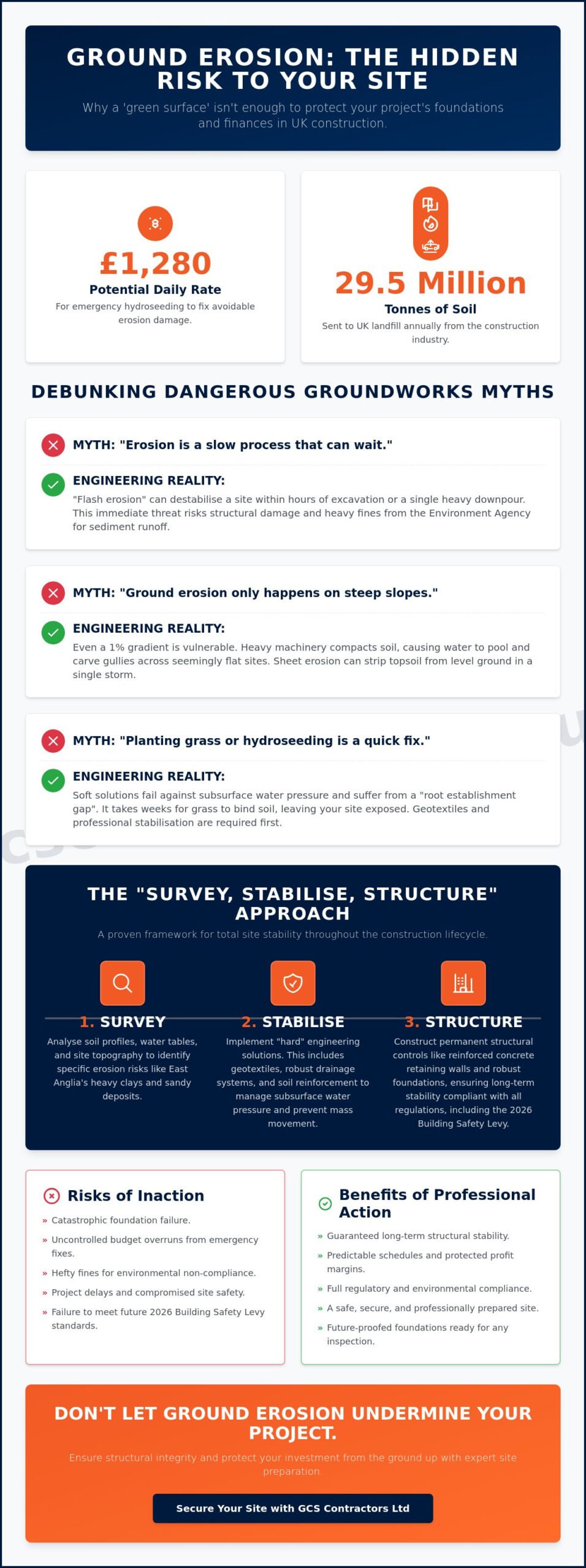
That fresh layer of turf might look like the solution to your site’s stability, but it’s often just a cosmetic mask for a deeper structural crisis. You want to keep your project on track and avoid the £1,280 daily rates for emergency hydroseeding or the regulatory fines associated with sediment runoff. Most developers assume that if the surface is green, the ground erosion is under control. It’s a mistake that contributes to the 29.5 million tonnes of soil the UK construction industry sends to landfill every year.
We understand that you need reliability and a safe pair of hands. This article explains why treating soil movement as a simple landscaping issue rather than a high-stakes engineering risk leads to foundation failure. You’ll discover how to distinguish between surface-level movement and structural instability so you know exactly when to call in a groundworks specialist. We’ll also preview the impact of the October 2026 Building Safety Levy and show how professional site preparation provides the structural stability your project requires. From foundations to finishing, getting the substructure right is the only way to protect your margins.
Key Takeaways
- Learn why ground erosion is a high-stakes engineering risk that requires structural intervention rather than just a quick horticultural fix.
- Understand the difference between surface-level movement and structural erosion to prevent unexpected costs and foundation failure.
- Discover why “hard” engineering solutions like retaining walls and concrete slabs are necessary to manage subsurface water pressure effectively.
- Identify the specific stages where a groundworks specialist must intervene to ensure your site remains compliant with the 2026 Building Safety Levy.
- Master the “Survey, Stabilise, Structure” approach to site preparation to maintain stability throughout the entire construction lifecycle.
Common Myths About Ground Erosion and Soil Stability in UK Construction
Groundworks aren’t just about moving dirt; they’re about managing physics. In the context of enabling works and site preparation, Soil erosion is the structural displacement of the upper layers of the earth. It’s a common misconception that this is a slow, natural process confined to the countryside. On a construction site, ground erosion can be 100 times more aggressive than on agricultural land because you’ve stripped the protective vegetative layer. Once site clearance is complete, your soil is exposed and vulnerable to the elements.
In Cambridge and the wider East Anglian region, soil profiles present unique challenges. Our heavy clay soils are prone to significant volume changes, whilst our sandy deposits can wash away in a single heavy downpour. Without immediate stabilisation, these soils lose their load-bearing capacity before you’ve even poured the first footing. This isn’t just a natural occurrence; it’s a structural vulnerability created by the act of development itself.
Myth: “Ground Erosion Only Happens on Steep Slopes”
Flat sites aren’t immune to instability. When heavy plant machinery compacts the ground, it creates an impermeable surface that forces water to pool and then rush across the site. This runoff carves rills and gullies into your prepared levels, even on a one per cent gradient. Sheet erosion can strip topsoil from level ground in a single storm, leaving your subsoil exposed and your site levels compromised. Effective ground erosion control must be a priority from the moment the first excavator arrives on site.
Myth: “Erosion Is a Slow Process That Can Wait”
You don’t have geological time on a build schedule. We see “flash erosion” occur within hours of bulk excavation if water flow isn’t managed. Beyond structural damage, there’s the legal risk. Allowing sediment to enter local drainage systems residential areas rely on can lead to heavy fines from the Environment Agency. Soil degradation costs the UK economy approximately £1.2 billion annually, and much of that starts with poorly managed site boundaries during the early phases of construction.
Engineering Reality: Why Surface Solutions Often Fail Against Structural Erosion
Soft solutions like turf or hydroseeding are often insufficient for active construction sites. They only address the surface. When you face deep-seated ground erosion, you’re dealing with structural instability that grass roots simply can’t hold. Adding more soil to an eroded gully is a common mistake. It adds weight without providing anchorage, which actually accelerates the collapse under its own gravity. You’re effectively feeding the problem rather than fixing it.
Subsurface water pressure is the silent killer of site stability. Without robust drainage systems residential developments can suffer from “piping,” where internal water flow hollows out the ground from within. This is the point where a project moves from needing a gardener to requiring a civil engineering firm. Adhering to UK guidance on excavation safety is mandatory to prevent these internal failures from becoming surface-level disasters.
Myth: “Planting Grass Is the Best Way to Stop Erosion”
There’s a significant “root establishment gap” that many developers overlook. It takes weeks for grass to create a binding network. In that time, a single East Anglian rain event can wash away the seed and the topsoil. For Cambridge clay, hydroseeding often fails because the water cannot penetrate the compacted surface, causing the slurry to slide off. We use geotextiles and soil stabilisation as precursors to ensure the ground stays put before any green finish is applied.
Myth: “Retaining Walls Are Purely Aesthetic”
Retaining walls are structural tools, not garden features. They prevent mass movement on complex sites where levels change significantly. Using reinforced concrete ensures long-term soil retention against lateral earth pressure that would otherwise blow out a simple timber fence or loose slope. If your project involves significant elevation changes, consulting professional concrete contractors is the only way to guarantee a “safe pair of hands” for your substructure. If you’re concerned about a shifting slope, our team can provide a professional site assessment to determine the right structural solution.
Preventing Ground Erosion: Professional Groundworks and Site Preparation
Professional erosion control follows a strict three-step protocol: Survey, Stabilise, and Structure. We begin with a detailed geotechnical survey to identify high-risk zones before any plant machinery touches the soil. This allows our team to plan bulk excavation with water flow as a primary consideration. By directing runoff into controlled channels from the first day of the project, we prevent ground erosion from undermining your site levels and compromising the build schedule.
Early-phase groundworks must include robust temporary drainage. This isn’t an optional extra; it’s a structural requirement for site safety. We integrate silt fences and attenuation tanks to manage sediment-heavy runoff, ensuring compliance with the environmental guide for coastal construction and inland local authority regulations. GCS Contractors Ltd provides a safe pair of hands for these complex operations, especially as developers prepare for the mandatory 10% Biodiversity Net Gain requirements rolled out in May 2026.
The Role of Proper Site Clearance and Enabling Works
Phased clearance is our preferred preventative measure. We don’t expose the entire site to the elements at once. Instead, we clear and stabilise sections in a controlled sequence to limit the surface area vulnerable to ground erosion. Using silt traps and temporary ponds helps manage water velocity during the build. Professional site preparation reduces the need for expensive remediation or the disposal of waterlogged soil later in the programme.
Integrating Foundations with Erosion Control
In cases where the upper soil layers are already compromised, we use piling or deep footings to bypass unstable material and reach a solid load-bearing strata. This level of precision is vital during Basement Excavation, where lateral soil pressure must be meticulously managed to prevent structural failure. From foundations to finishing, we ensure your substructure is built on a stable, well-prepared base.
Don’t leave your site’s stability to chance. Contact GCS Contractors for a professional site assessment to secure your project’s future.
Secure Your Project Substructure for 2026
Managing a construction site effectively requires moving past the myth that greenery equals stability. You’ve seen how internal water pressure and the “root establishment gap” can turn a standard site clearance into a structural crisis. Relying on soft landscaping alone often leads to the foundation failures that professional groundworks are designed to prevent. By implementing the “Survey, Stabilise, Structure” framework, you protect your site levels and ensure your project stays compliant with the Building Safety Levy regulations arriving in October 2026.
GCS Contractors Ltd is a trusted partner for developers across Cambridge and East England. As a CHAS Elite approved and ISO 9001 certified contractor, we provide the technical expertise needed to halt ground erosion before it impacts your build schedule. We understand the high stakes of civil engineering and offer a disciplined approach to site preparation. From foundations to finishing, our team ensures your project is built on a reliable, permanent base. Let’s get your project started correctly.
Ready to secure your site? Book a groundworks consultation with GCS Contractors today.
Frequently Asked Questions
How does ground erosion affect my house foundations?
Ground erosion removes the lateral support and subsoil from beneath your footings, leading to subsidence and structural cracking. When soil washes away, it creates voids that cause foundations to settle unevenly. This is especially dangerous in East Anglian clay where moisture changes already cause movement. Professional underpinning or structural repairs become necessary if the erosion reaches the load-bearing strata.
Can I stop soil erosion on a slope myself?
You can manage minor surface runoff with basic landscaping, but structural instability requires a groundworks specialist. DIY solutions often fail because they don’t address subsurface water pressure or the “angle of repose” for specific soil types. If the slope supports a building or boundary, a “safe pair of hands” is required to install engineered retaining walls. Incorrectly handled slopes can lead to total collapse during heavy rain.
What is the best way to prevent erosion during a construction project?
Implementing a phased site clearance strategy is the most effective method. This approach ensures you don’t expose the entire site to the elements simultaneously. You should also install temporary drainage systems and silt fences as part of your initial site preparation. These measures manage water velocity and keep sediment within your boundaries, preventing legal issues and protecting your prepared levels for foundations.
Do I need a retaining wall for my sloped garden in Cambridge?
You likely need a retaining wall if your garden gradient exceeds 35 degrees or if the slope is actively moving. In Cambridge, the heavy Gault Clay can become heavy and unstable when wet, putting pressure on lower boundaries. A reinforced concrete retaining wall provides the necessary structural support to prevent ground erosion from claiming your usable space. We recommend a professional survey to determine the lateral earth pressure on your specific site.