Roadworks and Paving in Cambridge: A Professional Contractor’s Guide
Failing to distinguish between a simple street work permit and a full S278 agreement can stall a Cambridge development for 24 weeks before the first spade hits the ground. Most site managers and developers know that roadworks and paving projects in Cambridgeshire are often complicated by shifting local regulations and specific soil requirements. It’s a high-stakes environment where a single compliance error or the wrong material choice leads to expensive delays and failed inspections.
You need a reliable partner who understands the technical nuances of the local landscape. This guide provides the clarity required to manage infrastructure projects with precision and professional authority. We’ll help you master the essential construction phases and select durable, cost-effective materials suited to the region’s unique conditions. You’ll gain the confidence to meet highways authority standards and ensure your project remains compliant from foundations to finishing.
Key Takeaways
- Understand the legal distinctions between street works and road works under NRSWA 1991 to ensure your Cambridge development meets essential statutory requirements.
- Learn the structural anatomy of a professional highway, focusing on how the sub-base prevents long-term surface cracking and sinkage.
- Compare the technical and aesthetic trade-offs between tarmac, concrete, and block paving to choose the most cost-effective solution for your site.
- Navigate the complexities of S278 agreements and local compliance standards to ensure seamless approval from the Local Highways Authority.
- See how GCS Contractors Ltd manages professional Roadworks and Paving from foundations to finishing, utilising specialised machinery and CHAS Elite standards.
Defining Roadworks and Paving for Cambridge Construction
Understanding the technical distinction between different types of highway activity is vital for any developer. The New Roads and Street Works Act 1991 (NRSWA) distinguishes between “street works,” which are typically utility-led repairs to pipes or cables, and “road works,” which involve major highway improvements or new construction. For residential and commercial projects across the East of England, professional Roadworks and Paving serve as the structural backbone of the entire site. These elements aren’t merely finishing touches; they’re engineered systems designed for heavy load-bearing, safe transit, and sophisticated water management.
The primary goals of any road construction project focus on durability and compliance. This involves selecting appropriate Road surface materials to ensure the finished product can withstand decades of use. Developers must also navigate the difference between “adoptable” roads, which are built to local authority standards for future council maintenance under Section 38 or Section 278 agreements, and “private” roads that remain the responsibility of the land owner. Getting this right from the start prevents costly delays and ensures the project meets the high standards expected in the Cambridge region.
The Role of Infrastructure in Site Readiness
Road construction starts long before the final layer of macadam is laid. It integrates directly with initial site clearance and bulk excavation phases. We prepare the road sub-base whilst simultaneously handling utility trenching in Cambridge for water, gas, and electricity service installation. This synchronised approach prevents the need for “double digging” and ensures the site remains organised. The road layout is the most critical factor in site logistics. It dictates how 20-tonne delivery vehicles and heavy machinery move through the project, directly impacting the speed and safety of the build. We provide a full range of services that move your project from foundations to finishing with total efficiency.
Local Context: Cambridge’s Unique Infrastructure Demands
Cambridge presents specific challenges that require a specialist approach. The rapid expansion of science and technology parks, such as those in the Silicon Fen area, demands road surfaces that can handle high volumes of commuter traffic and heavy plant machinery during the construction phase. We ensure that every Roadworks and Paving design accounts for the city’s unique status as a cycling capital. This means integrating wide, safe cycling lanes and prioritising non-motorised transit in accordance with local planning requirements. Our team manages site access carefully, ensuring that heavy construction traffic doesn’t disrupt the existing local network or compromise safety standards.
The Structural Anatomy of Professional Road Construction
Professional road construction requires a disciplined, multi-layered approach. We don’t just pour tarmac and hope for the best; we build from the ground up to ensure every surface survives the heavy plant and traffic loads common in modern developments. A standard road consists of four primary layers: the sub-grade, sub-base, base course, and the wearing course. Each layer must comply with the UK Highways Standards to guarantee structural integrity and user safety.
The sub-base is the most critical element for preventing surface cracking and sinkage. It acts as the main load-bearing layer, distributing the weight of vehicles across the sub-grade. In Cambridgeshire, ground conditions vary significantly. We often encounter heavy clay or the soft, silty soils of the Fens. To combat this, we use soil stabilisation techniques, such as adding lime or cement binders, to increase the strength of the natural ground before any aggregate is laid. We also integrate kerbing and drainage systems early in the build. Proper attenuation and runoff management prevent water from pooling, which is the leading cause of structural failure in UK roads. Working with experienced civil engineers near me in Cambridge and the East of England ensures these critical groundwork stages are executed with the technical precision required to protect your investment.
Flexible vs. Rigid Pavement Methods
Flexible pavements use bituminous materials, commonly known as tarmac or asphalt. These layers are designed to bend slightly under traffic loads, making them highly resilient for residential streets and local link roads. Rigid pavements consist of reinforced concrete slabs. These don’t flex and are typically reserved for heavy industrial yards or bus terminals where high-intensity point loads occur. We help developers choose the right method based on projected traffic volume and long-term maintenance budgets. For most Cambridge projects, a flexible bituminous approach offers the best balance of cost and durability.
The Science of Sub-Base Preparation
GCS Contractors focuses on using Type 1 MOT sub-base materials. This crushed aggregate provides maximum compaction and excellent drainage properties. On softer ground, we install high-tensile geogrids. These synthetic meshes lock the aggregate in place, preventing the lateral movement of stones under pressure. This technique can reduce the required thickness of the sub-base by up to 25% while significantly increasing the road’s lifespan. It’s how we deliver high-quality Roadworks and Paving that prevents future potholes. If you’re starting a new development, we can manage your Roadworks and Paving needs from foundations to finishing.
- Sub-grade: The prepared natural soil.
- Sub-base: The foundation layer for load distribution.
- Base course: The main structural layer of the pavement.
- Wearing course: The final, weather-resistant surface.
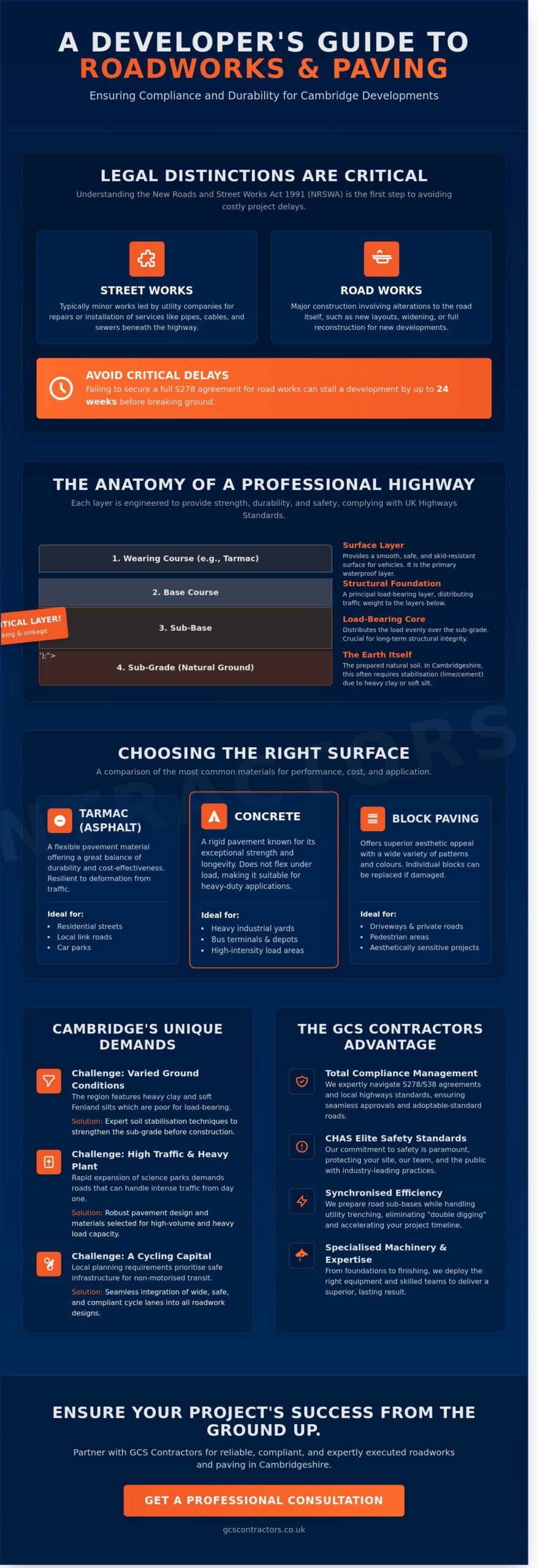
Choosing the Right Surface: Tarmac, Concrete, and Block Paving
Selecting the correct material for Roadworks and Paving requires a balance between initial capital expenditure and long-term lifecycle costs. Every project in Cambridge and Cambridgeshire faces unique challenges, from heavy HGV traffic to strict Sustainable Drainage Systems (SuDS) compliance rules. We provide technical guidance to ensure the chosen surface meets the specific load-bearing requirements of the site while adhering to local planning regulations.
Tarmac and Asphalt: The Cost-Effective Workhorse
Tarmac remains the standard for primary access roads in large residential developments. Its speed of installation is a major benefit for developers working to tight deadlines. Large areas can be laid and compacted quickly, often allowing for immediate load-bearing capacity within 24 hours. For urban centres like Peterborough or Bedford, we often recommend resurfacing existing asphalt to restore structural integrity. This process is significantly more cost-effective than a full excavation and can extend the road’s lifespan by 10 to 15 years. For domestic and smaller-scale projects, our detailed guide to driveway resurfacing in Cambridge covers how tarmac, resin, and block paving systems perform against the region’s clay-heavy soils.
Reinforced Concrete: Industrial Strength Paving
Concrete is the superior choice for heavy-duty environments like warehouse yards, loading bays, and bus routes. We use reinforced slabs to handle high-stress turning circles where tarmac might rut or deform under constant pressure. To prevent thermal cracking in large slabs, our teams install precision-cut expansion joints. These joints allow the concrete to expand and contract during temperature shifts without compromising the surface. As a CHAS Elite approved contractor, we ensure these industrial surfaces are built to withstand the 44-tonne limit typical of modern logistics hubs.
Block Paving and Kerbing: Precision and Aesthetics
Block paving defines high-end residential streets and pedestrian zones. It offers excellent “repairability” because individual blocks can be replaced if underground utilities require maintenance, leaving no unsightly patches. We install durable kerbing to protect these edges and manage surface water runoff effectively. For SuDS-compliant schemes, permeable blocks are essential. They allow water to filter directly into the sub-base, reducing the burden on local drainage networks. From foundations to finishing, we focus on the following maintenance factors for block-paved areas:
- Joint Stability: Using kiln-dried sand to prevent block movement.
- Weed Suppression: Applying professional-grade sealants to stop growth between joints.
- Edge Restraint: Installing heavy-duty kerbing to prevent lateral shift.
- Settlement Prevention: Ensuring a compacted sub-base to avoid uneven surfaces over time.
Choosing the right Roadworks and Paving materials ensures that the infrastructure serves the development for decades. Whether it’s the industrial strength of concrete or the aesthetic appeal of block paving, our team delivers a finish that meets ISO 9001 quality standards.
Navigating Compliance: S278 Works and Highways Standards
GCS Contractors Ltd manages the complexities of S278 agreements for developers across Cambridge. Under the Highways Act 1980, an S278 agreement is a legal requirement whenever a development requires permanent alterations to the existing public highway. This includes creating new site entrances, installing traffic lights, or upgrading existing footpaths. Cambridgeshire County Council acts as the Local Highways Authority, overseeing every stage of design and material selection. You can’t start Roadworks and Paving on public land without this formal approval in place.
The council’s role is to ensure that any changes are safe, durable, and don’t create future maintenance liabilities for the taxpayer. In busy areas like Cambridge city centre, traffic management is a critical part of the compliance process. We develop robust plans to minimise disruption, especially considering the high volume of cyclists and pedestrians. Failing to manage traffic correctly can result in fixed penalty notices under the New Roads and Street Works Act 1991, which can cost developers thousands in daily fines.
The S278 Process for Developers
The S278 journey follows a strict, disciplined sequence to ensure total transparency:
- Technical Submission: Detailed engineering designs are sent to the council for rigorous approval.
- Legal Agreement and Bond: A financial surety, often 100% of the estimated works cost, is put in place to protect the council.
- Inspection: Council officers monitor the site to ensure materials meet the 2023 Specification for Highway Works.
- Maintenance Period: A 12-month period where the contractor remains liable for any defects before final adoption.
It’s vital to distinguish between S278 and S38 agreements. S278 covers off-site works on existing public land, whilst S38 focuses on new, on-site roads intended for future adoption. Common delays often stem from inadequate groundworks surveys or poor coordination with utility providers. We prevent these bottlenecks through early-stage technical audits and clear communication with all stakeholders. Proper planning for utility trenching and underground service installation is a key part of this early-stage coordination, ensuring gas, water, and electrical mains are correctly positioned before the highway surface is laid.
Safety and Quality Standards in Civil Engineering
We maintain ISO 9001 and CHAS Elite certifications because they’re non-negotiable for modern highways contractors. These accreditations prove we operate a disciplined site. Our teams strictly follow the “Safety at Street Works and Road Works” code of practice, often called the Red Book. In Cambridge, where 32% of residents commute by bicycle according to 2021 Census data, our safety barriers and signage must be impeccable to protect vulnerable road users.
Every square metre of Roadworks and Paving must meet British Standards, such as BS 7533 for modular paving. This ensures the finished surface handles specific load capacities and provides the required slip resistance. We don’t cut corners on materials or safety protocols. From foundations to finishing, our approach is built on technical precision and regulatory compliance.
Need a reliable partner for your next highways project? Contact our Cambridge groundworks specialists to discuss your S278 requirements.
Expert Roadworks and Paving with GCS Contractors
GCS Contractors Ltd delivers a comprehensive service for infrastructure projects across Cambridgeshire. We operate from foundations to finishing. This end-to-end capability means we manage the entire project lifecycle, from initial bulk excavation and drainage installation to the final surface layer. It’s about accountability. By acting as a single contractor for every stage, we eliminate the scheduling conflicts and communication gaps that often occur when multiple firms are on-site.
We invest heavily in our own specialised plant machinery and high-grade materials. This allows us to maintain strict quality control and adhere to ISO 9001 standards. We ensure this excellence by sourcing from reputable suppliers like Essex Board & Timber for construction and site preparation materials. Our portfolio includes delivering durable Roadworks and Paving solutions for Cambridge science parks and large-scale residential extensions. We understand that infrastructure must withstand heavy usage. We don’t cut corners on material specifications or compaction depths.
- Reduced project lead times through integrated site management.
- Direct access to a modern fleet of excavators and paving equipment.
- Full compliance with CHAS Elite and safety regulations.
- Consistent quality from the first spade in the ground to the final line marking.
Our Approach to Infrastructure Projects
Structural integrity is our priority. We focus on the sub-base long before any surface is laid. A road is only as good as the ground beneath it. Our engineers ensure that compaction levels meet exact technical requirements to prevent future subsidence or cracking—a level of precision also championed by the Global Engineering Office for multidisciplinary infrastructure projects. We manage complex utility trenching and reinforced concrete works simultaneously, which is a vital requirement for modern Roadworks and Paving in busy urban environments.
Site logistics are handled with precision. We organise our operations to ensure minimal disruption to surrounding Cambridge businesses. This involves phased construction and clear traffic management plans. Whether we’re installing attenuation tanks or completing S278 highway works, our goal is to keep the site moving safely and efficiently.
Ready to Start Your Project?
Early contractor involvement is the most effective way to control your budget. Engaging our team during the planning phase allows us to identify potential site constraints and provide accurate costings. This prevents expensive variations later in the build. We offer a technical site survey to assess your requirements and provide a detailed quotation based on current UK market rates for materials and labour.
We’re a practical, results-driven partner for your next development. Our team is ready to provide the expertise your project needs to succeed on time and within budget. Contact GCS Contractors Ltd for your Cambridge roadworks project to discuss your specifications with a specialist.
Secure Your Next Cambridge Infrastructure Project
Successful road construction in Cambridge requires more than just laying tarmac. It demands a precise understanding of structural layers and strict adherence to S278 highways standards. Choosing the right surface, whether it’s durable concrete or versatile block paving, determines the long-term performance and safety of your site. High-quality Roadworks and Paving projects rely on technical precision and a disciplined approach to site management.
GCS Contractors Ltd provides a safe pair of hands for your civil engineering needs. We’re a CHAS Elite approved contractor and hold ISO 9001 certified quality management status. This means our team delivers compliant results from foundations to finishing. We specialise in complex S278 works across Cambridgeshire, ensuring every metre of road meets national highways regulations. We focus on tangible outcomes and technical precision to keep your development on track. Our local expertise ensures we understand the specific requirements of the Cambridge planning environment and local authority standards.
Enquire about our Roadworks and Paving services today to discuss your project requirements with our specialist team. We’re ready to help you build lasting infrastructure.
Frequently Asked Questions
What is the difference between a Section 278 and a Section 38 agreement?
A Section 278 agreement allows a developer to make permanent alterations or improvements to the existing public highway, whilst a Section 38 agreement covers the construction of new roads intended for adoption by the local authority. These legal frameworks ensure that roadworks and paving meet the strict standards set by the Highways Act 1980. We handle the technical requirements for both, ensuring all works in Cambridge comply with local council specifications.
How long does it take for a tarmac road to be ready for traffic?
Most tarmac surfaces are ready for light vehicular traffic within 24 hours of installation. For heavy goods vehicles or high-stress areas, it’s best to wait 48 to 72 hours to ensure the material has fully cooled and set. Temperature plays a critical role, as tarmac laid during 30°C summer peaks may require additional curing time compared to cooler autumn conditions.
Do I need a specific permit for roadworks on a private development?
You don’t usually need a street works licence for internal private roads, but you must have planning permission and comply with Building Regulations Part M. If your private development roadworks and paving connect to a public highway, you will need a Section 50 Street Works Licence. This permit is mandatory under the New Roads and Street Works Act 1991 for anyone placing or maintaining apparatus in the street.
Why is the sub-base so important in road construction?
The sub-base acts as the primary load-bearing layer, spreading the weight of traffic to prevent the surface from cracking or sinking. It typically consists of MOT Type 1 granular material compacted to a specific depth, often 150mm for standard roads. Without a correctly engineered sub-base, even the highest quality asphalt will fail within 24 months due to ground movement or poor structural support.
Can GCS Contractors handle both the excavation and the final paving?
We provide a complete “from foundations to finishing” service that covers everything from initial site clearance and excavation to the final surface course. As a CHAS Elite approved contractor, we manage the entire earthworks process and utility installations before laying the roadworks and paving. This integrated approach reduces the risk of scheduling conflicts and ensures consistent quality control across all phases of your project.
What paving material is best for heavy goods vehicle (HGV) access?
Fibre-reinforced concrete or 80mm thick heavy-duty concrete block paving are the most durable options for HGV loading bays and distribution centres. These materials withstand the high torsional forces and point loads generated by 44-tonne vehicles. For high-traffic haul roads, we often recommend a multi-layer hot rolled asphalt with a high stone content to prevent rutting and surface deformation over time.
How do you manage drainage on large-scale paved areas?
We implement Sustainable Drainage Systems (SuDS) to manage surface water runoff and prevent flooding on large developments. This often involves installing attenuation tanks, petrol interceptors, and permeable paving solutions that meet the requirements of the Flood and Water Management Act 2010. Our team ensures that all drainage systems are designed to handle 1-in-100-year storm events plus a 40% allowance for climate change. For residential projects where surface water management is equally critical, our guide on driveway resurfacing options in Cambridge for 2026 explains how permeable materials can help homeowners meet UK drainage compliance requirements.