Driveway Resurfacing in Cambridge: A Comparison Guide for 2026
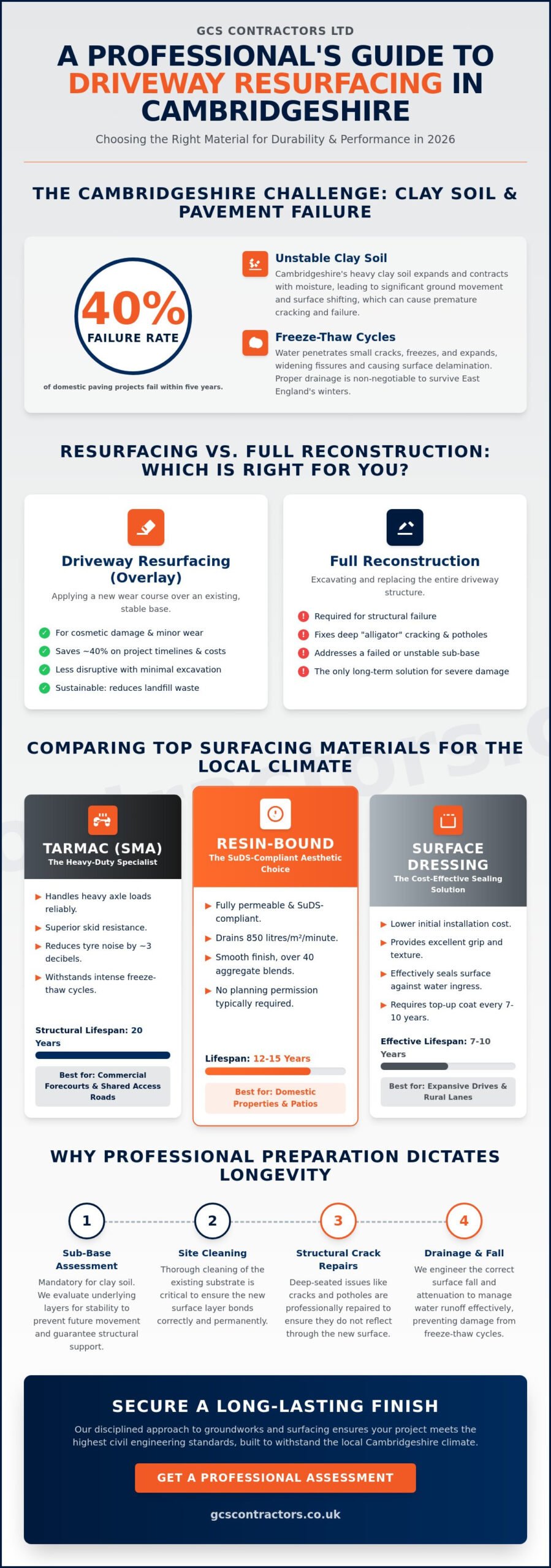
In Cambridgeshire, nearly 40% of domestic paving projects fail within five years because contractors ignore the unique shifting patterns of our local clay-heavy soil. You shouldn’t have to choose between a surface that looks professional and one that actually stays intact. It’s a common frustration to invest in driveway resurfacing only to watch cracks form or standing water collect after the first heavy autumn downpour. You want a result that adds value to your property and remains compliant with strict UK drainage laws.
We understand that reliability and technical precision are non-negotiable for your home or commercial site. This comparison guide for 2026 reveals the most durable materials for the local landscape, focusing on structural integrity and effective water attenuation. We’ll examine the specific performance of resin, tarmac, and block paving systems to help you secure a long-lasting finish with minimal site disruption.
Key Takeaways
- Learn why Cambridge’s heavy clay soil necessitates a professional sub-base assessment to prevent future structural failure and shifting.
- Compare the high-traffic durability of tarmac against the aesthetic and SuDS-compliant drainage benefits of modern resin-bound surfacing.
- Understand the technical distinction between an overlay driveway resurfacing and a full-depth reconstruction to maximise your project budget.
- Discover the critical preparation steps, from substrate cleaning to structural crack repairs, that dictate the long-term performance of your surface.
- Identify the essential site clearance and repair protocols required to ensure your driveway meets professional civil engineering standards.
Understanding Driveway Resurfacing Options in Cambridge
Driveway resurfacing is an overlay process. It involves applying a new wear course over an existing, stable base. This method differs from full-depth reconstruction, where the entire structure is excavated and replaced. By utilising the existing footprint, homeowners can refresh common driveway materials like tarmac or concrete without the disruption of a total dig-out. It’s a sustainable choice that reduces the volume of waste sent to Cambridgeshire landfill sites whilst instantly improving kerb appeal.
To better understand this concept, watch this helpful video:
Cambridge’s heavy clay soil presents specific engineering challenges. Clay expands and contracts significantly based on moisture levels, which can lead to surface shifting. A thorough sub-base assessment is mandatory before any driveway resurfacing project begins. We evaluate whether the underlying layers can support the new overlay or if they require professional stabilisation to prevent future movement.
Resurfacing vs. Full Replacement: Making the Call
Structural failure is the deciding factor for your project. If your drive shows deep alligator cracking or significant potholes, the sub-base has likely failed. Resurfacing won’t fix these deep-seated issues; it only hides them temporarily. However, if the damage is purely cosmetic or limited to minor surface wear, an overlay is the superior choice. For large estates in the CB postcode area, this approach often saves 40% on project timelines and reduces costs compared to full replacement.
The Cambridgeshire Context: Weather and Wear
East England faces specific freeze-thaw cycles that test the durability of any pavement. Water enters small surface cracks, freezes, and expands, causing delamination. Local groundworks expertise is vital to ensure your drive has the correct drainage capacity. Without proper fall and attenuation, even a new driveway resurfacing layer will fail within two winter seasons. We provide a disciplined approach to site preparation to ensure long-term performance against the local climate.
Comparing Top Materials: Tarmac, Resin-Bound, and Asphalt
Selecting the right material for driveway resurfacing depends on traffic volume, budget, and site drainage requirements. Tarmac remains the industry standard for durability in high-traffic zones, while resin-bound systems offer modern aesthetics for domestic properties. For the expansive drives found amongst Cambridgeshire farms, surface dressing provides a functional, cost-effective layer that seals the existing surface against water ingress.
Tarmacadam: The Heavy-Duty Specialist
Tarmac is a staple for roadworks and paving because it handles heavy axle loads without structural failure. We utilise Stone Mastic Asphalt (SMA) which features a higher bitumen content and added fibres. This technical composition improves skid resistance and reduces tyre noise by approximately 3 decibels compared to standard hot-rolled asphalt. Modern Asphalt pavement technology ensures these surfaces withstand the intense freeze-thaw cycles common in East Anglia. Over a 15-year period, SMA maintains its integrity with minimal maintenance, making it the preferred choice for commercial forecourts and shared access roads.
Resin-Bound vs. Resin-Bonded: The Critical Difference
Porosity is the primary distinction between these two systems. Resin-bound surfaces are fully SuDS-compliant, allowing water to drain through the matrix at a rate of roughly 850 litres per square metre per minute. You won’t require planning permission for this installation. In contrast, resin-bonded systems are non-porous and often suffer from “stone shed” within 24 months of application. We provide over 40 distinct aggregate blends to match the traditional Gault brick and limestone masonry found across Cambridge’s historic centre.
- Resin-Bound: Permeable, smooth finish, 12-to-15-year lifespan.
- Surface Dressing: Low cost, excellent grip, requires a “top-up” every 7 to 10 years.
- SMA Asphalt: High durability, jet-black finish, 20-year structural life.
From foundations to finishing, the success of any driveway resurfacing project relies on the quality of the sub-base. If you’re planning a renovation, our surveyors provide technical advice for local driveway projects to ensure your chosen material meets long-term performance goals.
The Professional Process: Why Preparation Dictates Longevity
Successful driveway resurfacing depends entirely on the integrity of the hidden layers. We follow a rigorous four-step sequence to ensure your investment lasts 15 to 20 years. First, our team performs a comprehensive site clearance. We remove all organic growth, oil stains, and loose debris from the existing substrate to expose any underlying weaknesses. Second, we address structural repairs. This involves filling deep potholes and sealing cracks over 5mm wide with high-grade bitumen. If the base layer moves, the new surface will fail; we ensure the foundation is stable before proceeding.
The third stage involves applying a high-quality tack coat. This specialised bitumen emulsion acts as a bonding agent between the old base and the new material to prevent delamination. Finally, we use professional-grade machinery to lay the chosen surface. This precision laying ensures uniform thickness and optimal compaction, which is impossible to achieve with manual tools alone. Any associated service runs beneath the driveway must also be correctly installed; our approach to utility trenching in Cambridge ensures gas, water, and electrical mains are safely positioned before the final surface is laid.
Mastering Drainage and SuDS Compliance
Water is the primary cause of surface failure across Cambridgeshire. We design every project to organise effective run-off, preventing the pooling that leads to foundation erosion. Modern driveway resurfacing must comply with Sustainable Drainage Systems (SuDS) regulations to manage surface water on-site. We integrate linear drains and soakaways into the design to handle heavy rainfall. This approach reduces pressure on local sewer networks and protects your property from water ingress.
Choosing Local Civil Engineering Expertise
Hiring experienced civil engineers near me ensures your project meets local council standards and S278 requirements where necessary. GCS Contractors Ltd provides a “Safe Pair of Hands” for every client. We apply CHAS Elite and ISO 9001 standards to residential and commercial sites alike. Our approach delivers a disciplined, compliant service from foundations to finishing, ensuring your driveway is built to professional engineering specifications.
Secure Your Cambridge Property Investment with Expert Resurfacing
Selecting the right material for your driveway resurfacing project requires a balance of aesthetics and structural durability. Whether you choose the cost-effective reliability of tarmac or the permeable, modern finish of resin-bound systems, the success of the installation depends on rigorous sub-base preparation. As a CHAS Elite Approved Contractor, GCS Contractors Ltd applies ISO 9001:2015 certified standards to every project, ensuring your new surface withstands the test of time and weather. Our expertise spans from residential driveways to complex S278 highway works, meaning we bring civil engineering precision to your property.
We manage the entire process from foundations to finishing. Our local knowledge of Cambridgeshire ground conditions allows us to specify the correct drainage and attenuation solutions for your specific site. This disciplined approach eliminates the risk of premature cracking or subsidence. Don’t settle for a contractor who cuts corners on the groundwork. We provide the technical skill and professional reliability needed for a seamless, long-lasting finish.
Request a Professional Site Survey from GCS Contractors
We’re ready to help you transform your property with a surface built to last.
Frequently Asked Questions
Do I need planning permission for driveway resurfacing in Cambridge?
You don’t need planning permission for driveway resurfacing if the surface is porous or if rainwater drains to a permeable area within your property boundary. Under the 2008 Town and Country Planning Order, any new surface exceeding 5 square metres must meet SuDS standards. If you choose non-porous materials without a dedicated soakaway, you’ll need to submit a full application to Cambridge City Council. Our team ensures all works comply with these mandatory drainage regulations.
How long does a resurfaced driveway typically last in the UK climate?
A professionally installed driveway resurfacing project typically lasts between 15 and 25 years in the UK climate. Asphalt surfaces handle the 800mm to 1,200mm of annual rainfall well, provided the sub-base remains stable. Resin-bound systems often reach the 25-year mark because they resist freeze-thaw cycles effectively. We use ISO 9001 quality-controlled materials to ensure your surface survives 50 or more frost cycles per winter without cracking or lifting.
Can you resurface over an existing concrete driveway?
We can resurface over an existing concrete driveway if the slab is structurally sound and free from major subsidence. The process requires thorough cleaning and the application of a polymer-modified bonding agent to ensure the new layer adheres correctly. If the concrete has cracks wider than 5mm, we must repair these first to prevent reflective cracking. As CHAS Elite contractors, we assess the substrate’s load-bearing capacity before starting any project.
What is the best time of year to organise driveway resurfacing?
The best time to organise resurfacing is between April and September when temperatures consistently stay above 10 degrees Celsius. Tarmac and resin require dry conditions and specific thermal windows to set correctly and achieve maximum durability. While we operate year-round in Cambridge and Cambridgeshire, scheduling work during these 6 months minimises weather-related delays. This ensures the finish meets the high standards expected of a specialist civil engineering firm.